

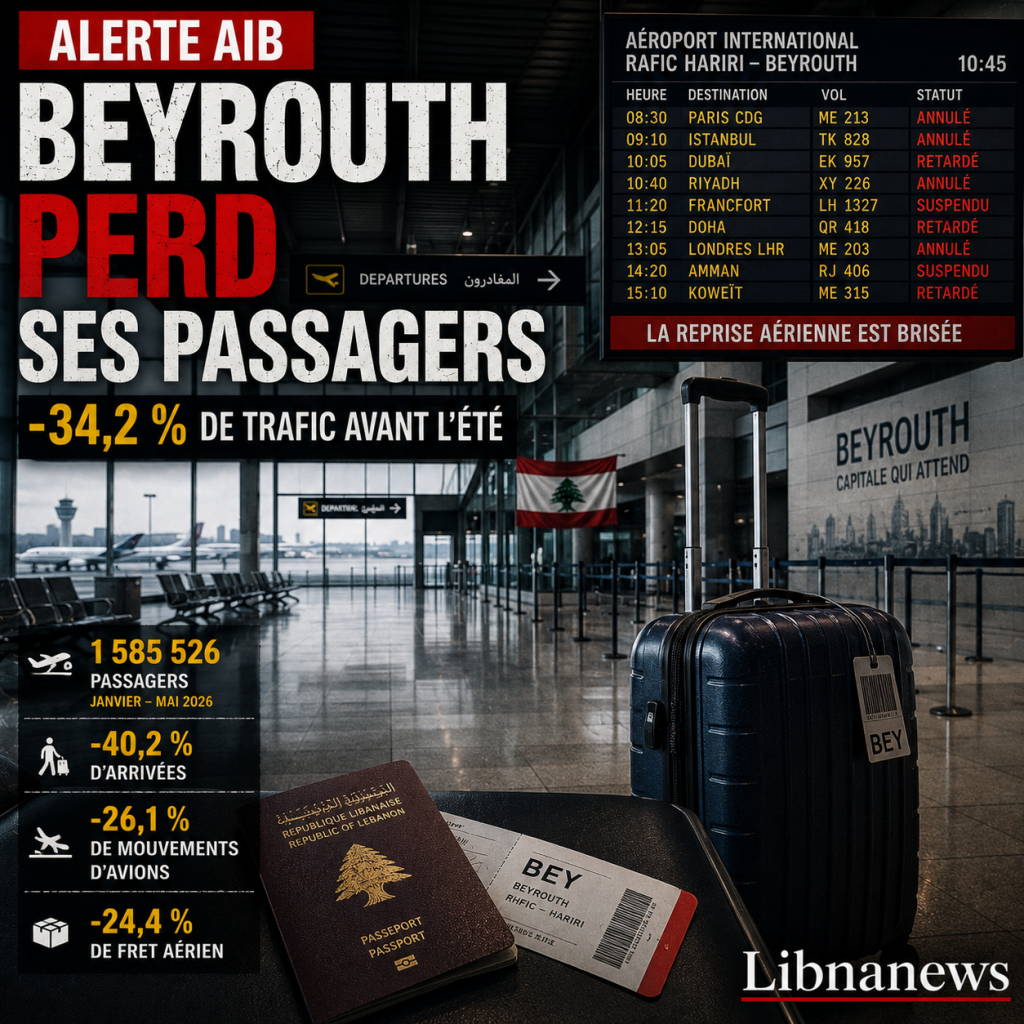
AIB: attendance collapses
The decline in traffic at Beirut airport is the most concrete measure of the economic slowdown caused by the war and regional tensions. Between January and May 2026, Rafic Hariri International Airport welcomed 1,585,526 passengers, compared with 2,409,618 during the same period of 2025. The decrease is 34.2%. It affects arrivals, departures, aircraft movements and freight. It therefore does not describe a one-time incident, but a break in air recovery when the country should have prepared for the summer season.
Beirut airport remains one of the last major breathing canals in the Lebanese economy. It links the diaspora to the country, supports tourism, brings currency, transports urgent goods and maintains a practical link with regional markets. When its activity drops by a third, the effects are not confined to the runways. They affect hotels, restaurants, taxis, travel agencies, renters, businesses, families waiting for their loved ones and businesses that depend on mobility.
The signal is all the more worrying as arrivals fall faster than departures. In the first five months of 2026, the airport recorded 753,921 arrivals, a 40.2 per cent decrease over one year. Departures declined by 27.7% to 830,155 passengers. This imbalance shows that Lebanon receives fewer visitors, even though it needs foreign exchange spending to support its balance of payments. The air crisis thus becomes a tourist, commercial and monetary crisis.
The figures of an aerial stall
| Indicator | Level or variation |
|---|---|
| Passengers at AIB, January-May 2026 | 1 585 526 |
| Passengers at AIB, January-May 2025 | 2,409,618 |
| Total decrease in passenger traffic | -34,2 % |
| Arrivals | 753 921, i.e. -40.2% |
| Departures | 830 155 or -27.7 per cent |
| Aircraft movements | -26,1 % |
| Air freight | -24.4% |
| Passengers in May 2026 | 338 772 |
| Passengers in May 2025 | 560 713 |
| Take-off and landings in May 2026 | 3,031 |
| Take-off and landings in May 2025 | 4,607 |
May confirms the breakdown. The airport welcomed 338,772 passengers, compared with 560,713 in May 2025. The decrease is 39.5% over a month traditionally important for the rise to summer. Take-offs and landings fell to 3,031, compared to 4,607 a year earlier. The decline in aircraft movements shows that airlines have not only carried fewer passengers. They also reduced their offer, cancelled rotations or adjusted their programs to meet regional risk.
This decline in supply is one of the heaviest signals. An airport may temporarily survive less filled aircraft. It suffers more when frequencies decrease. Fewer flights mean fewer seats available, more difficult connections, potentially higher prices and increased uncertainty for travellers. International carriers reason according to demand, insurance, safety instructions, operational cost and political visibility. When these parameters deteriorate, recovery may take time, even after a return to calm.
Comparison with pre-crisis is even more severe. Arrivals at Beirut airport are only 48.7% of the level recorded in the first five months of 2019. The recovery that began after the financial collapse did not return to its old base. It had only rebuilt part of the flows, thanks to the diaspora, regional tourism and relative normalization. The tensions of 2026 were enough to break that momentum. This fragility recalls that the Lebanese recovery was based less on sound economic foundations than on a minimum of security confidence.
Tourism, diaspora and currencies in decline
Tourism is the first sector exposed. Visitors arriving through the airport directly feed hotels, restaurants, cafes, shops, transportation services, family events and furnished rentals. A 40.2% drop in arrivals reduces these expenses even before companies can adapt. Reservations become late. Cancellations are increasing. Professionals are reluctant to hire for the summer. Stocks are reduced. In a private banking credit economy, this lack of visibility may be sufficient to block activity.
The diaspora is another essential channel. Its stays are not just tourism. They often finance care, work, purchase of durable goods, school or university fees and direct assistance to families. When expats postpone a trip, part of this currency flow stops. Bank or informal transfers may partially offset, but do not always replace on-site expenditures. The physical presence of an expatriate activates a consumption chain that money transfer does not reproduce entirely.
The decline in air traffic thus weighs on the balance of payments. Lebanon imports a lot of goods, including energy, medicines, food and equipment. It offsets part of these outings by visitor spending, diaspora transfers and services. When arrivals decline, this compensation weakens. The country must then find more external financing or draw on already limited margins. This pressure is in addition to rising transport costs and energy prices, which are themselves affected by regional tensions.
The decline in air cargo supplements this table. Bank Audi reports a decrease of 24.4% over the first five months of the year. Freight is not only measured in tonnage. It often concerns high-value products, urgent parts, medicines, technical equipment or goods that cannot wait for maritime delays. Its contraction may reflect a decline in business activity, business prudence, higher costs or less availability of flights. It affects importers, some exporters and sectors that are experiencing rapid logistics.
MEA under pressure, connectivity under surveillance
The air crisis also shows Lebanon’s dependence on a single infrastructure. Rafic Hariri Airport concentrates most of international civilian traffic. This centralization has long been presented as an advantage of density. It concentrates services, security, customs and companies. But it also creates vulnerability. A security alert, a deterioration of the military environment or a loss of confidence in the platform affects the entire country. The current decline reveals this dependence without demonstrating that immediate dispersal of supply would be the solution.
Middle East Airlines occupies a sensitive place in this sequence. The national company maintains the country’s connectivity when other carriers reduce their presence or avoid certain airspace. This function is vital. It allows Lebanese to travel, expatriates to return and the economy to maintain a minimal connection with the outside world. But it also increases pressure on civil aviation governance. The Lebanese regulator has launched a security audit of MEA following concerns expressed by international pilot associations about conflict operations and the handling of certain reports.
MEA rejects these charges and states that its operations are based on risk assessments coordinated with the authorities. This response is important because the company cannot afford a loss of confidence. But the existence of the audit recalls that air continuity in wartime is not just a matter of voluntarism. It requires clear procedures, protected crews, documented decision-making and independent supervision. In a market already in decline, any question about operational security can have an immediate commercial effect.
Public authorities must therefore treat the decline in traffic as an economic alert. It is not enough to say that the airport remains open. Travellers and airlines want to understand risks, guarantees, procedures and perspectives. Official communication often remains defensive. It responds to rumors, but hardly anticipates. But air transport is working on predictability. A family preparing a stay, a company planning a road or a hotelier hiring staff need clear signals several weeks in advance.
This trust requirement also applies to insurance. Insurers and operators examine regional risk, trajectories, proximity to conflict areas, reliability of information and the ability of authorities to coordinate. When the environment deteriorates, premiums can increase or conditions become more stringent. These costs are not always visible to the passenger, but they affect company decisions. A flight may be technically possible and commercially less attractive if its risk cost becomes too high.
A leading indicator of the economic crisis
The fall in activity at Beirut airport is taking place in an already weakened macroeconomic landscape. Moodys believes that the conflict has reduced tourist arrivals and increased pressure on external balances. More than one million people have been displaced by hostilities. The productive sectors, including agriculture, construction and industry, have been affected by destruction, logistical disruptions and the departure of workers. In this context, the air drop does not only accompany the crisis. It amplifies.
War-related losses make the situation more serious. Direct and indirect damage would exceed $20 billion and could approach $25 billion if the conflict continued. Over 61,000 dwellings were reported to have been totally or partially damaged between March and early May 2026. The economy therefore needs external flows to finance the emergency, maintain consumption and prepare for reconstruction. However, the fall in arrivals reduces one of the channels through which these flows entered the country.
The government should therefore place the airport at the centre of its short-term economic strategy. The priority is not just to keep the tracks open. It is to preserve existing connections, reassure companies, coordinate with international partners, support tourism professionals and publish regular data. A credible air policy must be measurable. It must state which companies operate, which lines are suspended, what security measures are applied and what actions are taken to limit cancellations before the summer.
Social risk is often underestimated. The summer season supports thousands of direct and indirect jobs. Many are precarious, seasonal or informal. A hotel that reduces its bookings employs fewer staff. A restaurant that expects fewer visitors reduces its purchases. A driver who transports fewer passengers loses his daily income. This chain does not always go through public statistics, but it affects households. The decline in the airport then turns into a decline in revenues in already weakened neighbourhoods and regions.
The regional dimension adds another danger. Other Mediterranean or Gulf destinations can absorb travellers who hesitate to come to Lebanon. A cancelled stay does not necessarily remain pending. It can be moved to Cyprus, Turkey, Greece, Egypt, Jordan or the Emirates. Once reservations are moved, Lebanon does not automatically recover them. Tourism competition does not stop during Lebanese crises. It sometimes takes advantage of uncertainty to capture markets that were still accessible.
Qolayat, a bet not to be confused with the answer
It is only in this context that Qolayat should be approached. The official launch of the development and operation project of René-Mouawad Airport in Akkar responds to an ancient demand from the North and a logic of unhindered. Prime Minister Nawaf Salam and Minister of Public Works Fayez Rasamny highlighted territorial justice and the prospect of a second air gate at the June 6 ceremony. But this project happens in a time when national traffic continues to contract.
A second airport can be useful in the long term. It can offer redundancy, support the Akkar, bring the North closer to its diaspora and reduce dependency in Beirut. But it requires fixed costs, equipment, security, supervision, roads, customs and a transparent economic model. If Qolayat does not create a new demand and merely moves part of the traffic from Beirut, it can aggravate the public charge. In a country in default, this risk cannot be treated as a secondary issue.
The government must therefore avoid turning Qolayat into a political screen masking the Beirut airport crisis. The core of the topic remains the collapse of AIB attendance, the loss of arrivals, the decline in flights and the weakening of travel revenues. Qolayat will not solve anything if the country does not restore first the confidence of travellers and companies. The next June figures will tell if the summer season can be partially saved, or if Beirut airport becomes the barometer of deeper contraction.






