

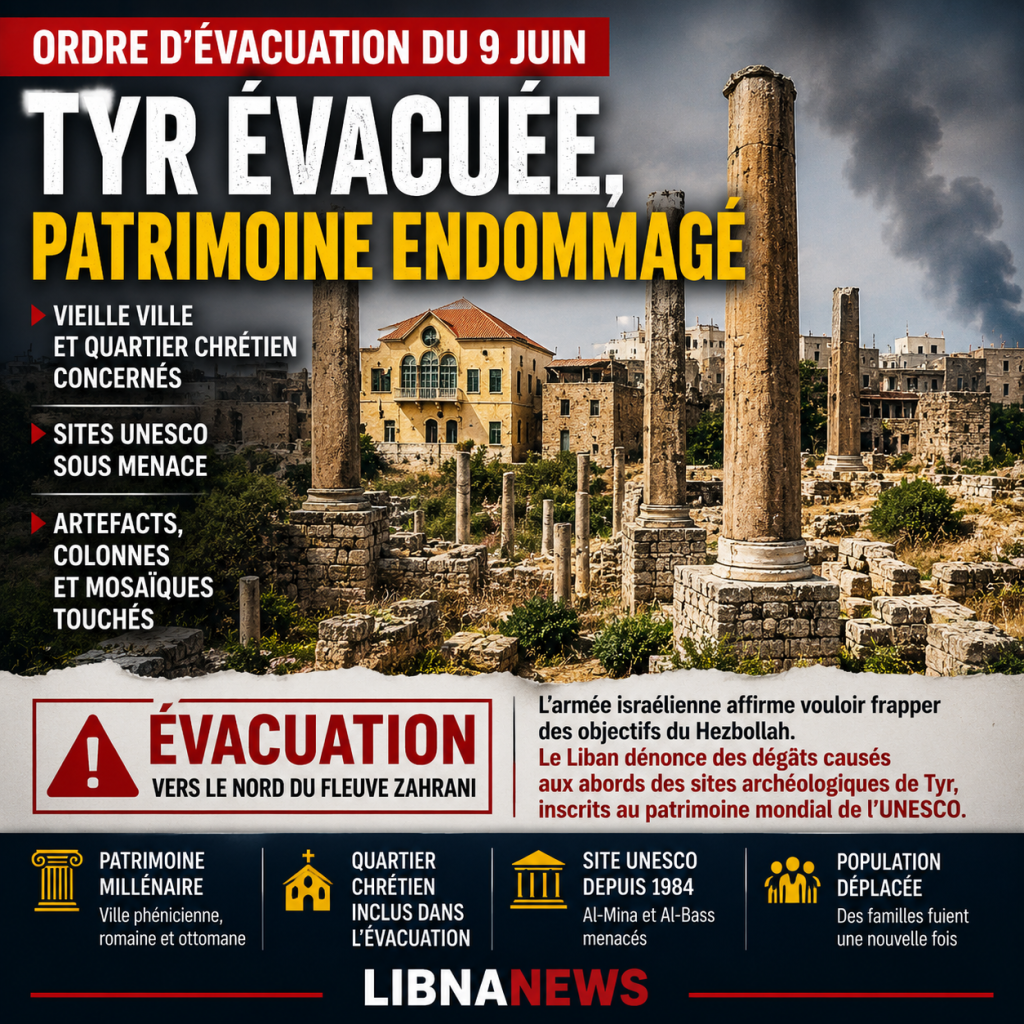
An evacuation order dated 9 June
On Tuesday, June 9, 2026, the Israeli army issued a new evacuation order targeting the city of Tyre, its camps and several surrounding areas, including the Old City Christian Quarter. The injunction was issued by the Arab-speaking spokesman of the Israeli army, who called on the inhabitants of the areas indicated on a map to leave immediately and head north of the Zahrani River. The Israeli army claims to want to strike Hezbollah targets.
This order marks a new step in the pressure on Tyre, a southern Lebanese coastal town about 20 kilometres from the Israeli border. The city had already been subject to several warnings in recent weeks, but the new order of 9 June explicitly included the old city and its Christian neighbourhood. Earlier warnings had referred to this area without including it in the immediate evacuation perimeter. Tuesday’s extension therefore reinforced the fear of a strike in a dense, inhabited and heritage urban fabric.
The order comes the day after the official Lebanese denunciation of damage caused in the vicinity of the archaeological sites of Tyre, inscribed in the UNESCO World Heritage Site. The Lebanese Ministry of Culture and the General Directorate of Antiquities reported damage caused by Israeli bombardments near the site. Artifacts, columns, capitals, column bases, mosaics and other ancient elements were reportedly affected by debris projected over a wide area.
Old Town and Christian Quarter concerned
Particular attention was paid to the mention of the Christian neighbourhood of Tyre in the evacuation order of 9 June. This area of the old town includes old alleys, stone houses, churches, hotels, guest houses and shops linked to local life and tourism. It also hosts families displaced from other parts of the South. Until the last few days, direct evacuation orders had been relatively preserved, even though the entire city was living under the threat of bombing.
Media reported that the Israeli army claimed to have detected Hizbullah activity in the old city, including in inhabited areas. These charges were not independently confirmed. According to the French press, the Lebanese army had been deployed to the Christian neighbourhood after previous warnings and had checked houses, hotels and guest houses. Local officials had claimed that no weapons or fighters had been found in the inspected premises.
The new evacuation order re-launched the departures. People left their homes as a precaution. Others remained, for lack of immediate solution or by attachment to their homes. Families who had found refuge in the old city after fleeing more exposed villages find themselves facing a new displacement. The situation is all the more difficult given that areas further north already host a large number of displaced persons since the beginning of the escalation.
An inhabited city, a world site
Tyre is not only a city in southern Lebanon affected by military orders. It is also one of the most important historical sites in the Eastern Mediterranean. Joined the UNESCO World Heritage Site in 1984, it preserves remains related to the Phoenician, Roman, Byzantine, medieval and Ottoman periods. Its two large archaeological complexes, Al-Mina and Al-Bass, form an exceptional heritage.
The site of Al-Mina is located in the old town, near the coast. It includes remains of former urban districts, columns, ancient streets and elements related to the port city. The site of Al-Bass, more east, is known for its necropolis, monumental arch, Roman vestiges, aqueduct and hippodrome. Both areas are surrounded by inhabited neighbourhoods, roads, shops, public buildings and Palestinian camps. This proximity makes the ruins particularly vulnerable to strikes in the immediate environment.
The Lebanese authorities recall that the archaeological sites in Tyre are protected cultural property. They stress that these are not military objectives. The Directorate General of Antiquities states that the premises are under its administrative and heritage responsibility. Any attack near the remains, even when it does not directly target the ruins, can cause damage through blast effects, concrete projection, metal fragments, dust or collapse of nearby structures.
Lebanon denounces damage to artifacts
The Lebanese Ministry of Culture announced that Israeli bombings had damaged the archaeological site in Tyre. According to officials quoted by international media, the strikes on Sunday caused significant damage to the heritage perimeter. The administrative office of the site was reportedly affected, while debris was said to have spread over a large area. Archaeological elements were reportedly affected by rubble.
The reported damage includes columns, capitals, column bases, mosaics and artifacts exposed or kept in the perimeter. The Lebanese authorities indicate that a full assessment remains difficult as long as the area remains exposed to strikes. Archaeologists must be able to access the site, inspect stones, document cracks, photograph affected objects and determine whether certain elements can be restored.
An antiquities officer in the South said, according to a news agency, that the damage was among the most significant on the site since the beginning of the last phase of the war. He referred to both direct damage, when buildings related to site management are affected, and indirect damage, when debris falls on the remains. This distinction is important because a bombardment that is a few tens or hundreds of metres away can still affect a fragile archaeological site.
An Appeal to Unesco and International Law
In response to the reported damage, the Ministry of Culture and the Directorate-General for Antiquities have called for the mobilization of international organizations responsible for heritage protection. Lebanon calls upon Unesco, the States concerned and the specialized agencies to recall the obligations under international humanitarian law and conventions relating to the protection of cultural property in the event of armed conflict.
The 1954 Hague Convention requires parties to a conflict to respect cultural property and avoid exposing it to destruction or damage. Tyre, as a Unesco-listed site, has a recognised value beyond the national framework. The Lebanese ministry therefore presents the damage caused near the ruins as an attack on a heritage that belongs to the history of humanity, and not only to Lebanese memory.
Protection emblems have already been used in several Lebanese heritage sites to recall their status. However, these measures remain limited if strikes are close to protected areas. Cultural authorities are therefore seeking diplomatic pressure to keep archaeological sites away from military operations. They also request that any allegations of armed presence near the ruins be verified before it is used to justify a strike.
A succession of alerts in Tyre
Tyre has experienced several warnings since the resumption of Israeli operations in the South. Earlier warnings had targeted areas of the city, neighbouring camps and areas south of the Zahrani River. The inhabitants were repeatedly called to leave their homes before strikes. The city was also affected by bombardments near its historic sites and residential areas.
On 9 June, the evacuation order was wider and more sensitive due to the inclusion of the Christian neighbourhood. This area had already been mentioned in Israeli warnings, but the agenda explicitly placed its inhabitants in the perimeter to evacuate. The Bass camps and other surrounding areas were also mentioned in warnings issued by the Israeli army.
The repetition of these orders weighs on the population. Each evacuation message causes departures, traffic jams, closures of shops, family calls, rushed returns to collect documents or medicines, and sometimes returns when strikes stop temporarily. This alternation of evacuation and return weakens daily life. It also prevents municipal and cultural services from working normally.
Heritage in the middle of neighbourhoods
The case of Tyre shows the difficulty of protecting a heritage located in a inhabited city. The ruins are not isolated in a deserted space. They are in contact with houses, roads, camps, tourist establishments and places of worship. A strike on a neighbouring building can reach an old site without direct targeting. Fragments of concrete or metal can damage a mosaic, crack a column or move stones that have already been weakened by time.
This configuration makes evacuation orders particularly sensitive. They don’t just move people. They also affect site monitoring and protection. When agents of the Directorate General of Antiquities cannot access the premises, the damage cannot be assessed quickly. Exposed objects cannot be moved or protected. Unstable areas cannot be secured. Delays in assessment can exacerbate losses, particularly if rain, vibration or new strikes affect already damaged elements.
People in the old town often recall that the heritage of Tyre is part of their living environment. The ancient remains, alleyways, churches, mosques, old houses and the port form an ensemble of memory, local economy and tourism. The threat to the ruins is therefore also a threat to urban identity. It adds to the fear of bombing and the difficulties of the displaced.
Israeli charges challenged locally
The Israeli army claims that its evacuation orders are related to the presence or activity of Hezbollah in civilian areas. She argues that the movement uses inhabited areas, which would justify warnings before strikes. Lebanon disputes any assimilation of archaeological sites to military objectives and claims that the ruins of Tyre are not used for military purposes.
In the Christian neighbourhood, local officials have already rejected charges of armed presence. The municipality and residents reported that the Lebanese Army had carried out checks after the previous warnings. Testimonies from the French press describe a neighbourhood where the inhabitants themselves claim to be monitoring the entrances and refusing to militarize their environment. These elements are not an international investigation, but they reflect the local position in the face of Israeli accusations.
The debate also concerns the burden of proof. An allegation of military presence in or near a civilian site may have serious consequences. It can justify an evacuation order, prepare a strike or make an entire neighbourhood suspicious. The Lebanese authorities therefore request that heritage sites be kept away from targeting stories, unless there is verifiable evidence. International organizations are called upon to play a role in documenting and recalling the law.
A city under humanitarian pressure
The order of 9 June arrives in a city that is already under strong humanitarian pressure. Tyre served as a reception point for families from border villages. Palestinian camps and working-class neighbourhoods concentrated vulnerable populations. Successive evacuations complicate access to water, care, medication, administrative documents and daily income. Older persons, children, persons with disabilities and families without vehicles are most at risk.
Residents who leave Tyre often have to seek refuge with relatives, in communities further north or in already saturated structures. Those who remain do so sometimes for lack of alternative. Traders must decide whether they close or maintain a minimum activity. Fishermen, artisans, hoteliers and restaurateurs have their work interrupted. The ancient city, which lived partly of cultural tourism, is almost paralyzed.
The situation also affects local authorities. The municipality must respond to alerts, coordinate with the security forces, inform the inhabitants and manage the effects of departures. Cultural services must protect sites in dangerous conditions. Hospitals and health centres must prepare to receive injured persons while managing staff movements. Each evacuation order therefore changes the organization of the city.
A sequence opened from the property damage
The recent chronology is now better established. Israeli strikes hit areas close to the archaeological sites in Tyre on Sunday, 7 June. On Monday, 8 June, the Lebanese Ministry of Culture and the General Directorate of Antiquities denounced the damage to the heritage, citing damaged artifacts and debris projected on ancient elements. On Tuesday 9 June, the Israeli army issued a new evacuation order targeting Tyre, its camps, its surrounding neighbourhoods and, this time, the Christian neighbourhood.
This succession gives the file a double dimension. The first is safe, with the evacuation of inhabited areas before announced strikes. The second is heritage, with damage already found on a classified site. Both are reinforcing. The closer the strikes to the old town and the ruins, the more the heritage risk increases. The more the Lebanese authorities denounce the damage, the more urgent the issue of international protection becomes.
The Ministry of Culture should continue to assess the damage as soon as security conditions permit. The inhabitants, on the other hand, remain confronted with the order of evacuation and the possibility of further strikes. International organizations are called upon to recall the status of Tyre and the need to preserve its sites. The city is located on June 9 between an immediate military order, an archaeological memory of several millennia and a population trying to determine whether to leave, stay or return.






