

After almost six months of war without a decisive political result, Donald Trump tries to move part of the confrontation with Iran from military ground to the world economy. The U.S. administration is now asking its allies, but also China, to significantly reduce their trade relations with Tehran. Washington threatens countries that continue to provide Iran’s economy with opportunities, financing or infrastructure to suffer severe economic consequences. This new campaign of pressure aims to deprive Iran of the revenues that enable it to support its economy and its war effort. It also reveals a difficulty: to effectively isolate Tehran, the United States must convince or coerce partners whose interests do not necessarily coincide with their own.
US Treasury Secretary Scott Bessent announced Thursday, August 20, that Washington was preparing the « hardest sanctions » against Iran, the details of which are due next week. Vice-President JD Vance spoke of a « new phase » of economic pressure. Donald Trump announced the day before an offensive to impose what he presented as a real economic war on the Islamic Republic.
Change is important. US sanctions against Iran have existed for decades and have already isolated much of Iran’s financial system. Today’s goal goes further: Washington wants to act on the states and companies that still allow Tehran to trade despite the sanctions.
Isolate Iran by attacking those who trade with it
American logic is based on secondary sanctions. The United States is not merely prohibiting its own companies from trading with an Iranian entity. They may also threaten a foreign company, bank or intermediary to lose access to the US market and financial system if they maintain certain relations with Iran.
This capacity is one of the most powerful instruments of US economic policy. An Asian or European bank may have no business in the United States while depending on the dollar for its international transactions. A shipping company may not be American but may require insurance, financing or services related to companies exposed to the US market.
Washington is trying to exploit this asymmetry.
According to the US statements of 20 August, countries that provide some form of economic support to Iran must now expect a much higher cost. Donald Trump’s expression of « lifeline » is deliberately broad. It suggests that the administration no longer wishes to focus solely on companies directly associated with the Iranian military or nuclear sectors.
However, the exact scope of the new measures was not yet detailed as at 21 August. It would therefore be premature to state that Washington will prohibit any trade with Iran or automatically apply the same penalty to each country concerned.
Rather, the announcement must be understood as a warning: the United States is preparing an extension of its ability to impose economic coercion and wants Iran’s trading partners to anticipate the risk themselves.
Why Washington changes method after six months of war
The calendar is not trivial. The war that began at the end of February was approaching its sixth month without producing the rapid outcome that Washington could expect.
Military operations hit Iran and its infrastructure heavily. However, they did not lead Tehran to accept American conditions. The nuclear issue remains unresolved, while the Strait of Ormuz remains at the centre of the energy and military power ratio.
Nor has diplomatic efforts so far produced a lasting agreement to emerge from the conflict.
The new economic campaign must therefore be understood as an attempt to change the relationship between the cost of war and that of compromise. Washington wants to progressively make maintaining the Iranian position more expensive than Tehran’s required concessions.
Scott Bessent himself established a link between economic pressure and the possibility of avoiding a new phase of large-scale military operations. His reasoning is that sufficiently effective sanctions can reduce the need to resume a massive military campaign.
This does not mean that Washington renounces force. Rather, economic pressure becomes another aspect of a coercive strategy in which the military threat remains available.
Oil remains the nerve of the US strategy
To understand this strategy, we must look at Iran’s external revenues. Oil remains essential to the entry of foreign exchange into the Iranian economy and thus to Tehran’s ability to finance its imports.
Washington has long sought to reduce these exports. But sanctions never succeeded in removing them completely.
The war and the re-establishment of the American blockade in July, however, had greatly disrupted the flow.
According to commercial data and information reported on 21 August, Iranian oil exports fell to approximately 534,000 barrels per day in August, compared with an average of nearly 1.4 million barrels per day in 2025. These figures are still likely to evolve and Iranian oil trade is particularly difficult to measure because of the methods used to circumvent sanctions.
The trend, however, is clear: the availability of Iranian oil for Asian buyers has been severely reduced.
This scarcity also changes prices. The Iranian crude was traditionally sold to some Chinese buyers with a discount to offset the risk of sanctions. With the decline in available volumes, some shipments are now trading on much less advantageous terms for refineries that depended on them.
The American goal is to transform this military and maritime disruption into sustainable economic isolation.
China holds much of the answer
This is where Donald Trump’s strategy meets his main obstacle.
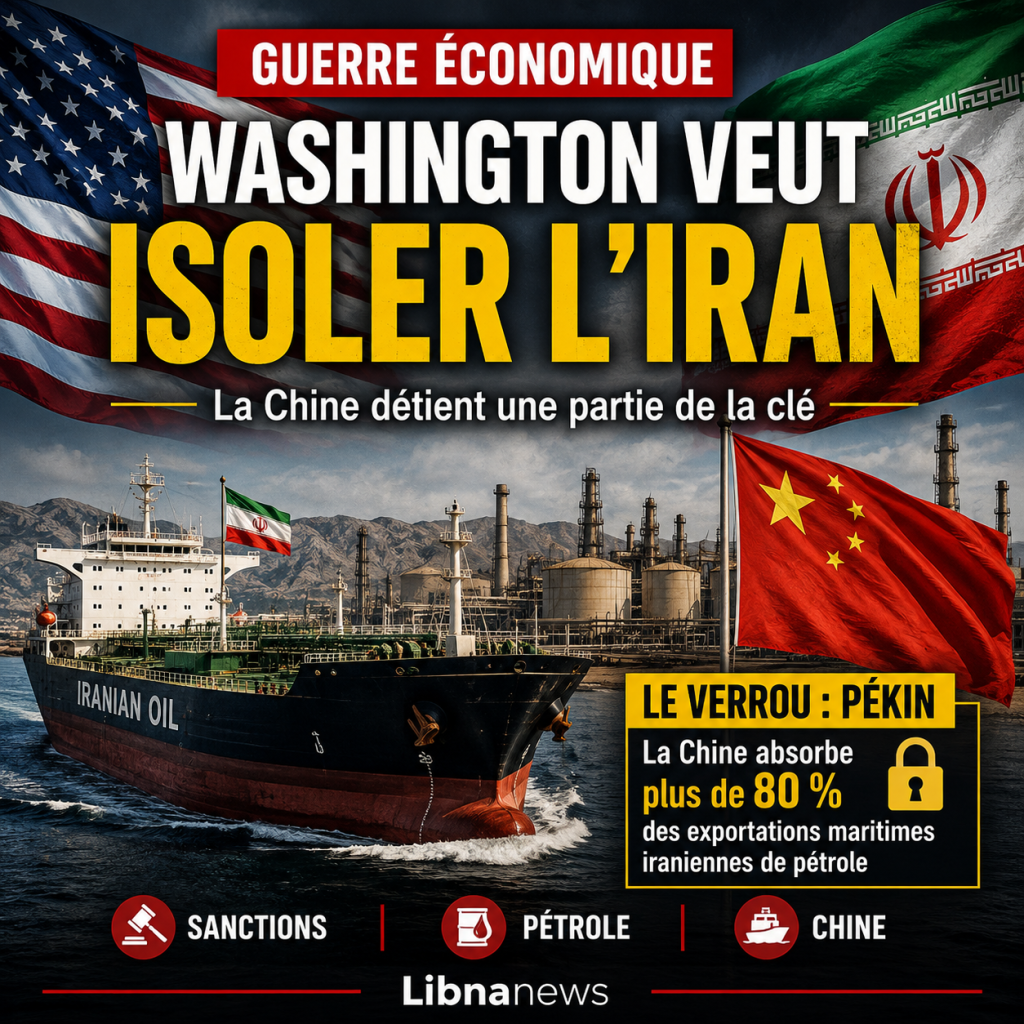
China accounts for over 80 per cent of Iranian oil exports shipped by sea, according to available trade estimates. Without the Chinese market, Tehran’s ability to monetize its hydrocarbons would be significantly reduced.
Beijing therefore becomes indispensable for any strategy aimed at asphyxiating Iran financially.
But asking China to cut its ties with Tehran amounts to asking the main strategic rival of the United States to help Washington achieve one of its major geopolitical objectives.
The paradox is considerable.
The United States has the means to increase the cost of Chinese purchases of Iranian oil. They may sanction refineries, traders, ships or financial intermediaries. They can complicate insurance and cargo payments and make the use of the international financial system more risky.
However, they do not directly control Chinese trade decisions.
Beijing also rejected the US strategy on Friday. Chinese diplomacy claimed that sanctions and pressure were not a solution to the Middle East crisis.
The reaction confirms that China does not accept the principle that Washington could unilaterally determine with which countries its companies can trade.
For Beijing, the stakes far exceed Iranian oil
China also has a strategic interest in challenging the extraterritoriality of US sanctions.
To accept Washington’s demands without resistance would set a precedent in a context where Beijing is specifically seeking to reduce its vulnerability to the US-dominated financial system.
The Iranian question thus joins the Chinese-American competition.
For Washington, the power of the dollar makes it possible to transform access to the US market into a diplomatic instrument. For Beijing, this use of the international financial system is an additional reason for developing payment channels and commercial relations that are less dependent on Western infrastructure.
This does not mean that Chinese companies ignore American risk. They make their own arbitrations.
A large company exposed to Western markets may find Iranian trade too risky. An independent refinery, with less interest in the United States and attracted by advantageous oil, can make a different calculation.
This is why sanctions against Iran have often produced segmentation rather than a complete stop to trade: those most exposed to the Western system withdraw, while specialist intermediaries accept more risks.
American allies also face a choice
Washington is not just targeting Beijing. The message is also addressed to US allies.
The Trump administration wants to prevent Western, Asian or Middle Eastern partners from offering Iran alternative channels to bypass its isolation.
The United Arab Emirates was an important case in that regard. Abu Dhabi announced this week the suspension of its trade with Iran, while the two economies have historically maintained close trade relations.
The decision is significant because the Emirates has long been one of the main connecting points between the Iranian economy and international markets. Dubai, in particular, hosts an important Iranian business community and has served as a platform for many exchanges.
But the American ability to replicate this result everywhere remains uncertain.
U.S. partners must consider their own energy, commercial and security interests. Some may support the goal of preventing Iran from developing certain military capabilities while refusing a strategy to cause its economic collapse.
The more Washington directly threatens its partners with reprisals, the more the coalition it seeks to build may also be perceived as a constraint rather than a common policy.
An economically powerful but not cost-effective strategy
The effectiveness of sanctions also depends on a variable that Washington does not fully control: the global energy market.
A sharp reduction in Iranian exports removes barrels from a market already disturbed by the war and the difficulties around the Strait of Ormuz.
Markets responded immediately to new US threats. On Thursday, US oil grew by almost 4%, while Brent grew by more than 3%, reaching its highest levels of the month.
This increase illustrates the American dilemma.
The more Washington succeeds in reducing Iranian supply, the more it can increase financial pressure on Tehran. But if this decrease results in a sharp rise in world oil prices, some of the desired effect may be neutralized.
Producers who continue to export benefit from higher prices. U.S. consumers can face an increase in fuel costs. Europe is exposed to higher prices for diesel and other refined products.
An economic campaign against Iran can therefore impose a cost on Tehran while exporting part of that cost to the economies that apply it.
Dropping volumes is not enough
There is also a difference between reducing Iranian exports and effectively depriving the government of revenue.
The financial effect depends on the volume sold, the price obtained, the cost of circumvention of sanctions and Iran’s ability to receive payments effectively.
Illegal export requires more intermediaries, ships, discounts and financial packages. It is therefore generally less profitable than normal sales.
Sanctions can be effective even when they do not bring exports down to zero. They reduce Tehran’s margin and increase the cost of each transaction.
But the experience of previous sanctions campaigns also shows Iran’s ability to adapt. Tehran has developed opaque trade channels, flag changes, cargo transfers and intermediaries to continue selling part of its production.
The upcoming economic battle will therefore also be a battle for maritime, financial and commercial control.
Can sanctions get what the war didn’t get?
This is ultimately the central issue of the new US strategy.
Economic sanctions can reduce the resources available to a government. It does not mechanically determine its political choices.
Iran has been living in various forms of American sanctions for more than four decades. These measures have affected growth, investment, currency and living standards. They have not led the Islamic Republic to disappear or abandon all its strategic objectives.
However, the situation of 2026 is different in its intensity. At the same time, the Iranian economy suffers from the consequences of the war, energy disruptions, trade restrictions and a new American attempt to cut off the remaining circuits.
The Trump administration therefore bets on a cumulative effect.
It hopes that the combination of military damage and economic asphyxiation will alter Tehran’s calculation without requiring a further major military escalation.
But pressure can also produce the opposite effect. If the Iranian leaders conclude that no concession will allow a lasting lifting of the sanctions, they may consider that they no longer have sufficient incentive to negotiate.
A coercive strategy opens a diplomatic path only if the adversary believes that a compromise will effectively reduce its cost.
Washington also turns its allies into a lever
The news of 21 August is perhaps less in the sanctions against Iran than in the magnitude of the pressure announced against countries that continue to trade with it.
Donald Trump seeks to transform the size of the US market and the centrality of the dollar into a power multiplier. The United States does not need to buy Iranian oil to limit its sales: it can try to convince every buyer that access to Iran will cost it more than abandon this market.
This strategy works as long as companies and states view access to the US system as more valuable than their relationship with Tehran.
It becomes more risky when the target is China.
A direct confrontation with Beijing around Iranian oil could broaden an economic war initially directed against Tehran to the relationship between the first two world economic powers. It could also speed up Chinese efforts to circumvent sanctions and develop non-dollar payments.
Washington thus plays on two contradictory horizons: to make maximum use of the current power of the US financial system while avoiding its coercive use too quickly pushing its partners and opponents to build alternatives.
Details of the new sanctions announced by Scott Bessent are expected next week. They will determine whether the White House favours targeted measures against oil buyers and their intermediaries or a much broader threat against states now in economic relations with Iran. The first test will be Chinese: without any substantial reduction in Beijing purchases, the total economic isolation sought by Washington will remain out of reach.




