

Killing strikes in the South, intense ground fighting and growing political pressure
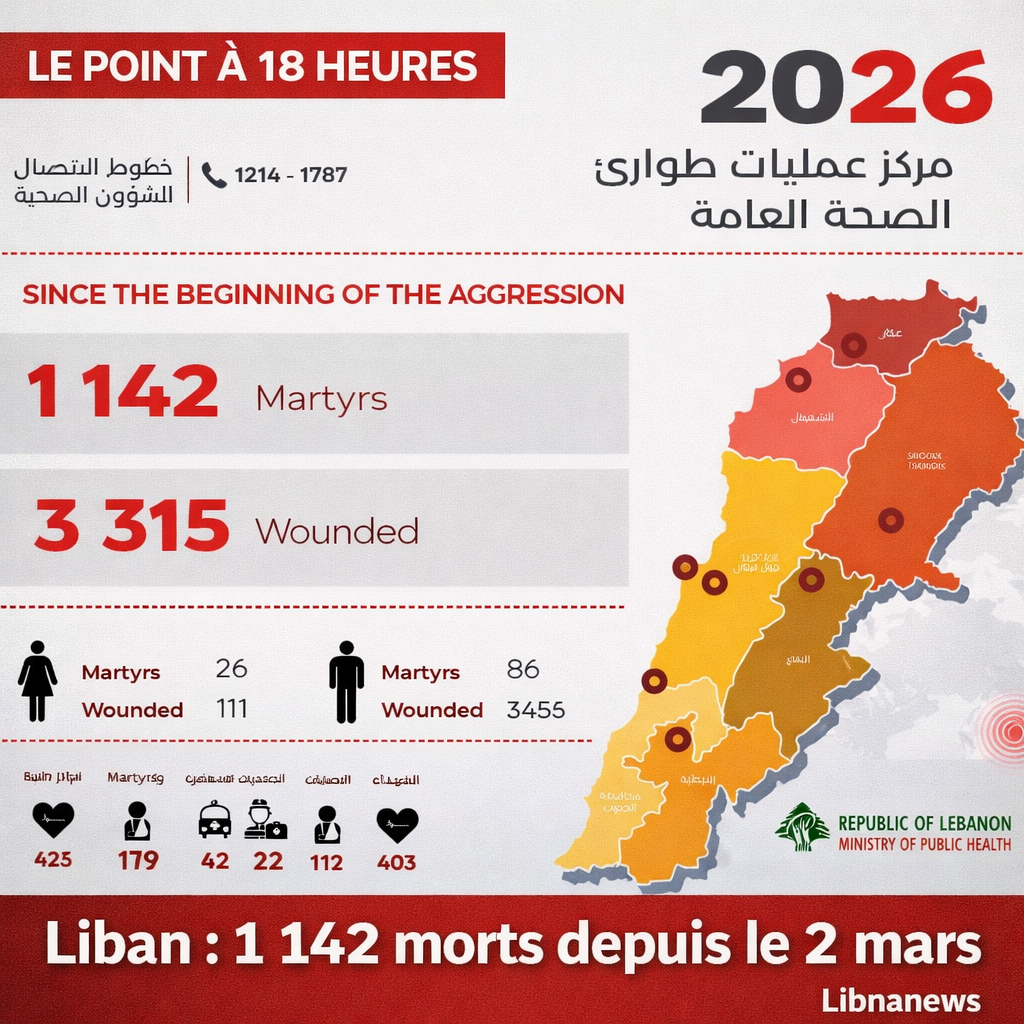
In Lebanon, the war is still growing at the end of the day. According to the daily report of the Ministry of Health transmitted by the National Information Agency, the cumulative balance from 2 March to 27 March reached1,142 deathsand3,315 injured. The infographic of the Health Emergency Operations Centre transmitted this afternoon also states, for the last 24 hours, that26 deathsand86 injured.
More and more deadly bombings in the South
The heaviest balance sheets of the last few hours come from the South. The Health Emergency Operations Centre has announced thattwo Israeli strikes on Saksakiyé, in the caza of Saida,6 deaths, including 3 children, and 17 injuries, including 7 children. Earlier, another strike onKfar Rummanehad done2 dead and 8 injured. These two confirmed attacks alone therefore represent8 dead and 25 injured.
Further bombardments were reported during the day in several southern localities. At the beginning of the evening, MTV relayed Israeli artillery fire against the outskirts ofBayyadaandTayr Harfa, while Reuters confirmed a dawn strike against a building in thesouthern suburbs of Beirut, marking the continuation of raids on the capital and its periphery.
On the ground, Israel pushes its buffer zone logic to the Litani
The military sequence is no longer limited to point strikes. Reuters now describes an Israeli campaign aimed atcut South Lebanon from the rest of the countryand to install abuffer zone to Litani, about 30 kilometres north of the border. Destroyed bridges, demolished houses, impassable axes and consolidated positions: Israeli logic is now territorial as well as military.
On the ground, this increase translates intoclose fightingin several sectors of the South. LBCI reported, quoting the spokesman for the Israeli army, that Israeli forces claim to have killedMore than 30 Hezbollah fighters in face-to-face clashesSouth Lebanon. This data is derived from the Israeli military narrative and cannot be independently verified at this stage, but it confirms the existence of direct land commitments and no longer merely a distant exchange of fire.
MTV had already broadcast images on 21 Marchclashes between Hezbollah and the Israeli armyin the sectorNaqourain the directionAlma al-Shaab, sign that the land front has been active for several days and has been densified with Israeli advance.
Israeli side, confirmed military deaths and wounded on the northern front
The human cost side of Israel is real and cannot be left aside. Reuters reported on 26 March thatTwo Israeli soldiers were killedfighting in southern Lebanon. The Israeli army itself announced it.
In addition, there are wounded. The Wall Street Journal reported on 27 March thatTwo Israeli soldiers were seriously injuredduring night fighting in South Lebanon. For his part, Reuters had already reported the death of a few days earlierIsraeli civilians near Misgav Am, finally attributed to a friendly fire from Israeli artillery and not a projectile from Lebanon.
In other words, the Israeli northern front remains under pressure. The confirmed Israeli military losses are at least at presentTwo deadin the fighting in Lebanon in the last 48 hours, along with serious injuries. The northern communities also remain exposed to rockets, missiles and drones, although the detailed balance sheets of each attack are not systematically consolidated in real time.
Hezbollah maintains its rocket, drone and air defence response
At the same time, Hezbollah continues to display a capacity for action on the ground. MTV relayed a statement from the movement claiming to havefired a ground-to-air missile against a warplane over Beirut. Again, this is a claim by Hezbollah, not independently confirmed at the time of publication.
The persistence of these announcements is part of a broader pattern described by Reuters: despite the intensification of the Israeli strikes and advance, Hizbullah continues to launch attacks that complicate the Israeli maneuver and fuel the Israeli side’s justification for a wider depth of security in the South Lebanon.
Beirut under pressure: politics tries to follow war
Domestically, war continues to stifle an already fragile state. Reuters reports that the Lebanese power aroundNawaf SalamandJoseph Aoun, toughened its line against Hezbollah, going so far as to ban its military branch, demand discussions with Israel and demand the departure of the Iranian ambassador. This inflection increases tension with Hezbollah as the country manages destruction, displacement and risk of internal fracture.
In parallel, the Head of Government Nawaf Salam received the ICRC Regional Director on 27 March and stressed the urgent need foradditional aidAs the number of attacks against relief workers increases. MTV relayed this meeting early in the evening.
In the Middle East, Trump temporizes Iran without relaxing the region
At the regional level, the day remains dominated by the decision toDonald Trumpto reject10 daysbefore possible strikes on Iranian energy infrastructure. Reuters and AP indicate that this period now runs until6 Aprilbased on discussions presented by Washington as encouraging, but contested by Tehran.
This stay does not reduce regional tension. AP stresses that Israel is threatening to do soExpanding his strikesThe war in Lebanon remains one of the most active theatres of this wider confrontation. In this context, the Lebanese front retains a dual function: pressure ground for Hezbollah and military demonstration space for Israel.
A broad front, a growing balance
At 6 p.m., the result was a multi-level war. TheOfficial Lebanese balance sheetclimb to1,142 deathsand3,315 injuredsince 2 March, with26 dead and 86 injuredonly 24 hours according to the health infographic of the day. In the field,SaksakiyeandKfar Rummanefurther increase the civilian human cost. On the ground, the Israeli army advances in a logic ofbuffer zone to Litani, while theclose fightingmultiplies. Israeli side, at leastTwo soldiers were killedand others were seriously injured. And politically, Lebanon remains caught between the humanitarian emergency, the confrontation with Hezbollah and the shadow of American-Israeli-Iranian escalation.






