

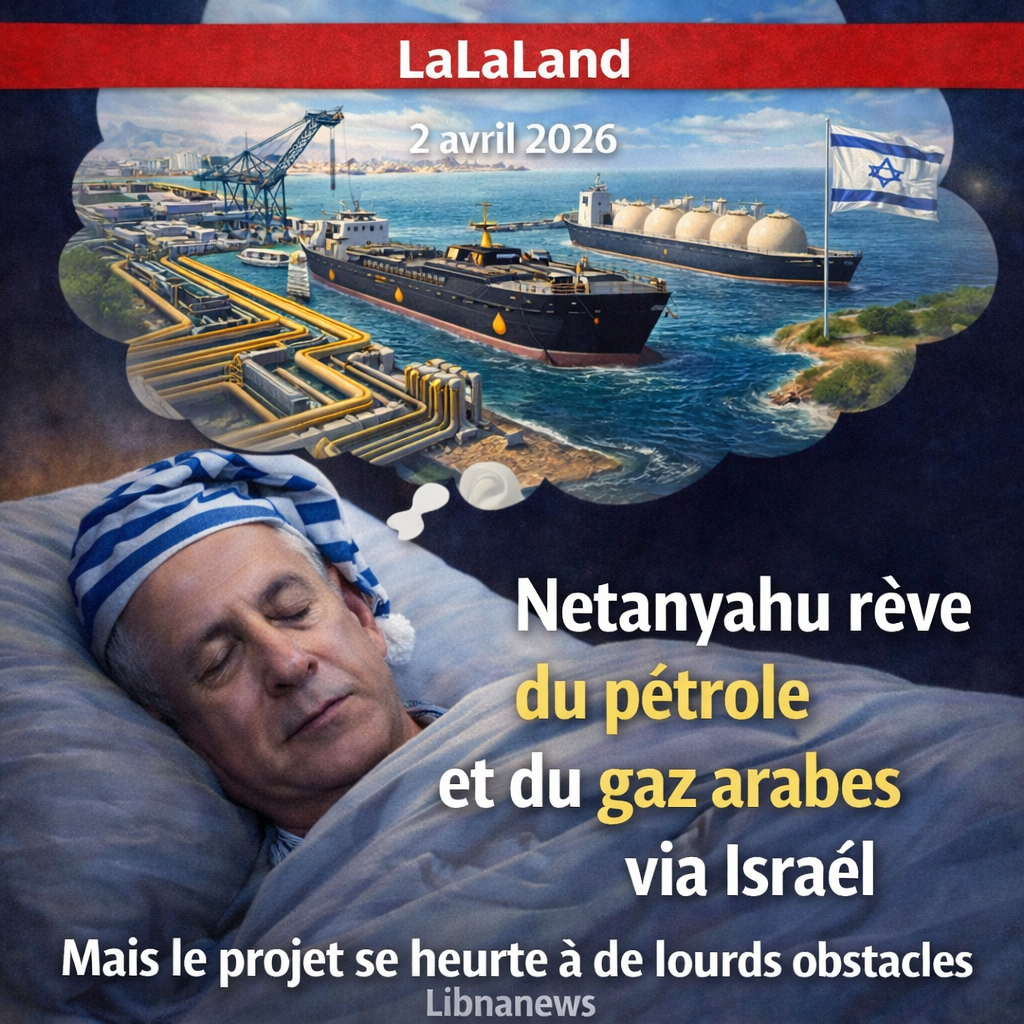
Benjamin Netanyahu said he wanted to make Israel an energy bypass corridor after the current war, with oil and gas flows to Israeli ports to avoid the Strait of Ormuz. The idea seems simple on paper. In reality, it faces three major locks: a considerable industrial cost, a persistent security vulnerability and a geopolitical equation still far from being resolved.
Benjamin Netanyahu has set out a clear ambition: after the ongoing war, the oil and gas of the Middle East should, according to him, be able to transit through the Arabian peninsula to Israeli ports, in order to circumvent Iranian threats on the Strait of Ormuz and other sea routes in the Gulf. The announcement is part of an acute energy crisis, while the Ormuz Strait, a vital passage for about 20 per cent of world oil and gas flows, remains heavily disrupted by the war.
At the political level, Israeli reasoning is legible. If Ormuz becomes permanently unstable, alternative roads suddenly take on immense strategic value. Israel already has a logistical asset with the Eilat-Ashkelon axis, a historic infrastructure linking the Red Sea to the Mediterranean. The Hebrew state can therefore argue that there is a material basis for becoming a regional energy platform. But transforming this intuition into a sustainable regional system is another matter.
An attractive project on the map, much more difficult on the ground
The first difficulty is industrial. Netanyahu is not just talking about making more use of existing infrastructure. It refers to pipelines to be built or extended regionally across the Arabian Peninsula to Israeli ports. This type of network requires massive investment, long delays, transit agreements, guarantees of financing and political coordination rarely brought together in the Middle East.
Even much more advanced energy projects in the region have addressed cost and cost-effectiveness issues. The example of the EastMed project is enlightening: supported for a time as a large gas corridor between the east of the Mediterranean and Europe, it saw its US support shrink due to doubts about its economic viability. Reuters already reported in 2022 that Washington had reservations about the economic meaning of the project, particularly because of its cost and technical complexity.
In other words, while a relatively coordinated submarine pipeline between allies or partners has already been found to be difficult to profitable, a land or mixed network linking Gulf producers to Israel, in a fractured regional environment, appears even more ambitious. The problem is not just to build tubes. These tubes must be filled over time, with solid contracts, in a market where buyers first arbitrate on the basis of the final cost, the stability of the journey and the political risk.
Israeli ports that exist, but a capacity far from unlimited
Israel does not come from scratch. The Eilat-Ashkelon pipeline exists, and Reuters already recalled several years ago that the EAPC company was committed to making Israel an oil hub between the Red Sea and the Mediterranean. Preliminary agreements were even mentioned with the United Arab Emirates after the Abraham agreements.
But this tool is neither a magic wand nor an Earth replica of Ormuz. Capacity remains limited in the face of the huge volumes normally absorbed by the Strait. The rise of this corridor would require an extension of terminals, storage, protections, maritime logistics and probably new regional interconnections. Even an enhanced use of the Eilat-Ashkelon axis would not alone replace the flows that Ormuz usually makes.
There is also another constraint: the current war is already disrupting the Israeli energy apparatus itself. Reuters reported that the Israeli authorities have interrupted some gas operations, which threatens project schedules such as Katlan d’Energan. A country that wants to become a regional corridor must first ensure the continuity of its own facilities. This point is not acquired in a context of military escalation.
Strategic obstacle: bypass Ormuz without getting out of the risk
The idea of Netanyahu is based on a real observation: Ormuz is a major bottleneck, today at the heart of the global energy crisis. Reuters pointed out this week that the effective closure of the Strait has already plunged markets into a scenario close to the worst, with trade-offs, high prices and massive losses for Gulf producers.
But bypassing Ormuz does not mean getting out of the risk. An energy road to Israel should be based on other vulnerable links. Oil transported to Eilat would still depend on the security of the Red Sea and the Bab al-Mandeb Strait, two areas already weakened by the Houthis attacks and the extension of the conflict. The Associated Press recently noted that the risk of renewed attacks in the Red Sea was putting this path back under heavy pressure.
In other words, the Israeli promise amounts less to replacing a safe road with another safe road than to moving part of the traffic to a different supply chain, itself exposed to missiles, drones, sabotage and regional instability. For insurers, traders or oil majors, this detail is central: an alternative of value only if it is sustainable and more predictable. But the Red Sea-Israel area is not yet.
Geopolitical lock: without broad normalization, no regional corridor
The most serious difficulty is probably political. Large-scale transport of Gulf oil and gas to Israeli ports requires more than just facilities. A stable regional diplomatic architecture is needed. This requires at least transit, security, investment and long-term agreements with several Arab States. This architecture remains incomplete.
Abraham’s chords had opened a window. They had made an economic corridor through Israel possible, at least among certain actors. But the war in Gaza, and then the regional explosion around Iran, slowed or frozen several normalization dynamics. Reuters already noted in 2023 that the new trade corridors based on Israel remained fragile, precisely because they were based on a rapidly reversible political environment.
The Saudi case is decisive. A large regional scheme has almost no chance of success without at least one form of Riyadh acceptance. But Israeli-Saudi normalization is not achieved, and the current regional climate makes it even more complicated. Without this central room, an energy corridor to Israel may remain partial, fragmented, or limited to a few opportunistic flows, far from Netanyahu’s ambition.
A risky economic bet in a region that has become more expensive
Finally, there is a fundamental contradiction. Netanyahu presents Israel as a future logistical refuge in the face of regional energy chaos. But Reuters observed a few days ago that the current war makes the entire Middle East much less attractive for oil and gas investments, due to the rising cost of insurance, personnel, equipment and capital. This increase in hazard pay affects the entire region, including Israel.
For investors, therefore, the question is not just whether Israel can offer an alternative route. The question is whether this road will be sufficiently safe and cost-effective to justify billions of dollars of commitment over twenty or thirty years. The more regional the conflict becomes, the more difficult the response becomes. Energy infrastructure is not a short-term diplomatic coup. It is a heavy asset, which requires legal stability, physical security and commercial visibility.
At the same time, Gulf producers already have some alternative roads, including via the Red Sea for Saudi Arabia and via Fujairah for the Emirates. These solutions are imperfect and insufficient to absorb all the loss of Ormuz, but they already exist. This means that any Israeli project will have to prove that it brings more than just an extra detour: it will have to be cheaper, faster or safer than existing or extended routes.
Israel aims at regional changeover, not just a transit market
Basically, Netanyahu’s announcement is not just energy. It is also geopolitical. It draws a vision in which Israel would emerge from the war not only as a regional military power, but as a necessary passage of part of the strategic flows between the Gulf, the Mediterranean and Europe. It is a way of turning a crisis into an opportunity for regional centrality.
But this centrality is not decreed. It involves ending or at least reducing several simultaneous conflicts, lasting Arab warming towards Israel, massive financing, securing the Red Sea and Israeli infrastructure, as well as sufficiently strong demand from producers and customers. At this stage, each of these elements remains uncertain.
Netanyahu’s announcement therefore illuminates an ambition more than a ready-to-use project. It translates a strong strategic intuition: the Ormuz shock pushes all actors to seek alternative routes. But between this intuition and the reality of a dominant energy corridor through Israeli ports, the gap remains immense. Economic, strategic and geopolitical obstacles are such that the post-war period could first produce partial, temporary and fragmented solutions, far from the great regional shift suggested today.






