

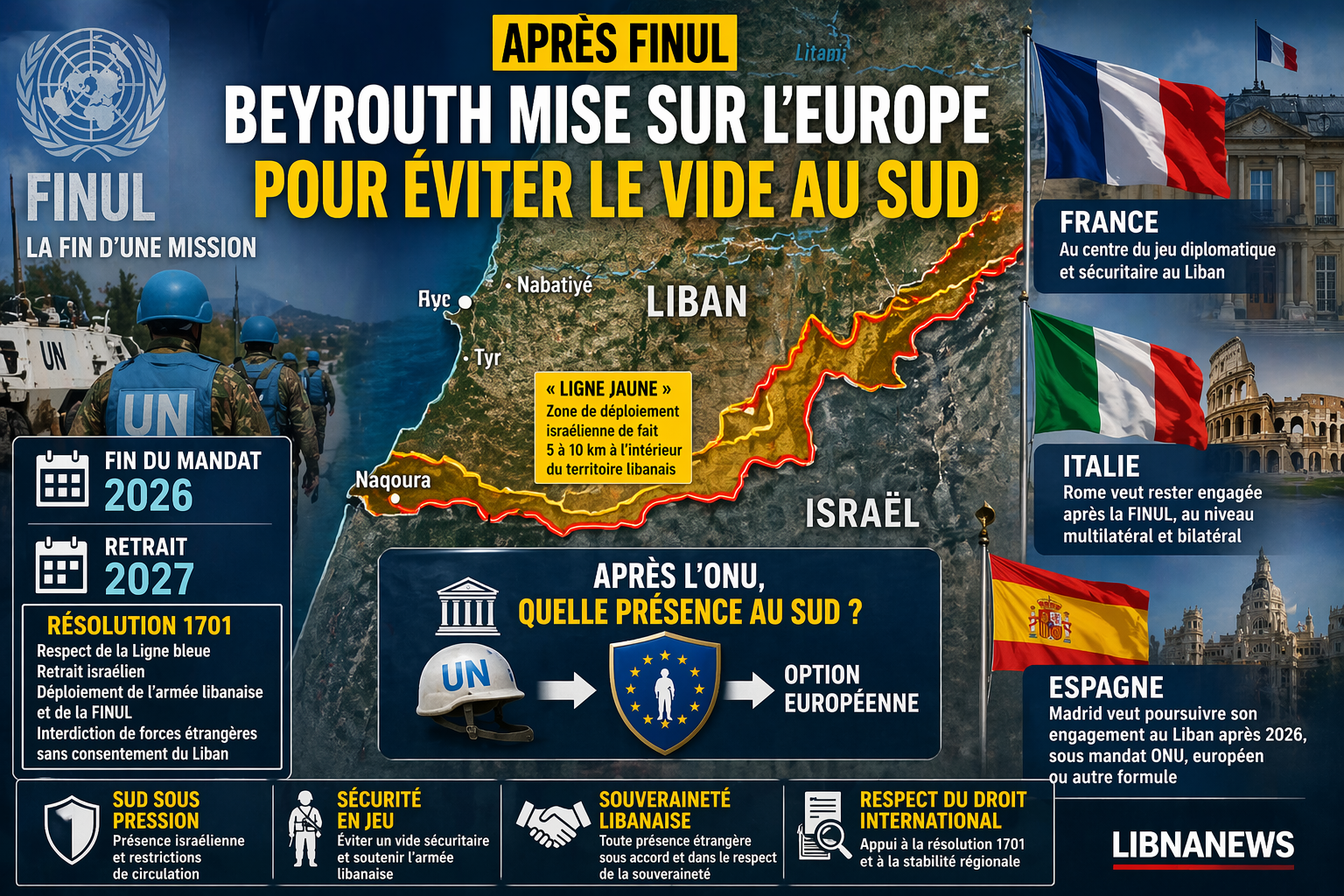
In Beirut, post-FINUL is no longer a distant hypothesis. It has become a matter of political, military and diplomatic work, even though the United Nations mission must cease operations at the end of 2026 and begin its withdrawal in 2027. In Lebanese leadership circles, the idea has been taking shape for several months: to avoid a security vacuum opening up in the South, as Israel consolidates a de facto presence inside Lebanese territory and imposes further restrictions on movement along the border. It is in this context that a scenario of lasting international presence, brought by some European countries, draws Beirut’s attention.
The frame is not frozen yet. At this stage, there is no formally adopted plan defining permanent French, Spanish or Italian bases on Lebanese soil after UNIFIL. For the time being, the term itself is more relevant to the scenarios discussed in Beirut and several capitals than to a legally agreed architecture. But several clues converge. Italy publicly stated that it would continue to do its part even after the UN mission, maintaining a multilateral and bilateral presence. Spain claimed to want to remain engaged in Lebanon after 2026, whether under United Nations, European or other terms. On the Lebanese side, President Joseph Aoun, for his part, welcomed any country wishing to maintain forces in the South following the withdrawal of UNIFIL, provided that a specific framework was agreed upon. Finally, in Paris, the debate is less public on the final form, but France remains at the centre of discussions on the future security arrangements in South Lebanon.
For Beirut, the question is not just to replace peacekeepers with other uniforms. The question is who will remain on the ground as resolution 1701 enters an open challenge area. Since the resumption of the war in March, Israel has advanced inside southern Lebanon, imposed new traffic maps, carried out demolitions in dozens of villages and installed what it presents as a new line of deployment. In the Israeli communications relayed in recent days, the term « yellow line » has even emerged to refer to this new area, comparable to that used in Gaza. For Beirut, on the contrary, this development reinforces the interest of an international presence that is not merely symbolic.
After UNIFIL, Lebanon is already seeking follow-up
The starting point is now known. On 28 August 2025, the United Nations Security Council renewed the mandate of UNIFIL « for the last time » until 31 December 2026. The text then provides for a gradual and orderly withdrawal over the year 2027, in coordination with the Lebanese government. This decision was taken after a compromise by France, but under very clear American pressure. Washington then explained that it would no longer support further extension, believing that the security environment had changed and that the Lebanese State now had to assume more responsibilities in the South.
Israel, for its part, had welcomed this perspective as the confirmation of a long-standing line. At the United Nations, his ambassador had claimed that UNIFIL had failed in its mission by letting Hezbollah become a regional threat. Since then, this criticism has remained constant. The Israeli argument is that the mission helped freeze an illusion of stability without preventing Hezbollah’s military roots south of the Litani River. In this reading, the departure of UNIFIL paves the way for another security model, less United Nations, more bilateral or more directly controlled by the dominant military and diplomatic actors.
In Beirut, this deadline has been read differently. From the beginning of the year, Joseph Aoun began preparing the post-FINUL as a matter of state. In January, during an exchange with the United Nations Deputy Secretary-General for Peace Operations, Jean-Pierre Lacroix, the Lebanese Presidency reported that the Head of State welcomed any country wishing to maintain forces in the South to assist the Lebanese army after the withdrawal of the United Nations mission, subject to an agreement on the framework for action of this future arrangement. The sentence was a turning point. Lebanon was no longer simply calling for UNIFIL to survive. It opened the door to a new international presence, provided that it remained compatible with its sovereignty.
This line has not been abandoned since. On the contrary, it has been reinforced by the military degradation of the southern front and the discussions launched on a more lasting ceasefire with Israel. In Beirut, the January signal was understood as the official opening of a construction site: to think of a device that extends an international presence in the South without mechanically extending UNIFIL in its current format.
Italy advances to the open, Spain wants to stay, France keeps hands
Among the contributing European countries, Italy was the most clearly expressed. During his official visit to Lebanon, the Italian Minister of Defence Guido Crosetto said that « even after UNIFIL », Italy would continue to do its part, firmly supporting the international presence and contributing to the capacity-building of the Lebanese armed forces. He added that Rome would guarantee its presence at both the multilateral and bilateral levels, including through the Technical Military Committee for Lebanon and the MIBIL mission. This declaration has a concrete scope: it means that Rome is not preparing to leave the Lebanese theatre with the sole closure of the UNIFIL chapter.
Italy is not leaving anything. It is one of the main contributors to the UN mission, has an ancient political anchor in Lebanon and already maintains bilateral instruments of military cooperation. Its choice to remain in one form or another can therefore be read as the most explicit basis for a post-FINUL device.
Spain, for its part, held a less detailed position on the form, but very clear on the intention. On 19 March, Pedro Sánchez declared that the ambition of the Spanish government, like that of several other nations present in the mission, including France and Italy, was to continue the commitment to Lebanon after 2026. He added that the formula remained to be determined, whether it was through the United Nations, the European Union or another structure. So Madrid has done two things: the planned end of the current mandate does not mean automatic withdrawal of Spanish interest in South Lebanon; and maintaining a European presence on the spot is now an open subject, not a taboo.
France is at an intermediate point. Officially, Paris does not yet present a public scheme as detailed as that of Rome. At the same time, Paris remains at the heart of the issue. On the one hand, because France drafted the UN resolution that organized the last extension of the mandate. On the other hand, because it remains one of the main countries involved in the mission, and recently reaffirmed that UNIFIL is intended to remain an essential element of credibility for the resolution of the crisis in southern Lebanon. Finally, because Emmanuel Macron, at his meeting with Nawaf Salam on 21 April, recalled that France would continue to assist Lebanon in preparing its negotiations with Israel, even without sitting directly at the Washington table, a format in which Paris wanted to be present but to which Israel and the United States refused to associate.
In other words, Paris does not yet publicly say: « we will establish permanent bases ». But France is well present in the strategic conversation on the post-FINUL. In Beirut, it is understood that it is one of the countries that Lebanon seeks to retain in the game, alongside Italy, Spain and other European partners.
South Lebanon changes its nature under Israeli maps
This post-FINUL reflection took on a new urgency with the Israeli military decisions of April. On 20 April, the Israeli army issued maps directing the inhabitants of southern Lebanon to stay away from a wide strip of territory on the border and not to approach the Litani area. Reuters reported that this new line of deployment ran, depending on the sectors, between five and ten kilometres inside Lebanese territory. The Israeli army presented this band as a buffer zone to protect northern Israel from Hezbollah.
On the ground, the consequences are immediate. Access to dozens of localities is restricted. Villages are partially emptied. Demolition continues. Traffic axes become impassable or prohibited. The area is indeed turning into an Israeli military-controlled space, where Lebanese civilians are ordered not to return. In the Israeli communications relayed by several media, this new line was brought closer to the « yellow line » already used in Gaza. The term is less important, in essence, than the reality it covers: a de facto no mans land, drawn unilaterally by Israel within Lebanon.
For Beirut, this slide is central. These are no longer just one-off violations of the cease-fire, or a residual Israeli military presence in a few disputed points. It is an attempt to organise the land on a sustainable basis, through maps, prohibitions, partial occupation and destruction. It is precisely this scenario that makes the idea of a sustainable international presence more attractive to the Lebanese executive.
Why Beirut sees this as a question of resolution 1701
The core of the dispute is both legal and military. Resolution 1701, adopted in 2006 after the war between Israel and Hezbollah, is based on several well-known principles: cessation of hostilities, respect for the Blue Line, Israeli withdrawal from Lebanese territory, the parallel deployment of the Lebanese army and UNIFIL in the South, and the absence of weapons or armed forces other than those of the Lebanese State and the United Nations mission in that area. The text also recalls that there should be no foreign forces in Lebanon without the consent of the Lebanese Government.
With this in mind, the militarized band that Israel is installing today in South Lebanon is in frontal collision with the 1701 architecture. It’s Beirut reading. It is also the case of several contributing capitals of UNIFIL, which see in the maintenance of Israeli troops inside Lebanon, in the restriction imposed on civilians and in the repeated incidents with the Blue Helmets as a violation of the 2006 security framework.
Israel presents things differently. For him, 1701 failed to neutralize Hezbollah south of the Litani. The Hebrew state therefore defends the need for more direct security control. But this speech faces a major difficulty: the resolution does not allow a unilateral reorganization of Lebanese territory by the Israeli army. It is precisely in order to close this gap between the text and the ground that Beirut is looking with interest today at any formula that would maintain, after UNIFIL, foreign contingents capable of physically occupying the diplomatic and security space that the UN mission will leave behind.
Tensions with Israel strengthen the interest of a European presence
The other decisive factor is the deterioration of relations between Israel and several of the major UNIFIL contributing countries. The dispute is not dated yesterday. By October 2024, the French, Italian and Spanish leaders had jointly condemned the targeting of the mission by the Israeli army and denounced unjustifiable attacks against peacekeepers. At the time, they were talking about serious violations of Israel’s obligations under resolution 1701 and humanitarian law.
The 2026 sequence further exacerbated these tensions. In April, Italy summoned the Israeli ambassador after Israeli warning shots struck an Italian UNIFIL convoy. Antonio Tajani described the incident as a violation of resolution 1701, and Giorgia Meloni called for an end to Israeli military operations in Lebanon. On the same day, Spain summoned the Israeli Chargé d’affaires to Madrid to protest the alleged unjustified detention of a Spanish UNIFIL soldier by the Israeli army.
France, too, has publicly denounced intimidation deemed unacceptable against its soldiers in Lebanon. A few days later, two French soldiers were killed following the ambush on 18 April against a mission patrol. In this context, the post-FINUL question is no longer a theoretical debate on the institutional form of the international presence. It becomes a political test: do Europeans stay on a ground where their soldiers have been targeted, or do they leave it to Israel, the Lebanese army and local actors to redefine the border alone?
The international presence is not only military
It is on this point that Beirut insists most. UNIFIL is not only an interposition or patrol force. It is also mandated to observe, report and document violations of resolution 1701. Its presence on the ground therefore produces something other than a military effect. It creates an international capacity for observation. It is this role that makes its future so sensitive.
For Lebanon, the outright disappearance of the mission would leave the South without permanent institutional witnesses at the very moment when Israel was seeking to impose a new military geography in the border area. A smaller European mission, a renewed multilateral presence or a sustainable maintenance of foreign contingents under another status would, on the contrary, offer continuity of presence and documentation.
Israel sees UNIFIL as a mechanism that has failed to prevent the anchoring of Hezbollah. Lebanon, for its part, also sees it as a safeguard against the diplomatic erasure of the South. As long as foreign soldiers, identified, mandated and linked to European capitals, remain there, every incident, every destruction, every obstacle to movement and every movement of troops continue to be observed by something other than the only parties to the conflict. This is one of the reasons why Beirut is so interested in the proposal for an international maintenance.
Why the European option seduces Lebanese power
The French proposal, in a broad sense, seduces Beirut for a simple reason: it is not limited to a slogan of support for Lebanon. It is part of a broader framework in which France supports Lebanese sovereignty, supports negotiations on Israeli withdrawal and remains committed to strengthening the Lebanese armed forces. For the Lebanese power, this combination is important. It links security, diplomacy and international continuity on the ground.
Lebanon knows that it alone will not be able to impose a complete withdrawal on Israel or to enforce 1701 mechanically. But it can try to avoid the worst-case scenario: the departure of UNIFIL, without a solid intermediary, leaving an Israeli army in a buffer zone, a Lebanese army still in the process of redeployment and a border that has become fully militarized by unilateral logic.
This is where the idea of a sustainable European presence, even if reduced and legally rethought, becomes politically attractive. It would not replace Lebanese sovereignty. She would give him time, support and witnesses. In Beirut, this is already enough to make post-FINUL no longer a mere horizon of withdrawal, but one of the major diplomatic projects of the moment, at a time when Washington is pushing negotiations with Israel, while South Lebanon is increasingly turning into an occupied space, mapped and restricted by an Israeli army that advances faster than law.






