

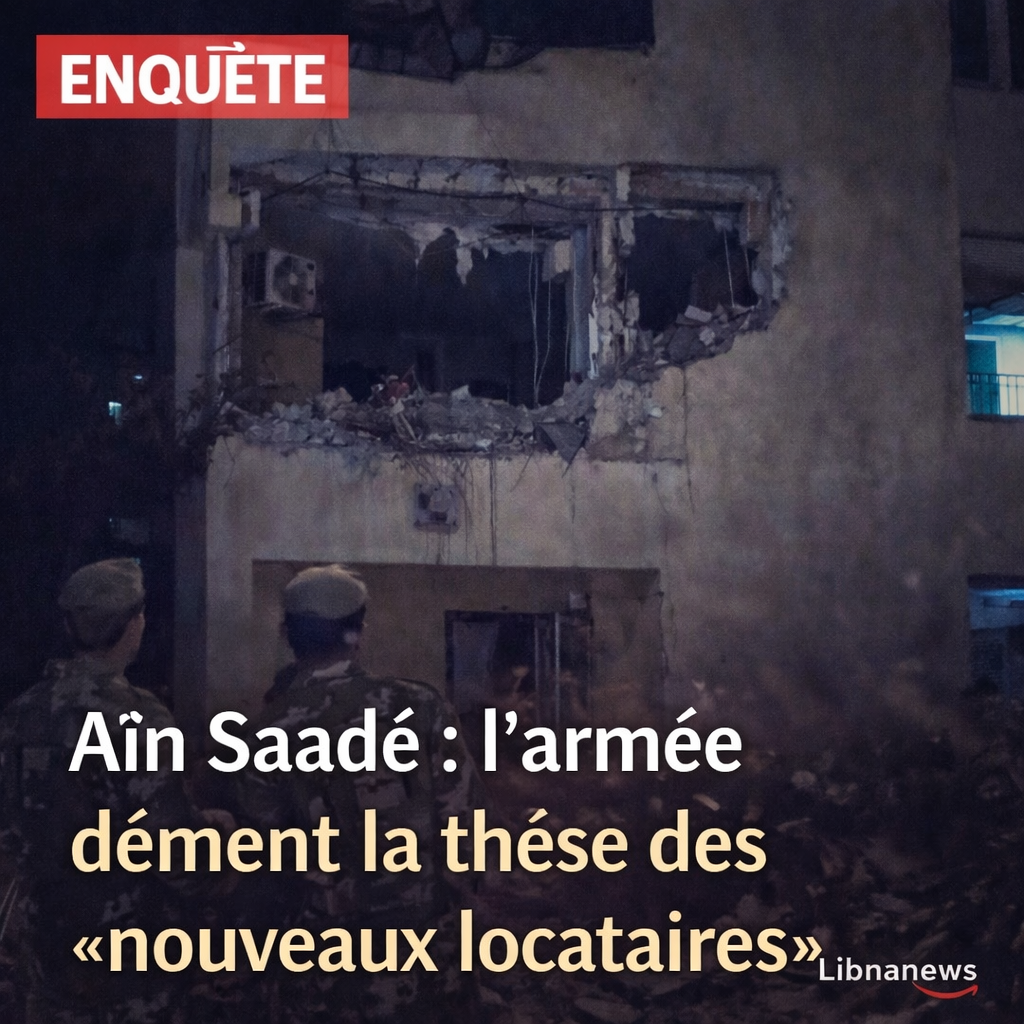
The Israeli strike on the evening of April 5 against an apartment in Ain Saadé, Metn, continues to fuel controversy. At the heart of the questions is a rumor quickly spread after the attack: the alleged presence of new tenants in the building, a hypothesis advanced to explain the strike. However, in its preliminary conclusions, the Lebanese Army asserts precisely the opposite.
In its communiqué, the military institution states that the first on-site investigations did not reveal anyno recent arrival of new tenants in the buildingTargeted. This element is central, as it contradicts one of the stories that circulated in the hours following the bombing, according to which newly installed occupants could have been the real target of the raid.
A rumor appeared almost immediately after the strike
As often after such an attack, several versions began to circulate very quickly. In the first few hours, while the aid was still scouring the rubble and the exact identity of the victims was gradually confirmed, the idea of new tenants has been imposed in some discussions as a possible path. It suggested that the apartment or building could have been used recently by a person wanted or related to an activity targeted by Israel.
This hypothesis took even more place as the strike itself seemed extremely targeted. According to the Lebanese army,two GBU-39 bombscrossed the roof, then the fourth floor, before exploding atthird floorwhere three people were killed and others injured. Such technical precision naturally fed the idea that specific intelligence had led to the raid.
Army communiqué closes first door
It is precisely on this point that the military communiqué changes the reading of the case. By stating thatPreliminary investigations revealed no new tenants in the buildingThe Lebanese army closed one of the most commented explanations since the attack. This does not mean that all shadow areas have disappeared. However, this means that at this stage one of the most relayed leads is not based on the findings of field investigators.
In other words, the controversy concerned a hypothesis which had acquired a form of credibility in public space before even being verified. The military communiqué introduces here an essential distinction between speculation and established element. He also recalls that, after such a strike, the rapid circulation of unconfirmed narratives can guide public debate in an erroneous direction.
Why this issue has become so sensitive
The question of new tenants is not a simple real estate detail. It touches at the heart of the political and security controversy around Ain Saadé. If new occupants had actually taken possession of the apartment shortly before the strike, some might have seen the evidence of an underground presence or of a punctual use of the place. On the other hand, if no new tenant existed, then the question becomes more disturbing:What was the exact targeting of the apartment on?
This is where the case takes on a broader dimension. The strike on a residential building in the Metn, far from the immediate fronts of the South, has already caused a strong emotion. The fact that the army dismisses the thesis of new occupants reinforces questions about the precise nature of the intelligence that led to the attack, or the possibility that another element might have motivated the strike.
Another track remains open: the man seen by motorcycle
However, the military communiqué does not close the entire file. The army says thata person was seen leaving the motorcycle building immediately after the attack. The investigation continues to identify this individual and to establish further details. This element is sufficient to keep open the possibility of an unexplained fact around the strike.
But again, the army is cautious. It does not publicly link this person to a particular target, organization or responsibility. It merely points out this fact as a point of inquiry. This caution is important, because it contrasts precisely with the speed with which certain interpretations had circulated around so-called new arrivals in the building.
A narrative battle around a targeted strike
The case of Ain Saadé illustrates a mechanic now frequent in the episodes of war: before the end of the technical findings, several competing accounts emerge to explain what happened. In this case, the thesis of new tenants had an immediate function. It allowed an apparent logic to be given to a strike on a residential building, suggesting that the target was not related to the usual inhabitants of the building.
The denial of the Lebanese army does not end the controversy. He’s moving it. The question is no longer just who lived in the building, but why such a precise strike was carried out under these conditions, with what prior information, and against what real target. By calling to avoid speculation until the end of the investigation, the military command visibly seeks to contain this battle before it turns into a parallel truth.






