

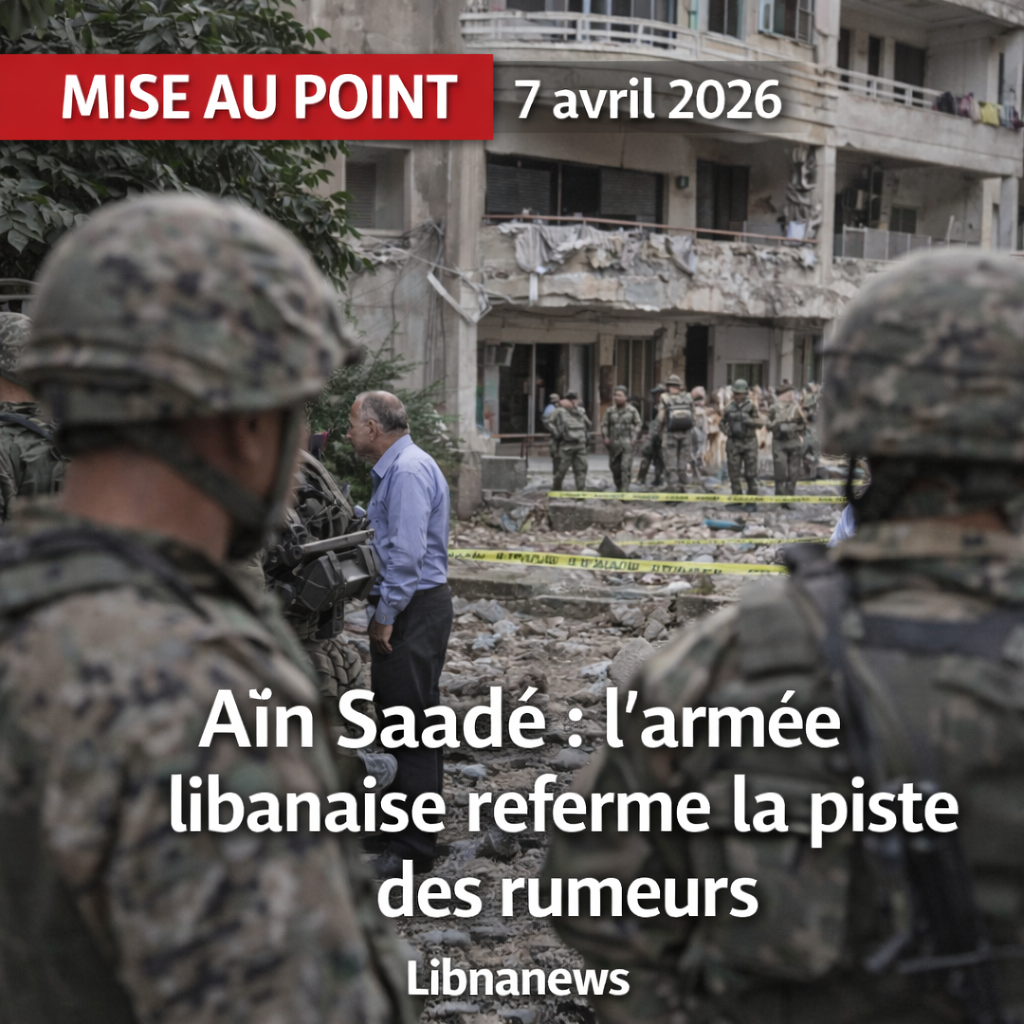
In Ain Saadé, the Lebanese Army communiqué significantly changes the reading of a file that has become explosive far beyond the strike itself. The Army Command announced that the man seen leaving the building by motorcycle at the time of the Israeli raid was not a fugitive linked to clandestine activity, but a deliverer, who had delivered medicine in recent months to the inhabitants of one of the apartments in the building. In the same text, the military institution insisted on the continuation of the investigation in order to clarify the circumstances of the attack, while calling not to fuel speculation on sensitive security issues. This development is important because it does not only correct a detail. It aims to break a suspicious mechanism that since the strike threatened to turn a military file into an internal fracture.
The case of Ain Saadé was never a mere security episode. From the very beginning, it took on a particular political and Community dimension. The town, in Metn, does not belong to the usual imagination of areas directly assimilated to a military theatre. The Israeli attack on an apartment in the area immediately led to a wave of shock, all the more so as three people were killed and the identity of the person on the bike fed a cascade of assumptions. In a war-torn country, misinformation is fast. A man who moves away from a targeted building immediately becomes, in the most nervous accounts, a moving proof. This is precisely what the military statement is trying to dismantle today.
Press release that defuses a package
The wording of the Army Command is clear. After investigation and security follow-up, the person who left the building by motorcycle and then disappeared was identified as a delivery person. The army states that in recent months it had delivered medicine to residents of one of the apartments. This is not anomaly. It aims to respond directly to the most inflammable rumor of the last few hours: that of a man who fled the premises because he was allegedly linked to a presence or activity targeted by Israel. MTV also reported shortly before that clarification that there was no basis for the information circulating about an arrest of this alleged suspect and that the investigation was still ongoing. The military communiqué thus closes, at least temporarily, this speculative sequence.
This clarification comes after an already very significant first communiqué. The army reported that an apartment of Ain Saadé had been targeted on 5 April at about 9 p.m. by two GBU-39 bombs that could be fired from a warplane or a warship. Its specialized teams had conducted a field survey, concluding that the two projectiles had crossed the roof and the fourth floor before detonating on the third, which was the target. The institution also claimed that the first investigations had not revealed the presence of new tenants in the building. By combining these two statements, the army is trying to build a coherent line: no evidence of new suspicious occupants, no confirmation of an underground track, and now requalification of the biker as a mere deliverer of medicines.
The political weight of this sequence is considerable. Because in a context of expanded Israeli strikes, the idea that a residential building in an area like Ain Saadé could have served as a anchor for a military target would immediately have displaced fear. It has reportedly reinforced suspicions between neighbours, internally displaced persons and residents, between so-called safe areas and areas perceived as potentially infiltrated. The army, by explicitly asking not to launch speculation, does not only seek to preserve the secrecy of the investigation. It also tries to prevent a security issue from turning into an internal narrative conflict.
A strike that immediately fractured the narratives
From the start, the attack on Ain Saadé was found at the crossing of several competing versions. LBCI had reported, on the basis of initial information, that no new residents had been discovered in the building concerned. At the same time, locally relayed elements maintained the idea of a suspected motorcycle leak. This opposition between technical investigation and the fugitive’s imagination quickly created a harmful climate. In today’s Lebanon, such a rumor is never neutral. It reacts to old fears, including that of war falling into civilian buildings outside the most anticipated frontal areas.
The statement issued this Tuesday by the army thus acts as an act of takeover. He doesn’t say he still knows why Israel hit this apartment. He doesn’t close the file on the merits. He says something else: one of the most commented elements of the case, namely motorcycle departure, should no longer be used as implicit evidence of guilt or involvement. This is an essential distinction. In security crises, the temptation is strong to turn a common behaviour into an absolute clue. The army recalls here that a motorcycle, a hasty departure or a temporary disappearance is not enough to build a credible story.
This caution is all the more necessary as the attack has already caused a strong trauma. According to LBCI, the strike killed three people. Regional media also recalled that the victims included a local Lebanese Forces official and his wife, further increasing the political burden of the event. Even without entering into all identities, the fact that a residential and socially remote neighbourhood is affected by conventional confrontational lines is enough to fuel far wider interpretations than the mere military fact. That is precisely why the army’s speech here counts more than a technical correction. She’s trying to prevent polarization.
What the army says, and what it doesn’t say yet
However, the press release should be read with precision. The army does not say that it has clarified the exact reasons for Israeli targeting. She says she is continuing investigations to clarify the circumstances of the attack. In other words, the requalification of the rider is not a complete explanation of the strike. This is an important point, because the opposite temptation would now be to consider that any mystery is lifted. That’s not the case. The military institution spreads a fantasy track that has become dominant in public space, but it does not yet provide the key to Israeli choice.
This gap leaves open a central question: on what basis did Israel hit this apartment? The Lebanese Army does not yet have any Israeli operational justification. His findings relate to the typing mode, the point of impact, the absence of new identified tenants and now the identity of the delivery person. The rest is still part of the investigation. This is where the press release takes on an almost political tone. In essence, he says to the opinion: do not fill the shadow zones yourself, because it is precisely in these voids that internal tensions arise.
This posture contrasts with the very rapid circulation of unverified assumptions for two days. It also reflects a deeper problem in contemporary Lebanon: the space between the raw fact and the official explanation is often occupied by competing narratives, courier channels, parties, militant relays or media seeking to fill the uncertainty even before the investigation produced its findings. In a war context, this phenomenon becomes even more dangerous. A simple silhouette leaving a building can be charged with disproportionate political significance. The army chose to cut short this drift before it further poisoned the file.
Ain Saadé, or the fear of war changing geography
One of the deep springs of the case is geographical. Ain Saadé does not belong, in the common perception, to the same mental space as the villages of the South, the border approaches or the bastions directly associated with the military confrontation. When a strike strikes a building in the Metn, it causes a particular shock: it gives the feeling that the war can break out elsewhere, in areas hitherto experienced as peripheral to the front. This is the anguish that the biker’s rumor has worsened. It suggested, watermarking, that an ordinary building could have housed an undeclared target.
The military communiqué is therefore also trying to protect some civilian cohesion. By claiming that the biker was a drug deliverer, the army not only restored an identity. It breaks a assignment mechanism. It prevents ordinary delivery work from being reinterpreted as a trace of illegality. In today’s Lebanon, this distinction is vital. For as war spreads, society becomes more sensitive to fear of infiltration, suspicion of newcomers, and the temptation to judge before knowing.
This risk is not theoretical. In recent days, several political and local reactions have already shown how quickly a strike in a civilian area could be translated into a debate on displaced persons, reception, new tenants or the alleged presence of targets in residential buildings. The army, by explicitly asking to refrain from speculation, intervenes at a time when security is no longer merely a matter of ballistic investigation, but also of managing the social fabric.






