

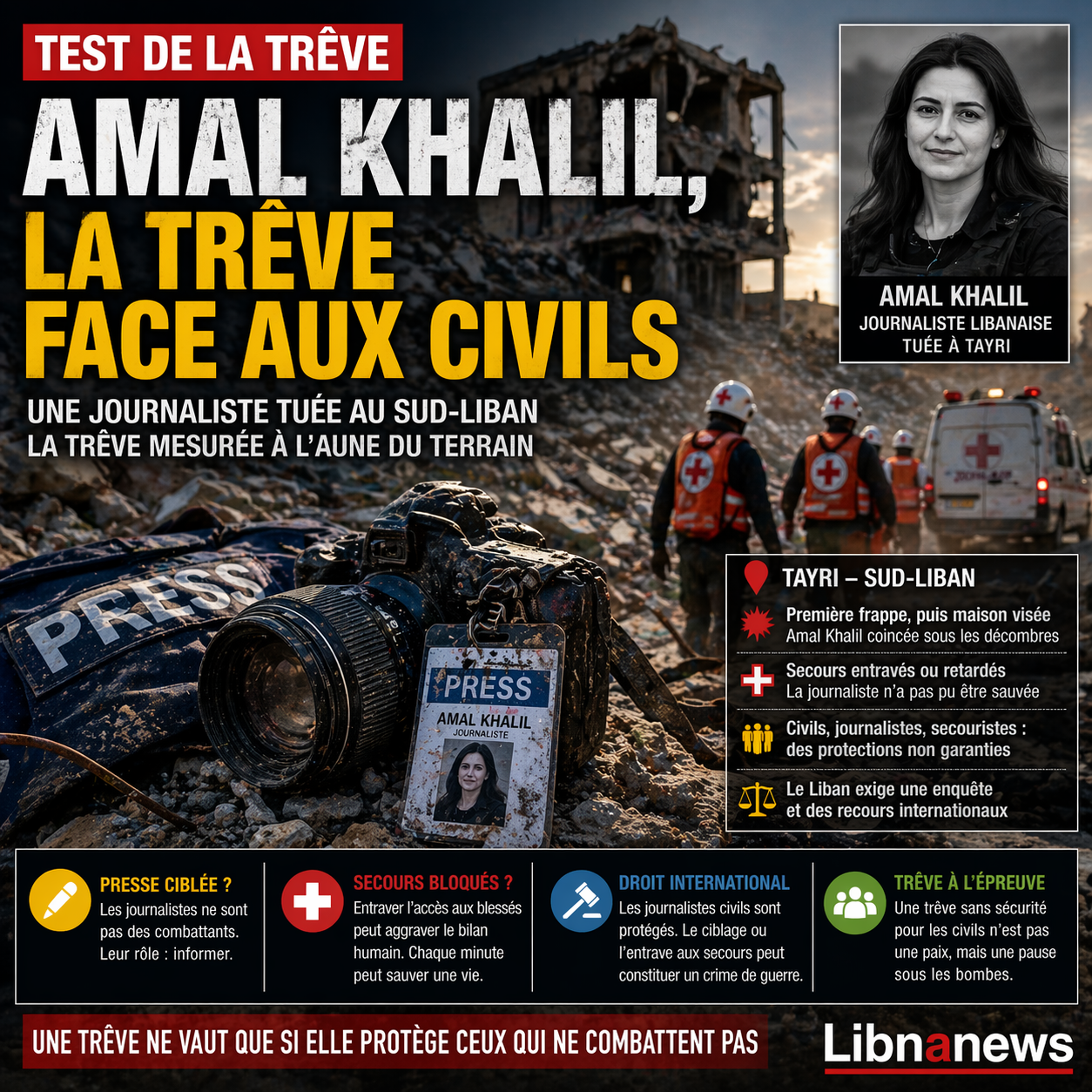
The death of Lebanese journalist Amal Khalil is shifting the debate on the truce. The ceasefire is no longer based solely on diplomatic communiqués, meetings in Washington or United States statements. It is now measured by the real protection of civilians, journalists, relief workers and people living in the South. A truce that lets a journalist die under the rubble, after a strike and in a context where relief was reportedly obstructed, cannot be presented as a mere technical step towards a settlement.
A journalist killed in the heart of the South
Amal Khalil covered the situation in southern Lebanon when the attack took place near Tayri. She was with a fellow photographer. Both women documented the consequences of previous strikes. According to the information reported in the press kit of 24 April 2026, a first strike hit a nearby area. The two journalists then took refuge in a house. The building was targeted in turn. The photographer was injured. Amal Khalil was stuck under the rubble.
The sequence has become a national symbol. It combines several elements that go beyond the individual drama alone. The victim was a journalist. She worked in the field. It covered a hit area. She would have been threatened before. Relief was reportedly delayed or prevented from reaching the site of the attack quickly. These elements transform the death of Amal Khalil into a political, legal and diplomatic record.
The question is no longer limited to how the truce can be extended. It becomes more precise: does a truce make sense if journalists cannot cover its violations? Can it be credible if rescuers cannot reach the wounded? Can it open a peace if it does not protect first those who document war?
The truce in the face of his first moral test
Washington is pushing to turn the ceasefire into a political process. The White House wants to go fast. Donald Trump announced a three-week extension. He wishes to receive Joseph Aoun and Benjamin Netanyahu during this period. American language speaks of agreement, possible peace and diplomatic window. But the death of Amal Khalil imposes another vocabulary. It brings the discussion back to facts, victims and rules of war.
The truce is not just a stoppage of fire between the armed forces. It must create a space where civilians breathe. It should allow families to travel, rescue workers to intervene, journalists to check and residents to know what is happening in their villages. If this space does not exist, the word truce becomes weak. It only covers part of the real.
Amal Khalil dies precisely in this gap. On the one hand, diplomats talk about extension. On the other hand, the terrain remains dangerous. The South remains marked by strikes, destruction, displacement and fear. His death shows that the truce cannot be validated by advertisements. It must be proven by the real reduction in the risk to civilians.
Journalism as a target or as a witness
The status of journalist gives this case a special significance. War reporters are not fighters. Their role is to document, verify, collect testimonies, photograph, film and transmit. Their presence sometimes disturbs armies, as it makes the effects of military operations visible. But this embarrassment cannot become a motive for targeting or intimidation.
In conflict zones, the journalist often plays the role of the last independent witness. It shows the houses destroyed, the roads cut off, the displaced families, the funerals, the overcrowded hospitals and the relief services under pressure. Without this work, war becomes more opaque. Official versions occupy all space. The victims are losing their voice.
The death of Amal Khalil thus affects an essential freedom. It is not just about the profession. It concerns the right of the public to be informed. It also concerns the possibility for Lebanon to document what it is suffering. In a conflict where each camp produces its own story, the presence of journalists on the ground remains decisive. It makes it possible to challenge denials, verify destruction and prepare possible legal files.
Rescue in the center of the charge
The most serious point, beyond the strike itself, concerns access to the rescue. Several reports indicate that the arrival of rescue teams would have been hampered. This question changes the scale of the file. In armed conflict, preventing or delaying access to the wounded can directly aggravate the human impact. Every minute counts under the rubble. Every delay reduces the chances of survival.
First aid workers, medical teams and the Red Cross must be able to act. Their mission is not part of a camp. It is the protection of life. When access is impeded, violence is no longer limited to the initial strike. It continues after the attack. It weighs on the wounded, families and field teams.
In the case of Amal Khalil, this dimension gives a new burden to the case. It is not just a journalist killed during an operation. It is a journalist who could have been rescued earlier if access had been guaranteed. The investigation will have to establish the facts accurately. But, politically, doubt is already enough to weaken the credibility of the truce.
A case that requires the State to act
The Lebanese government cannot treat this death as a mere episode of war. It must document, qualify and bring it before the competent authorities. The official word has already referred to war crimes and international remedies. This path must be structured. It involves evidence, testimonies, images, medical reports, geolocation data, schedules and elements on emergency access.
The state must also protect other journalists. This implies clear protocols for hazardous areas, coordination with international bodies, continuous documentation of attacks against the press and firm communication with mediators. Lebanon cannot only demand a truce. It must require that this truce include guarantees for professionals who cover the ground.
This requirement must be part of the Lebanese mandate in any discussion in Washington. The protection of journalists should not be an annex. It must be a central indicator of the sincerity of the ceasefire. If journalists cannot work, then no one can verify whether the truce is respected.
Washington facing a contradiction
The United States wants to push diplomacy. They want to present the extension of the truce as an advance. But the Amal Khalil case puts Washington before a contradiction. How can we speak of rapid peace if the minimum conditions of protection are not guaranteed? How can we ask Lebanon to move forward politically if the ground continues to cause deaths among civilians and journalists?
The White House must therefore do more than convene delegations. It must obtain practical commitments. These commitments must cover the cessation of strikes, access to relief, the safety of journalists and the prohibition of destruction in villages. Otherwise, American mediation may be perceived as unbalanced.
The problem is also language. To say that Israel can defend itself, while calling for caution, is not enough. Lebanon needs verifiable safeguards. Journalists need secure access areas. First aid workers need corridors of intervention. Families need to know that the bodies and wounded will not remain under the rubble for hours.
Professional Anger Becomes Public Anger
The meetings of journalists after the death of Amal Khalil show that the profession does not want to let the matter dissolve in the rhythm of diplomatic announcements. The portraits of the journalists killed, appeals to the courts and requests for international remedies give the mobilization a collective reach. It’s not just a grief. This is a refusal of impunity.
The anger of journalists joins that of the families of the South. Some ask for the right to cover. Others ask for the right to live and return. The two requests come together. Without journalists, destruction remains less visible. Without inhabitants, villages become war zones emptied of their lives. The truce must therefore protect both those who live and those who testify.
This mobilisation can also influence the state’s position. The more public the file becomes, the more difficult it becomes to reduce it to an incident. The authorities will have to carry it in international discussions. They will also have to report on their actions. The Amal Khalil case thus becomes an institutional follow-up test.
International law as a battlefield
International humanitarian law protects civilian journalists performing professional missions in conflict zones as long as they are not directly involved in hostilities. This protection does not give them superior status to other civilians. She recalls above all that they cannot be targeted because of their work. It also requires the parties to the conflict to respect the principles of distinction, precaution and proportionality.
This legal basis gives Lebanon a tool. It enables a file to be structured around the protection of civilians and the press. It also links the Amal Khalil case to other reported attacks against journalists, relief workers and civilian infrastructure. The goal is not just to denounce. It is to build a chain of responsibility.
The Security Council has already affirmed the need to protect journalists in armed conflicts. Specialized international organizations also monitor attacks against media professionals. Lebanon can therefore place the case in a broader context. He must avoid the death of Amal Khalil being treated as an isolated event. It must become a play in a documented file on the conditions of the war in the South.
The South as a space of disputed truth
South Lebanon is not only a military theatre. It is also a space where truth is disputed. Each strike gives rise to competing versions. Every destruction can be justified, denied or minimized. In this context, journalistic work becomes crucial. It allows you to fix places, dates, names, images and consequences.
Amal Khalil was one of those who worked in this dangerous space. His death recalls that field journalism exposes to extreme risk. It also recalls that war zones are not only dangerous because of weapons. They are also because the witness sometimes becomes an embarrassment.
The protection of journalists must therefore be integrated into the truce mechanism. It is not enough for the armies to speak to the mediators. We need clear rules for the press. We need public commitments. There must also be an immediate response to violations. Without these guarantees, the ground will remain opaque and the truce will remain unverifiable.
A direct impact on negotiations
The death of Amal Khalil reinforces the Lebanese position on a specific point: no serious negotiation can ignore the protection of civilians. The Washington issue cannot be limited to weapons, the border and security arrangements. It must include journalists, relief workers, villages, displaced persons and conditions of return.
For Beirut, this matter must become a requirement. Any extension of the truce must include a mechanism to investigate serious incidents. It must also provide guarantees for humanitarian access. It must clarify the parties’ responsibility in the event of strikes against identified civilians. Finally, it must integrate press protection into international monitoring.
This approach can strengthen Lebanese diplomacy. It moves the debate from mere Israeli security to human security in Lebanon. It obliges mediators to look at the ground. It also gives Joseph Aoun and Nawaf Salam a central argument: the truce has value only if it protects those who do not fight.
A truce to be rebuilt by evidence
Trust will not come back by declaration. She’ll come back with evidence. The people of the South must see the attacks stop. Relief must be unhindered. Journalists must be able to work without being threatened. Families must be able to bury their dead, recover their wounded and return to their villages.
Amal Khalil becomes the name of a test. If her death is documented, carried and monitored, she can reinforce the Lebanese demand for guarantees. If absorbed by the diplomatic flow, it will become the symbol of a truce that speaks of peace while letting the land produce victims. The choice now lies with Lebanese institutions, mediators and international bodies.
The three-week period required by Washington must therefore be read from Tayri as much as from the White House. The American calendar will only make sense if the security of civilians becomes verifiable. The truce cannot be defended unless it protects journalists. Peace cannot be credible if it begins with forgetting those who died trying to show war.






