

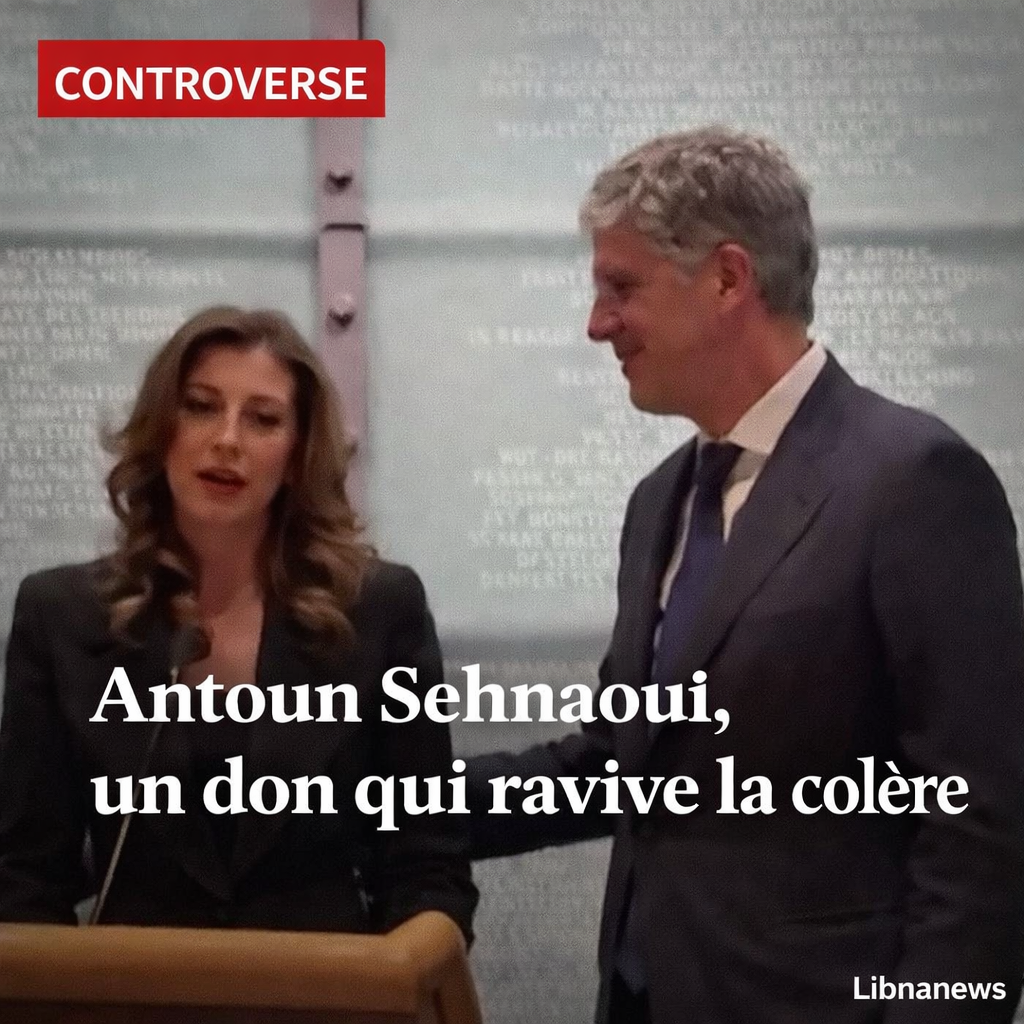
The controversy was not the result of a rumour, but of a carefully assumed public scene. On Tuesday, 14 April, Antoun Sehnaoui himself announced that he had attended the Days of Remembrance ceremony of the United States Holocaust Memorial Museum in Washington, D.C., with Morgan Ortagus, where their inscription on the Donors Wall was unveiled. In absolute terms, the fact could be a matter of traditional memorial patronage. In Lebanon, it was received quite differently. Because Sehnaoui is not an anonymous benefactor, but one of the best known figures in the banking sector since the collapse of 2019. Because Morgan Ortagus is not a neutral guest, but an American official identified on a hard line against Hezbollah and very favourable to Israel. And because the scene comes as Israel continues to bomb Lebanon daily, while Washington pushes direct negotiations between Lebanese and Israeli leaders. On social networks as in part of the public debate, this gift was therefore not read as a mere gesture of memory, but as a symbol of double standards that became unbearable for many Lebanese.
A public gesture, in a politically flammable moment
The first point to recall is simple. The museum concerned is an American memorial dedicated to the Shoah, not an institution of the State of Israel. Legally and factually, this distinction counts. It avoids easy amalgams. But it did not prevent the controversy, because it is not just about the nature of the recipient institution. It focuses on the moment chosen, the identity of the protagonists and the symbolic burden of the scene. The museum states that the inscription on its Donors Wall corresponds to donations of at least $50,000. For his part, Sehnaoui claimed the gesture by explaining that he supported the work of the institution. A media source also noted that this was the first appearance of a Lebanese name on this donor wall. In a country where every public sign is reinterpreted through war, money and international loyalty, these details are enough to turn a donation into a political affair.
What has set the powders on fire is also telescoping with regional news. On the same day, Lebanese and Israeli representatives in Washington held direct discussions that had been unheard of for decades under American pressure, as Israel continued its offensive in Lebanon. Reuters reported on Wednesday that the war had already left more than 2,000 people dead and 1.2 million displaced in Lebanon, according to the Lebanese authorities. AP described, at the same time, new Israeli strikes on the south of the country, including around Tyre, the very day after these discussions. In this context, part of Lebanese opinion has seen in the Sehnaoui-Ortagus sequence not a philanthropic parenthesis, but the image of a proximity deemed displaced with American and pro-Israeli circles while the bombs continue to fall on Lebanon. This reading is political, not judicial. But it is she who structures the controversy.
Morgan Ortagus changed the meaning of the image
Morgan Ortagus’ presence turned the episode. Without it, the gesture would probably have aroused criticism, but probably not with the same intensity. Ortagus was, under Donald Trump, one of the most visible American voices on the Lebanese file. Reuters already recalled in February 2025 that it was laying the « red line » of Hizbullah’s presence in the Lebanese government. In April 2025, the same agency reported that it called for the rapid disarmament of Hezbollah and other armed groups. His name is therefore associated, in part of Lebanese opinion, with a vision that is very aligned with Israeli and American regional security priorities. It appeared in Washington in the arm of a great Lebanese banker, in a highly charged memorial ceremony, during discussions on Israel and Lebanon, immediately conferred on the image a geopolitical dimension.
The controversy has grown even more because of what Ortagus himself said. A media source reported that she had described Sehnaoui and her family as « generations of Lebanese Zionist Christians, » who she had said were proud of her gesture and that she had even suggested that he take a personal risk by publicly supporting the Jewish people. The same source points out that she presented the gesture as « technically illegal » under Lebanese law, while stating that a donation to an American museum is not, in itself, automatically illegal. It was precisely this mixture of assumed provocation, emotional proximity and political subtension that ignited the comments. Since Wednesday, the word « Zionist » returns everywhere around the name of Sehnaoui. This is not a neutral qualifier in Lebanon. It is a highly conflicting marker, especially in a country that remains formally hostile to Israel and where many still regard Israel as an enemy, even more so as the Israeli army bombards Lebanese territory daily.
The personal link between Ortagus and Sehnaoui is moreover more treated as a mere rumor. Carnegie wrote in January 2026 that the relationship between the two raised issues of conflict of interest around the international mechanism linked to the ceasefire between Lebanon and Israel. The same media source quoted above confirmed on Wednesday that their common appearance attracted even more attention as it intervened after months of speculation about their relationship. In the current sequence, Morgan Ortagus does not appear as a discreet companion. It appears to be an American political figure, favoring Israel, formerly in charge of the Lebanese case, now linked to one of the country’s most disputed bankers. It is this superimposition of roles that gives the case a scope far beyond privacy.
Bank liabilities immediately resurfaced
If Sehnaoui’s name triggers such an immediate reaction, it remains closely linked to the Lebanese banking crisis. On his own site, he presents himself as Managing Director of the SGBL and investor in several sectors, including the media. In the opinion, however, it also embodies a banking system accused since 2019 of having effectively frozen the access of depositors to their funds in foreign currency. Reuters recalled in March 2022 that the crisis had deprived most savers of normal access to their dollar deposits. In the same year, a London court ordered Bank Audi and SGBL to pay $4 million to a depositor whose money remained blocked in Lebanon. This dispute has struck the minds because it has given a concrete judicial form to an already immense anger in Lebanese society. It was this memory that came up suddenly when the images of Washington appeared.
For many applicants, the contrast is brutal. On the one hand, a large Lebanese banker can have his name recognized among the donors of a leading American institution. On the other hand, thousands of savers continue to associate the Lebanese bank with the confiscation, arbitrariness and erasure of their economies. It is this moral gap that feeds anger. On networks, reasoning comes back in a thousand forms: how can a man representing one of the country’s largest banks display a prestigious gift in Washington when so many Lebanese have never freely recovered their money? This question does not prejudge a personal criminal offence. It says something else: a break in legitimacy. In Lebanon after-2019, international philanthropic money is reread through the blocked money of depositors. And this rereading is enough to load the gesture of considerable symbolic violence.
Old transfers, investigations and suspicions are also
Anger is not just social. It also feeds on judicial and media liabilities. Reuters reported in March 2022 that a Lebanese judge had banned several bank leaders, including Antoun Sehnaoui, from travelling in the course of bank transaction investigations. The agency made it clear that no criminal charges had been laid against them. This precision is essential. It prevents it from writing that Sehnaoui was reportedly convicted for illegal transfers abroad. On the other hand, it does not erase the fact that it was indeed targeted by investigative measures in a climate of widespread suspicions about bank management during the crisis. For opinion, the legal nuance exists. But it often weighs less than the accumulation of controversies. In the Lebanese public space, the idea of a banker permanently surrounded by suspicions has long been established, even where justice has not established a definitive truth.
This is also why the Washington sequence reactivates so much archive, old articles and old accusations. As soon as a new episode breaks out, the whole Sehnaoui case comes back to the surface: disputes over deposits, past investigations, suspicions of irregular operations, judicial battles, proximity to the political world and the place taken in several sectors of power. The current controversy is therefore not an isolated controversy. It is a controversy-reservoir, which aspires to old grievances and recomposes them around a recent image. In this sense, the gift to the Washington Museum acts less as the sole cause of the scandal than as its visual trigger. He provides his detractors with the symbol they lacked to reaggregate angers that have been installed for years.
The battle over the media weighs in reading the moment
The other important aspect concerns the media. A report on the financing of the Lebanese press cites Ici Beirut and IM Lebanon among the platforms funded by Antoun Sehnaoui. This point counts, because he makes him much more than a bank actor. He also makes it, in the eyes of many, a man who has tools of media influence in a country where information is itself a political battlefield. The subject is not whether these media belong to him legally in the strict sense of the term, but whether a specialised report presents them as financed by him. In the current climate, this data feeds a simple idea: Sehnaoui would not only be protected by its bank and networks, but also by a capacity to weigh on public narrative. This reinforces the resentment generated by its international visibility.
To this dimension is added the series of complaints against journalists and media investigating the banking sector. A human rights organization reported in April 2025 that Sehnaoui had filed a second complaint against journalist Ramy al-Amin. OCCRP, taken over by Skeyes, detailed complaints against Daraj following investigations into the bank’s relations with the former Governor of the Bank of Lebanon, Riad Salamé. For its part, the International Federation of Journalists referred to the prosecution of more than ten journalists from several media in cases related to reports on SGBL and the banking sector. Whether these complaints are considered legitimate, excessive or intimidating, their political effect is clear: they reinforce the image of a powerful man, accustomed to defending his position on the judicial as well as the media. In the current controversy, this image plays a full role.
Trump, Washington and the image of proximity to US power
Another element that comes back in loop in the comments: its closeness displayed with Donald Trump and, more broadly, with the American Republican entourage. On his own networks, Sehnaoui publicly congratulated Trump on his victory in November 2024 and launched a « Make Lebanon great again » that marked the minds. This alone is not enough to establish documented funding for the Trump campaign in the sources consulted here. On the other hand, it does establish an assumed and visible political affinity. In the Lebanese context, this detail weighs heavily. It reinforces the image of a man already connected in Washington, already familiar with the codes of trumpism, and now shown alongside Ortagus in an American memorial ceremony as the United States oversees discussions between Lebanon and Israel. This accumulation of signs feeds a perception of proximity to American power circles, whether diplomatic, political or worldly.
This perception is further reinforced by the fact that Ortagus is not a secondary figure in the trompist ecosystem. Reuters presented her in 2025 as the US deputy envoy in charge of the Middle East and the first senior official of the Trump administration to come to Lebanon after Joseph Aoun’s election. His speech on Hezbollah, his constant defence of Israeli security priorities and his visibility in Washington are part of a well-identifiable camp. Hence, its relationship with Sehnaoui and their common appearance move the gaze: the controversy no longer concerns only a banker in difficulty of image. It affects the way in which some of the Lebanese elites are perceived to be connected to international networks that do not live the Lebanese war from the same point of view as the Lebanese street. This is also why comments speak of a « world apart », detached from the fate of the depositors and the experiences of the families bombed.
Why the word « Zionist » came back so fast
The term itself is not new, but it crossed a threshold Wednesday because it was pronounced in the video and then resumed at very high speed in the reactions. A media source reported that Ortagus had described Sehnaoui and her family as « Zionist Lebanese Christians » and that she had presented her gesture as evidence of moral clarity. In the Lebanese debate, such a word acts as a detonator. It turns a controversial donation into a positioning test. Some Internet users and opponents use it to portray it as ideologically aligned with Israel. Others, on the contrary, see it as a revealing of what they consider its ancient orientation. None of this is a judicial finding or official political definition. But it would be artificial to pretend that the word had not changed the sequence. He offered the polemic his most explosive formula and his most immediately mobilizing framework.
Again, the context explains everything. In a country hit almost every day by Israeli bombardments, where more than 2,000 deaths have been recorded since the start of the current offensive, according to the Lebanese authorities, the lexicon of the report to Israel did not abstract. It affects war, mourning, sovereignty and collective memory. Many Lebanese can very well distinguish, in theory, an American museum from Israeli politics. But when the image shows a great Lebanese banker, a pro-Israeli American diplomat, a public gift, and words valuing his support in the midst of war, this distinction is politically crushed. This explains why many Lebanese people found the gesture not only questionable, but also inappropriate or even insulting, in view of the national moment.
A case that goes beyond the Sehnaoui case
In essence, the violence of the reaction lies in the fact that the case concentrates several Lebanese injuries in a single image. There is the wound of depositors, who see the face of a great banker come back when their own money remains, for many, trapped in the system. There is the wound of the war, as Israeli strikes continue in the south and Washington-sponsored discussions deeply divide the Lebanese scene. There is also the wound of distrust of elites, perceived as capable of re-establishing an international stature as the country continues to collapse. The gift of Washington did not create these fractures. He made them visible in a single sequence, readable by all, immediately shareable and almost impossible to demine.
This is why the current controversy is not simply a temporary indignation on networks. It touches on something deeper: the legitimacy of a man to be able to publicly represent a moral, generosity or risk-taking, while a large part of the country associates him first with the bank, frozen deposits, trials against journalists and claimed proximity to American figures who are very hostile to the « resistance » camp. This judgment is a political, social and symbolic judgment. But in Lebanon today, it often weighs heavier than a procedural defence. And as long as the Israeli bombing continues, as long as the depositors remain without a just solution and as long as Washington appears both as a mediator and as Israel’s support, every such gesture will be read as much more than an act of patronage.






