

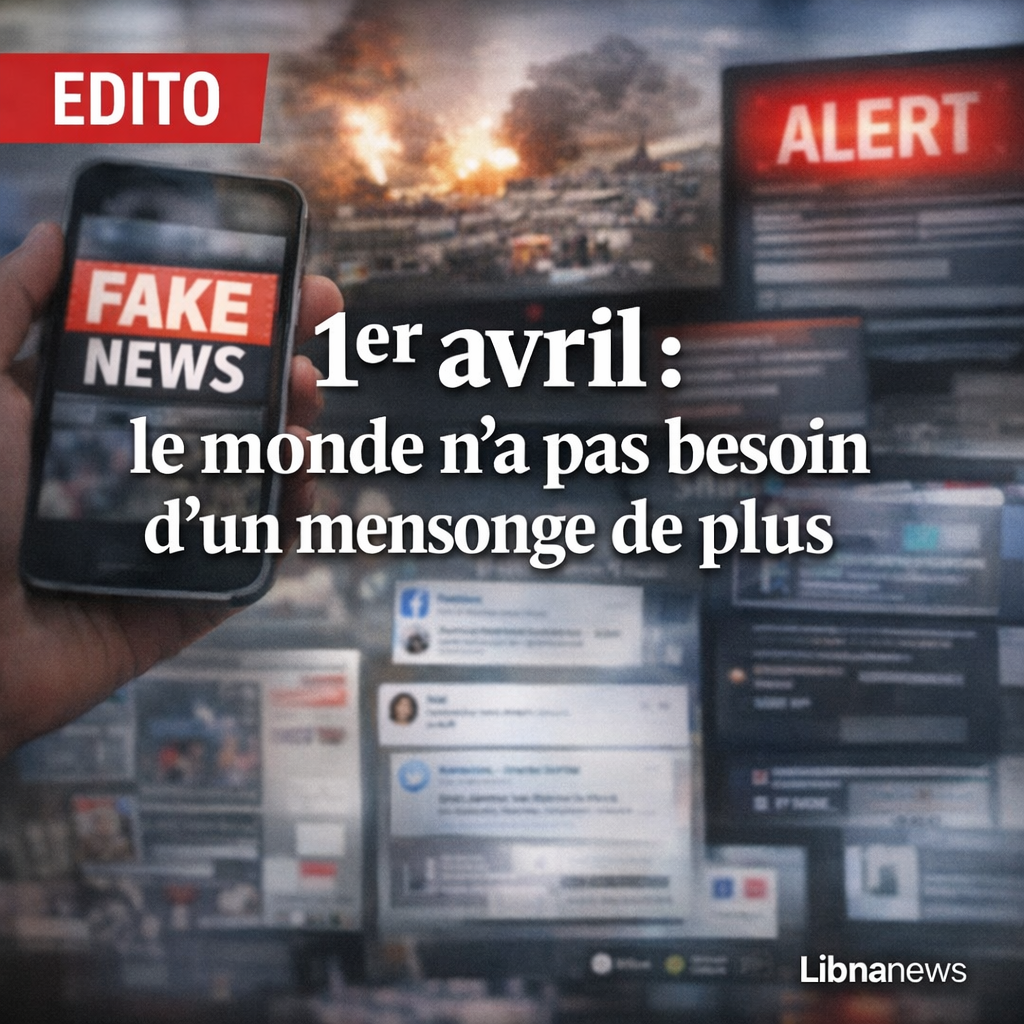
Tomorrow, the calendar will appear on April 1.
In ordinary times, the date allows winks, false harmless titles, potash traps and jokes without consequence. But the world is not in an ordinary time. On the contrary, it passes through a sequence where the border between the real, the false, the inconceivable and the manipulated becomes more blurred every day. In such a moment, April 1 ceases to be a slight parenthesis. It’s almost a tone mistake.
Because you have to face reality. The Middle East is living at the pace of strikes, responses, displacements, upsurges, sluggish markets and sluggish diplomacy. The UN warns about the loss of life, about poverty, about the erasure of a year of growth in the Arab world, while social networks pour into the same stream of rigged videos, recycled images, rumors of invented deaths, false attacks and false military triumphs. Reuters has thus had to deny in recent weeks several contents presented as evidence of Iranian strikes or destruction in Israel, when they were either videos generated by IA or images taken out of context.
The problem is no longer that of organised misinformation. It is also that of collective fatigue of verification. When news becomes too heavy, too fast, too anxious, some of the public no longer seeks evidence. She seeks confirmation of what she already fears, or what she hopes to hear. That’s where the fake thrives. He doesn’t win because he’s perfectly credible. He wins because he arrives at the right time, in the right format, with the right emotional spring. Reuters recently recalled that experts in digital forensics had probably thought IA generated a video presented as an Iranian missile dam on Tel Aviv. The fake didn’t need to be impeccable. It just seemed plausible for a few hours.
In this context, making jokes tomorrow would not only be inappropriate. That would add noise to an already dangerous noise. Confusion is no longer a side effect of war. It has become one of its grounds. The Associated Press reported this week that the war with Iran shows how much digital combat is now embedded in the real fight, with cyberattacks, espionage, intoxication and content intended to sow fear or erode confidence. Manipulation no longer comes after the bombs. She’s with them.
A time when the fake moves at the speed of the shock
The first drama of this time was speed.
In the past, a lie needed a solid relay, a complacent media, a militant channel, a propaganda apparatus or a network already formed. Now, a few accounts are enough. A spectacular image, a vaguely credible logo, anxiogenic music, a pretty clean montage, and the fake goes around the phone before the real one even started his work. This shift changes everything. It not only weakens editorials. It weakens the intimate perception of reality.
In recent conflicts, and even more so in the current regional escalation, misleading content takes several forms. There are the old recipes, always effective: archive images come out as if they were new, videos of another country renamed as an emergency, inflated numbers without source, caught screenshots. And then there’s the new generation of the fake: sequences created from all parts by AI tools, with fires, missiles, buildings hit, panicked crowds or supposedly dead heads of state. In particular, Reuters had to verify rumours of the death of Benyamin Netanyahu, fed by Iranian media and relayed online, before the Israeli leader appeared publicly to cut short.
What makes the situation even more serious is that the fake does not even need to be believed by all to produce its effects. All he has to do is sow doubt. Doubtful content can be shared in case you want to. A blurred video can be relayed because it’s never known. A grotesque rumor can survive because, after all, anything is possible. The poison’s here. It not only destroys accurate information. It destroys the very reflex of prioritizing, waiting, comparing and overlapping. A society that loses this reflex becomes vulnerable to everything.
The Reuters Institute has been highlighting this for months: the year 2026 confirms that AI, deepfakes and disinformation are now a structural challenge for journalism and public space. This is no longer a marginal subject for digital specialists. It is a central issue for civic trust.
April 1st falls at the worst moment
April 1st is based on an implicit pact: everyone knows, basically, that it is a game. The joke works because it intervenes in a common space where the basic reality remains solid. We can trap nicely, because the general framework is stable. But what remains of this pact when news is saturated with false missiles, false balance sheets, false deaths, false victories, false press releases and real panics?
Tomorrow, a false humorous title on a strike, a false diplomatic statement, a false security alert or a false departure of public personality would not fall into a playful vacuum. It would fall into an already flammable ecosystem. It would be read too quickly, shared without hindsight, captured out of context, sometimes translated, diverted and reinjected elsewhere without mentioning the initial joke. A local joke could become a global misinformation in less than an hour. That’s the novelty. On 1 April digital is no longer that of paper newspapers. It is that of unoriginated screenshots and unreturned sharing.
The moment is all the more ill-chosen as the emotional economy of current affairs is already saturated. On Tuesday, UNDP estimated that the escalation in the Middle East could cost Arab countries up to $186 billion in one month, with millions of jobs threatened and millions more people exposed to poverty. The United Nations, for its part, has also raised the tone on the safety of peacekeepers and on the seriousness of regional developments. In such a climate, the joke does nothing. She’s parasitic.
What this interference means must be measured. When families seek to know if a road is open, if a neighbourhood has been hit, if a relative is alive, if an evacuation is real, if a curfew is confirmed, if a flight has been cancelled, if a school will reopen, the false one is not insignificant. It can waste time, cause panic movements, expose civilians, harden hatreds or ruin reputations. There are days when irony has its place. But there are also days when public space needs to be cleaned, not cluttered.
Humor is not the problem, the time is
You have to be fair: the problem is not humor in itself.
A society that no longer laughs becomes ill. The problem is the context. A joke isn’t just what she says. It is also the environment in which it falls. But the current environment is one of the most volatile in recent years. Between regional war, competing propaganda, economic tensions, cyber attacks, political polarizations and industrial production of false content, the terrain has never been so badly prepared to host topical hoaxes.
Even politicians and armies are evolving in this grey area. Reuters reported in mid-March that Donald Trump accused Iran of using artificial intelligence as a weapon of misinformation to distort the perception of war. Whether or not we adhere to this formulation, it shows one thing: the battle of narrative has become a strategic issue recognized by the states themselves.
In other words, lies are no longer just a slippage of margins. He’s in the center. It is embedded in doctrines, in communication channels, in militant reflexes, in the instant consumption of news. Therefore, each additional actor who adds a fake, even to laugh, contributes objectively to the same fog. The intention does not erase the effect. A false humorous news has not the same objective as a hostile manipulation. But on a saturated social wire, propagation mechanics can become very close.
There is also a simpler moral reason. Many people today live with a phone in their hands as one once held a transistor in wartime: to know, minute by minute, where the danger is. In this context, the hoax is no longer received as a collective game. It is received as an intrusion into a real anguish. A relaxed opinion and a nervous population are not trapped in the same way.
The real job tomorrow will be to slow down.
The best service to the public tomorrow will not be to be funny at all costs. It will be clear.
Clear on what we know.
Clear about what we don’t know.
Clear about what is involved in testimony, rumor, propaganda, verification or uncertainty.
This applies to the media, of course. But it also applies to everyone. Don’t share too fast. Don’t catch a joke to get her out of context. Don’t post a fake screen because it’s well done. Do not relay a spectacular video before checking its origin. Do not confuse speed with information.
This slowdown is not naive. On the contrary, it is a civic act. In an era of flux, checking becomes a form of resistance. Waiting ten minutes before sharing is sometimes avoiding ten thousand mistakes. Search for the first source, look at the date, spot visual inconsistencies, compare with reliable media, beware of anonymous accounts that appeared the day before: these simple gestures are nothing heroic, but they reconstruct a minimum of common reality.
Perhaps the most worrying thing is not that there are many fakes. Times of crisis have always produced them. The most worrying is that the emotional boundary between true and false weakens. Content sometimes seems to us to be true because it looks like our fear of the moment. A democracy, an open society, a country in crisis or a region at war cannot last long if the feeling replaces the evidence.
There are dates that require restraint
April 1 must not be prohibited by moral decree.
But it can be looked at with maturity. And this year, maturity requires restraint. Not only out of respect for the dead, for the wounded, for the displaced, for those waiting for a new check. She also commands it by lucidity. The global public space is no longer stable enough to withstand without damage an entire day of false assumed against the backdrop of real disasters.
What is missing most today is not humor.
That’s not the comment either.
Trust.
And trust is not rebuilt with one more lie, even signed with a wink. It is reconstructed with just words, facts held, patient checks and a form of collective discipline in the face of vcarm.
Tomorrow, the best fish of April would be to make none. Not through austerity. But because a world already drowned in intoxication, staging and fake shrapnel does not need to be added, to laugh, one more drop to the fog.






