

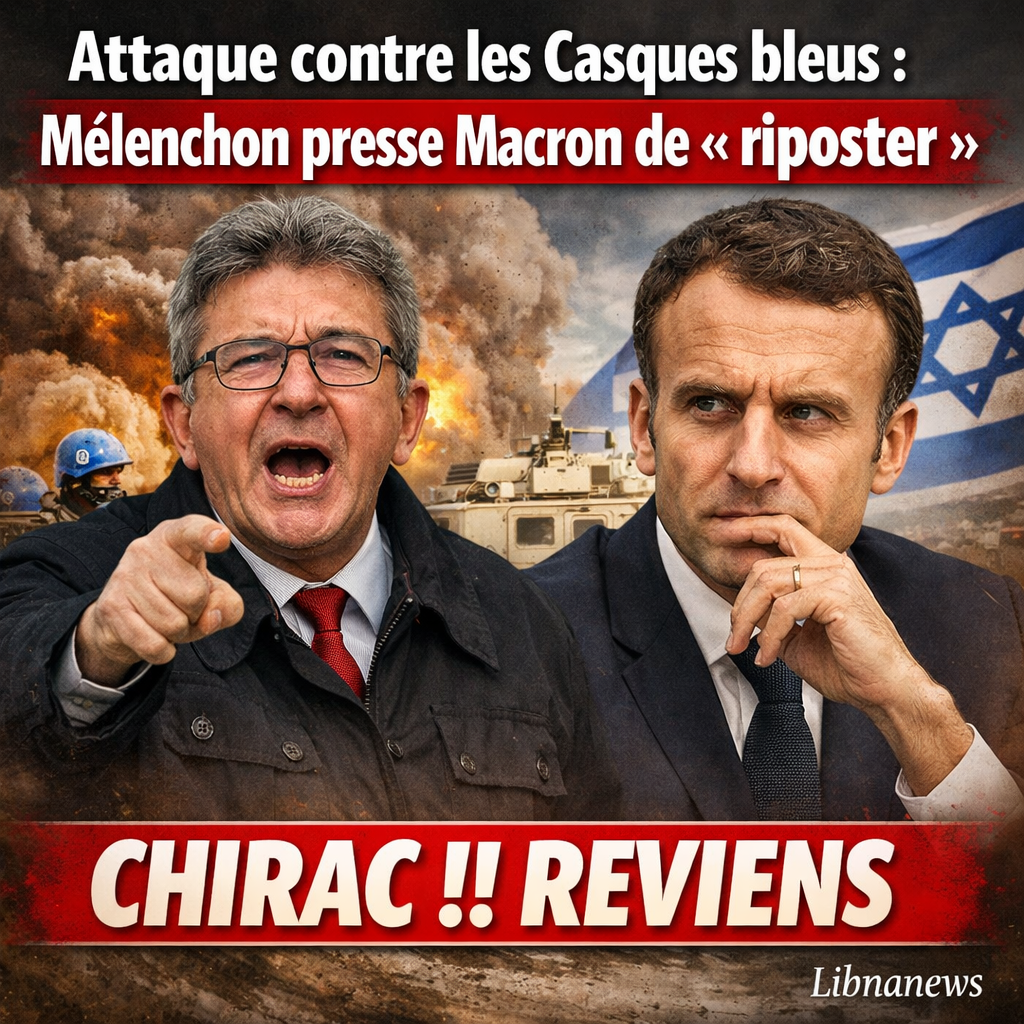
After the attacks that cost the lives of three UNIFIL peacekeepers in Lebanon in less than 24 hours, Jean-Luc Mélenchon chose the verbal auction. On X, the leader of La France insoumée directly called Emmanuel Macron: « Recall to Macron: Chirac doctrine when shooting a French man under blue helmet, the French respond. He added: « Otherwise Netanyahu will start again. This position comes at a time when France has already requested an urgent meeting of the UN Security Council and the exact circumstances of the two incidents remain under investigation.
A declaration of rupture in a high voltage moment
The release of Jean-Luc Mélenchon takes place in an extremely tense regional context. According to Reuters, two peacekeepers were killed on Monday in the explosion of a vehicle near Bani Haiyyan, in southern Lebanon, after another peacekeeper died in a separate incident the previous day. The UN reported that the origin of the explosion remains unknown in one case, while an investigation is under way into the entire sequence. The head of United Nations peacekeeping operations recalled that peacekeepers should never be targeted.
It is in this context that Mélenchon chose to use the register of the « response ». His message does not describe an existing French decision. He issued a political injunction to the President of the Republic, invoking an alleged « chirac doctrine ». In the state of information available, France did not announce military action in response to the attacks against UNIFIL. The official French line is diplomatic and multilateral: condemnation of attacks, demand for the protection of peacekeepers and referral to the Security Council.
Paris condemns, but remains on diplomatic ground
The reaction of Paris is firm, but it does not use Mélenchon’s vocabulary. The French Ministry of Foreign Affairs had already condemned in March the firing of UNIFIL soldiers and recalled that the protection of UN personnel should be guaranteed in accordance with international law and Security Council resolution 1701. After the deadly incidents this weekend, France requested an urgent meeting of the Security Council, indicating that it intends to internationalize the response rather than engage alone in a logic of retaliation.
This difference in tone is central. Where the French executive seeks to include the crisis within the framework of international law and the UN mandate, Jean-Luc Mélenchon proposes a reading based on deterrence by force. His message clearly targets Benjamin Netanyahu, whom he implicitly accuses of testing the limits of the French reaction. By writing « Otherwise Netanyahu will start again, » he suggests that the lack of a military response would encourage a repetition of attacks. But this hypothesis is a political judgment, not a fact established by the ongoing investigations.
A political controversy fuelled by emotion and ambiguity
The formula chosen by Mélenchon also raises an ambiguity. The peacekeepers killed in the incidents identified by Reuters were Indonesian, not French. His message, however, invokes the case of « a French man under blue helmet », which moves the debate towards a principle of general protection for French soldiers deployed under international mandate, more than towards the strict facts of recent hours. This gives its statement a political significance: it speaks less of the victims identified than of the posture France should adopt against Israel.
This shift is not insignificant. It allows France to place the Lebanese question in its broader accusation against Israeli policy and against Emmanuel Macron’s prudence. For several months, Jean-Luc Mélenchon has denounced what he has described as the lack of a Western response to Israeli operations in the region. His intervention on X continues this strategy of direct confrontation with the French executive.
International law requires the protection of peacekeepers
On the merits, there is little doubt about the seriousness of the case. France, the United Nations and several States recall that peacekeeping personnel enjoy special protection. The French Ministry of Foreign Affairs stresses that their security must be ensured in accordance with international law and resolution 1701, which, in particular, governs the arrangements in South Lebanon. For their part, the United Nations warned that attacks against peacekeepers could constitute serious violations of international law and, depending on the circumstances, war crimes.
It is precisely this legal basis that explains the current French reaction. By calling for an urgent meeting of the Security Council, Paris seeks to place the case within the framework of the international obligations of the parties to the conflict. This approach differs from an immediate national « response ». First, it seeks to establish responsibilities, protect UNIFIL and reaffirm the legitimacy of the UN mandate in an increasingly exposed South Lebanon.
Mélenchon pushes Macron on a terrain he didn’t choose
The political interest of the sequence is therefore due to this lag. Emmanuel Macron condemns, seizes the United Nations and stresses the stabilizing role of UNIFIL. Jean-Luc Mélenchon is trying to impose another framework: that of a France that should use force to restore its credibility. This is not just a comment on Lebanon. It is also a way of challenging the diplomatic doctrine of the executive and accusing him of weakness against Benjamin Netanyahu.
An essential fact remains: at this stage, the circumstances of the attacks against peacekeepers are not fully established. The UN investigates both incidents, and Reuters points out that the origin of Monday’s deadly explosion remains unknown. In such a context, Mélenchon’s request for a « response » takes the risk of anticipating the findings of the investigation at the same time as Paris, for its part, relies on fact-finding and international diplomatic pressure.
The contrast is therefore clear: on the one hand, an official France seeking to assert the right and responsibility of States before the Security Council; on the other, an opponent who wants to transform the emotion caused by the attacks on UNIFIL into a demonstration of firmness against Israel. In this battle of narratives, Mélenchon’s formula has already achieved its immediate objective: to move the debate from the field of inquiry to that of the response.






