

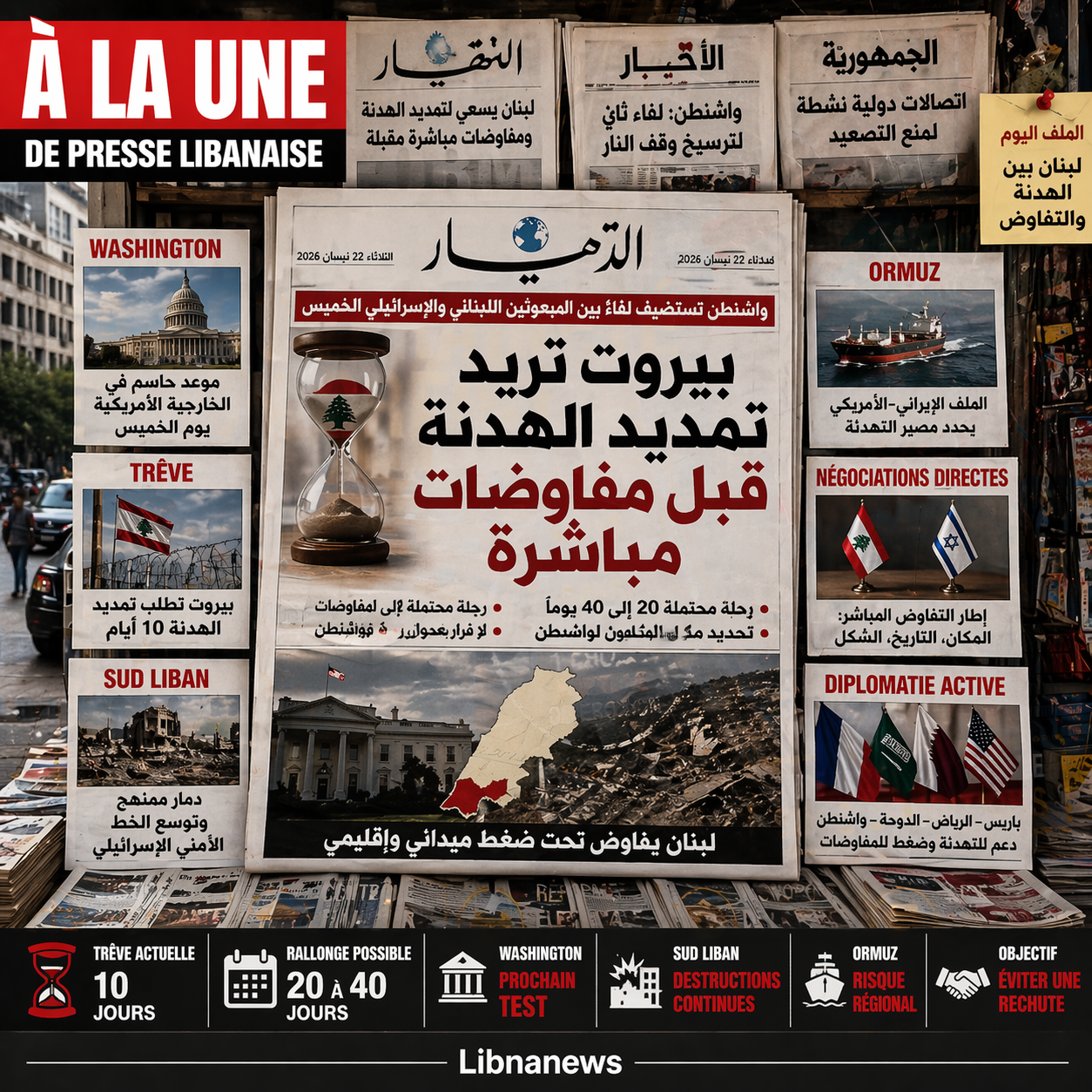
Beirut tries to pull a suspension before getting into the hard one
Official Lebanon is not yet seeking a settlement. He first seeks to avoid an immediate relapse into war. On the eve of a new meeting in Washington, the aim is to prolong the truce, contain the destructions in the South and delay as much as possible the entry into a direct negotiation whose tempo remains largely dictated from the outside.
Washington imposed as a compulsory passage
On 22 April, the front pages converge on a central point: Thursday, 23 April, the scheduled meeting of the State Department should focus on both the extension of the ceasefire and the preparation of direct negotiations between Lebanon and Israel. InAl Jumhouriaof 22 April 2026, official sources explain that Beirut will explicitly request an extension of the truce, while the place, calendar and form of the following sequence will be discussed. The daily newspaper evokes a possible extension of twenty to forty days.Ad Diyarof 22 april 2026 describes the same logic, with lebanese diplomacy mobilized to obtain an additional delay before the shift towards more direct talks.Al Sharqof 22 April 2026 fits in with this reading stressing that the maximum that Beirut can remove, at this stage, is a modified and strengthened version of the truce agreement.
This common denominator says the essential: Lebanese power is not moving towards Washington with the idea of a global compromise. He’s going to save time. The American meeting is presented not as the beginning of a crisis exit, but as an airlock. The priority for Beirut is to prevent an already fragile truce from collapsing even before the diplomatic phase is framed.
InNaharof 22 April 2026, Joseph Aoun’s formula is put forward almost as a doctrine: diplomacy is a bloodless war. She’s nothing ornamental. It serves to ensure that a politically heavy orientation is accepted internally. InAl 3arabi Al Jadidof 22 April 2026, this same line is described as an effort by the Presidency to present direct negotiation not as a concession, but as an instrument intended to stop attacks, Israeli withdrawal and the restoration of a form of state control over the South.
The South continues to be crushed as diplomacy advances
The problem is that the military scene has not really closed. InAl Quds Al Arabiof 22 April 2026, Israel is described as pursuing a systematic destruction of houses, neighbourhoods and infrastructure in border localities, after imposing what the newspaper calls a yellow line covering 55 municipalities and villages in the South. The newspaper insists on the sharp gap between the discourse of de-escalation and the reality of the terrain: the truce is discussed as demolitions continue.
Al Jumhouriaof 22 April 2026 goes in the same direction, but giving this contradiction a more direct political scope. The newspaper reports that Lebanese political circles believe that the state should make its participation in the Washington meeting conditional upon stopping the systematic dismantling of homes in the border area. The idea is no longer only that the war continues in deafness. It is that negotiations may be held under duress, while Israel produces new facts on the ground.
This tension is at the heart of the front page. Lebanon seeks to open a diplomatic sequence even though military logic has not receded enough to create a real stabilization framework. The destroyed villages, the displaced inhabitants and the continued security pressure in the South weigh on the credibility of the formal approach.
The fate of the Lebanese truce remains suspended in Islamabad
Daily newspapers do not read the Lebanese sequence as an autonomous file. InAl Jumhouriaof 22 April 2026, it is clearly written that the fate of the truce in Lebanon cannot be separated from that of the discussions expected in Islamabad.Ad Diyaron 22 April 2026, this idea is reiterated by explaining that the opening of direct negotiations between Beirut and Israel could still depend on an additional preparatory round, itself linked to the evolution of the dialogue between Washington and Tehran.
Al 3arabi Al Jadid22 April 2026 shows this articulation. The daily highlights the confusion surrounding Iranian participation in Islamabad, the contradictory messages from Washington and Pakistan’s difficulty in transforming the truce into a genuine political process. The reading is simple: if the American-Iranian folder derails, the Lebanese sequence can explode with it.
Al Akhbarof 22 April 2026 pushes this analysis further. The newspaper asserts that the case of the war against Lebanon remains at the heart of the American-Iranian trade and that Tehran informed the Pakistani mediator that it does not consider the current situation to be a genuine ceasefire. As long as there is no complete cessation of hostilities or immediate Israeli withdrawal, writes the daily, it is at best a unilateral truce. This position illuminates the extreme precariousness of the open parenthesis in Lebanon.
U.S. pressure already exceeds ceasefire issue
When reading several titles, Washington does not only seek to prolong the truce. The United States is also seeking to frame the content of the next phase. InAd Diyaron 22 April 2026, the US administration was presented in favour of a 20-day extension, but as part of a road map with concrete Lebanese commitments on the issue of arms. The newspaper also mentions the American insistence on the composition of the Lebanese delegation, which shows that Washington is not content to arbitrate the timetable: it wants to influence the political architecture itself of the negotiation.
InNaharof 22 april 2026 and inAl Sharqof 22 April 2026, this pressure appears in a more institutional form. Both newspapers highlight international support for the strengthening of the Lebanese army, the stabilization of the southern front and the restoration of the state monopoly. But behind this more diplomatic presentation, the message is the same: the discussion on the truce already opens up to the much more sensitive one of the relationship between the state and arms.
A precarious truce, an imposed calendar, a Lebanon under duress
The photograph of the day is clear. Lebanon is not moving towards a negotiated peace. It attempts to prevent the collapse of a precarious military pause before being pushed towards direct negotiation, which neither fully controls the pace nor fully controls the parameters. InAl Jumhouria,Ad Diyar,Nahar,Al Sharq,Al Akhbar,Al Quds Al ArabiandAl 3arabi Al Jadidon 22 April 2026, the differences of tone exist, but the final observation is joined: Beirut is moving towards Washington with an ever ravaged South, a narrow margin of manoeuvre and a regional equation capable, at any time, of flying the truce into bursts.
The negotiation debate becomes a major test for the state
In Lebanon, the issue is no longer just military. It has become institutional and political. Who negotiates, with what mandate, how far, and in the name of what? Behind the Washington sequence, it is already an inner battle that begins.
Aoun sets a political ceiling and refuses symbolic changeover
InNaharof 22 April 2026, President Joseph Aoun appears determined to personally frame the sequence that opens. The newspaper insists on one point: yes to direct negotiations, not an uncontrolled political leap. The Head of State does not want to meet Benjamin Netanyahu at this stage, nor does he want to see a sense of premature change. According to the newspaper, it sets a clear course for the discussions: the final cessation of Israeli military operations in Lebanese territory, the withdrawal of occupied villages in the South, the deployment of the Lebanese army in border areas, the release of Lebanese prisoners and the settlement of disputed points in the border route.
The same line crossesAl Binaaof 22 April 2026, which reports that the President confirmed that the negotiations would be conducted by a single official channel, under exclusive Lebanese leadership, and that they would not mean abandonment or surrender. InAd Diyarof 22 April 2026, this choice is presented as both a political and a constitutional decision. Daily stresses the use of the former ambassadorSimon Karam, responsible for institutional processing of the file. The idea is clear: the Presidency wants to show that the subject belongs to the State, within the framework of its prerogatives, and not to a floating mediation or a DIY under pressure.
A delegation thought as an inner as well as external message
InAd Diyarof 22 April 2026, the composition of the delegation is not technical. The daily explains that the choice ofSimon Karam, with the possibility of joining a civilian personality and a specialized military profile, aims to send two simultaneous messages. The first is sent to Washington: Lebanon wants to be treated as a state that speaks through its institutions. The second is directed towards the interior: the Presidency intends to keep its hands on a politically explosive sequence.
Al 3arabi Al Jadid22 April 2026 goes in the same direction by recalling that the Washington meeting is just a prelude to a more structured phase, which Beirut is seeking precisely to mark before it opens. This concern for order has nothing to do with it. It reflects a central fear that a poorly framed negotiation will become a factor of internal disorder instead of a stabilization instrument.
Berri refuses the image as much as he fears the previous
InNaharof 22 April 2026, the Speaker of the Chamber, Nabih Berri, appears as the other pole from which the interior scene must be read. The newspaper notes that it rejects direct negotiations in their form, more than it denies the need for a substantive discussion. In other words, the conflict is also about the image, the symbolic threshold that a State agrees to cross. The daily sums up this tension with a useful formula: disagreement is less on the principle of a political exit than on how to assume it.
InAl Sharqof 22 april 2026, the echoes ofAin el-Tinehgo in the same direction. The newspaper describes an active coordination between the presidency and the presidency of the House, with the aim of not letting the Washington sequence turn into an institutional divide. So the question is not whether there is a debate. There’s one. But the system is still trying to contain it before it becomes an open crisis.
The weapons file is already at the center of the game
This is where the external pressure reaches the internal fracture lines. InAl 3arabi Al Jadidof 22 April 2026, the current sequence is presented as a moment of truth for the issue of the monopoly of armed force. The daily recalls that the war and its aftermath have placed the Hezbollah weapons dossier at the centre of American and Israeli demands, with the risk of internal confrontation in the background if the issue were to be dealt with under duress.
Ad Diyar22 April 2026 is even more explicit. The newspaper states that Washington is already pushing for concrete Lebanese commitments on this issue, while seeking to influence the community and political composition of the delegation. InAl Akhbarof 22 April 2026, this pressure is read as the translation of an unfavourable balance of power: Beirut enters into the discussion with few assets, a divided internal front and a widely imposed timetable from the outside. The daily warns that Lebanon risks talking about negotiation while Israel seeks first to impose by force the results of this negotiation.
A national dialogue as the only valve
This is why several newspapers show the same need, even when they formulate it differently. InAl 3arabi Al Jadidof 22 April 2026, the current situation makes it more urgent than at any other time to hold a Lebanese national dialogue, in order to prevent the issue of arms and negotiation from becoming a mechanism of confrontation between Lebanese. InNaharof 22 april 2026, the idea of a clear roadmap, defining what is acceptable and what is not, comes back as a minimum condition to absorb the political shock of the current sequence.
This is all at stake in this second reading of the day. Lebanon is not just talking to Israel, nor even to Washington. He is arguing with himself about how to enter this phase, the political price of diplomatic openness and the red lines that must not be crossed. The closer the discussions approach, the more the issue ceases to be theoretical. It becomes a direct test for the state’s ability to speak with one voice.
Islamabad becomes the thermometer of a still unstable regional truce
Behind the Lebanese sequence, it is another diplomatic front that conditions the continuation: that of the discussions expected between Washington and Tehran in Pakistan. But, from one newspaper to another, the same impression dominates: nothing is really stabilized, messages remain contradictory and Ormuz continues to raise the risk of an immediate regional relapse.
A negotiation announced but still floating
InAl 3arabi Al Jadidof 22 April 2026, Islamabad appears as the tipping point of the day. The daily reports that regional officials are referring to a new session of discussions between the United States and Iran in the Pakistani capital, with the idea of a high-level meeting. But the same newspaper immediately highlights the gap between the announcements and reality: neither Washington nor Tehran clearly confirm, and Iranian official television even denies, at this stage, any presence of Iranian officials on the spot.Ad Diyarof 22 April 2026 insists on the same uncertainty by writing that Pakistan still awaits a formal Iranian agreement, despite efforts to convince Tehran to participate.
This hesitation is at the heart of the problem. Islamabad is presented as the possible place for de-escalation, but it is not yet the place for a really launched negotiation. InAl Akhbarof 22 April 2026, the postponement or suspension of J.D. Vance’s journey is read as the sign of a still blocked sequence, where consultations continue without a clear path.Al Binaaof 22 April 2026 pushes further this reading by saying that Washington has already had to step back on certain signals of rupture, notably by replacing the idea of an extension of the truce with a logic of immediate confrontation. In other words, the discussions exist, but they are still ahead of a real process.
Washington keeps the pressure, Tehran refuses the surrender table
InAl Quds Al Arabion 22 April 2026, Donald Trump maintained a double language that came back in several newspapers: he continued to affirm that an agreement was possible, while repeating that Iran had no choice but to come to negotiate and that a resumption of war remained on the table if no agreement was reached.Ad Diyarof 22 April 2026 sums up this posture as an American attempt to transform Islamabad into the culmination of a balance of power, not only in a compromise.Al Binaaof 22 April 2026 describes the same logic even more frontally: Washington would seek to maintain the pressure of the blockade and the military threat while imposing a negotiation conducted from a position of superiority.
Faced with this, the Iranian line is remarkably stable in today’s press. InAl Quds Al Arabiof 22 april 2026, asAl AkhbarandAl Binaaof the same day, Tehran reiterates that it will not negotiate under threat. The Iranian Foreign Minister presents the blockade of Iranian ports as an act of war, while other Iranian officials explain that participation in Islamabad will depend on a framework that is results-oriented, not a stage of surrender. This consistency does not erase the differences in tone between newspapers, but it gives a common key to reading: Iran wants to arrive at the possible table without appearing to have given way even before the opening of the discussions.
Ormuz remains the real lever of the crisis
The Strait of Ormuz returns everywhere as the centrepiece of the file. InAl Quds Al Arabion 22 April 2026, Doha and Tokyo stressed the need for a comprehensive agreement to reopen the Strait and stabilize energy flows.Al Jumhouriaof 22 April 2026 reports armed incidents near the Strait and describes a climate of extreme distrust where each camp tests the other’s boundaries. InAl Binaaof 22 April 2026, the issue is formulated in a crude way: without a solution on the de facto closure of Ormuz and on the blockade, the truce cannot stand on a lasting basis, because markets, oil and supply chains impose their own timetable on diplomacy.
This is what gives this sequence its real scope. In several titles, Islamabad is not only a diplomatic appointment. This is the place where the capacity of the regional truce to survive the maximum pressure logic is measured. As long as the Ormuz crisis remains open, as long as American threats and Iran’s refusal to negotiate under duress continue to respond, the region remains suspended from a short-term balance. And that is precisely what weighs on Lebanon: the southern border depends on a face-to-face wider than it is, the outcome of which is not played in Beirut.
Paris, Riyadh and Doha work to prevent the collapse of the Lebanese sequence
As Washington’s appointment approaches, diplomatic activism is intensifying around Lebanon. France wants to stay in the game, Saudi Arabia and Qatar show their support, and Beirut is trying to turn these support into political coverage. In the end, however, none of these partners really set the pace of the crisis.
Macron seeks to resettle France in the Lebanese case
InNaharof 22 april 2026, asAl JumhouriaandAl Sharqof the same day, the meeting between Emmanuel Macron and Nawaf Salam at the Élysée is presented as a central moment of diplomatic day. The French message is clear: the truce must be extended to allow negotiations to be opened, Israeli withdrawal from the South and the issue of disarmament must be placed within a Lebanese framework. France also promises to remain committed to the humanitarian side, to the reconstruction of the destroyed areas and to support the Lebanese army.
InNaharNawaf Salam adds a more concrete element: Lebanon would need EUR 500 million in the next six months to deal with the humanitarian emergency. The daily newspaper also highlights the tone adopted by the Prime Minister, who seeks to defend the diplomatic path without appearing in a position of weakness.Al Sharqrepeats this same line by stressing that Salam presents direct discussions as a choice of national responsibility, not as an admission of impotence.
Al AkhbarHe read the French sequence with more hardness. The paper describes an Emmanuel Macron who wants to prove that he did not get out of the regional game, even though his influence is contested. He insists on the criticisms that accumulate in Paris against the limited results of French activism and on the French president’s irritation at the lack of responsiveness of Lebanese actors after the death of a French soldier in the South. Where other newspapers talk about support,Al Akhbarmost notably, France is still seeking to preserve a role.
Gulf supports Aoun, but does not replace Washington
InAl Jumhouriaon 22 April 2026, Joseph Aoun’s double contact with Mohammed bin Salman and with the emir of Qatar was presented as an important political support for the Lebanese official line. The daily insists on Saudi support for the effort to alleviate the Lebanese crisis, as well as Qatari support for efforts to stop the escalation, secure Israeli withdrawal and strengthen the deployment of the army in the South.
This reading is confirmed inAl 3arabi Al Jadidwhich emphasizes Doha support for the extension of the ceasefire and regional mediation. The newspaper also shows that, for Qatar, the stabilization of Lebanon is part of a broader set of energy security, regional crisis and the maintenance of diplomatic channels. In other words, Qatari support is not only Lebanese: it is part of a more general attempt to avoid regional deflagration.
InAl SharqThe Saudi sequence takes another form. The newspaper insists on the visit of presidential adviser André Rahal to Saudi Arabia and on Beirut’s effort to probe the regional climate before the Washington meeting. Again, the signal is clear: Lebanon seeks to expand its diplomatic coverage so as not to appear alone against the Washington-Tel-Aviv couple.
Real support, but without taking over the case
This external mobilization counts, but it has its limits. InAl Jumhouriaas inNaharall these supports are described as useful levers to consolidate the truce and accompany the discussions. None of these newspapers, however, suggest that Paris, Riyadh or Doha are taking over the issue. The center of gravity remains American. The decisive meeting is held in Washington, D.C., the negotiating tempo is set there, and even French or Arab supporters are described as accompanying elements rather than instruments of decision-making.
That is what gives this diplomatic sequence its true scope. Lebanon has managed to reactivate around it a circle of potential political, financial and military support. But it does not yet have a counterweight capable of changing the main power ratio. Paris can support, Riyadh can cover, Doha can help stabilize. None of these actors alone can loosen the state in which Beirut enters on the eve of Washington.
The South is treated like a land to remodel, not like a frozen front
From one day to another, the observation is brutal: the truce did not end the destruction. In the border villages, demolitions continue, residents remain at a distance and the Israeli yellow line appears increasingly as an attempt to impose a new security geography in the South.
A declared truce, explosives still at work
InAl Sharqof 22 april 2026, the scene is described unambiguously: despite the announced truce, israeli demolitions and explosions continue in communities likeBeit Lif,Chamaa,Bayyada,NaqouraandTayr Harfa, with public buildings, schools, municipal seats and houses reduced to the ground. The newspaper adds artillery fire, permanent drone overflights and even an ambulance fire, which shows that the cease-fire did not put an end to the daily pressure on the ground.Al Quds Al Arabiof 22 April 2026 repeats the same sequence by speaking of systematic destruction of residential neighbourhoods and civilian infrastructure in several villages in the South.
This reading is reinforced inAl Binaaof 22 April 2026, which describes an almost daily rate of violations: dynamited houses, artillery, drones, repeated injunctions to displaced persons not to return. The newspaper also points out that a drone strike in the Litani area has caused injuries, an additional sign that the southern border remains subject to a military wear and tear logic even though diplomacy is at the forefront. The truce exists on paper. On the ground, it is more like a partial suspension in which Israeli destruction capacity continues to exert itself.
The yellow line as an attempt to redraw the South
It is around this notion ofyellow linethe most politically heavy reading is crystallized. InAl Quds Al Arabiof 22 April 2026, Israel is presented as having drawn a line covering55 municipalities and villagessouth. The newspaper puts this announcement in direct contact with the demolitions under way and sees it as less of a defensive device than a way of imposing a new territorial fait accompli.Al Binaarepeats this idea by explaining that this route would be part of a strategy to destroy vital equipment and the very conditions of daily life, on a model reminiscent, according to the newspaper, of methods already used in Gaza.
InAl Akhbarof 22 April 2026, this logic is formulated even more clearly. The daily is not just about a military line, but about a military linecontrol engineeringwhich would tend to transform the border strip into empty, mutilated and functionally subordinated to Israeli imperatives. It evokes a depth of about10 kilometres, promised to become a devitalised area, separated from its population by destruction, warnings and the impossibility of a normal return. In other words, the subject is no longer just the continuation of the strikes. This is the attempt to change the geographical and human reality of South Lebanon in a lasting way.
Preventing the return of residents becomes a de facto objective
This impression is central inAl 3arabi Al Jadidof 22 April 2026. The newspaper explains that Israel continues to destroy houses to prevent residents from returning, and describes a South treated as an area to be rendered uninhabitable rather than temporarily secure. In its reading, the Hebrew state failed to impose by total occupation what it is now trying to achieve through demolition, forced evacuation and prolonged military pressure. The comparison with Gaza appears in watermarks, not as a formula, but as a modus operandi: emptying, destroying, and then negotiating on an already transformed terrain.
Al Binaagoes in the same direction by describing a security area divided into categories, accompanied by repeated warnings to the displaced so that they do not return. The newspaper also quotesNabih Berri, which explicitly refuses any recognition of a yellow line to the south and warns that an Israeli retention in such a form would mean that the confrontation remains open.Al Quds Al Arabireports the same position: for Berri, no part of Lebanese territory can be abandoned or unilaterally redefined by Israel. The Lebanese diplomatic line thus encounters a simple reality: as long as the border is reshaped by force, every discussion of the truce remains bleak with a suspicion of fait accompli.
Talk while the South is demolished
It is this gap that dominates the entire press of April 22. On the one hand, Beirut is preparing to discuss the extension of the truce and the opening of negotiations. On the other hand, several newspapers describe a South still worked by explosives, drones, injunctions for non-return and the implementation of a new safe mapping. InAl AkhbarThe paradox is summed up sharply: while Beirut speaks of negotiation, Israel is already seeking to impose by force the outcome of this negotiation. It is probably the sentence that best summarizes this section. The South is not just an area violated by war. It is being transformed under the eyes of a Lebanese power that is still trying to save a precarious truce.
The arm of the state and Hezbollah cease to be implicit
Behind the discussion on the truce and direct negotiations, another line of fracture is imposed in the press of 22 April: the one which now more frontally opposes the presidency and the government to Hezbollah. The question is no longer just that of the war in the South. It becomes the monopoly of decision-making, arms and the framework within which Lebanon agrees to reposition itself.
Aoun and Salam assume a state line
InAl 3arabi Al Jadidon 22 April 2026, the sequence is presented as a turning point: the Lebanese government now considers that any Hezbollah military initiative directly exposes the country to a regional relapse, and the priority displayed becomes the protection of Lebanon rather than the preservation of ambiguity over weapons. The newspaper recalls that Joseph Aoun has described some of the party’s initiatives as irresponsible, while Nawaf Salam has committed himself to protecting the population and putting the decision of war back into the state’s domain.Al Sharqof the same day takes the same line in a more institutional form, recalling the presidency’s commitment to supervised diplomacy, the deployment of the army and the exclusive authority of the institutions.
With Hezbollah, the relationship between Aoun and armed power is getting stronger
InAl Jumhouriaof 22 April 2026, the diagnosis is much more frontal. The daily even devotes a full reading to the question:Aoun and Hezbollah, how far?It describes a relationship that has deteriorated significantly since the last state decisions on arms, the framework of negotiations and the party’s security activities. The newspaper explains that Hezbollah still thought it could distinguish Joseph Aoun from Nawaf Salam, believing him more flexible, more open to a form of compromise. This reading, according toAl JumhouriaDon’t hold it anymore. The Head of State now believes that dialogue will no longer yield political results if it does not lead to any real developments on the party side.
InNaharof 22 April 2026, this rupture is formulated even more dryly. The daily describes a Hezbollah that is trying to rip off the President’s negotiating map to put it back in the Iranian hand, while putting pressure on the presidency and the government to reverse the decisions taken regarding the monopoly of arms and the supervision of the party’s activities. The central idea of the newspaper is clear: Hezbollah is not only waging a battle against Israel or around the truce. It is also conducting an internal battle to prevent the state from turning the current sequence into a sustainable political shift.
The debate on weapons is no longer peripheral
That’s the heaviest data this day. InAl Sharqof 22 april 2026, asAd DiyarThe issue of arms monopoly is no longer a diplomatic ulterior thought. It already imposes itself as the true content of the phase that opens. The newspaper points out that several political forces are pushing for accelerated implementation of government decisions on the limitation of Hezbollah’s military and security activities, while continuing negotiations for a lasting end to the war.Ad Diyarwashington itself wants to make concrete commitments in this area, which means that the discussion of the truce is already fighting in it over the interior architecture of Lebanon.
Hezbollah threatens, temporizes, then tries to contain the rupture
InNaharof 22 April 2026, the tone used against the party is particularly hard. The newspaper talks about a campaign of threats, pressure and disincentives against both heads of the executive.Al Sharqon the other hand, the Israeli threats against the party, but also shows that, on the Lebanese side, internal tensions are rising to the point of fear of contamination of the entire national climate. More nuanced,Al Jumhourianotes that while Hezbollah strongly attacked the presidential line, it then tried to lower the level of confrontation a little, indicating that it also measures the risk of too wide a fracture with the state. The daily even notes that it is not necessary to exclude, in the long run, deeper internal developments if regional and Iranian pressure continues to change the balance of the party.
The state is testing its ability to impose a new centre of gravity
The political section of this 22 April therefore says something deeper than a simple disagreement on the format of the negotiations. InAl Jumhouria,Nahar,Al Sharq,Ad DiyarandAl 3arabi Al Jadid, despite different tones, the same idea goes back: the Lebanese State is trying to move the centre of gravity of the national decision. He wants to take over the war, the negotiation and the very definition of Lebanese interest. Hezbollah, on the other hand, is trying to curb this shift, redefine it or contain it. This is what makes this sequence something other than a simple truce. It becomes a test of internal sovereignty.
Humanitarian emergency and reconstruction cease to be background issues
Throughout the newspapers of 22 April, the same shift occurred: war was no longer only told by its military and diplomatic calculations. It is also measured by its immediate costs, by the cities trying to relive under threat, by the fragile hospitals and by the magnitude of the financial needs that Beirut is beginning to estimate openly.
Lebanese power begins to give emergency price
InNaharof 22 april 2026, asAl SharqandAl Binaaof the same day, Nawaf Salam puts a figure on what Beirut must now face:eur 500 millionthe next six months to deal with the humanitarian emergency. The Prime Minister links this request to the continuation of the truce, support for the army and the security forces, and the need to avoid social collapse in the most affected areas. In these three newspapers, therefore, the diplomatic sequence conducted in Paris is not only about negotiations with Israel. It is also used to prepare for the immediate aftermath of the war: relief, maintenance of services, assistance to internally displaced persons and the first steps of reconstruction.
InAl SharqEmmanuel Macron promises that France will continue to support the displaced and participate in the reconstruction of the areas destroyed by the Israeli strikes.Al Binaain addition, the French President also defended the reprogramming of a conference in support of the Lebanese army and security apparatus. The idea that goes back in several tracks is simple: the stabilization of Lebanon will not only be played in Washington or Islamabad. It will also depend on the ability to prevent the collapse of the affected territories.
Tyre tries to recover, but under fear of a return to war
It’s inAl 3arabi Al Jadidof 22 April 2026 that this tension appears most clearly. The newspaper devotes a long report toTyre, a city that tries to reopen its shops, clean its streets and resume a minimal pace of life, while living in permanent fear of a resumption of strikes. The daily gives a series of very concrete indicators: the city welcomed17,000 displaced personsof which:3,800in accommodation centres, while the rest were distributed to relatives or different neighbourhoods. The report describes residents who are reopening their shops, families returning to their damaged buildings, but also a population that is still living with the idea that a new war cycle can begin at any time.
The same newspaper recalls that the last strikes left at least16 deathsin the city, with missing people still wanted under the rubble,35 injuredexited from the rubble and about 40 others treated on site after being touched on the seafront. This human matter changes the reading of the truce. In diplomatic texts, there is a question of timing, delegation and mediation. In Tyre, we are talking about broken streets, improvised hotels in refuge, shops that reopen without certainty and families that remain because they no longer have any other place to go.
Recovery remains hampered by damage and restrictions
InAl 3arabi Al Jadid, the city does not find a normal life. She only tries not to sink. The newspaper shows that the stocks had to be replenished by the truce, after the difficulties of supply caused by the war and the damage to the logistics routes. He also pointed out that fishermen were prevented from working normally because of a lack of full security clearance to return to the sea. Even when the shops reopen, even when the port starts moving again, the local economy remains suspended from military clearance and fear of a new raid. Survival resumes, not normality.
Southern health care system emerges from war at the end of the day
This fragility also crosses the hospital sector. InAd Diyarof 22 April 2026, the picture is particularly heavy. The newspaper describes asouthern health system exhaustedwith establishments damaged by the blast of strikes and medical teams who take advantage of the truce not to really blow, but to prepare for a possible resumption of hostilities. The report refers to damage in a number of hospitals, including Tyre and Nabatiyah, with affected equipment, blown glass, and already energized handling capabilities. He also stated thatDoctors Without Borderscontinues to support several structures, including Jabal Amel Hospital, Lebanese-Italian Hospital in Tyre, Nabatiyah Government Hospital and Najda Chaabia Hospital.
InAl Quds Al Arabiof 22 april 2026, the finding extends toNabatiyah, where the city and its civil institutions remain marked by the accumulated strikes. The newspaper talks about65 raidssince the beginning of the last war, nearly a hundred deaths according to the president of the municipality, and schools still unable to be truly rehabilitated. Again, war is not only told as a front line. It appears to be a deep wear and tear of the urban fabric, public services and the ability of a city to hold.
Reconstruction is no longer an abstract horizon
What this section finally says is the transition from crisis vocabulary to prolonged survival vocabulary. InNahar,Al SharqandAl Binaa, the need for emergency financing is now publicly assumed. InAl 3arabi Al Jadid, the people of Tyre give birth to this emergency by its ruins, its displaced and its shops which reopen half. InAd DiyarandAl Quds Al ArabiHospitals and cities in the South show that reconstruction cannot wait for the complete end of the crisis: it already begins, in the midst of the rubble, in uncertainty, with insufficient means and under the threat of a return of war.
This move is important. It means that, even if the entire political scene looks at Washington, Islamabad or the southern border, the real test of the coming weeks will also be played here: in Lebanon’s ability to prevent the truce from leaving half a living territory, breathless institutions and cities condemned to survive while waiting for the next strike.
The regional economy is already paying the price of a war that is far beyond the front
In the newspapers of 22 April, war is no longer only described by strikes, negotiations or front lines. It is also measured by what it already deregulates: oil, supply chains, tourism, aviation and until the region’s logistics calculations. The conflict is emerging from the military to become an immediate economic shock.
Ormuz Strait becomes the central vulnerability point
InNaharof 22 April 2026, as in several titles devoted to the regional sequence, an idea goes up strongly: the Strait of Ormuz is not only a strategic issue, it is the vital hub of the regional economy. The newspaper recalls that the Gulf States depend on this passage not only for their oil exports, but also for the entry of a very large part of their essential goods. The newspaper points out that80% and 85%basic needs of the Gulf countries, from food to consumer goods, flow through this axis. In this reading, the slightest block does not only threaten oil prices. It threatens the normal functioning of regional markets.
InAl 3arabi Al Jadidof 22 April 2026, the same crisis is read internationally. The daily explains that the impact of the war far exceeds the Middle East and is already joining global debates on energy, prices and trade balances. The subject is no longer that of a simple regional tension. It is a shock that spreads far beyond the war zone.
Tourism, air transport and food prices are already suffering the shock
InAl Sharqof 22 April 2026, the diagnosis is brutal. The newspaper reports, quoting the Egyptian Prime Minister, that the daily losses of the tourism sector in the region would reach$600 millionbecause of the war, the cancellation of flights and the decline in travel in the Middle East. The same daily adds that the rise in tensions has hit a single energy, supply chains, trade, transport, industry and consumption movement. He also cites an increase in2.4 %the FAO Food Price Index compared to the previous month, while the World Food Programme warns about an unprecedented disruption of global supply chains.
InNaharof 22 April 2026, this wave of shock is visible through another sector: aviation. The daily describes a growing crisis in air fuel, aggravated by oil supply disruptions and navigation restrictions around Ormuz. The consequence is direct: the banknotes are likely to climb again, but above all the very regularity of the links becomes more uncertain. The newspaper no longer only talks about an increase in travel costs. He talks about an area that enters an exceptional pressure zone.
Lebanon regards its ports as a possible but fragile remedy
This is where a more specific Lebanese angle appears. InNaharof 22 April 2026, the Lebanese ports are presented as potential support points for part of the regional trade if the traditional Gulf routes are disturbed. The daily insists on the geographical position of Lebanon, at the interface between the Mediterranean, Gulf, Syria and Iraq, and suggests thatBeirutasTripolicould regain greater logistical utility in a time of re-engineering of flows. But this hypothesis remains suspended on an obvious condition: that Lebanon itself should not plunge into military instability.
That is essential. War creates both a threat and a theoretical opportunity for the country. Threatened, because any regional blockage weighs on imports, prices and internal vulnerability. Relative opportunity, because a partial redeployment of trade routes could restore a role for its port infrastructure. But none of this can be consolidated if the southern border remains exposed and the country enters a new phase of confrontation.
A region already entering the post-economic shock
What they finally sayAl Sharq,NaharandAl 3arabi Al Jadidof 22 April 2026, is that the regional economy has already left the time of anticipation. It has entered into the effects. Tourism is losing money now. Aviation is under stress now. Food, energy and logistics markets are already beginning to absorb the cost of the conflict. Lebanon, for its part, finds itself in a typical position of this crisis: struck by war, exposed to its regional repercussions, but also tempted to transform its commercial geography into a lever of survival.
Christian villages in the South also appear in the fire line
A more discreet but revealing angle crosses the press of 22 April: the war not only strikes positions or infrastructures. It also reaches Christian border villages, churches, religious symbols and communities now caught between isolation, emergency aid and the risk of political instrumentalization.
Religious symbols no longer separate from war
InAl Quds Al Arabion 22 April 2026, one observation was made: the Christian churches and symbols of Lebanon were not spared by successive Israeli offensives. The daily, based on a survey attributed to the agency Anadolu, evokesseven churches damagedanda statue of Christdesecrated, in a sequence that goes beyond the mere collateral damage to become a political and religious subject in its own right.
The newspaper compiles a list of affected locations that measure the phenomenon:Derdghaya,Yarun,Sarda,Deir Mimas,Alma al-Shaab, but also areas likeNabatiyahorHadath, where religious buildings suffered damage to varying degrees. The most sensitive point, however, is thatDebel, where an Israeli soldier was filmed breaking a statue of Christ.Al Quds Al Arabistressed that the incident had led to a wave of local and international condemnations, including of catholic church officials, which saw it as a serious violation of religious symbols and human dignity.
The daily life adds another heavy fact: toClayaa, fatherPierre al-Rahi, priest of the parish of Saint Georges, was killed during Israeli attacks on the locality in March. This changes the nature of the file. It is no longer just buildings damaged by war. They are also ecclesial lives that have been severely affected by military violence.
Christian border villages now live in isolation
This theme reappears inAd Diyar22 April 2026, but from a more territorial angle. The newspaper reports that severalchristian border villages, located in or near the area now included in theyellow line, live under a regime of virtual isolation. The ban on traffic, the destruction of roads and bridges, as well as the new lock imposed on the South, prevent the normal entry of relief and supplies.
The newspaper explicitly cites the situation ofRmeich,Ain EbelandDebel, where the issue is no longer only safe, but humanitarian. The information reported indicates discussions on the possible opening up ofhumanitarian corridor, intended to allow the departure of those who want to leave or the transport of essential goods. Although everything is still unclear, the mere fact that this hypothesis is mentioned says something about the real state of these localities: they are no longer only exposed villages, but threatened pockets of asphyxiation.
Humanitarian aid itself becomes sensitive
InAl Quds Al Arabiof 22 April 2026, this fragility is compounded by political malaise. The newspaper reports that helpers came to some Christian localities in the South, especially after the visit of the Apostolic NuncioPaolo BorgiatoDebel. But the same text also indicates confusion about other cargoes intended forRmeich, with information referring to indirect coordination or transfer of premises via the Israeli army, before local officials specified that it was aid provided by an American organization and not by Israel itself.
This episode says a lot about the nervousness of the moment. In villages cut off from their natural environment, the mere arrival of humanitarian aid can immediately be read as a relief gesture, an operation of influence or an attempt to open an unaccepted political channel. The war thus has another consequence: it blurs the boundary between assistance, communication and pressure.
A territorial and symbolic divide beyond the military front
What Together ShowsAl Quds Al ArabiandAd Diyarof 22 April 2026, is that the war in the South does not crush all communities in the same way, but that it reaches them all. In the case of Christian border villages, it strikes both the territory, places of worship, religious symbols and ordinary supply channels. Military pressure is coupled with symbolic vulnerability.
This section therefore adds an important dimension to the table of the day. The South is not only a space for armed confrontation or strategic demolition. It also becomes a space where war reshapes community balances, isolates certain localities, weakens religious landmarks and transforms humanitarian aid into suspicion. This is another way of saying that the truce remains deeply incomplete.
The truce is already cracking on the ground
The 22 April press does not describe a calm front, but an unstable suspension. Between rocket fire, intercepted drone, Israeli response and open threats of a resumption of war, the question is no longer whether the truce is fragile. She is. The question is how much longer it can last before the ground goes beyond diplomacy again.
The first military signal came from the South
InNaharon 22 April 2026, the formula was clear: the truce seriously waved on the eve of the second Washington sequence. The daily reports that the Israeli army has announced rocket fire targeting its forces in the IsraeliRab al-Thalathine, as well as a drone launched from Lebanon and intercepted over northern Israel. InAl Quds Al Arabion the same day, the same sequence is described as a Hezbollah response to Israeli violations, with firing directed at Israeli forces deployed south of the forward line of defence.Al Binaagoes even further by stressing that this is the first official communiqué of Hizbullah demanding an operation since the entry into force of the ceasefire, the party claiming to act in response to more than200 violationsisrael since the beginning of the truce.
Hezbollah tests the border without announcing a complete return to war
The way this sequence is told matters. InAl Binaaon 22 April 2026, Hezbollah presented the operation as a calibrated response, intended to recall that the truce cannot be a white-sing given to Israel to continue its destruction. InAd Diyarthe title itself raises the question:has the resistance really started again?The daily newspaper evokes a combination of explosives, rockets and drones, while suggesting that it is not yet a general resumption of fighting, but a clear military signal: the terrain is neither frozen nor neutralized. This reading joins that ofAl Jumhouriawhich speaks of a first declared return of Hezbollah against the background of Israeli violations and regional uncertainty.
Israel responds by already talking about a new possible cycle
The Israeli reaction, as it goes back to the press on 22 April, is immediate and revealing. InAl SharqIsraeli Defense MinisterIsrael Katzaffirms that the disarmament of Hezbollah remains a central objective, pursued by military and diplomatic means, and threatens new operations if the Lebanese State does not fulfil its obligations. The newspaper adds that he refers explicitly to a fate comparable to that of South LebanonRafahorBeit Hanounif Hezbollah continues to act. InAl Quds Al Arabi, Katz goes so far as to threaten directlyNaim Qassem, sign that even under truce, Israel already speaks the language of escalation. In other words, the military sequence of the day does not produce a mere Israeli protest. It immediately reactivates the war speech.
The battle of narrative begins before the battle of weapons
What also strikes in several daily newspapers is the battle over the very interpretation of the incident. InAl BinaaThe Israeli army is described as having first spoken of a detection error before then admitting that rockets had been fired and a drone intercepted. InAl Quds Al ArabiSome Israeli channels are portrayed as recognizing fire, while other military sources minimize or challenge it. This hesitation is not secondary. It shows that both sides are still seeking to control the political extent of the connection. No one wants to appear like the one who blew up the truce, but everyone wants to be able to use it to justify the next step.
A truce that survives, but under permanent threat
The tableNahar,Al Binaa,Ad Diyar,Al Quds Al ArabiandAl Sharqof 22 April 2026 is therefore unambiguous. The ceasefire didn’t jump, but it’s not really intact anymore. It survives in a climate of violations, limited responses, explicit Israeli threats and military signals sent by Hezbollah to remind us that no real stabilization exists as long as the Israeli army remains present and destruction continues in the South. Diplomacy is still moving forward, but it now does so with a front that starts talking again. And, in this type of sequence, it is often the terrain that eventually dictates tempo.






