

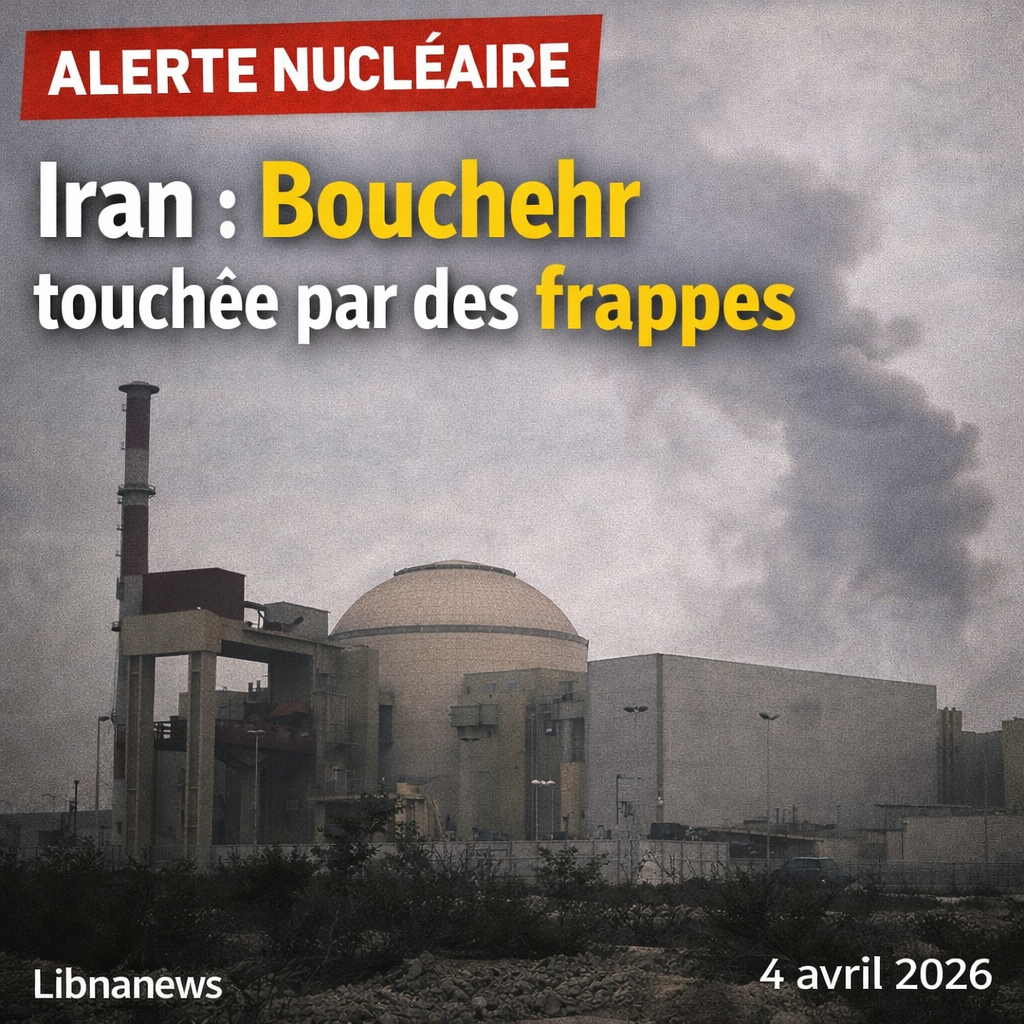
An Iranian state media strike against the United States and Israel hit the area of the Bouchr nuclear power plant in southern Iran on Saturday morning. According to the official Irna agency and other media reporting to the Iranian authorities, a security officer was killed. The main installations would not have been damaged, even if support buildings or outlying areas were reached according to several consistent accounts. Beyond the immediate record, the event marks a new level: touching the environment of an active nuclear power plant is not like any other strike. This opens up a more dangerous, diplomatically explosive and potentially heavy sequence for the entire Gulf region.
A strike near the Bouthr power station, with a death
The information available at this stage converges on a key point: a projectile reached an area near the Bouchr nuclear power plant on Saturday. The Iranian official agency Irna spoke of an impact in the power plant sector, while claiming that no damage had been recorded on the main installations. Other relays, citing the Iranian Atomic Energy Organization or Iranian agencies, refer to the death of a security officer as well as damage to a support building or the peripheral area of the site. The wording varies according to the media, but the heart of the story remains the same: the Boucheshr complex was approached again by the war, this time with a fatal victim.
The grade between « near zone », « district », « plant grounds » or « support building » is not insignificant. She says first that, within the first few hours of such a strike, the information remains partial and highly controlled. It then says that a nuclear site reads in successive circles: reactor, sensitive systems, technical dependencies, fences, access routes, security personnel. Even when a reactor is not reached, striking its immediate environment is already a major risk. The fact that no damage was reported on the nuclear facilities themselves does not therefore reduce the significance of the event. On the contrary, he stressed how narrow the margin of error became.
The episode comes in a context where Bouchr had been mentioned several times in recent weeks. Reuters reported on 18 March that a projectile had already struck an area near the plant without causing any casualties or damage to the site itself, according to information transmitted by Iran to the International Atomic Energy Agency. At the end of March, the Agency also confirmed that a projectile had hit the plant site, indicating that a structure about 350 metres from the reactor had been reached and destroyed in a previous incident. On Saturday, the diagram seems more serious: the site is no longer only close to the official narrative, it records a death.
Why Bouchehr is a separate site
Bouchehr is not a symbolic installation among others. It is the only civilian nuclear power plant operating in Iran, located on the Gulf coast. It has considerable energy, industrial and political value. Reuters recalled this week that Russia, via Rosatom, remains committed to it and was even preparing for the evacuation of part of its staff, proof that the perceived level of risk around the site had significantly increased. When a site of this nature is repeatedly targeted or threatened, the question is no longer only military. It immediately becomes regional and international.
This singularity is due to several reasons. First, an active nuclear power plant concentrates systems where safety depends on business continuity, team calm, access integrity and the protection of auxiliary infrastructure. Then, the Bouchehr site is located on the Gulf coast, in an area where energy interests intersect, maritime routes and the presence of foreign actors. Finally, the complex combines Iran’s national dimension with Russian cooperation, which immediately broadens the circle of countries directly affected by any deterioration in the security of the site. Even in the absence of a reported radioactive leak, an incident on or near Bouthr resonates well beyond the province concerned.
The International Atomic Energy Agency has reiterated since the beginning of the war that no military action should endanger nuclear power plants or their personnel. In the information transmitted on 24 March by the Iranian authority about a previous incident, the message already insisted on this point: the exploitation teams must be able to work safely. This formula, very technical in appearance, contains a simple reality. A power plant is not only dependent on the concrete of its reactor. It also depends on people, procedures, communication lines, peripheral equipment and a stable environment. A close strike is enough to weaken this balance.
What one can say, and what remains to be confirmed
At the time of writing, several elements may be used with caution. First, an impact was well reported in the Bouchr area on Saturday morning by Iranian authorities and international media reporting their statements. Then a security guard was announced dead. Finally, no damage to the main facilities was reported in the available reports. On the other hand, the exact extent of material damage remains less clear: some accounts speak of an area close to the plant, others of a support building or the perimeter of the site.
The designation of authors also deserves to be treated rigorously. The Iranian state media attributed the strike to a « American-Zionist » action, and several international dispatches repeated this attribution as the Iranian version of the facts. But, in the results consulted, there is no direct public demand from Washington or Tel Aviv on this specific episode. It is therefore correct to write that Iran attributes the strike to the United States and Israel. It would be more fragile to state, without any distinction, that a joint responsibility has been officially recognised by both countries. This distinction is important, especially as information about strikes on sensitive infrastructure is evolving very quickly.
This point of method also counts on the journalistic level. In a high-intensity war, each camp spreads its story, adjusts its vocabulary and seeks to install its reading of events. The treatment of Bouchehr provides an almost perfect illustration. The Iranian authorities stress the criminal nature of the strike and the absence of damage to the facilities. Foreign relays stress the extraordinarily dangerous nature of an attack near an active power plant. Nuclear observers first look at the distance of impact, the nature of the buildings affected and the potential safety consequences. Between these three levels, the same strike does not tell exactly the same thing.
An escalation that has lasted for weeks
Saturday’s attack does not arise in a vacuum. It is part of a war that has been waged for several weeks between Iran on one side and the United States and Israel on the other, according to recent reports from PA, Reuters and other media. The Associated Press refers to a war that entered its sixth week and reports that Bouthr has already been targeted several times during the conflict. The fact that a civilian nuclear power plant is mentioned several times in military chronologies is sufficient to measure the degree of escalation achieved by Iranian theatre. We are no longer talking only about conventional military sites, but about a perimeter where the boundary between strategic target and systemic risk is becoming thinner.
The March precedents reinforce this impression. Reuters reported on 23 March that the Kremlin considered the strikes near Bouthr to be dangerous. A few days earlier, the IEAEA already confirmed an impact on a structure about 350 metres from the reactor. These episodes were already a warning. The Saturday incident, with a death, gives this cycle a new dimension. It can no longer be classified as near-incident without human consequences. Repetition itself becomes a central information. The more a nuclear site is exposed to close strikes, the greater the likelihood of a serious, even involuntary, accident.
This repetition also transforms the international perception of the Iranian case. For years, Iran’s nuclear debates have focused on enrichment, inspections, uranium stocks, buried facilities and Tehran’s potential ability to move towards nuclear weapons. Now another issue is needed: the physical security of a power plant operating in the midst of an enlarged regional war. The slide is considerable. It shifts attention from proliferation control to the prevention of an industrial or radiological disaster.
Nuclear risk does not need direct impact on reactor
A misleading idea must be ruled out here: the absence of damage to the reactor does not mean that there is no risk. A power plant operates through an interdependent chain of elements. Electrical systems, auxiliary buildings, access roads, security devices, communications and human crews count as much as the core of the installation. A strike on the perimeter, destruction of secondary equipment or disruption of operations can create serious difficulties, even without perforating the main reactor enclosure. IEAEA’s warnings make sense in this context.
The problem is even more sensitive when strikes are repeated. A site can absorb an isolated incident. It becomes much more vulnerable when teams work in fear of a new impact, when access roads are threatened, when foreign staff withdraw and when support facilities can be affected. The Russian decision to organise the evacuation of part of its employees from Bouthr illustrates this environmental change. It alone does not prove an immediate danger to the reactor. However, it shows that actors directly linked to the site no longer regard the threat as theoretical.
There is also one often underestimated point: the political risk of even a limited nuclear accident. In the Gulf, proximity to maritime energy routes, riparian states and critical infrastructure means that an incident in Boucheshr would have repercussions far beyond Iran. Even without a major radiological disaster, the mere suspicion of a serious deterioration of safety could cause panic, economic disruption, diplomatic reactions and new military tensions. A hit nuclear power plant is never purely national information.
A highly political strike
At the political level, the Bouchehr incident signals something other than a mere widening of the target spectrum. He suggests that the war against Iran has entered a phase where the red lines become blurred. Reuters reported recently that Donald Trump threatened Iran with strikes against bridges and power plants. At the same time, war reports indicate an increase in bombardments on increasingly sensitive infrastructure. Bouchehr inserts into this dynamic of step climbing, where each new target changes the thresholds of the conflict a little more.
This development also affects diplomacy. A strike near Bouchr embarrasss those partners who politically or militarily support the campaign against Iran, as it immediately exposes to the reproach of having approached a civilian nuclear site. It strengthens Tehran’s ability to plead that it faces not only a military offensive, but a threat to regional security. It also places Russia in a sensitive position, given its historical role on the site. So the file is out of the military face. It becomes a matter of international credibility and overall risk management.
For Israel, logic can be read differently. In a context where the Israeli authorities claim to want to reduce Iran’s capacity on a sustainable basis, the approach to highly strategic sites can be a demonstration of scope and pressure. For Washington, if the Iranian allocation is accurate, it would mean a growing acceptance of the risks associated with an extended campaign. But precisely because no clear joint public claim is visible in the sources consulted for this episode, the attack on Bouthr also produces another effect: it increases opacity. But opacity is rarely stabilizing around a nuclear site.
Security law and doctrine are at the forefront
Civilian nuclear sites have a special place in international safety law and practice. Without entering into a definitive legal qualification on Saturday’s episode, a simple idea dominates international doctrine: nuclear installations must not be placed in a situation where a military operation could cause a major accident. The warnings relayed by the AIEA after the March incidents are part of this logic of absolute prevention. Once a projectile reaches the site or its immediate vicinity, the question is no longer abstract. It’s getting operational.
The law of war clearly distinguishes military objectives from civilian infrastructure. But the nuclear issue creates an additional requirement. Even when a party claims to be aiming at a given objective, it faces the need to avoid disproportionate or uncontrollable harm. That’s why Bouthr is not a site like any other. A miscalculation, misguided projectile, a shock wave on related equipment, a secondary fire or a blockage of access for technical teams could produce consequences unrelated to the military benefit sought. The risk is not only legal. It’s structural.
This centrality of safety also explains why every incident around Bouchehr is scrutinized with a particular intensity. We’re not just trying to find out if there’s any visible death or damage. The aim is to determine whether the normality of the operation is altered, whether the teams remain in place, whether the nuclear authorities maintain a precise view of the state of the site, and whether the international partners consider the situation still tenable. When foreign personnel begin to withdraw and projectiles come closer, these issues become much more pressing.
A wave of shock far beyond Iran
The scope of the event is far beyond Iran. Bouchehr is on a strategic coast for global energy supply. Any serious deterioration of the site, or even any serious concern about its safety, would have effects on markets, maritime insurance, traffic in the Gulf and perception of regional risk. Recent war dispatches already show tensions around the Strait of Ormuz, trade disruptions and a climate of high instability. Adding to this landscape a nuclear power plant regularly approached by strikes amounts to introducing an additional anxiety factor for regional capitals as well as for global economic actors.
The Gulf countries necessarily observe this development with concern. An Iranian power plant located on the coast does not only concern the Iranian state. In the event of a major accident, the environmental, commercial and psychological effects would immediately cross borders. Even without an extreme scenario, the simple repetition of incidents around Bouthr fuels lasting instability. It reinforces the idea that war is no longer contained in a conventional framework, but that it now affects infrastructure whose vulnerability involves the entire region.
There is finally a precedent effect. If the immediate environment of an active nuclear power plant becomes a regularly hit area without a decisive international response, this can help normalize the unacceptable. This is probably the most worrying point. The first function of restraint around civilian nuclear power is precisely to avoid such a threshold being trivialised. However, the series of incidents of March and then this fatal strike in April tends to show that this restraint severs.






