

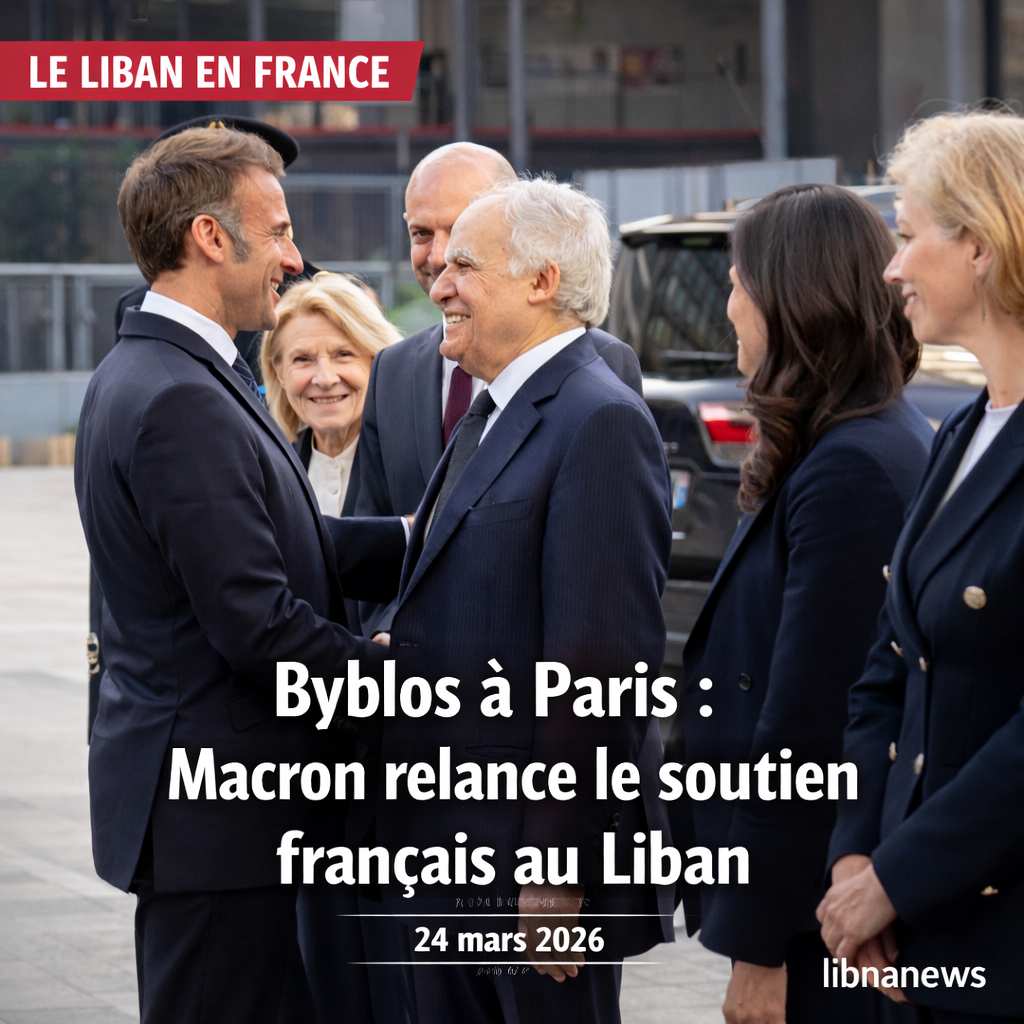
The opening of the exhibition« Byblos, the Millennial City of Lebanon »at the Institute of the Arab World in Paris, not only took the form of a cultural event. It turned into a diplomatic scene on Monday, March 23, 2026, at a time when Lebanon was still under bombardment, displacement and increasing pressure on its sovereignty. By personally opening the exhibition, Emmanuel Macron reaffirmed France’s support for Lebanon, its government and President Joseph Aoun. The French Head of State has, above all, placed the heritage within a broader political framework: the defence of Lebanese territorial integrity, the rejection of violations of international law and the need to stop fighting. The event, dedicated to one of the oldest inhabited cities in the world, thus involved archaeology, memory, diplomacy and the message of solidarity in a regional context marked by war.
The exhibition itself is a major event. According to the Institute of the Arab World, it brings together about400 piecesand highlights the history of Byblos, the major port of the ancient Mediterranean, linked very early to Egypt, Mesopotamia and the Aegean world. The route also gives a central place to recent archaeological discoveries, notably the excavations of a necropolis of the middle Bronze age that remained intact, carried out in the framework of a cooperation between the General Directorate of Antiquities of Lebanon and the Department of Oriental Antiquities of the Louvre. IMA indicates that the exposure is held fromMarch 24 to August 23, 2026, in its exhibition rooms, and that it is part of a collaboration with the Lebanese Ministry of Culture and the General Directorate of Antiquities. Beyond the Parisian showcase, the exhibition thus shows the continuity of a Franco-Lebanese scientific and museum work carried out for several years.
But the symbol goes far beyond the museum setting. Elysée stresses that the opening of the exhibition takes place in « a context marked by strong tensions in the Near and Middle East » and presents this meeting as a way to highlight the historical, cultural and archaeological richness of Lebanon while recalling the depth of the ties that unite with France. The image is strong: while the war delayed the project, complicated the transport of works and prevented the transport of certain pieces, Paris chose to make Byblos not only an object of heritage admiration, but also a marker of political permanence. In other words, culture is used here as a diplomatic language. It allows France to say that it remains present alongside Lebanon, including when the security terrain remains extremely unstable. This reading is based on the elements highlighted by Elysée and IMA in the presentation of the event.
Macron puts Byblos in the debate on Lebanese sovereignty
The political heart of the evening is in Emmanuel Macron’s speech. In the Verbatim published by the Elysée, the French President described Lebanon as a« Opportunity to live together », insisting on the singularity of a country capable, according to him, of carrying out a common national project despite religious and cultural diversity. This idea is not new in French rhetoric about Lebanon. But in the current context, it takes on a more direct meaning. Macron was immediately linked to the defence of international law, peace and the denial of any violation of Lebanese sovereignty. He claimed that« Nothing must justify »the violation of the territorial integrity of Lebanon and the absence of« double standard »in the application of international law. This passage, pronounced while the southern part of the country is under very strong military pressure, gives the inauguration an explicit diplomatic scope.
The French message became even clearer when Emmanuel Macron recalled Paris’ support for the Lebanese government and President Joseph Aoun. According to the text published by the Elysée, he said he wanted to continue the humanitarian aid provided.« in recent weeks »to support internally displaced persons and affected areas, and« do everything to stop the bombs », for the cessation of the ongoing terrestrial operation and for« the territorial integrity of Lebanon is recovered ». Here again, the exhibition serves as a setting for a much wider speech than culture. The heritage becomes the medium for a clear political message: France wants to pose as diplomatic, humanitarian and heritage support for an attacked Lebanon. This shift from culture to strategy largely explains the scope of the presidential visit.
This articulation between culture and sovereignty has nothing to do with anecdotal issues. In times of war, international exhibitions can become symbolic protective gestures. They show that a country is not reduced to its military fronts, human balance sheets or institutional crises. In this case, Macron clearly meant that the Lebanese issue was not just a regional security issue. It also commits a model of coexistence, a history and a civilizational continuity which France considers worthy to be defended. The presence of the Head of State at IMA, rather than a simple written message, reinforces this reading. It enshrines the event in a diplomacy of signs, where heritage serves to remind that Lebanon must not only be thought through war, but also through what it represents in Mediterranean history and in French political imagination. This interpretation is based on the content of the presidential speech and the level of representation chosen for the inauguration.
Ghassan Salamé highlights the depth of the Franco-Lebanese link
On the Lebanese side, the inauguration also served as a political platform. According to the report provided, the Minister of CultureGhassan Salaméon behalf of the PresidentJoseph Aoun. He stressed the depth of bilateral relations between Lebanon and France, stressing Paris’ continued support for the country. In the current sequence, this formula does not only refer to cultural or historical cooperation. She also referred to France’s role in diplomatic, humanitarian and heritage matters, as Beirut tried to preserve its institutions, protect its civilians and maintain a presence on the international scene.
This staging is important. Byblos’ heritage here becomes a diplomatic resource. It recalls that Lebanon speaks not only on behalf of a state in difficulty, but also in the name of a historical depth that precedes and transcends it. This explains the tone of Lebanese interventions during the evening. In the text provided, several officials present emphasized Lebanon’s ability to resist, recover and maintain its cultural presence in the world despite the war. This register of phoenix or resilience is not new in the Lebanese public discourse. But in Paris, in a great cultural place and with the visible support of the French presidency, it acquires a more institutional dimension: it becomes a message addressed to both French public opinion, Western partners and the Lebanese themselves.
The interest of this sequence is also due to Byblos’ choice. The city concentrates several narratives that overlap well with the political narrative of the moment. Byblos refers to the birth of maritime exchanges, the circulation of alphabets, connections between ancient worlds and the very long duration of urban occupation on the Lebanese coast. Being the subject of a large exhibition in Paris during the war makes it possible to say that Lebanon is not only a territory of contemporary confrontation. It is also a founding space for cultural, commercial and intellectual circulation. The choice is therefore consistent with the line defended by Macron and relayed by Salamé: remember that Lebanon’s sovereignty concerns not only a regional balance, but also a universal human heritage. This reading is based on a link between the theme of the exhibition and the political content of speeches.
An exhibition marked by war up to its windows
One of the most striking dimensions of the exposure is that it bears, physically, the trace of the conflict. According to information published this week, several parts could not be transported to Paris due to the war, rising insurance costs and transportation risks. A convoy of28 stone workswas cancelled after a recent offensive and several major objects remained in Lebanon because of their value and the security environment. Some windows are therefore partially empty. Far from weakening the point, this absence has become an element of narrative. It recalls that the war not only destroys buildings or infrastructure: it also disrupts the chains of conservation, study, circulation and sharing of heritage.
This visible lack gives exposure a particular strength. Usually, a great museum appointment seeks to mask constraints, to present perfect coherence, to offer the visitor a finished story. Here, war comes into the system itself. The absent works say that complete cultural normality is impossible. They recall that protecting the heritage in Lebanon now requires security arbitrations, escorts, delays and sometimes temporary abandonments. This point also joins one of the passages of Macron’s speech, when he evokes the missing pieces and asserts that« Nothing can resist culture ». The formula then takes on a concrete meaning: it does not deny obstacles, it shows them as additional proof of the need to continue this type of cooperation.
The exhibition thus becomes doubly political. First because it gives rise to a speech of support in Lebanon. Then because it materializes the effects of war on the heritage. The scientific cooperation between the Directorate-General of Antiquities of Lebanon and the Louvre, highlighted by IMA, therefore appears to be both a safeguard and a research effort. The excavations of the Bronze Age Necropolis, presented as one of the highlights of the journey, show the vitality of Lebanese archaeology. But their exhibition in Paris, at this moment, also highlights the fragility of this scientific production when the country plunges into violence. The result is paradoxical: the exhibition celebrates the permanence of Byblos while making visible the precariousness of contemporary Lebanon. This is probably what gives it its strongest dimension.
France Reactivates Cultural Diplomacy in the Near East
The event is also part of an older tradition of French diplomacy in the Levant. Lebanon has long held a singular place in the external narrative of Paris, mixing political proximity, historical memory, linguistic cooperation, educational ties and cultural networks. The Institute of the Arab World, the Louvre, the French Ministry of Foreign Affairs, the Ministry of Culture and the scientific partners mobilized around the exhibition participate in this influential architecture. Elysée also stresses that France wants to continue to engage alongside Lebanon, via IMA, the relevant ministries and heritage cooperation. This formulation is important: it shows that French action is not limited to crisis diplomacy. It also requires a continuous cultural presence, conceived as a lever of political relationship and outreach.
This choice corresponds to a precise logic. In very degraded regional contexts, cultural diplomacy often allows for the maintenance of channels of influence where conventional diplomacy encounters military or geopolitical power relations. Protecting sites, financing research, hosting exhibitions, supporting researchers and heritage institutions: these actions do not replace political or humanitarian action, but they prolong the relationship in a register less exposed to the immediate failure of negotiations. For Lebanon, this continuity is very important. It offers a form of lasting recognition, at a time when security emergencies can easily crush everything else. For France, it allows us to maintain a singular word about Lebanon, articulated in both international law, culture and shared memory. This analysis is based on the nature of the actors involved in the exhibition and the formulations chosen by Elysée and IMA.
The timetable further reinforces this dimension. The project had been announced and then postponed because of the war. Its conclusion in March 2026 therefore functions as a resumption of the initiative. It is no coincidence that Macron insisted that nothing should prevent the culture and work of researchers. It was not just a tribute to the museum teams. The point was also made that Lebanon cannot be abandoned solely by the confrontations. In this sense, the exhibition on Byblos becomes almost a counter-recital. To the brutality of destruction, it contrasts the long duration of civilizations. To the obsession of the front, it contrasts maritime routes, trade and traffic. To the fragmentation of the present, it opposes the idea of a common and transmissible heritage. This symbolic construction explains why the inauguration went beyond a simple cultural opening.
Byblos, or the other face of Lebanon in the war
The choice of Byblos was therefore nothing ornamental. In the Lebanese imagination as in the outside look, the city embodies a rare temporal depth. IMA recalls that it is one of the oldest inhabited cities in the world and has played a decisive role in Mediterranean history, notably through its relations with the Pharaohs and its place in the diffusion of the Phoenician alphabet. By honouring it, France and Lebanon propose a reading of the country which refuses to reduce the bombardments to the present day. They recall that the Lebanese coast was a place of circulation of goods, ideas and scriptures long before being a regional war zone. This is also why the exhibition touches on a sensitive point: it seeks to show what Lebanon continues to be, even in the test.
This idea passes through Macron’s speech when he presents Lebanon as a country larger than himself, carrying a message of respect and coexistence. It also crosses the Lebanese word, when it insists on the country’s ability to stand up despite the war. Heritage is not mobilized here as a mere identity setting. It serves to reformulate a central political question: what is defended when defending Lebanon? A territory, of course. A sovereignty, no doubt. But also a certain relation to plurality, culture and historical duration. This gives this exhibition a deeper resonance than that of a large classical museum event. It speaks of the past, but it intervenes in the present, in a battle of stories about what Lebanon still represents for itself and its partners.



