

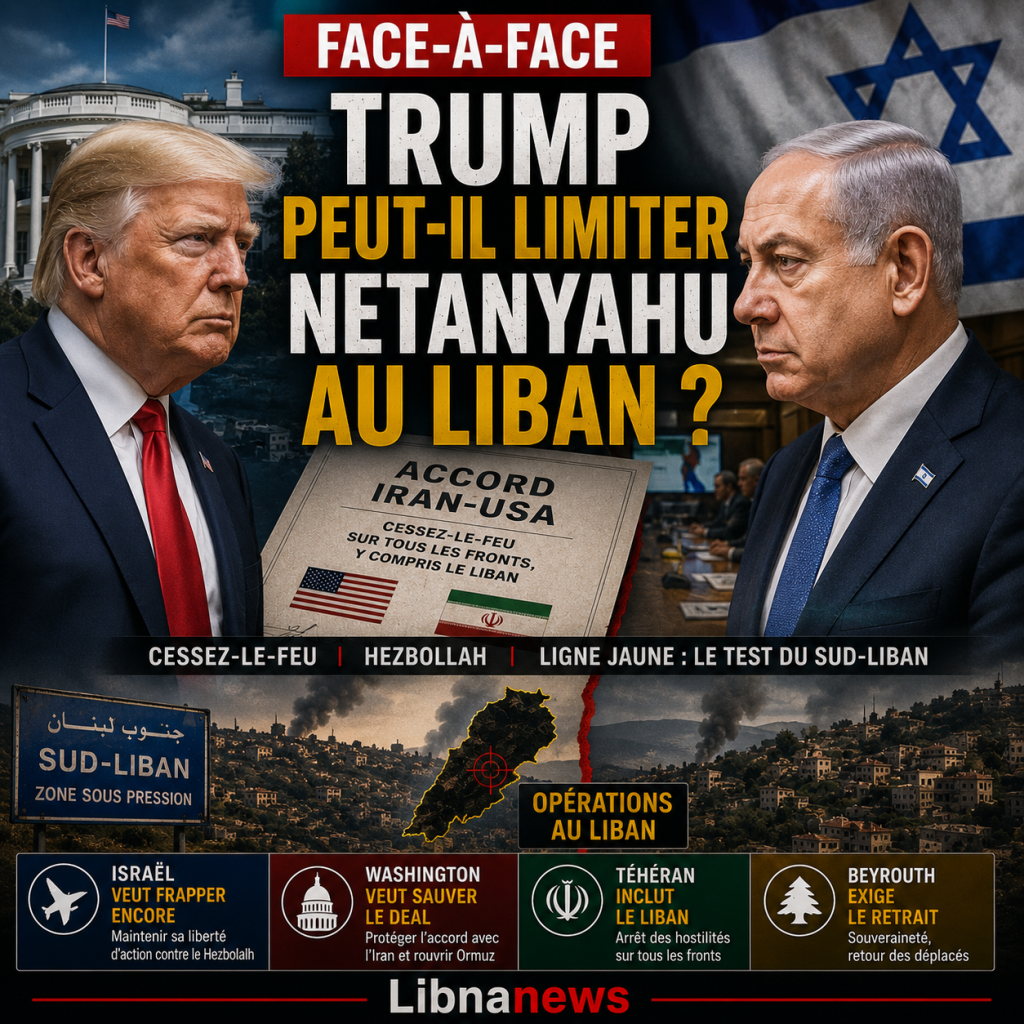
The question seems simple. However, it has become one of the most sensitive points of the post-agreement between Washington and Tehran. Can Israel accept a limit to its operations in Lebanon, while its government reiterates that security in the north of the country requires freedom of action against Hezbollah? The regional compromise announced on the night of 14-15 June opens a new phase. It must suspend hostilities, reopen Ormuz and postpone the most difficult nuclear issues for further negotiations. But its application in Lebanon depends on an actor who did not sign it directly: Israel. If the Israeli army continues its strikes, Tehran will cry out for the violation. If she slows down or withdraws, Benjamin Netanyahu will have to explain to her that the agreement with Iran now limits part of the Israeli strategy.
Israeli objectives in Lebanon
Since the beginning of the war, Israel has presented its action in Lebanon as a defensive necessity. Shots from Lebanese territory have emptied some of the localities in northern Israel. Hezbollah drones, rockets and anti-tank missiles have fuelled a very strong demand for security. For the Israeli government, therefore, the priority is to prevent the return of Hezbollah near the border. This requirement structures the whole debate. Israel wants to remove fighters, destroy deposits, monitor axes, prevent the rebuilding of positions and maintain the ability to strike quickly. A strict limit to operations would be perceived in Tel Aviv as a dangerous reduction in this margin.
Northern security is not just military. It is also political. Displaced Israeli families are waiting to know whether they can return to their communities. Northern mayors are asking for visible guarantees. Right-wing and far-right parties demand that Hezbollah no longer appear a few kilometres from the border. Benjamin Netanyahu cannot ignore this pressure, especially in an election period. It must show that war has produced a concrete result. A ceasefire that would leave Hezbollah standing, relieved Iran and Israeli villages still concerned would be difficult to defend in front of its electorate.
This constraint explains Israel’s desire to retain territorial maps. The yellow line, presented as an advanced security line in southern Lebanon, meets this logic. It does not have the international value of the Blue Line. It is not recognized by Beirut. It is not the result of an agreement accepted by all parties. But it allows Israel to materialize a de facto buffer zone. In this reading, the limit to its operations can only be accepted if a depth of security exists. Without this depth, Israel considers that the army would end up waiting for the next attack, instead of preventing it.
The problem is that this logic is unacceptable to Lebanon. A unilateral buffer zone in the south means prevented villages, prohibited land, roads under surveillance and conditional return of inhabitants. Beirut calls for full withdrawal, respect for sovereignty and the return of internally displaced persons. Hezbollah also uses this Israeli presence to justify its continued armed posture. Thus, the more Israel insists on a safe area, the more it gives the opponents of its withdrawal a political argument. The limit to its operations cannot therefore be reduced to a matter of military tactics. It affects the status of Lebanese territory.
Washington and Tehran tightened up
The American constraint is now stronger. Donald Trump wants to save the deal with Iran. He wants to reopen Ormuz, calm oil prices and prevent war from becoming an internal burden before mid-term elections. The Israeli strike on Beirut, just before the compromise was announced, sparked public and private irritation in Washington. The U.S. president accused Benjamin Netanyahu of a timing deemed dangerous. It’s not a strategic breakup. It’s a warning. The United States continues to support Israel, but no longer wants every Israeli decision to jeopardize a regional de-escalation at the price of concessions.
This American pressure changes the Israeli calculation. Military aid, intelligence coordination, diplomatic protection and support for the Security Council remain essential for Israel. Tel-Aviv cannot treat U.S. applications as mere comments. If Washington believes that a strike in Lebanon threatens the agreement with Iran, the political cost to Israel increases. Delays in delivery, tensions in Congress, public criticism or less diplomatic protection can be a burden. Netanyahu must therefore arbitrate between maximum freedom of action and the preservation of its main strategic support.
The Iranian risk is similar. Tehran claims that Lebanon is included in the de-escalation. This position is not only rhetorical. It aims to protect Hezbollah, to preserve Iran’s regional credibility and to prevent Israel from continuing a war on its front. If Israel continues to strike deeply in Lebanon after the planned signature in Switzerland, Iran may say that Washington does not hold its guarantees. It may threaten to suspend technical discussions, slow the reopening of Ormuz or allow its allies to react. Israel must therefore integrate the fact that every operation in Lebanon can produce a reaction beyond Lebanese theatre.
The diplomatic cost is not limited to the United States and Iran. Europeans, Arab countries and maritime actors have an interest in stabilizing the region. France insists on Lebanese sovereignty and freedom of navigation in Ormuz. The Gulf countries, even hostile to Iran, do not want an open war that turns their infrastructure into targets. Saudi Arabia and other Arab capitals also observe how Lebanon will be treated. If Israel maintains a presence or strikes without a clear framework, it feeds the idea that de-escalation only protects energy interests and ignores the sovereignty of fragile states.
Four scenarios for Israel
However, Israel has several scenarios. The first is to maintain targeted strikes. In this scenario, the Israeli army accepts a decline in the pace of operations, but retains the right to strike frames, depots, launchers or convoys deemed threatening. This model allows Netanyahu to say that he did not renounce the defence of the north. He reassures some of Israel’s opinion. But it is the most risky for the regional agreement. A targeted strike can kill civilians, provoke a Hezbollah response and give Iran a pretext to challenge American good faith.
The second scenario is partial withdrawal. Israel could abandon certain positions, reduce its visible presence and maintain surveillance capacity. This choice would offer an image of de-escalation without total renunciation. It would allow Washington to present progress. It would give the Lebanese army and the Finul a wider space. But he would leave two problems. First, the areas still controlled or monitored by Israel would remain contested. Then, Hezbollah could consider that any partial withdrawal confirms the effectiveness of its pressure and maintains its posture until complete withdrawal.
The third scenario is the buffer zone. Israel could maintain a depth of security in southern Lebanon, with fewer strikes but a presence or capacity for permanent intervention. This is the scenario preferred by supporters of a harsh deterrent. It responds to requests from northern Israeli communities. It prevents the immediate return of Hezbollah near the border. But it is in frontal contradiction with Lebanese demands. He may also install a prolonged occupation. A buffer zone without Lebanese agreement would be a permanent source of incidents, legal challenges and international pressure.
The fourth scenario is enhanced international surveillance. It would require a sharper Israeli withdrawal, accompanied by an increased deployment of the Lebanese army and a better mandated Final. Liaison and verification mechanisms could be used to report violations, monitor armed movements and avoid automatic responses. This scenario is most compatible with a sustainable regional agreement. It is also the most difficult to implement. Israel doubts the ability of the Lebanese army to prevent Hezbollah from returning. Hezbollah refuses to appear as being disarmed under Israeli pressure. Finul cannot impose a solution alone.
One alternative would be to create pilot areas. The Lebanese Armed Forces would exercise exclusive responsibility, with international support and enhanced monitoring. This would allow Lebanese sovereignty to be tested in stages. It would give Israel concrete indicators. It would give Beirut an opportunity to restore its authority. It would allow people to return gradually. But it requires a Lebanese internal political agreement. Without Hezbollah’s minimum consent, these areas would become a point of friction. Without Israeli withdrawal, they would lose credibility. Without funding, they would remain a paper device.
Can Israeli deterrence change form?
The central question is therefore that of trust. Israel does not trust Hezbollah. Hezbollah does not trust Israel. Lebanon does not trust unwritten guarantees. Iran does not trust the American ability to contain Netanyahu. The United States does not trust Iran on nuclear and regional networks. In this landscape, a limit to Israeli operations can only be accepted if accompanied by evidence. Maps, schedules, patrols, alert mechanisms, inspections and political sanctions for violations.
Netanyahu must also deal with the Israeli debate. Its opponents may accuse him of having waged a costly war to reach an agreement that lets Iran negotiate and Hezbollah survive. Its toughest allies can demand continued operations. Security officials may prefer a formula that stabilizes the north and avoids prolonged confrontation with Washington. This internal tension makes the decision more unstable. Israel can accept a limit in practice, while refusing to recognize it publicly. It can reduce strikes, but maintain the discourse of freedom of action. He may withdraw from certain points, but keep a permanent threat.
The position of the Israeli army will count as much as that of the government. The military wants operational guarantees. They know that an extended presence in Lebanon exposes troops, mobilizes resources and multiplies incidents with the civilian population, the Finul or the Lebanese army. They also know that a complete lack of control can allow Hezbollah to reorganize its networks. Their preference could be for a hybrid arrangement: withdrawal from certain areas, aerial surveillance, intelligence, exceptional strikes and indirect coordination with mediators. This model would be more discreet, but it would remain disputed if it is not framed.
For Lebanon, accepting this ambiguity would be dangerous. A ceasefire based on permanent Israeli exceptions would weaken the State. He would give Hezbollah the argument that no international guarantee protects the country. He would make the return of the displaced uncertain. It would prevent rapid reconstruction. It would maintain the South in a state of low-intensity war. Beirut must therefore request that any limit be written, verified and linked to the withdrawal. Sovereignty cannot depend on an oral promise of restraint.
Can Israeli deterrence coexist with a regional agreement? Yes, but only if it changes shape. A deterrence based on frequent strikes and a territorial presence in Lebanon will conflict with the agreement. A deterrence based on intelligence, international surveillance, US pressure and strictly framed responses could be compatible with a lasting truce. However, this change requires political discipline that Netanyahu has not always shown, and guarantees that Hezbollah will not accept without Israeli withdrawal.
So June 19 will not only say whether Washington and Tehran can sign a text. He would say whether Israel agreed to turn a military freedom of action into a strictly supervised freedom of alert, verification and response. The test will take place on concrete actions: a real reduction in strikes, withdrawal of disputed positions, gradual return of the inhabitants, increased role of the Lebanese army, freedom of movement of the Final. If these actions fail, Israel may have retained its military margin, but the regional agreement will enter Lebanon with a visible weakness from day one.






