

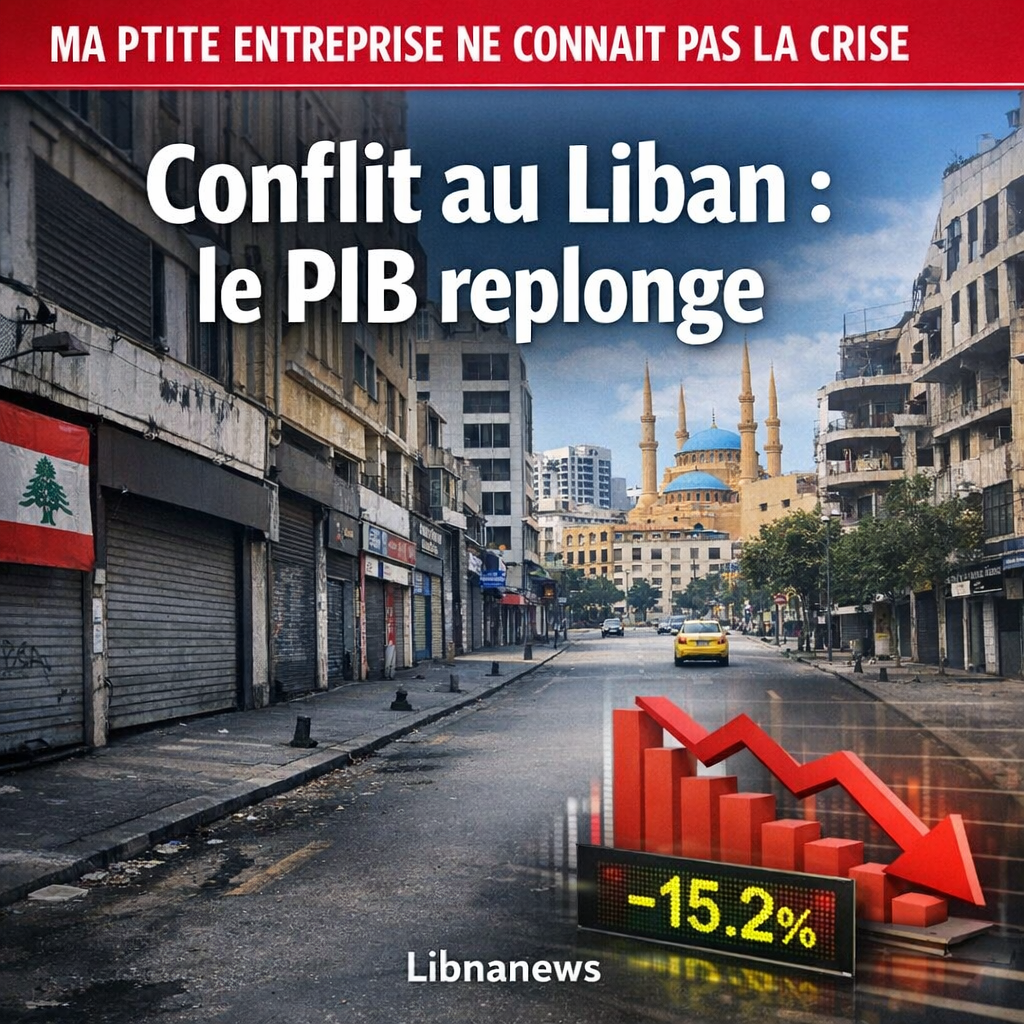
The current conflict is exacerbating the Lebanese economy in a sense of urgency. After a year 2025 marked by a slight improvement in some indicators, the already fragile recovery was abruptly interrupted. The most severe signal concerns gross domestic product. According to an estimate contained in the economic documents transmitted, the actual activity could contract12% to 16% in 2026Depending on the duration of the war. This forecast contrasts with the stabilization scenarios mentioned at the beginning of the year and places Lebanon in a sequence of value destruction, job losses and erosion of government revenues.
This decline in GDP, however, sums up only part of the shock. At the same time, the economy suffers the cessation of part of tourism, the disruption of trade, damage to roads, electricity and networks, and the weakening of already vulnerable agriculture. The World Bank recalled in early March 2025 that the previous war had already increased the total economic cost to$14 billionof which:6.8 billionphysical damage and7.2 billioneconomic losses. It also estimated that Lebanon’s real GDP had contracted from7.1% in 2024, while a conflict-free scenario would only have given rise to modest0.9 %.
Lebanese GDP goes down again
TheLebanese GDPremains the best thermometer of the current crisis, as it aggregates both falling demand, production losses and partial paralysis of several services. The Institute of International Finance, quoted in the attached economic note, considers that the conflict between Israel and Hezbollah is another negative shock for an economy already compressed since 2019. Its contraction range, between12% and 16% in 2026, mainly based on the collapse of tourism activity, supply chain disruptions, damage to infrastructure and the decline in labour mobility in the affected areas.
This deterioration is all the more serious since Lebanon was barely emerging from a phase of relative monetary stabilization. In December 2024, the World Bank estimated that the cumulative contraction in real GDP since 2019 exceeded38 %At the end of the year, the combined effect of the banking crisis, monetary depreciation, contraction of domestic demand and conflict. At the beginning of March 2025, the same institution brought the cumulative decrease toalmost 40 per centAt the end of 2024. The country therefore approached 2026 with an already used productive apparatus, a very small investment capacity and an almost non-existent budgetary margin.
The current conflict not only destroys present wealth. It also undermines the growth potential of the coming years. When a road becomes impassable, when an electric station is hit, when a greenhouse or a firm workshop, the impact does not stop in the current quarter. Companies delay orders, households cut out their spending, real estate projects are suspended and investors postpone any decisions. Thus, a survival economy gradually replaces a production economy.
Tourism, services and currencies: the first floor of the shock
Tourism remains one of the first channels of transmission of the crisis. The documents provided show that, in 2025, Lebanon had hosted1 635 490 visitors, an increase of44.6%Over a year. This improvement had supported activity in hotels, restaurants, transport and seasonal trade. In particular, it strengthened foreign exchange inflows, a vital point in a country where external services and transfers play a central role.
However, this engine was again gripped. Bank Audi’s weekly note points out that flight suspensions continued at Beirut airport at the end of March 2026, with the exception ofMiddle East AirlinesandRoyal Jordanian. For an economy highly dependent on air transport, this is enough to measure the magnitude of the impact. Fewer flights mean fewer tourists, fewer business trips, fewer bookings and fewer revenues for the entire service ecosystem.
The IIF goes further and considers that the collapse of tourism is already the main driving force behind the decline in GDP. This is consistent with Lebanon’s recent history. When insecurity rises, discretionary spending falls almost immediately. Restaurants, non-essential shops and cultural activities have been reduced even before the physical destruction of assets. In a country where household consumption also depends on diaspora stays, the multiplier effect is rapid.
What the breakdown in services shows
- likely decrease in hotel reservations and catering;
- decrease in passenger traffic and travel expenses;
- reduction of foreign exchange earnings in a partially dollarized economy;
- weakening seasonal and informal jobs;
- increased pressure on small urban businesses.
These effects are not isolated. They add to a wider decline in retail trade. In the note transmitted, a Member of Parliament refers to a decrease of around60 %of turnover excluding essential goods compared with March 2025 and the judgment of aroundhalf of the private sectorin certain areas. This type of data should be read with caution, but it describes a climate of abrupt retraction, where companies retain the essentials, push back investment and reduce their stocks.
Agriculture, industry and logistics under pressure
The second stage of the shock affects productive sectors. In exposed areas, farms lose land, crops, access and labour. The Lebanese Ministry of Agriculture, quoted in Byblos Bank’s economic note, estimated that27 March 2026that46 479 hectareseither22%agricultural land in the country had been damaged. The damage includes field crops, olive trees, citrus fruits, banana groves and greenhouse crops. The document also states that76.6%Southern farmers have been displaced.
For a net food and energy importing country, this damage to local production has a double cost. First, it reduces the income of thousands of families. It then increases the need for imports at a time when roads, warehouses, collection points and logistics capacities are themselves disrupted. The pressure on food security becomes both a macroeconomic and a social issue.
Industry is not spared. The IIF mentions supply chain disruptions, less labour mobility and direct damage to productive capital. Fitch Solutions, relayed by Bank Audi, adds that the resumption of the conflict with Israel and the closure of the Strait of Hormuz in March 2026 have seriously clouded the prospects for trade and freight in Lebanon. Prior to this escalation, the institution was still expecting real growth in trade.7.4 %in 2026, carried by reconstruction and a start of recovery of exports. This scenario is now weakened by the country’s dependence on regional sea routes and the damage already suffered by logistics infrastructure.
The case of theSultaniyahillustrates this fragility. Its decommissioning deprived electricity more than60 villagesof Bint Jbeil district, as well as several localities of Marjeyoun and Tyre. Beyond the humanitarian dimension, every blow to the network increases the production costs of companies, already forced to use private generators and imported fuel.
External finance: current deficit, reserves and energy bill
The crisis is also reflected in external accounts. According to the documents submitted, the IIF expects a widening of the current account deficit, which is14% of GDPin 2025 to about17% of GDP2026. The logic is simple. Exports of goods and services suffer from the conflict, while the oil bill increases with rising energy prices. The report points out that petroleum products represent a major part of the Community’salmost one quarter of total importsLebanon.
This pressure comes as the Bank of Lebanon’s liquid reserves remain limited. Byblos Bank’s note indicates that they reached$11.67 billionby mid-March 2026, down by$229.6 millionSince the beginning of the year. At the same time, the value of gold reserves increased to$47 billion, but this asset does not constitute an immediate cash flow solution without major political choice. Moreover, the IIF stresses that maintaining exchange rate stability remains a priority, at the price of a delicate balance between short-term stability and medium-term sustainability.
The regional context reinforces this vulnerability. ESCWA warned the19 March 2026continued strikes could significantly increase economic losses as attacks disrupt infrastructure, trade and essential services. For its part, a note relayed by Bank Audi mentions that a sustained increase in oil prices could carry the annual invoice of Lebanon’s fuel imports of about4.8near$6 billion, or aboutAdditional $100 million per month.
Some indicators of degradation
| Indicator | Recent level | Economic reading |
|---|---|---|
| Expected real GDP contraction in 2026 | -12% to -16% | major recessive shock |
| Current deficit expected in 2026 | 17% of GDP | increased need for external funding |
| BDL Liquid Reserves mid-March 2026 | $11.67 billion | limited defence margin |
| Damaged agricultural land | 46 479 ha | decrease in production and food risk |
| Tourist arrivals in 2025 | 1.64 million | comparison basis now threatened |
Inflation, purchasing power and government revenue
The conflict finally affects prices and public finances. Officially, inflation was no longer the explosive profile of previous years. The consumer price index rose by12.3%in February 2026 according to Byblos Bank’s note, after much higher rhythms in 2024 and 2025. This relative moderation is partly due to the stabilization of the exchange rate and the dollarization of a large part of the transactions.
But this overall reading masks a very concrete deterioration in the cost of living. The most important increases are precisely those that households make the most of: education, rent, food, energy and transportation. In February 2026, the cost of education rose by35.7%food and non-alcoholic beverages16 %, the actual rents21.7%, while transport was still gaining8.2 %over a month. For already compressed incomes, these increases reduce real consumption and fuel the contraction of GDP by demand.
On the state side, the effect is equally worrying. The IIF estimates that the recession will erode VAT, customs and service revenues, while social spending, support needs for internally displaced persons and reconstruction expenditure are increasing in the opposite direction. This reversal could shift the modest primary surpluses of the last two years to new deficits. The situation is all the more sensitive as Lebanon remains in sovereign default and depends on concessional financing, international aid and transfers of expatriates to loosen the fabric.
The World Bank already insisted in June 2025 that the rehabilitation of critical public infrastructure was a prerequisite for economic and social recovery. At that date, it approved a draft$250 millionto launch the most urgent repairs in the affected areas, while placing it in an extensible framework$1 billion. The message is clear: without rapid reconstruction of water, energy, transport, health and municipal services networks, private activity will remain hampered.
An economy that still holds, but by its shock absorbers
Despite the violence of the shock, some shock absorbers remain visible. Diaspora transfers continue to play an external buffer role. The private sector, accustomed to crises, adapts its schedules, moves operations, stores more and generalizes flexible work when it can. The best-capitalized companies seek to maintain their flows, even at higher logistical and energy costs. It’s not a sign of good health. Rather, this is evidence of an economy that is trained to operate under permanent stress.
In humanitarian terms, however, the margin is narrowing rapidly. TheFlash Appealof the UN, launched by March-May 2026, aims$308.3 millionto provide vital assistance up to1 million people. OCHA reported at the end of March more than136,000 internally displaced personshosted in663 collective shelters, while Reuters reported that in totalmore than one million peoplehad been displaced since the March escalation. When displacements are so large, the economic cost exceeds the production loss alone. It covers housing, education, health, social protection and the labour market.
It is in this context that the decline in GDP should be read. It is not just a macroeconomic indicator. It summarises the fragmentation of productive space, the cessation of a portion of services, the rise in import costs, the destruction of infrastructure and the shift from an increasing share of the population to a subsistence economy. As long as the current conflict continues, the forecast of a two-digit contraction is no longer an extreme scenario. It became the central framework for analysing the Lebanese economy in 2026.






