

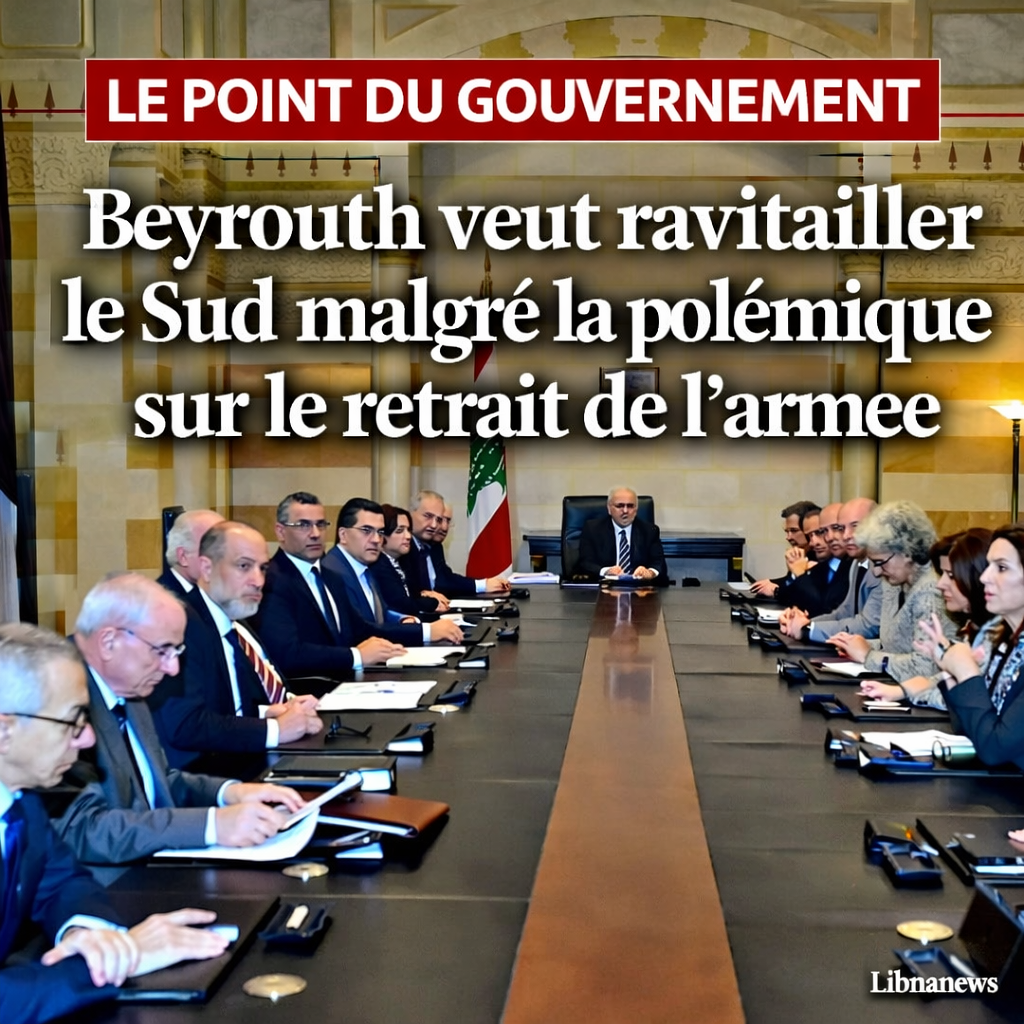
Meeting on Wednesday morning in the Grand Sérail under the presidency of Prime Minister Nawaf Salam, the Council of Ministers placed at the heart of its discussions the situation on the ground in southern Lebanon and how to maintain supplies to the inhabitants of the villages still inhabited, despite the bombings, the encirclement of certain areas and the rapid deterioration of the conditions of access. At the end of the meeting, the Minister of Information, Paul Morcos, reported that discussions had focused on the military and security presence in the South, on maintaining contact with the occupied or besieged areas, and on ways to deliver essential needs and services there, with the aim of mobilizing international support to ensure such access.
The political title of this meeting is therefore less to a spectacular announcement than to a priority clearly assumed by the executive: to avoid certain southern localities falling into complete isolation. In the language of government, it is not only a question of helping displaced persons who have already arrived in the receiving regions, but also of supporting the « villages that hold », i.e. the inhabitants who remained in front-line areas. This nuance is essential. It means that the Council of Ministers does not only want to treat the South as a space of departure and exodus, but also as a territory where the State still seeks to maintain a presence, services and a form of administrative continuity.
But this Council of Ministers intervenes in a much more tense context than the only official communication suggests. For several days, the Lebanese public debate has been dominated by the issue of the withdrawal of the Lebanese army from several border localities, including Rmeish, Ain Ebel and Baraachit, in a context of Israeli progress, growing military pressure and strong criticism of the State’s ability to remain present in the South. The military command itself explained that it had made a redeployment to avoid the encircling of its units and the closure of their supply lines. In other words, the government meeting cannot be read separately from this controversy: if the executive insists today on supplies, it is also because the question of the concrete link between the state and the villages of the South has become central.
A Council of Ministers under the weight of military withdrawal
During the meeting, Defence Minister Michel Menassa exposed developments on the ground, including Israeli attacks on several regions and the repositioning of the Lebanese army to avoid its encircling. This formulation follows the line already defended by the command: redeployment is not presented as a voluntary abandonment of the ground, but as an adaptation imposed by military evolution. However, on the political front, nuance is not enough to extinguish criticism. When part of the public sees the army leaving border towns, the question is no longer limited to military tactics. It deals with what remains of the actual state presence in the most exposed areas.
This gives this government meeting a special meaning. Speaking of supplies, services and maintaining communication with the occupied or besieged areas, the government responds indirectly to the ongoing controversy. He seeks to say that the presence of the state is not limited to the presence of the army on every point of the front. It also measures the ability to deliver aid, maintain a secure and administrative link, and show the local residents that they are not cut off from Beirut. This response remains fragile, but it is politically understandable: in the face of accusations of state vacuum, the executive puts forward logistical and institutional continuity.
Interior Minister Ahmad Hajjar said that elements of the Internal Security Forces remained present in the remaining front-line villages. Here too, the message is clear. Although the army has redeployed some units and left some localities under pressure, the state wants to show that it has not completely disappeared from the advanced areas. This presence, even reduced, has practical and symbolic value. It helps to maintain a minimum of local organisation, relay needs and maintain contact with people living in increasingly precarious conditions.
Supply becomes a matter of sovereignty
At first glance, talking about supplies may seem to be part of the humanitarian register alone. In reality, in the current context, it is also a matter of sovereignty. When a government states that it wants to maintain essential needs and services to occupied, surrounded or difficult to access localities, it says in a vacuum that these communities are still part of its space for action. As long as the State can communicate with them, provide assistance or maintain security relays, it continues to exercise a form of concrete presence. If this link were completely broken, the consequence would not only be humanitarian. She would also be political.
This dimension is reinforced by the current Israeli context. Israeli Defense Minister Israel Katz said that Israel intended to establish a control zone south of the Litani after the war and maintain « security control » over the area, including the Litani bridges. He also claimed that hundreds of thousands of Lebanese displaced persons would not be allowed to return south of the river until Israel’s security was assured, and that all houses in villages near the border would be destroyed. In this context, the issue of supplies is becoming even more acute: maintaining aid to the villages of the South also means, for Beirut, refusing to treat these areas as already lost or permanently cut off from the rest of the country.
The Lebanese government therefore speaks logistically, but the subtext is territorial. As Israel shows more clearly its intention to control a part of the South in a sustainable manner, every road kept open, every service preserved, every institutional presence retained takes on greater political value. What the Council of Ministers is trying to preserve is not just a flow of aid. It is also the principle that villages in the South remain linked to the Lebanese state, even when under extreme pressure.
A Council of Ministers faced with a multiple crisis equation
The meeting of the Grand Sérail also recalled the magnitude of the human shock. According to the point presented by the Minister of Defence, the Israeli attacks resulted in 1,268 deaths and 3,750 injuries. These figures, taken from the official communication, measure the pressure on the executive. The Government must follow the military front, organize relief, respond to the needs of internally displaced persons, coordinate accommodation, support local communities and maintain a link with communities still standing in the South. It is therefore not a routine meeting, but a Council of War Management Ministers, where the State tries to hold several emergencies together.
Each minister presented his department’s efforts in the area of relief and supply, particularly for the « Tenacic villages ». This expression is not neutral. It allows the government to build a narrative where the villages of the South are not only destroyed or emptied, but still inhabited spaces, which continue to exist politically and to which the state still intends to respond. This narrative counts a lot at a time when the controversy over the withdrawal of the army feeds the suspicion of a gradual abandonment from the South. The Council of Ministers is precisely seeking to oppose this reading of another image: that of a weakened state, albeit still committed to the continuity of the link with these territories.
The call for international support is consistent. Paul Morcos explained that the government is seeking external support to ensure the arrival of essential needs and services to the areas concerned. This support is not only financial. It also focuses on logistics, access and material capacity to deliver food, fuel, medicines and basic services to areas where war makes any displacement more dangerous. This demand reflects a simple reality: the scale of the crisis today exceeds the only Lebanese national capacity.
The political context weighs on every word of government
What makes this Council of Ministers particularly sensitive is therefore the gap between the sobriety of official communication and the brutality of the political context. On the one hand, the government talks about coordination, accommodation, relief and maintenance of services. On the other hand, the public debate is dominated by the withdrawal of the army from certain localities, the fear of a vacuum of sovereignty and the rise of Israeli announcements on a future hold south of the Litani. Between the two, the executive is looking for a balance line: do not deny the degradation of the land, without however endorsing the idea of a total break between the state and the South.
That is why the title of this sequence must reflect that it is a Council of Ministers. The meeting does not only have an administrative function. It serves to show government cohesion, to refocus priorities, to respond to polemic without facing it in front of each other, and to show that political power is still trying to organize something in a context where military room for manoeuvre is being reduced. The Council of Ministers is becoming an instrument for political stabilisation as well as an operational coordination place.
In the end, the line defended on Wednesday in the Grand Sérail can be summed up as follows: the partial withdrawal of the army from certain border areas opened a major political crisis, but the government wants to show that this withdrawal does not mean a complete break in the link between the state and the villages of the South. Hence this emphasis on supplies, the residual presence of internal security forces, inter-ministerial coordination and the search for international support. In today’s Lebanon, sending what to live in besieged localities is no longer just a humanitarian gesture. It has become a way of continuing to affirm that these villages remain fully Lebanese.






