

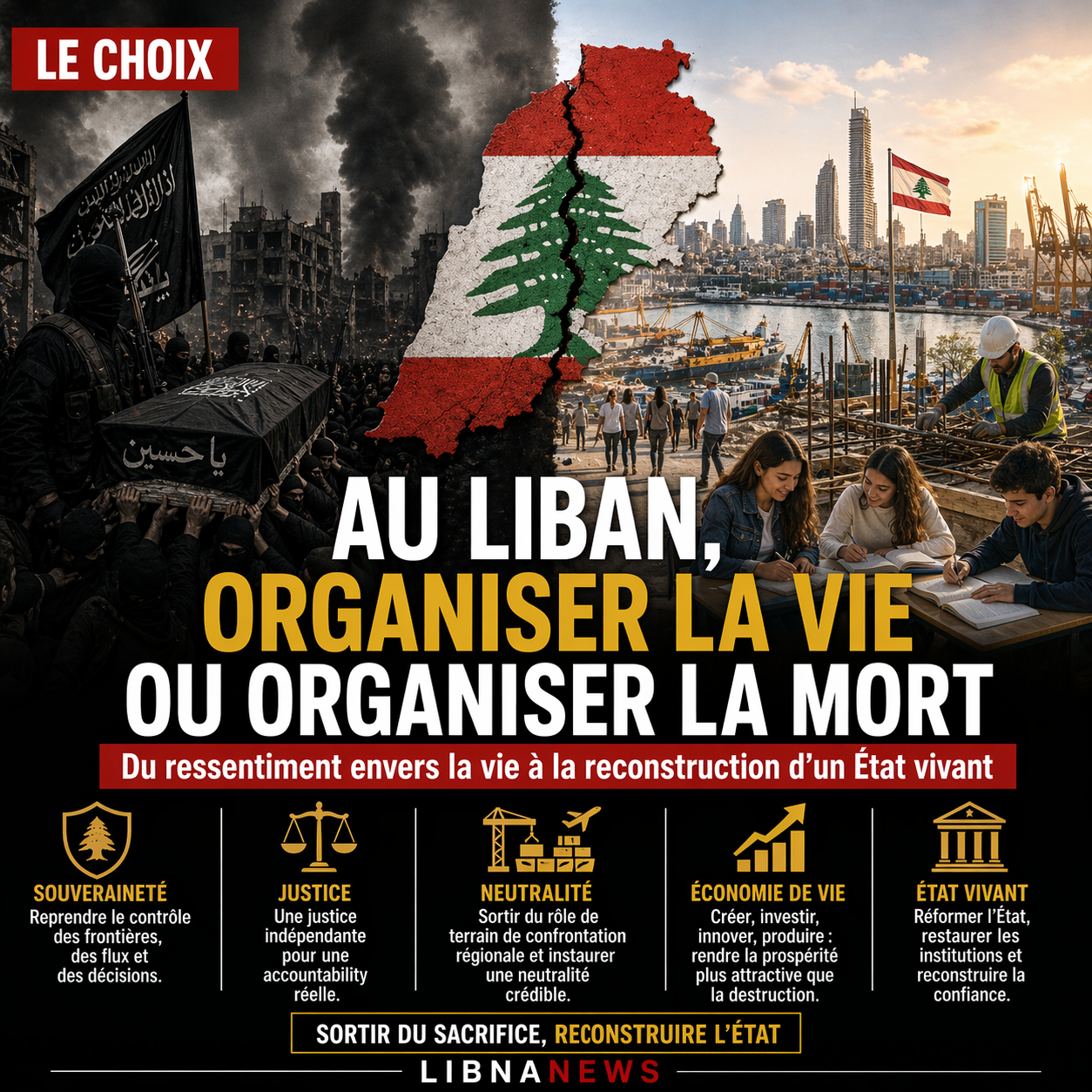
From resentment of life to reconstruction of a living state
There are moments in history when a society is not only fluctuating under the weight of economic or military crises, but under a deeper, more insidious drift: the one that transforms death into a political horizon.
It is not just a question of war. All societies are experiencing war. What distinguishes certain contemporary dynamics is another thing: the progressive construction of an imaginary where death is no longer a tragedy, but an end; where sacrifice is no longer an exception, but a norm; where to live fully becomes suspect, almost secondary.
Resentment Against Life
Any ideology that glorifies death almost always begins with an unease in the face of life. Not biological life, but life in what it has free, multiple, unpredictable.
This malaise turns into resentment.
Resentment against prosperity perceived as corruption, against freedom perceived as decadence, against diversity perceived as disorder. In this context, life is no longer a value in itself. It becomes a test to transcend or even an obstacle to overcome.
Then appears a fundamental inversion: what elsewhere is considered an irreparable loss — death — becomes a fulfillment here.
Sacrifice Theology
This shift is not just about politics. It anchors in a particular reading of the religious.
Sacrifice becomes central. Not as an exceptional act, but as an ideal. Martyr is no longer a tragic figure. He becomes a normative figure.
However, any society that establishes sacrifice as a model mechanically produces a hierarchy of lives: some lives are to be lived, others to be offered.
This logic, pushed to its end, ends up trivializing the destruction — of self, of others, of the world.
When the Umma exceeds the Patria
To this is added a major political break: the dissolution of the nation-state as a framework of loyalty.
When the first allegiance is no longer to the homeland, but to a transnational community — Umma — then sovereignty becomes secondary.
And when this Umma is itself structured around a principle of centralized religious authority, embodied in certain doctrines by the Wilayat al-Faqih, the consequence is clear: there is no longer autonomous national sovereignty.
In this vision, political boundaries become contingent. The state is no longer a subject. It becomes a land.
The logic of permanent war
Such a structure cannot function without permanent tension.
It rests on a constant opposition: between pure and unclean, between the believer and the enemy, between the world as it is and as it should be.
War in this context is not an accident. It is a condition of existence. It nourishes the narrative, legitimates the sacrifice and maintains the mobilization.
Without conflict, the system loses its energy.
Anti-Semitism, visceral anti-Zionism and absolute conflict
In this ideological landscape, some forms of hostility go beyond political criticism to become structural elements of identity.
When the adversary is essential, the conflict ceases to be political in order to become existential. And an existential conflict has no lasting compromise. It produces only cycles of confrontation.
In this context, hostility towards Israel is central. But to understand it, it is necessary to distinguish between policy and structural.
Criticism of a State, its policies or actions, is legitimate in any international debate. It belongs to the order of politics, therefore of the questionable, of the negotiable.
But what is often observed in some regional dynamics goes beyond this framework.
There is a shift towards absolute anti-Zionism, which no longer targets policies, but the very existence of the State of Israel. This shift turns a political conflict into an existential conflict.
Where does this radicality come from? It is placed in several superimposed layers.
First, an unsolved historical memory marked by wars, defeats and collective humiliation. In this context, Israel is perceived not only as an adversary, but as the symbol of a wider imbalance — political, military, and sometimes civilizational.
Secondly, a political instrumentalization of the conflict, which allows us to unite, mobilize and divert attention from internal crises. Conflict becomes a tool for cohesion. It structures identities, legitimates powers, justifies sacrifices.
But there is also a deeper dimension.
In some ideological visions, the existence of a sovereign non-Muslim state at the heart of a space historically perceived as belonging to religious or civilizational continuity poses a problem of legitimacy. It is no longer a question of borders, but of representation of the world.
To this is sometimes added a confusion, whether voluntary or not, between: Judaism (religion), Jews (people), Zionism (political project), State of Israel (geopolitical reality).
When these distinctions disappear, rejection becomes global, indistinct, and tends to take essentialized forms.
It is at this point that political criticism is shifting towards a logic of structural hostility.
And in this sense, the denial of the State of Israel is not just a strategic goal. It becomes an ideological necessity.
For accepting Israel’s existence would be tantamount to questioning certain founding narratives, certain worldviews, certain power relations.
The refusal then becomes an identity.
But this position has a major consequence: it locks the conflict into a permanent impasse.
For a conflict in which one of the actors denies the existence of the other can produce neither compromise nor lasting stabilization. It can only produce cycles of confrontation.
And these cycles in turn fuel sacrificial logic.
The anthropological shift
What is at stake is even deeper: it is an anthropological shift.
In a life-oriented society, children are raised to live better than their parents. In a society structured around sacrifice, they are raised to be ready to die for a cause.
When dying becomes a promise of meaning, living loses its centrality.
The economy of sacrifice
A society organized around death cannot produce a stable economy.
Investment implies confidence in the future. Innovation implies freedom. Prosperity requires peace.
In their place a parallel, dependent, fragile economy develops. A survival economy.
The capture of sovereignty
In this model, sovereignty is not only weakened: it is captured.
The state remains apparently, but the real decision moves elsewhere: towards parallel structures, towards external ideological centers.
The result is an institutional fiction.
Companies taken hostage
A structured, coherent, sacrifice-ready minority can impose its logic on a majority attached to life but fragmented.
The imbalance is not demographic. He’s existential.
The silence of majorities
Those who want to live have something to lose. They’re careful, scattered.
Conversely, those who sacralize death do not have this constraint.
It is this asymmetry that often explains the domination of a minority over a majority.
Out of the sacrificial logic
Leaving this model cannot be a slogan. It’s a strategy.
Rehabilitating real sovereignty. Redefine the collective narrative. Rebuilding an economy of life. Clearly separate faith and power. Restore the individual.
Application in Lebanon: from theory to action
Lebanon is today the perfect venue for this duality.
A country divided between two systems: a life system, fragmented, weakened, and a system of mobilization, structured, coherent.
The real issue is not technical. It’s structural.
But we have to say things clearly.
How do you want Lebanon’s friendly countries to help Lebanon… If Lebanon itself does not help?
For more than ten years, the same requirements have been laid down: a truly independent judiciary, financial control of the state independent of political powers, deep restructuring of the state, effective responsibility of the leaders.
Nothing structural has been put in place.
As long as these reforms are not initiated from within, no external aid, however massive, can produce anything but a temporary respite.
Because we don’t save a country… Against himself.
Strategic objective
Restore effective sovereignty based on a living economy.
Priority 1 — Progressive recovery of sovereignty
Without frontal confrontation, erosion and institutional framework. Resuming control of flows: customs, ports, airport.
Axis 2 — Reversal of the narrative
Making core values successful, creative and prosperous. Mobilizing the diaspora as a strategic lever.
Priority 3 — Targeted economic reconstruction
Create stable, protected, attractive economic zones. Making war economically incompatible.
Priority 4 — Strategic neutrality
Remove from the role of regional confrontational terrain. Create credible and guaranteed neutrality.
Axis 5 — Institutional reform
Independent justice, real accountability, electoral reform. Without justice, no reconstruction holds.
The fundamental choice
Basically, the question is simple: Organize life, or organize death. Both logics are incompatible.
The courage to live
There is a clear courage to die.
But there is a rarer, more demanding courage: that of living. Build. Create. Forward. Deny fatality.
Civilizations do not disappear only when they are defeated. They disappear when they stop believing that life deserves to be lived.






