

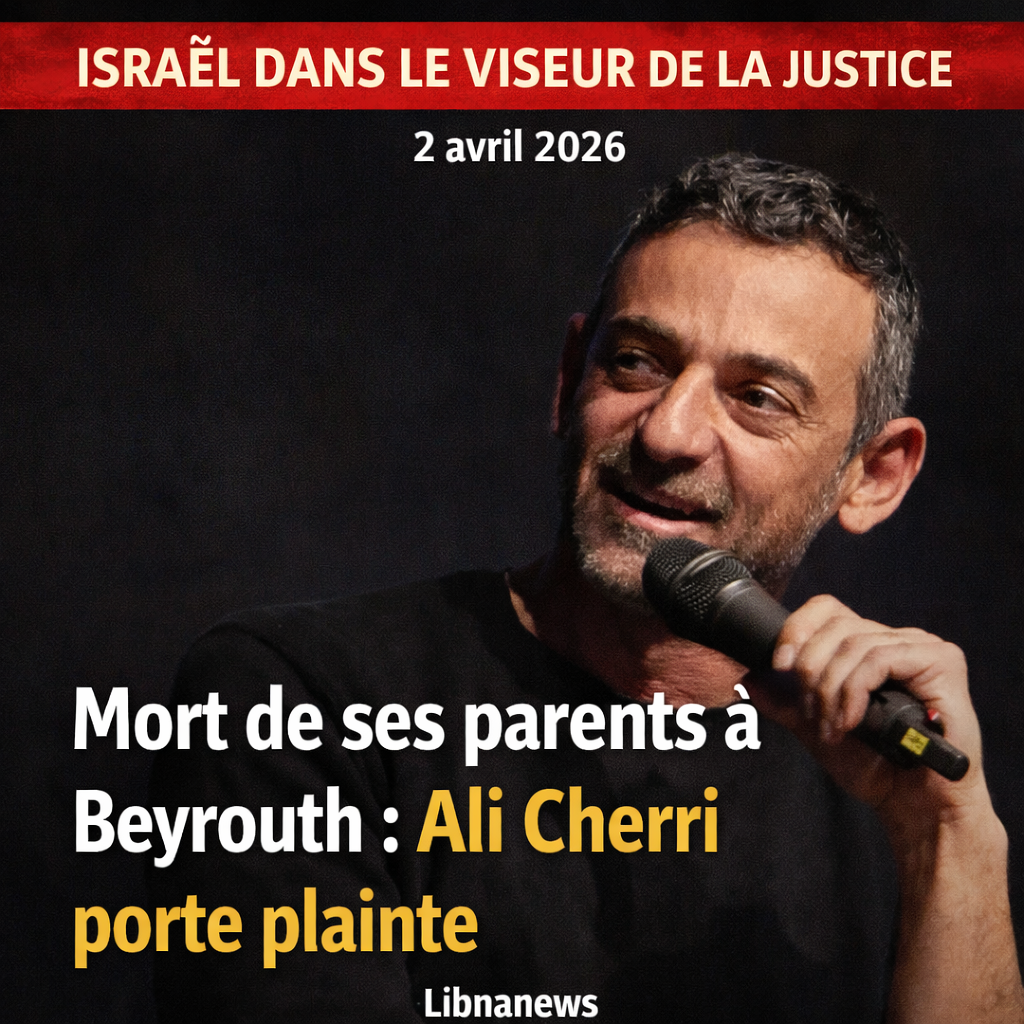
Franco-Lebanese artist and filmmaker Ali Cherri seized the French courts after his parents died in an Israeli bombing of the family building in Beirut on 26 November 2024, a few hours before the ceasefire came into force. Filed with the International Federation for Human Rights, the complaint concerns a possible war crime and places the alleged attack on a civilian building in the Lebanese capital at the centre of the case.
Ali Cherri’s complaint in France marks a new stage in the judicialization of the strikes in Lebanon during the war between Israel and Hezbollah. The Franco-Lebanese artist and filmmaker initiated this procedure after his parents died in the bombing of their apartment in the Mazraa-Barbour neighbourhood of Beirut. The attack, carried out on 26 November 2024, occurred only a few hours before the ceasefire came into force. Seven civilians were killed in the strike, including the artist’s father and mother.
Beyond the family tragedy, the case has a broader political and judicial dimension. The complaint before the French courts denounces a deliberate attack on a residential building. It is based on the idea that the building affected was not a military objective but a civilian property protected by international humanitarian law. By choosing to refer the matter to the French courts, Ali Cherri does not only seek to have personal harm recognized. It also places at the heart of the debate the question of criminal responsibility in the bombings that struck Beirut in the last few months of the conflict.
The case is part of a sequence in which several Israeli strikes in Lebanon have raised strong challenges to their legality. This time, the appeal comes from a recognized figure in the international art scene, but the heart of the case remains that of a destroyed apartment, of civilians killed and of a family demanding accounts. The stake is not merely symbolic. It is also legal: turning a destruction of war into a subject of judicial investigation, with precise criminal qualifications, technical elements and a chain of responsibility to be established.
A strike on the eve of the ceasefire
The bombing targeted in the complaint struck Ali Cherri’s family building in the Mazraa Barbour area in Beirut on 26 November 2024. The attack occurred about ten hours before the entry into force of the ceasefire between Lebanon and Israel. This temporal proximity gives the folder a particular load. While the truce was imminent, the strike hit a residential urban area of the capital and resulted in the death of several civilians.
The victims included the artist’s parents, who were killed in their apartment. The building suffered heavy destruction, with several floors blown or rendered uninhabitable. For complainants, the very nature of the target is at the centre of the case. They claim that it was a civilian building and not a military facility. It is on this point that the architecture of the complaint rests: if the building were to be used for civilian purposes, then its deliberate destruction could be a war crime.
The temporality of the bombardment also feeds a broader question about the conduct of operations in the last hours of the war. In modern conflicts, the approach to a ceasefire does not automatically suspend fighting, but it often reinforces the requirement for careful consideration of military necessity and humanitarian consequences. In this case, the central question therefore becomes this: what was the operational justification of a strike against a residential building in Beirut a few hours before the truce? This is precisely what the complaint intends to have a judge examine.
A complaint based on a possible war crime
The remedy in France is based on a heavy criminal characterization: that of war crimes. Specifically, the complaint argues that the bombing could constitute a deliberate attack on civilian property. Under international humanitarian law, parties to a conflict have a permanent obligation to distinguish military objectives from civilian and civilian objects. This distinction is one of the most fundamental principles of the law of war.
In the case of Ali Cherri’s family building, the complainants consider that this obligation has not been fulfilled. Their argument is not limited to saying that the strike would have been reckless or disproportionate. He goes further: he claims that the building was a civilian object and that his attack is therefore potentially deliberate and illegal. This qualification, if retained, would place the case within the scope of the most serious crimes prosecuted by specialized courts.
The filing of the complaint in France is also based on the personal situation of Ali Cherri, a Franco-Lebanese, and on the possibility of seizing the competent pole for international crimes. The case is not a conviction in itself. It initiates proceedings and asks the court to verify whether the evidence gathered is sufficient to initiate judicial information. But the mere fact that the case comes before a specialised court already gives the case a new scope. It is no longer just a public denunciation or a story of destruction. This is a formal request for criminal qualification.
The central role of visual expertise
The complaint is based on a technical investigation based on images, digital reconstitutions and field documentation. A digital reconstruction carried out by Forensic Architecture, along with evidence collected by Amnesty International, is being mobilized to support the idea that the strike deliberately targeted a civilian building. These expertises have become, over the past few years, major instruments in war crimes cases.
The use of this type of methodology responds to a well-known difficulty of contemporary conflicts. In many cases, direct access to strike sites, chains of command and military justifications remains extremely limited. Human rights organisations and specialized teams must therefore reconstitute the facts from a fragmented set of materials: videos, satellite images, photographs, debris, testimonies, building plans, strike temporalities. These elements are then crossed in order to reconstruct the scene and test the consistency of the available versions.
In the Ali Cherri case, this dimension is particularly important. The record is not based solely on personal testimony, however upsetting it may be. It seeks to be part of a broader evidentiary framework based on spatial analysis and independent documentation. It is this combination of family mourning and expert work that gives the complaint its density. The case is presented not only as an individual suffering, but as a possible documented example of a violation of international humanitarian law.
A complaint against Israel that goes beyond the personal case
Even though Ali Cherri’s parents’ tragedy is at the centre of the case, the complaint against Israel far exceeds the only intimate framework. It is part of a broader sequence marked by the intense bombings in Lebanon between October 2023 and November 2024, the destruction of homes, massive displacements and repeated accusations of violations of the law of war. In this context, each documented case can become a test case to question more broadly how military operations have been conducted.
The appeal filed in Paris could thus become a reference for other Lebanese victims. If the French justice system decided to open judicial information, this would create an important precedent. This would show that a bombardment in Lebanon may, under certain conditions, be examined by a foreign court specialized in international crimes. For many families, this would open up a very limited possibility: that of a concrete judicial framework to make their case heard.
The case also raises a deeper question about the place of impunity in contemporary conflicts. Air strikes against urban areas often produce a huge mass of destruction, but very few cases result in an individualized investigation of responsibilities. By filing a complaint, Ali Cherri moves the center of gravity of the debate. It is no longer just a matter of politically condemning a war or denouncing destruction. The aim is to require a judge to examine a specific case, a specific date, a specific building, identified victims and a strike whose legality is contested.
Paris as a judicial scene
France’s choice is not neutral. Paris has a specialized centre competent for certain international crimes, including war crimes. For the complainants, this court offers a framework that is both more structured and more likely to open up a genuine investigation than other areas where recourse is more limited. The judicial strategy here is to get the case out of the field of emotion alone, to include it in the procedure.
This illustrates a broader trend observed in recent years. Increasing numbers of victims and organizations are using national jurisdictions with expertise to try crimes committed abroad. France is one of the countries where this kind of litigation can emerge. This mechanism does not guarantee the outcome of all complaints. However, it provides a procedural space where remedies remain rare or non-existent.
In the case of Ali Cherri, the application before the French court also allows the case to be settled in a territory governed by law where documentation, testimony and expertise can be placed on the file. This is an important change of registry. A war strike, which could have remained drowned in the mass destruction of the conflict, becomes a legally individualized fact. It is subject to qualification, argument and inquiry. This passage from the narrative to the record is in itself a turning point.
The artist faced with the destruction of his own family history
The scope of this case also lies in Ali Cherri’s trajectory. His artistic work has long explored the ruins, bodies, remains, borders and traces left by political violence. But with this complaint, the artist no longer treats destruction only as an object of reflection or creation. He finds himself confronted in his own family history. The destroyed apartment is not an abstract symbol. It is the place where her parents lived, becoming in seconds a field of debris.
This dimension gives the file a particular intensity. Legal recourse does not replace mourning. It does not restore lost lives or destroyed family space. But it otherwise extends the memory of the event. He refused to allow the bombing to be absorbed by the general noise of war. He claims that a building in Beirut, a date, victims and possible responsibilities deserve special consideration. For a family, this approach is often the only way to put loss in a continuity that is not just that of silence or oblivion.
The case also shows how artists, intellectuals and public figures can, at times, become actors of judicialization. Their visibility does not change the nature of the facts. But it can increase the resonance of a complaint and draw attention to broader accountability mechanisms. In this case, Ali Cherri does not appear merely as a recognized personality. He first appears to be a son who brings to justice the death of his parents in their apartment in Beirut.
What the procedure seeks to establish
The complaint lodged in France aims to have several decisive points verified. The first concerns the civilian nature of the destroyed building. The second concerns the possible absence of elements to justify this building as a military objective. The third touches the decision chain that led to the strike. Finally, the procedure seeks to determine whether the attack can be described as a war crime under applicable law.
In other words, justice must examine not only the material fact of destruction, but also the operational context in which it occurred. Who gave the order? On what basis? With what information? What precautions have been taken? What was the stated or real objective? These issues are essential in any case relating to bombings in urban areas. They are even more so when a residential building and killed civilians are at the centre of the file.
The outcome of the complaint will therefore depend on the ability of technical, documentary and personal elements to convince the court to go further. At this stage, nothing is acquired on the merits. But the procedure has already produced a political and symbolic effect: it gave a judicial name to what, for the Cherri family, was first an intimate catastrophe. It has also reopened a key issue in the Lebanese case: responsibility for strikes against civilian spaces.
A case to count in Lebanon’s litigation
If progress is made, it could be an important part of the international dispute related to Lebanon. Judicial remedies of this nature remain rare when it comes to Israeli strikes on Lebanese territory. The Ali Cherri case could therefore become a point of reference, not only for other victims, but also for lawyers, NGOs and investigators working on violations committed during the conflict.
The case also has a signal value. It recalls that bombings against civilian areas do not necessarily disappear with the end of the fighting. The ruins can become evidence. Images can become evidence. Families can become complainants. And States, even when acting in a war context, may see certain operations subject to judicial review abroad.
In this context, Ali Cherri’s approach transforms a tragic episode of war into a question of law. It places in the centre civilian deaths, the destruction of a residential building and the need to establish whether the strike was a lawful military action or a prohibited act. The file is only at its starting point. But it already highlights what the families of the victims have been trying to impose for a long time: that a bombardment be not only told, but judged.






