

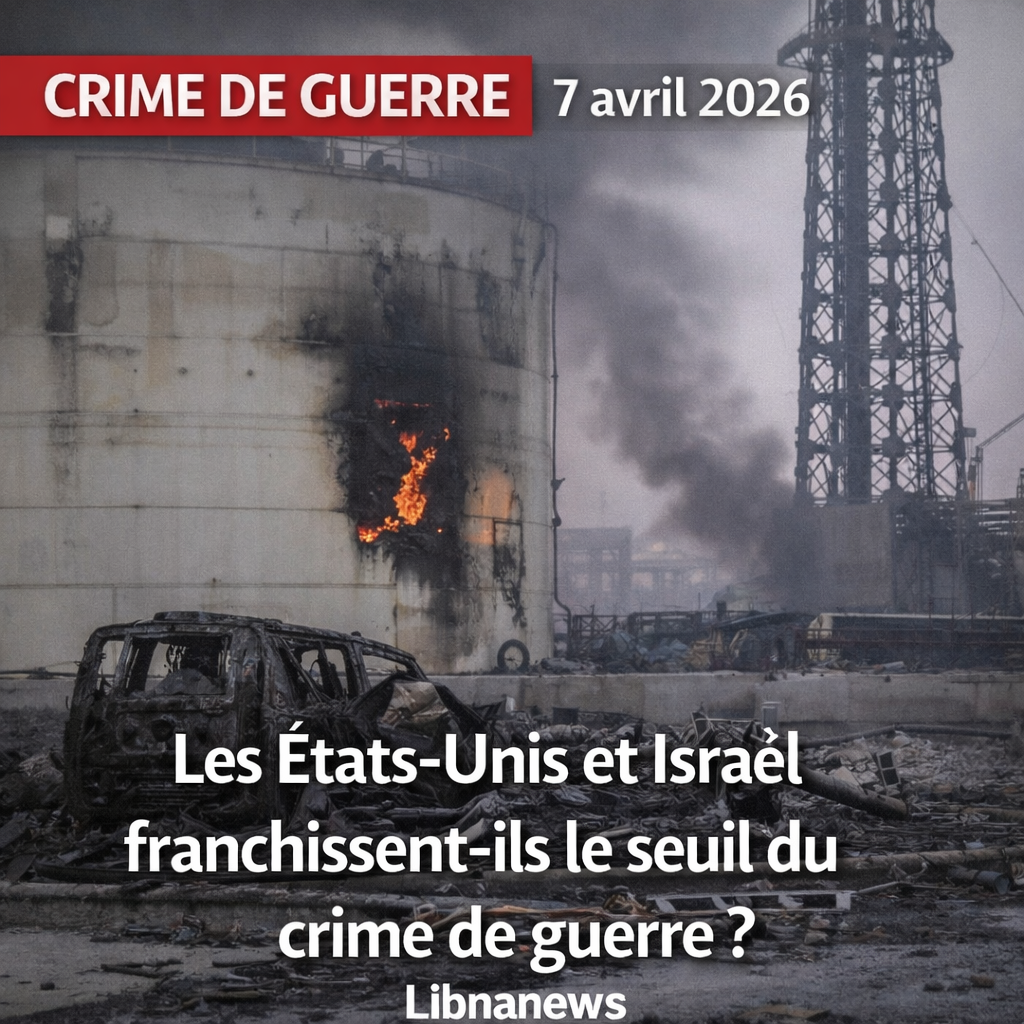
The question is no longer marginal. It no longer belongs only to NGOs, militant forums or opposing diplomacy. It is now at the centre of the international debate: are the United States and Israel, by aiming at or threatening to target bridges, power plants, gas sites and other infrastructure essential for civilian life, turning into war crimes? Given the facts, Washington’s rhetoric and the widening of targets in Iran, the most rigorous response is neither a speedy acquittal nor an expeditious condemnation. Only a court can decide. But one thing is already clear: the legal risk is serious, documented, and now recognized far beyond the only opponents of the United States and Israel. Experts in international law, the International Committee of the Red Cross, United Nations officials and several major media outlets are openly talking about potentially unlawful attacks on vital civilian infrastructure.
This shift is due to two mutually reinforcing elements. The first is material: strikes in Iran targeted bridges, railways, energy installations, and Kharg Island was hit on military targets in the immediate vicinity of the country’s main oil node. Israel, for its part, has repeatedly hit the South Pars gas complex, as well as petrochemical and industrial sites of very high civil and economic value. The second is verbal: Donald Trump explicitly threatened to destroy Iranian bridges and power plants and, questioned about the risk of war crime, replied that he was « not at all » worried, before justifying his position by describing Iranian leaders as « animals ». This sequence has been reported by several American agencies and media; The White House did not publicly specify which media had asked the question, even though Trump was caught in the New York Times in the same period.
The use of this word, « animals », is not a rhetorical detail. Under the law of war, dehumanization alone does not create crime, but it counts. It sheds light on the political intention, the way the target population is thought and the report assumed with humanitarian limits. When a head of state threatens to spray the infrastructure of a country, claims to be indifferent to the accusation of war crime and justifies this indifference by means of a formula of dehumanisation, he no longer merely speaks as a belligerent. It establishes a framework in which civil suffering becomes secondary or even politically useful. It is precisely this kind of slippage that the ICRC denounced when it warned, two weeks ago, that « war on essential infrastructure is a war against civilians » and that deliberate attacks on vital services can constitute war crimes.
Law is stricter than war communication
The core of the topic was a simple rule of international humanitarian law: civilian property could not be targeted as such. The Geneva Conventions and customary law require a distinction between military objectives and civilian objects. A bridge, power plant, gas site, energy network or industrial infrastructure does not automatically become lawful targets because they have economic or symbolic value. They can only be attacked if they make an effective contribution to military action in the specific circumstances of the moment, and the attack must respect proportionality and possible precautions to avoid excessive damage to civilians. The ICRC further recalls that it is prohibited to attack, destroy or render useless objects indispensable for the survival of the civilian population. The Rome Statute, which established the International Criminal Court, also protected civilian property and covered war crimes and, in the most serious cases, certain crimes against humanity.
This is where the distinction between military attack and criminal attack becomes decisive. A so-called « dual » infrastructure, such as a power plant that supplies both barracks and hospitals, can sometimes be considered a military objective. But the law does not permit its destruction freely. A concrete, immediate and sufficiently precise military advantage must be demonstrated. It is then necessary to assess whether the expected damage to civilians is proportionate. And we must finally take all possible precautions. However, it is precisely on these three points that concerns are growing. Legal analyses relayed by news agencies indicate that a general threat against « all » the power plants or « all » the bridges of a country is far removed from the logic of individualized military objectives and tends towards a logic of collective punishment or political coercion.
In other words, not everything is played in the physical nature of the object concerned, but in intent, accuracy, proportion and context. A bridge used exclusively for a military movement may, under certain conditions, be targeted. A campaign announced against all the bridges of a country, to force political capitulation, falls into another category. Similarly, striking an energy site directly integrated into a military operation is not equivalent to threatening to shut down the entire power grid of a state. It is this difference that Donald Trump’s comments deliberately blur when he promises to « destruct » Iranian bridges and power stations in a few hours if Tehran does not give in.
The facts alleged in the United States
Since late February, according to news agencies and several reference media, the United States has initially focused its strikes on Iranian military and nuclear targets, before gradually expanding its spectrum to increasingly sensitive infrastructure for civilian life. A bridge in Karaj was struck. Explicit threats have been made against bridges and power plants across the country. Kharg, Iran’s main oil export point, saw American strikes on military targets in the immediate vicinity of the country’s most strategic energy infrastructure. Legal experts cited by AP, the Washington Post and other media believe that this trend is bringing American action closer to a campaign against systems essential to daily life, and not just against ad hoc military capabilities.
The presidential threat itself has become a legal fact. Trump said he could destroy Iran’s bridges and power stations in a few hours, and he explained that he was not « at all » afraid of committing a war crime. When a journalist asked him how such a campaign might not be covered by the war crime, he replied by invoking the abuses of the Iranian regime and adding: « they are animals ». This answer is not a judicial decision, but it weighs heavily in the context. It shows that the protection of civilians is not at the heart of the presidential argument; It is relegated to a logic of moral retaliation and absolute constraint. Several American war law experts have reported in the press that such a speech circumvents or disregards the safeguards usually imposed on military targeting.
In addition, more than one hundred American jurists have, according to agencies, signed an open letter suggesting that some American strikes in Iran could constitute war crimes. The letter cites attacks on schools, medical sites and vital systems. Again, caution is required: not all allegations are yet established by an independent and contradictory investigation. But the mere fact that this level of alarm is now carried by leading academics shows that it is no longer in a purely political polemic. Legal language was imposed because the facts and threats crossed a threshold.
What Israel is accused of
Israel, for its part, is in an even more delicate position on the legal front, because its action is not limited to the current Iranian front. The arrest warrants issued by the International Criminal Court against Benyamin Netanyahu and Yoav Gallant in November 2024 were already based, inter alia, on suspicions of war crimes and crimes against humanity related to the deprivation of essential property in Gaza. Israel strongly challenges these accusations, but the institutional fact exists: the ICC has held that there are reasonable grounds to believe in crimes involving the deprivation of food, water, medicines and other essential goods. This precedent is very important in the current analysis, as it shows that the issue of infrastructure and vital systems is not abstract in the Israeli case; It is already at the heart of an international criminal dispute.
On the Iranian front, agencies reported that Israel had repeatedly hit the South Pars gas complex, described by AP as an « energy lifeline » for Iran. The site plays a major role in the country’s gas supply, petrochemical production and export earnings. Other media also documented strikes on petrochemical, industrial and health facilities, including medical and pharmaceutical institutions. Here again, Israel can invoke the military use of certain sites or their role in financing armed structures. But the more energy, medical and industrial systems with very strong civil centrality are affected, the more difficult it becomes to rule out the question of proportionality and distinction.
The classical Israeli argument is that the Iranian regime, like other armed actors in the region, voluntarily interlocks its military facilities into civilian networks. The law does not ignore this reality. If civilian infrastructure is used for direct military purposes, it may lose its protection. But this argument does not function as a general immunity. It does not allow indiscriminate strikes, attacks on entire networks, or destruction of vital systems when the military advantage expected remains unclear or disproportionate. In other words, even dual use does not automatically whiten a campaign against electricity, gas or bridges.
War crime, yes; crimes against humanity, perhaps
The strongest issue at this stage is war crime. The law is clear: targeting civilian property without military necessity, or causing excessive civil damage to the military advantage expected, can constitute a war crime. Attacks on essential services, when their destruction endangers the survival of the population, may fall into this category. On this point, Trump’s threats, strikes on bridges, attacks on major energy installations and repeated targeting of critical infrastructure in Iran create a serious basis for legal suspicion against the United States and, as the case may be, against Israel.
The characterization of crimes against humanity is heavier and more difficult to establish. It usually involves a widespread or systematic attack against a civilian population, in accordance with a State or organisational policy. Certain forms of « extermination » or « other inhumane acts » may include the deliberate imposition of destructive living conditions. The mere bombing of an infrastructure is therefore not enough automatically. On the other hand, if a demonstrated campaign sought to break the civil life of a country on a sustainable basis by destroying its electricity, bridges, gas networks, health systems and roads, then the question would no longer be theoretical. That’s precisely why Trump’s vocabulary — « a civilization is going to die tonight » — alarmed lawyers so much. It seems to assume the civilian scale of destruction, not only its military utility.
We must remain rigorous: we do not decree a crime against humanity in an editorial or even in a report. But it can be seen that the elements that feed this qualification are approaching dangerously. When the US President publicly threatens to destroy the vital infrastructure of a whole country, claims his indifference to the accusation of war crime and dehumanizes the adversary, he no longer leaves any doubt about the legality of certain strikes. He himself opened the door to the most serious qualifications.
What one can say, without waiting a court
At the strictly journalistic and analytical level, the observation can be formulated with caution but without detours. Yes, the United States and Israel today face serious charges of war crimes as a result of attacks, threats of attacks or campaigns targeting vital civilian infrastructure such as electricity, gas, bridges and certain industrial or medical systems. No, it is not possible at this stage to assert as a definitive judicial act that all these acts already constitute war crimes or crimes against humanity: this will depend on independent investigations, evidence of military or non-military use of the sites concerned, proportionality, intent and the actual extent of civil damage. But the red line is further away. She’s already visible.
And this is probably the central point. The novelty is not only that lawyers, humanitarian workers and diplomats now use the word « war crime ». The novelty is that American leaders themselves speak as if they wanted to trivialize this possibility. The ICRC warned that the rules of war should be respected « in words and in acts ». It’s an essential reminder. For the law of war does not collapse only when a bomb strikes a power plant. He also began to shirk when a head of state explained that he was « not at all » afraid of committing a war crime and that those opposite were « animals ». From there, the question is no longer just what is being bombed. The question also becomes: what limit does not yet have to be crossed?






