

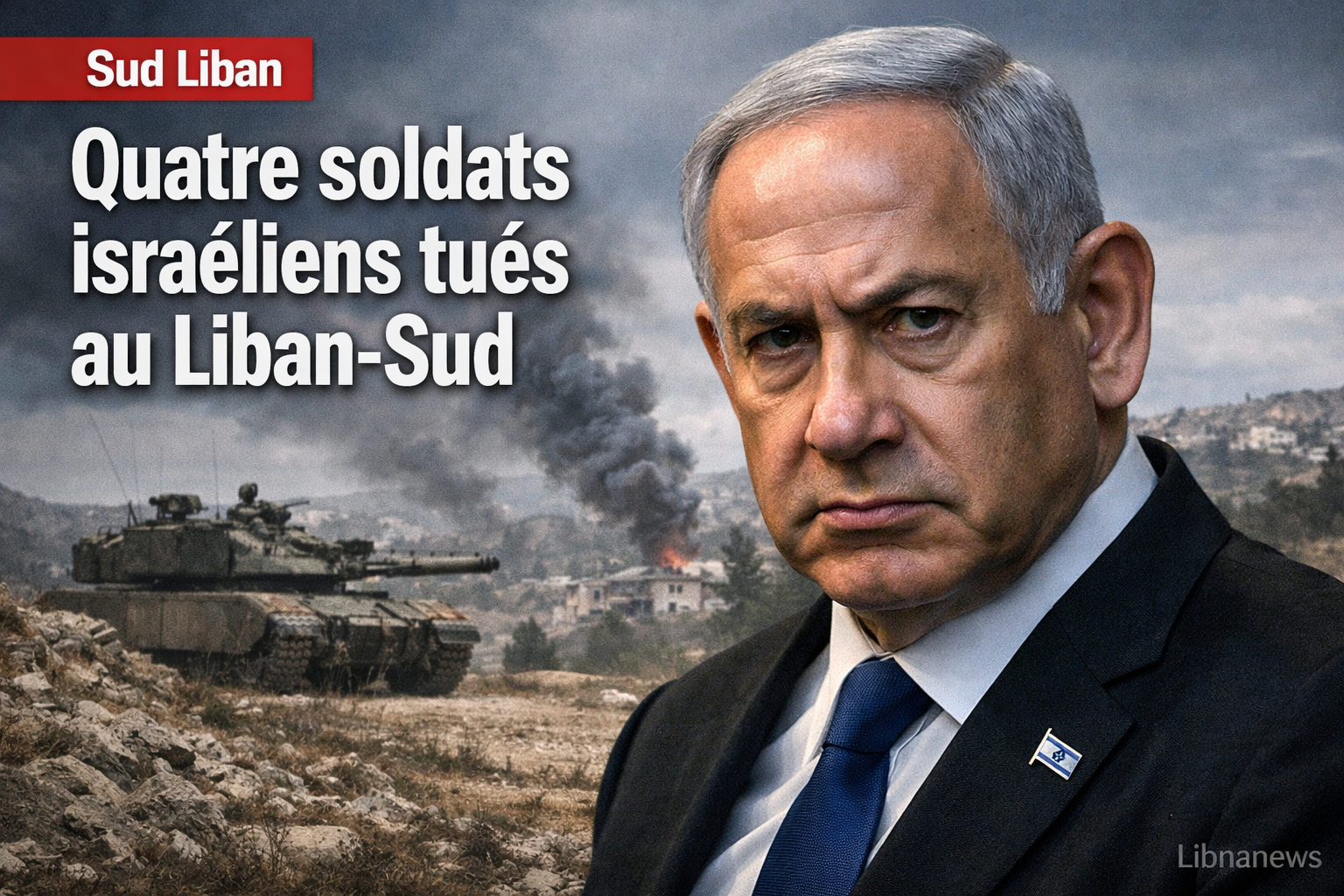
On Tuesday, the Israeli army announced the death of four soldiers in southern Lebanon, all affected by the same incident the previous day. According to the military statement relayed by several international media, three members of a Nahal Brigade reconnaissance unit died « in combat » on Monday, while a fourth soldier was killed in the same episode. Another member was seriously injured and one reservist was slightly injured. With these deaths, the official Israeli record of military casualties in Lebanon since the resumption of hostilities on 2 March now reaches 10 deaths. This sequence marks a turning point in an operation presented to Israel as necessary to secure the northern border, but which exposes its land units to a war of wear and tear on rugged, fragmented and highly militarized terrain.
An incident affecting the Israeli campaign
Beyond the human record, this incident focuses on several of the difficulties encountered by the Israeli army in southern Lebanon. First, it recalls that ground operations remain vulnerable to close combat, anti-tank fire and ambush, even when aviation dominates the airspace. Secondly, it comes at a time when Benjamin Netanyahu’s government has chosen to further expand the scope of operations in Lebanese territory. On 29 March, the Israeli Prime Minister stated that he had ordered an additional extension of the « security zone » in southern Lebanon. A few days earlier, his Minister of Defense had already mentioned an Israeli checkpoint to the Litani River, some 30 kilometres from the international border. This direction confirms that the objective is no longer merely to respond to one-off fire, but to reshape the military environment along the border in a sustainable manner.
However, the price of this strategy is becoming increasingly clear. The ground offensive exposes Israeli units to a different type of confrontation than remote strikes. In border localities, hills, steep valleys and discontinuous urbanization create land for brief but deadly clashes. Even when Hezbollah’s positions are weakened by bombings, the movement’s ability to conduct localized actions remains intact in several sectors. Reuters still reported, at the time of the death announcement, that the Israeli army did not provide precise details of the circumstances of the incident. This silence underlines both the imperatives of military communication and the operational uncertainty inherent in this front.
A resumption of war since 2 March
The death of these four soldiers is part of a new phase of the conflict on the Israeli-Lebanese border. According to Reuters and the UN agencies, the open escalation resumed on 2 March, in a deeply degraded regional context. Since then, gun exchanges, airstrikes and ground operations have increased in intensity. Hezbollah has resumed rocket fire into Israel, while the Israeli army has launched a much broader campaign in Lebanon, combining bombings, ground penetrations and evacuation orders. The Israeli authorities present this action as a security imperative to remove the threat from the northern border. On the Lebanese side and in international organizations, the reading is the opposite: the offensive has turned the country into a national human crisis.
Health data published by the World Health Organization, based on figures from the Lebanese Ministry of Health, show a rapid increase in civilian casualties and hospital pressure. As early as 8 March, WHO reported 394 deaths and 1,130 injuries since the beginning of the escalation, noting that Nabatiyah governorate was among the most affected. On 20 March, a further assessment by the organization reported a total of 3,585 casualties, of which 1,001 were killed and 2,584 were injured as at 19 March. These data do not only describe the intensity of the strikes. They also show the speed with which southern Lebanon, and then other regions, were dragged into a spiral well beyond the single front line.
Southern Lebanon, the heart of an asymmetrical confrontation
Southern Lebanon remains the military and symbolic heart of this confrontation. It is there that the Israeli army seeks to prevent rocket fire, to keep units away from Hezbollah and to reduce the capabilities of infiltration or anti-tank fire to the north of Israel. But this ambition has come up against a reality that has been known for years: the ground is in favour of a mobile, decentralized and familiar force of reliefs. Fighting in the South does not follow the logic of a linear battle. They are characterized by irregular contacts, destruction of villages, openings of evacuation corridors and successive re-engagements in areas already bombed.
The presence of Finul adds an additional layer of complexity. In recent days, the United Nations has confirmed the death of three Indonesian peacekeepers in two separate incidents in southern Lebanon. Two of them were killed after the explosion of their vehicle near Bani Hayyan, while another soldier of the UN mission was killed by the explosion of a projectile near a position near Adchit al-Qusayr. The Secretary-General of the United Nations has recalled that attacks against peacekeepers constitute serious violations of international humanitarian law and can be considered a war crime. This reminder shows how the South Lebanese theatre has become crowded, dangerous and difficult to control, even for the actors officially responsible for monitoring the cessation of hostilities.
A war that crosses the border
The current sequence is no longer limited to a bilateral confrontation between Israel and Hezbollah. Reuters points out that the new phase of war in Lebanon is part of a broader regional confrontation, in which Iran, Tehran’s regional allies and Israel’s partners intervene directly or indirectly. In this context, the Lebanese front serves as both a military field, a political lever and a strategic message. For Israel, the north can no longer remain an area of permanent threat. For Hezbollah, pressure on this border retains a dissuasive and political value, even at the cost of massive destruction in Lebanon.
This regional dimension also explains the harshness of the objectives announced by Israeli leaders. Benjamin Netanyahu claimed that he wanted to « fundamentally change the situation in the north, » while Israel claimed to eliminate a large number of Hezbollah fighters and reduce some of its ballistic capabilities. At the same time, sources cited by Reuters estimated more than 400 Hizbullah fighters killed since 2 March. However, none of these figures is sufficient to say whether the strategic objective is achievable. The recent military history of the Lebanese border shows, on the contrary, that a superiority of fire does not automatically translate into lasting political control of the ground.
Political Military Losses in Israel
In Israel, the death of four soldiers in the same incident exceeds the strict operational framework. Each human loss revives the debate on the real cost of a prolonged land offensive. The government emphasizes the need to secure northern localities and to keep Hezbollah away. But the families of soldiers, the opposition parties and part of the opinion are now looking at the coherence between the objectives and the results achieved. Ten Israeli soldiers killed in less than a month in this theatre alone represent, at the scale of this resumption of war, a warning signal for the executive.
This political pressure is all the greater as the Lebanese front remains intertwined with other military and diplomatic issues. The Israeli authorities want to show that they keep the initiative on several fronts at once. Yet, the opening or expansion of a land theatre in Lebanon mechanically leads to arbitrations in men, intelligence and communication. It also requires that the public should justify the losses incurred for an objective which remains formulated in general terms: to remove the threat, to create a safe zone, to restore deterrence. The longer the fighting continues, the more concrete the question becomes: how long can a regular army hold a moving front without turning a one-time operation into a prolonged engagement?
In Lebanon, continued human degradation
On the Lebanese side, the death of Israeli soldiers does not change the dominant reality of the conflict: the overwhelming majority of destruction and displacement is concentrated on Lebanese territory. The reports published by WHO and UNHCR describe a growing crisis. At the end of March, UNHCR reported that more than one million people had been forced to flee their homes since 2 March. In its follow-up table covering the week of 16-22 March, the UN agency recorded 1,049,328 displaced persons registered on the Lebanese government platform. As strikes multiply, schools turned into shelters, damaged road networks and the saturation of reception facilities further complicate assistance.
The health sector is under extreme pressure. The WHO reports refer to attacks on emergency medical services, damaged ambulances, affected relief centres and several hospitals closed or partially out of service. On 12 March, the organization had already recorded 33 attacks against medical emergency services since the beginning of the escalation, with 18 dead and 45 injured among the personnel concerned. At the same time, needs are increasing in collective shelters, where displaced persons are concentrated. This humanitarian reality gives southern Lebanon a unique place in the regional crisis: it is both the starting point of the military confrontation and the space where its civilian consequences remain the most visible.
What the Monday « incident » reveals
The word chosen by the Israeli army, « incident », is not trivial. It allows to group under a neutral formula an episode whose contours remain unclear but whose consequences are heavy. In contemporary conflicts, this type of formulation often aims to leave the exact tactical qualification open: ambush, anti-tank fire, explosion, direct confrontation or a combination of several factors. The absence of public detail therefore feeds the assumptions, without making it possible to decide. What is certain, on the other hand, is that the episode struck a reconnaissance unit, so soldiers engaged in contact, observation and avant-garde missions.
This is important because he says something about the current phase of operations. An army that projects reconnaissance units into disputed areas accepts a higher level of risk in order to open the ground, detect threats or prepare for broader actions. When these units suffer significant losses, this may indicate either a better organized adverse resistance than announced, or an increase in still unstable areas. In both cases, the Monday incident recalls that the battle of southern Lebanon is not just a matter of spectacular airstrikes. It is also involved in short, poorly documented but decisive commitments for real control of the ground.
Between buffer zone logic and risk of collapse
The Israeli buffer zone logic is not new. It responds to an old concern: to prevent a hostile force from directly threatening communities in northern Israel through fire, infiltration or anti-tank attacks. But the historical experience of the Lebanese border shows that the creation of a security depth alone does not guarantee lasting security. It requires continuous control, fine intelligence and political management of conquered or neutralized spaces. But each of these parameters is expensive, including when the adversary avoids frontal confrontation.
The problem is all the more sensitive as Hezbollah does not need to hold a territory in a conventional way to continue to weigh. It is sometimes enough to demonstrate its military survival, maintain a residual fire capacity or cause symbolically heavy losses. The death of four Israeli soldiers in one episode is precisely in response to this demonstration logic. It does not in itself reverse the balance of power, but it recalls that a land offensive can quickly produce a politically heavy balance for the party that engages it. At this point, therefore, the question is not only how far the Israeli army can move forward, but at what human and political cost it intends to stabilize what it conquers or neutralizes.
A front whose outcome remains undecided
In the short term, the Israeli announcement confirms above all that the northern front has entered a more expensive and less predictable phase. Israel’s targets are tightening, military losses are accumulating, Hezbollah’s capabilities remain partially active and the humanitarian situation in Lebanon continues to deteriorate. The peacekeepers themselves now pay a direct tribute to this escalation. This combination makes any quick reading misleading. Neither the Israeli firepower nor Hezbollah’s ability to survive locally is, for the moment, sufficient to draw a simple exit scenario.
On the ground, each new deadly episode alters the perception of the balance of power without necessarily changing its deep structure. The four deaths announced on Tuesday will weigh on the Israeli communication, the families concerned and the risk assessment by the units involved in the border band. At the same time, Lebanon continues to absorb the main shock in the form of civilian deaths, destruction of infrastructure and mass displacement. It is this twofold reality, military on one side, humanitarian on the other, which today defines South Lebanon: a space where the border is no longer a line, but a permanent attrition zone.






