

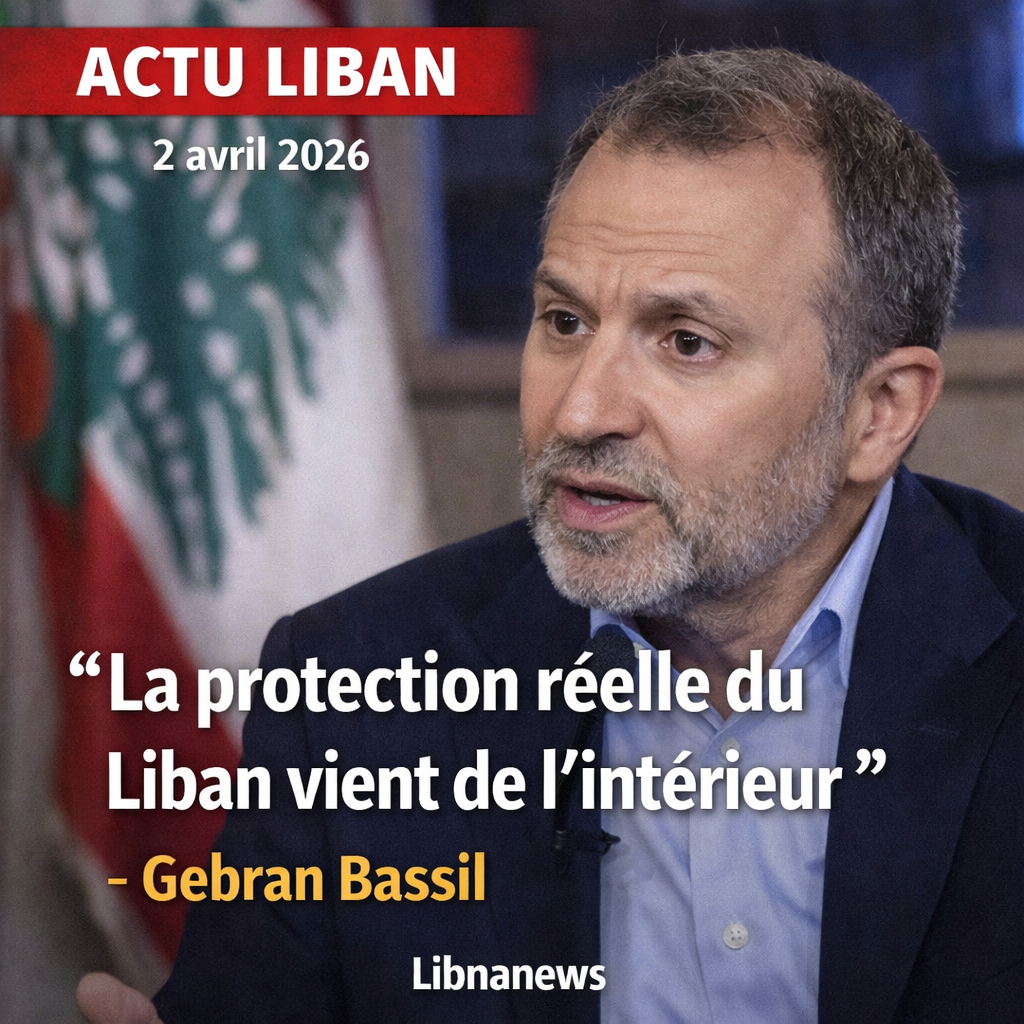
The President of the Free Patriotic Movement, MP Gebran Bassil, said that Lebanon was facing « an existential danger » in a context of regional war, pressure in the South and strong internal tensions. In an interview with Télé Liban, he denounced what he described as « ethnic cleansing » led by Israel, pleaded for national protection first based on an internal agreement and assured that his party was « only a messenger of good will to preserve this small country ».
The President of the Free Patriotic Current, Gebran Bassil, gave a very dark picture of the Lebanese situation. « Lebanon faces an existential danger, » he said, considering that the threat far exceeds the military framework. According to him, the risk is as much about the future of the South as it is about the integrity of the country itself. « There is a danger of seeing a part of the South amputated, and there are large countries talking about Sykes-Picot and changing borders, » he said. In his view, « this war, by its scale and transformation, threatens to dislocate Lebanon. »
Turning to the debates on the political system, Gebran Bassil asked the question of the country’s division in very direct terms. « How can Lebanon be divided geographically? » he asked, before pointing out that Christian villages and settlements extend over the entire territory. He said that « there should be no pre-position against federalism, » but that « geographical federalism is difficult in Lebanon. » At the same time, it reaffirmed its commitment to the Taif agreement. « We must stick to Taef, » he said, adding that « the condition for changing it remains agreement and realism. »
Call to protect border villages
The head of the CPL devoted a significant part of his intervention to the situation of border localities. He appealed to the army leadership to facilitate a safe passage for the exposed inhabitants. « I call on the army command to ensure a safe corridor for the inhabitants of the border villages, » he said. He also explained that contacts had been made with the Final and the Apostolic Nunciature to monitor the situation on the ground.
Gebran Bassil praised the tenacity of the inhabitants who remained there despite the bombings and the risks. « What happened there, attachment to the earth, warms the heart, » he said. It considered that the maintenance of these families on their lands is a form of resistance. « Whether Christian or Muslim, the one who stayed in the South resists, because he has decided to stay on his land in these circumstances, » he said. However, it has taken care to promote those who have left the most exposed areas. According to him, those who left also showed firmness and attachment.
In this reading, the question of the South is not limited to a front line. According to the MP, it commits the human and territorial future of the country. « We are Christians and Muslims, united by the will to stay on our land, » he insisted. He also recalled that, in his view, the Government bears direct responsibility with the Finul to ensure effective protection for the inhabitants of the border regions.
» We are only messengers of good will »
The President of the CPL then detailed the initiative launched by his party on the topic of the protection of Lebanon. He explained that visits and contacts were under way with religious, political and institutional leaders. « The current goes to the authorities, personalities and speaks with everyone, » he said. He stated that he had requested an appointment from the Lebanese Forces, but had not yet obtained it.
Gebran Bassil stressed the nature of this approach. « We want to bring everyone together, and we are just messengers of good will to preserve this small country, » he said. He added that the initiative had received « a favourable reception from religious and political references » because, according to him, it is expressed « in the language of the protection of Lebanon and not in that of a conflict between us ».
In his view, the gravity of the moment required maintaining dialogue among those responsible, even without removing substantive differences. « When we face an existential danger, we need to talk, not to give up our positions, but to confirm that there are red lines not to be crossed, » he said. He cited in the first place the absolute refusal of internal confrontation. « Among these red lines there is a ban on falling into internal fighting, » he hammered.
The rejection of a war between Lebanese
Gebran Bassil insisted at length on the need to prevent any shift towards a civil war. « What would we gain from an internal war? He asked. He believed that the country was already paying a heavy toll on human lives, destruction and forced departures. « We pay a terrible price in death, destruction of houses and emigration, » he said.
He also referred to the situation of Christians, whom he considered exposed in the current crisis. « Christians are in danger, but they must not be in error, » he said. He said he saw in the Apostolic Exhortation published by the Vatican in 1996 a fundamental landmark. « The compass is the apostolic exhortation issued by the Vatican in 1996, as well as what the pope said, » he said, adding: « There is no salvation for us without a Christian unity within a national unity. »
In the same vein, he denounced the projects he considered doomed to failure. « He who misleads this role and wants to repeat projects that have failed is he who misleads Christians, » he said. He assured that his camp had always been « receptive to any initiative to unify the Christian effort around the constants. » For him, the current crisis cannot be used as an excuse for overbidding that would destroy the little cohesion still preserved.
« The real protection of Lebanon comes from within »
On the role of the state, Gebran Bassil defended a clear line. « Lebanon must be its own guarantor, » he said. He considered that « the real protection of Lebanon comes from within », not from total dependence on outside actors. With this in mind, he called on the government to further support the military institution. « The government must protect the army, ensure a consensual climate and provide it with the necessary support in armaments, not create problems for it, » he said.
He also criticized what he considered a lack of initiative by the executive. « The government can do more, especially through diplomatic work, » he said. He made a clear distinction between two attitudes. « There is a difference between the fact that the state is standing at a distance from a war that it has not chosen between Hezbollah and Israel, and the fact that it is keeping away from the prevention of an internal war, » he explained.
According to him, the absolute priority is to prevent the regional conflict from turning into a Lebanese-Lebanese confrontation. « Why should we wait for a friend of Lebanon to tell us: stay committed to Lebanese identity and not give up the idea of Lebanon? » he asked. In his statement, this responsibility lies first and foremost with the Lebanese institutions and officials themselves.
Criticism of the lack of a defence strategy
The head of the CPL regretted the absence, in his view, of serious State work on a national defence strategy. « I never heard of a committee formed by the government to study a defence strategy, » he said. He accused the executive of waiting for an American document before approving it. « They only waited until the American sheet arrived, then they endorsed it, » he said.
For Gebran Bassil, Lebanon should be able to formulate its own approach. « We Lebanon could ask America to arm the army and conclude a defence agreement to protect Lebanon, » he said. He immediately added that this implies, in his logic, a redefinition of the status of Hezbollah. « Hezbollah must agree not to be part of an axis in Lebanon, » he said.
He developed the idea that the neutralization of Lebanon could pave the way for an arms solution. « If Lebanon is protected by neutralizing it, then Hezbollah can be asked to surrender its weapons, » he said. However, he warned that a resistance movement benefiting from popular anchoring does not disappear simply by military operation. « A resistance sustained by its base does not end with a single military action, and history has shown, » he said.
Hezbollah, war and political responsibility
Gebran Bassil blamed Hezbollah for having engaged the country in a war he had not chosen collectively. « Hezbollah has brought us into a war of support for Iran, » he said. He considered that no political component could lead Lebanon as a whole into a conflict « without the will of others ». He stressed, however, that the State must also assume its own responsibilities by proposing a defence strategy that obliges all parties to place themselves under its authority.
He also considered that Hezbollah is now committing a major political error. « Hezbollah’s mistake is to tie his weapon to his honour, » he said. He recalled that he had heard Hassan Nasrallah say in the past that « the weapon was a burden » and that it would « disappear when his function ended ». « Today we hear another speech, » he added.
At the same time, he highlighted another element. « What is happening is also about the Shiite component and gives it a pretext to say: I want to preserve my existence, » he observed. In his view, this reality cannot be ignored in any attempt to resolve the crisis. His approach is to maintain a clear critique of Hezbollah while refusing to treat the Shiite community as a party to be crushed.
» What Israel does is ethnic cleansing »
On Israel, Gebran Bassil used the toughest words of the interview. « What Israel does is ethnic cleansing, » he said. He accused the Hebrew state of seeking to cause the displacement of a central component of the country. « Israel is moving an essential component, » he said, believing that this strategy aims to change internal balances and create a lasting divide between Lebanese.
He also denounced what he considered an Israeli attempt to oppose each other. « Israel is trying to create a distinction between the Lebanese by giving the image that targeting only concerns the Shiites, » he said. According to him, the objective is clear. « She wants to put the Shiites in front of Sunnis and Christians, » he said.
In this way, he called not to regard the Shiites as a defeated community. « Don’t make the mistake of treating the Shiites as a beaten confession, » he said. « We will continue to live together, » he insisted. He recalled that Lebanon as a whole bears the human and material costs of war. « We all pay, through lost lives, destroyed homes and emigration, » he said.
IDP file and fear of non-return
Gebran Bassil said he did not fear, in itself, the return of the Shiite displaced to their localities. « I am not afraid that they will not return home, » he said, recalling that they had returned after the previous wars. « They came back in 2006 and 2024, » he added. His concern, he explained, is more about those who would seek to prevent this return. « Fear comes from the one who moves them so they don’t come back, » he said.
It recognized the existence of tensions in certain reception areas. « Fear comes from two sides, » he said. On the one hand, he referred to « some displaced persons » whose behaviour could be outside the legal framework. On the other hand, he denounced « those who fuel » tensions and claimed that they did not want to receive displaced persons. « Those who say we don’t want to welcome displaced people, also feed fear, » he said.
To prevent slippage, he offered some safeguards. « They are our loved ones, but with clear rules, » he explained. He cited, inter alia, the prohibition of new constructions and the requirement for Hezbollah to prevent the presence of combatants in places of refuge. « There must be no fighters who can cause the targeting of places of displacement, » he said.
The reminder of the dialogue launched under Michel Aoun
Questioned about past attempts around a defence strategy, Gebran Bassil recalled that President Michel Aoun had convened a dialogue table on this issue. « President Michel Aoun called for a dialogue table to discuss this issue, but it was boycotted, » he said. He also delivered a direct exchange with Hassan Nasrallah. « He said, « Let it go, » Basil said. « But we refused, » he added.
This reminder aims, in his speech, to show that the debate on arms and the role of the State is not today. He also stressed that a review of the system could not take place during the war or in post-war bargaining. « Reviewing the regime does not take place during the war, or just afterwards as an object of negotiation and barter, » he said.
It further considered that Lebanon retains the capacity to recover the territories occupied by Israel. « Lebanon has the capacity to recover the occupied areas, » he said, recalling that Israel had occupied certain areas in 1978 before withdrawing in 2000. But he felt that the situation is now aggravated by the fact that the country must wage « an additional battle » to recover occupied land when it was previously concentrated on the Shebaa farms.
Iran, diplomacy and criticism of the Minister of Foreign Affairs
Gebran Bassil reiterated that « Iranian interference is not acceptable », whether in Lebanon or the Gulf. But he also attacked how the diplomatic file was handled in Beirut. He accused Foreign Minister Youssef Rajji of acting in contradiction with the Constitution in the case of Iranian Ambassador Mohammad Reza Sheibani.
« What the Foreign Minister has done is contrary to the Constitution, » he said. He recalled that « the President of the Republic is the one who accredits the ambassadors » and that an ambassador can only take office after the signature of the accreditation documents by the Head of State. « The documents were signed in December 2025, and it was on that basis that he came to Lebanon, » he said. « The delivery of credentials is a formality, but the signature has taken place, and its cancellation also requires the signature of the President, » he added.
Beyond the specific case, he criticized how the authority acted without legally blocking its decisions. « When the power makes a decision, it must protect it, » he said. Otherwise, according to him, « it is his own stature that is affected. » He pleaded for » courage » and for a management that is not based on « avoidance of responsibility ».
Opening to Saudi Arabia
At the regional level, Gebran Bassil highlighted improved relations with Saudi Arabia. « The relationship with Saudi Arabia has improved, » he said. He recognized the kingdom « the right to be anxious to see the region around it undivided and not fragmented ». According to him, Riyadh defends the unity of states because a regional break-up would expose him more.
He presented the Saudi role as a positive factor for Lebanon. « The Saudi role is positive in preserving the unity of Lebanon, despite a tough stance towards Hezbollah, » he said. He added that Saudi officials « listen with reason » when it comes to seeking solutions.
This approach is part of a broader regional framework. « It was this project that led Crown Prince Mohammed bin Salmane to ask for a two-state solution before normalization, » he said. In referring to that position, he wanted to show that some major Arab actors remained committed to the idea of unified and stable states, which he considered an essential element for the future of Lebanon.
Syria and the principle of non-interference
The President of the CPL also addressed the Syrian issue. « I am pleased with the position of Syrian President Ahmad al-Shareh to refuse to intervene in the conflict in Lebanon, » he said. He claimed that he did not agree to ingest himself in Syrian internal affairs. « What is happening inside Syria concerns Syria, » he said.
However, he noted that, according to him, factions were overtaking. « I do not agree to see a Christian, a Alawite or a Druze living in fear, » he said. At the same time, he considered that Ahmad al-Shareh « exceeds expectations » in trying to preserve Syrian unity, open his country and say in Lebanon: « I do not want to intervene ».
Basil also found that the Syrian leader had made « a major personal transformation. » At the same time, however, he denounced « Lebanese attitude towards Syria », particularly on the issue of Islamist detainees involved in the killing of military personnel. Again, his speech aims to combine non-interference, sovereignty and firmness on security issues.
The outcome of the war and the risk of enlargement
In conclusion, Gebran Bassil considered that the cessation of the war will depend on the camp capable of imposing its conditions. « He who has the capacity to impose his conditions and the form of the solution is the one who will determine whether the war stops, » he said. He found that Israel would not end the conflict until it suffered losses that it could no longer bear. « The Israeli considers that he still has time to get more on the ground, » he said.
He reiterated, however, that we must achieve a situation where « these wars are no longer repeated ». « The problem is not from us, but from Israel, » he said, referring to « the wars of the gods over this region » and their instrumentalization for religious purposes.
Finally, he accused Iran of widening the scope of confrontation to put pressure on the United States and its allies. « Iran leaves an injury by hitting the Gulf countries, » he said. « He expands the confrontation zone to put pressure on America and its allies to stop the war, » he added. He also referred to the use of « reserve cards » such as Bab al-Mandeb, stressing that this strategy has a cost for Tehran. « We want a complete solution that leaves us out of war, » he said, before concluding: « The war must stop, and my deepest wish is that it does not worsen. »






