

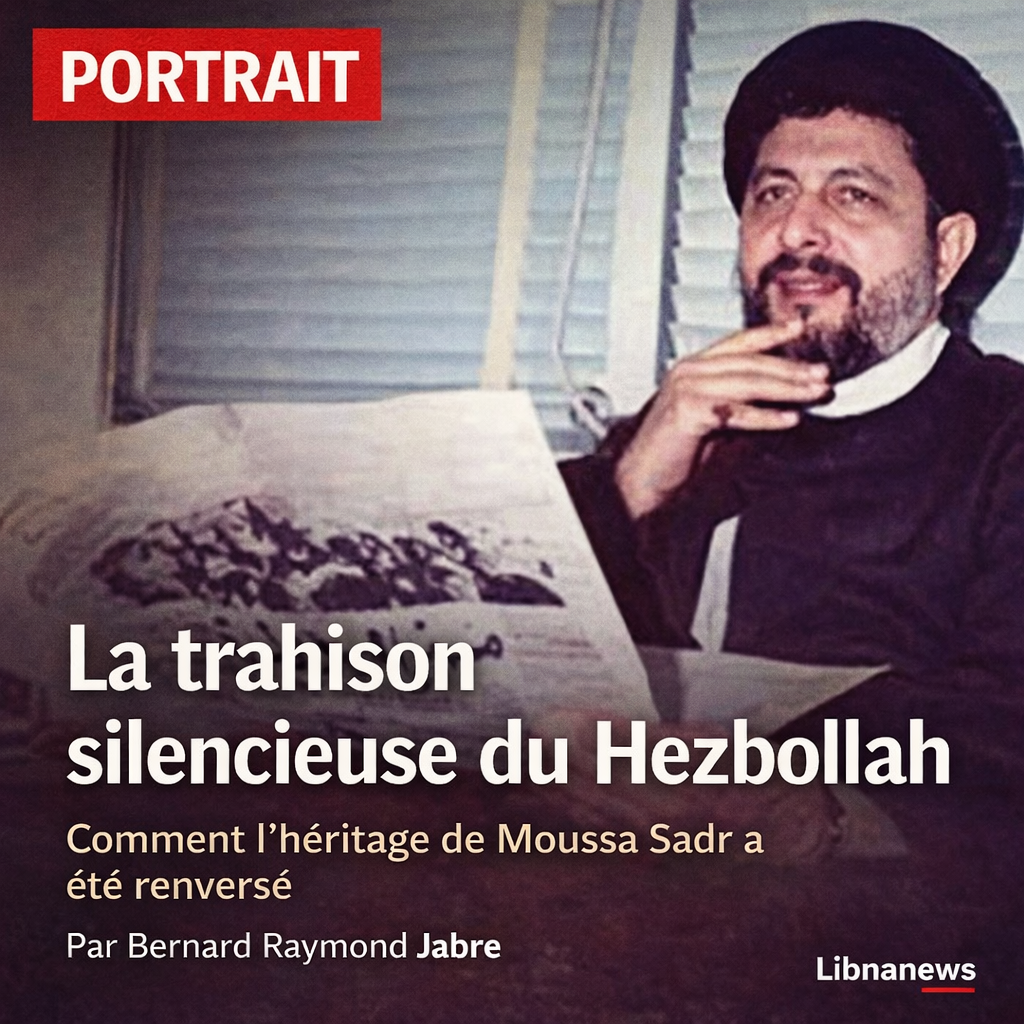
There is, in the heart of contemporary Lebanon, a fracture that it refuses to name. It is neither military nor strictly denominational. It is deeper, almost invisible to the pressed eye: an intellectual and perhaps even spiritual fracture. It contrasts two irreconcilable visions of the same destiny. On one side, that carried by Moussa Sadr, that of a Shiism rooted in Lebanese land, inscribed in the State and oriented towards national construction. On the other hand, the one gradually imposed through Hezbollah and, to a different but real extent, Amal — a transnational vision, articulated around a regional project whose centre of gravity is outside Lebanon.
It would be comfortable to talk about evolution. But this word is too weak, almost misleading. What happened is of another nature. It is a net rupture, a strategic and doctrinal shift. And when a community moves so far away from its own founder, the word that imposes itself is no longer that of transformation, but that of betrayal.
When Moussa Sadr arrived in Lebanon in the 1960s, he discovered a community relegated to the margins, absent from decision-making centres, locked in a form of political and social marginality. His ambition is not to project it across borders, nor to include it in a global ideological plan. On the contrary, it is to bring it back to the heart of Lebanon. He wants to make Shiites full citizens, actors of the state, participants in the national construction. His vision is based on simple but powerful evidence: Lebanon is not a temporary space, nor a battlefield for external causes. He is a permanent homeland.
This idea, apparently obvious, is in reality deeply subversive in the context of the era. She refuses both abandonment and instrumentalization. It rejects the idea of a chiism wandering, dependent, or subject to external power centers. At Sadr, dignity is rooted. The force goes through integration. And religion itself is part of a national, non-imperial framework.
Then comes 1978. The disappearance of Moussa Sadr in Libya remains a historical mystery, but its consequences are perfectly legible. With him disappears not only a leader, but a balance. A lock jumps. A space opens up. And this vacuum comes at a critical moment: on the eve of the 1979 Iranian Revolution.
The timing is disturbing. For Sadr was precisely an alternative path, that of autonomous Lebanese Shiism, capable of resisting possible ideological centralization from elsewhere. Its absence will allow another vision to impose, more structured, more radical, and especially carried by a State: the Islamic Republic of Iran.
With this revolution, political chiism changes its nature. It ceases to be simply a social or national component to become a geopolitical instrument. The concept of wilayat al-faqih introduces a transnational hierarchy, a form of religious and political centralization that transcends borders. Lebanon is no longer a framework, but a link. A room in a larger set.
It is in this context that Hezbollah is born. And from the beginning, the break with Sadr’s legacy is perceptible. Where Sadr sought to integrate, Hezbollah built a parallel structure. Where Sadr spoke of state, Hezbollah speaks of axis. Where Sadr saw Lebanon as an end, Hezbollah makes it a means.
Gradually, this logic is necessary. Amal, however direct heir to Sadr, is also drawn into this dynamic, oscillating between historical fidelity and political realities. But it is Hezbollah that most clearly embodies this shift. His engagement in Syria alongside Bashar al-Assad marks a decisive turning point. From then on, it becomes impossible to argue that his action is strictly Lebanese. It is part of a coherent, Middle East-wide regional architecture.
This slide profoundly transforms the very nature of the project. What was presented as a national resistance gradually becomes an instrument integrated into a regional strategy. Lebanon, in this configuration, is no longer protected. He’s exposed. It becomes a front, a platform, sometimes even a lever.
This is where the contradiction with Moussa Sadr becomes unsustainable. For everything in this evolution contradicts the founding principles which he had laid down. Where he advocated integration, duality was observed. Where he defended sovereignty, one sees dependence. Where he spoke of national dignity, there is a geopolitical projection.
An attempt can be made to justify this development by the context, by threats, by regional power relations. But none of these explanations is enough to erase the doctrinal reversal that has occurred. This is not just a strategic adjustment. It is a reversal of purpose.
The question today is therefore of particular gravity. It is not just about balance of forces or regional stability. It affects the very identity of the Lebanese Shia community. Is it still true to Moussa Sadr’s vision, or has it become part of a project that goes beyond it and redefines it?
And beyond that, Lebanon itself is being questioned. Is it still a homeland, in the full sense of the term, or is it a space crossed, used, instrumentalized by external logics?
The story, as always, will eventually cut. But it will not only judge events. She will judge the choices. Not those that have been imposed, but those that have been accepted, integrated, sometimes even claimed.
And at the centre of this judgment, there will be an absence. Moussa Sadr’s. Not only as a missing man, but as a lost possibility. For with him, it is not only a figure that has been erased. It may be another trajectory of Lebanon that has closed.






