

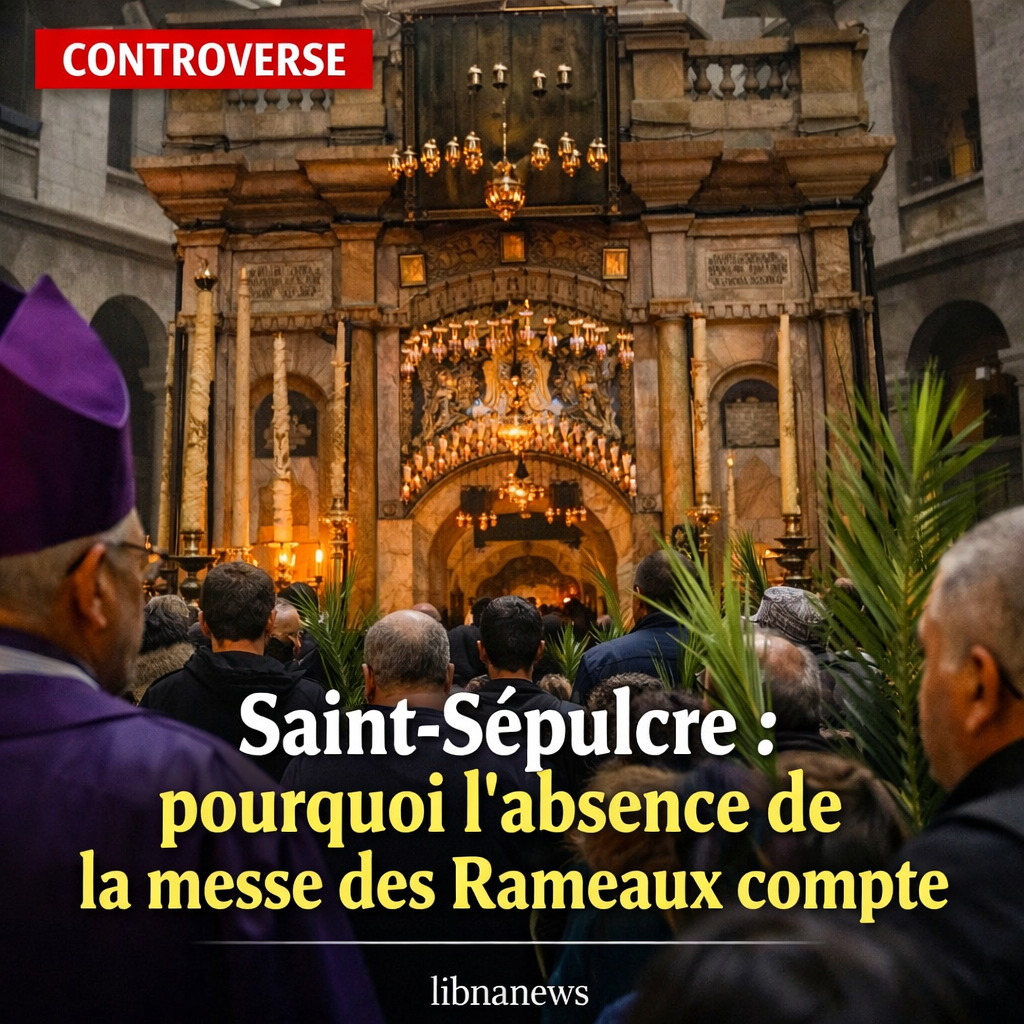
The blockade on Sunday of the Latin Patriarch of Jerusalem at the entrance to the Holy Sepulchre far exceeded the police incident. Although the Israeli authorities subsequently lifted the ban and announced a limited prayer framework for the following days, the Palm Mass did not take place where it was to be celebrated. For Christians, and not only for Catholics, this shift changes everything. The Holy Sepulcher is not a church among others. This is the place where generations of faithful worship like the crucifixion, burial and resurrection of Christ. In the Christian calendar, the week that opens with the Palms focuses the very heart of faith. To prevent the celebration in this place at the precise moment when the Church enters the Passion therefore did not only have a practical or diplomatic significance. The act reaches a symbolic, liturgical and historical centre of world Christianity.
Sunday, March 29, the Israeli police prevented Cardinal Pierbattista Pizzaballa, the Latin patriarch of Jerusalem, and the Custos of the Holy Land, Father Francesco Ielpo, from entering the church to celebrate the Palm Mass. In a joint communiqué, the Latin Patriarchate and the Custody of the Holy Land denounced a measure « clearly unreasonable and grossly disproportionate ». The Israeli authorities have invoked security reasons related to the regional war, the closure of the major holy sites of the Old City and the difficulties of evacuation in the event of an alert. The sequence partially changed at night, when the police announced a limited prayer mechanism and that access was restored for the rest of Holy Week. But the essential was already acquired: the celebration of the Palms in the Holy Sepulcher had not taken place. Instead, a prayer was held at the church of All Nations, at the foot of the Mount of Olives.
Why the Holy Sepulchre occupies a unique place
To understand the gravity of the episode, you must leave the place. The Holy Sepulchre, in the Old City of Jerusalem, has been held since the fourth century for the site where Jesus was crucified, buried and raised from the dead. The basilica therefore houses not only a sanctuary of memory. It brings together the Golgotha and the empty tomb together. In Christian understanding, these two points are inseparable: the death of Christ and his resurrection form a single Paschal mystery. The Custody of the Holy Land also presents the basilica as the Christian « heart » of the Old City and as the place where Calvary and Tombeau stand together. The reference books also recall that the site has been continuously recognized since late antiquity as the location of the death, burial and resurrection of Jesus.
This centrality gives the Holy Sepulcher a singular status in world Christianity. Rome is the institutional center of Catholicism. Bethlehem is the place of the Nativity. Nazareth refers to the Annunciation and childhood of Jesus. But the Holy Sepulchre concentrates the Paschal event, that is, the core of the Christian faith. For millions of believers of different faiths, Jerusalem is not only a setting for the Gospels. It is the place where the Passion and Easter, suffering and hope, the cross and victory over death are articulated. When the Latin Patriarchate explained on Sunday that hundreds of millions of faithful look to Jerusalem and to the Holy Sepulchre during those days, he did not describe a form of communication. He recalled a deep ecclesial fact.
Palms are not just a mass of the calendar
The date further reinforces the scope of the impediment. Palm Sunday opens Holy Week. In the Christian liturgy, this celebration unites two dimensions: Jesus’ Messianic entrance to Jerusalem and the immediate announcement of his Passion. The branches express the welcome of Christ; the reading of the Passion already announces the cross. Liturgically, the Church enters that day into the sequence that leads to Holy Thursday, Good Friday, and then Easter night. The Palm Mass is therefore not only valid because it is important. It is worth it because it launches the movement that leads to the empty tomb. Now in the Holy Sepulcher, this movement is almost tangible. The place does not illustrate the story; He’s incarnate for the faithful. Celebrating the Palms elsewhere is still possible on the canonical plane. But celebrating them in the Holy Sepulcher, in Jerusalem itself, gives the liturgy an incomparable spiritual, historical and pastoral density.
The Christians of the Holy Land also live this day as a passage. In ordinary times, the Rameaux procession descends from the Mount of Olives to the Old Town and gathers thousands of people. This year, the procession was cancelled due to the restrictions imposed by the war. The Latin Patriarchate had accepted these constraints and planned a non-public celebration, with a very limited number of ministers, precisely to comply with the security instructions. It was this point that fuelled the indignation of the local Church: she did not contest the military context, she felt that a minimal liturgy, closed to the general public and broadcast at a distance, could stand as it had happened since the beginning of the conflict. So the police refusal did not interrupt a crowd. He prevented the liturgical act itself.
Why celebrate despite the ban had a meaning
We must avoid a misunderstanding here. To emphasize that it was important to celebrate despite the ban does not amount to calling for physical provocation or recklessness in the face of risk. The question is liturgical, symbolic and pastoral. In Christian tradition, Mass is not simply a social gathering that could be moved to the infinite without loss of meaning. It is also an inscription in a time and place. Some places are not interchangeable. The Holy Sepulcher is less than any other, because he touches the narrative and sacramental heart of faith. When a Palm Mass is prevented, it is a whole religious language that is broken: that of continuity between the Gospels, the memory of the early Christians, the liturgical tradition and the present presence of the faithful in the Holy Land.
Next, maintaining the celebration was a witness. The churches in Jerusalem are not only guardians of stones. They carry a fragile human presence in a city where religious, political and security are constantly confronted. In this context, celebrating in the Holy Sepulchre, even in a small way, means that prayer continues, that the city is not only delivered to the logic of arms, and that the Christian liturgical calendar does not disappear under the effect of war. This logic is not peculiar to Latin Catholicism. By 2020, during the pandemic, Christian leaders in charge of the Holy Sepulchre had already maintained the offices by the ministers serving, according to the rules of the « status quo », even though the faithful could not enter. The idea was clear: when public access becomes impossible, the Church’s prayer at the holy place must not be extinguished.
Finally, celebrating in the Holy Sepulchre despite the disputed ban had a scope of religious freedom. The Latin Patriarchate has explicitly linked Sunday’s impediment to an infringement of freedom of worship and the « status quo » of Jerusalem. The term is not decorative. In holy places, the status quo refers to all historical balances that regulate the distribution of liturgical rights, spaces and timetables among Christian communities. The Holy Sepulchre is divided among several churches, according to old, complex and sometimes millimetred arrangements. An external decision which suspends, even for reasons of security, the exercise of an office provided for in this framework is therefore more than just a one-time public order. It affects a historical balance upon which Christian coexistence in the most sensitive place of Jerusalem rests.
A shared sanctuary, so even more sensitive
The Holy Sepulcher is not administered by a single institution. Six Christian denominations have recognized rights, with three major communities at the centre of the system: the Greek Orthodox Patriarchate, the Armenian Patriarchate and the Catholic Church through the Latin Patriarchate and the Franciscan Custody. Other communities, Coptic, Syriac and Ethiopian, also have more limited rights. This superimposition of titles, uses and schedules makes the place a co-existence laboratory as well as a permanent focus of susceptibility. Every office, every route, every key, every timer counts. In such a framework, Sunday’s prevented Mass takes on an additional dimension: it touches a place where stability is based on scrupulous respect for inherited practices.
What the episode says about the moment in Jerusalem
The Sunday incident is in a city under extreme stress. AP recalls that the great holy places of Jerusalem were closed or severely restricted due to the war and missile fire, and that an intercepted missile burst had fallen earlier in March on the roof of the Greek Orthodox Patriarchate, a few steps away from the Holy Sepulchre. The Western wall is limited, the mosques’ esplanade was largely emptied during the end of Ramadan, and the Old City is slowing down. This background explains safety caution. It does not, however, remove anything from the reach of the gesture that prevented Catholic leaders from entering. On the contrary, it reveals how Jerusalem has become a place where risk management can now suspend, even briefly, the most deeply rooted religious actions.
For Eastern and Western Christians, the problem is therefore twofold. First, there is the concrete deprivation of celebration in the holy place. Then there is the precedent. The Latin Patriarchate spoke of a first in centuries. This formulation has weight. It means that, despite wars, empire changes, health crises and periods of extreme tension, the idea had been preserved so far that at least the ministers responsible for the place could carry out the liturgy of Holy Week. Breaking this continuity, even once, not only produces emotion. This creates a flaw in the imagination of permanence surrounding the Holy Sepulchre and, with it, the Christian presence in Jerusalem.
Why the importance of the place exceeds the believers alone
The Holy Sepulchre matters to Christians because it touches upon the resurrection. But its importance goes beyond the strict framework of devotion. Historically, it has structured pilgrimages, religious architecture and even diplomatic balance around holy places. Politically, it recalls that Jerusalem is not only a claimed capital or a city under threat; It is also a world-wide holy city, with every closure, restriction and incident echoing in Rome, Athens, Yerevan, Beirut, Paris, Washington and beyond. Preventing the Mass of the Palms in the Holy Sepulchre therefore does not only hurt an ecclesial sensitivity. The act sends to the world the signal that in the heart of the Holy City, even the most emblematic rituals can be interrupted by the logic of conflict.
On the pastoral level, the absence of Mass in the Holy Sepulchre strikes because it affects already exhausted communities. Christians in the Holy Land have been living for months under war, traffic restrictions, the collapse of the pilgrimage and economic anguish. For them holy week is much more than a time of devotion. It is also a moment of collective anchoring, visibility and continuity. When the Palm procession is cancelled and Mass in the Holy Sepulchre is prevented, many feel that they are being taken away both a place, a voice and a common rhythm. Cardinal Pizzaballa was able to pray elsewhere. Access eventually got loose. Yet the symbolic wound remains because it concerns less the abstract possibility of celebrating than the possibility of celebrating here, that day, to the exact point where the Christian faith places the victory of life over death.






