

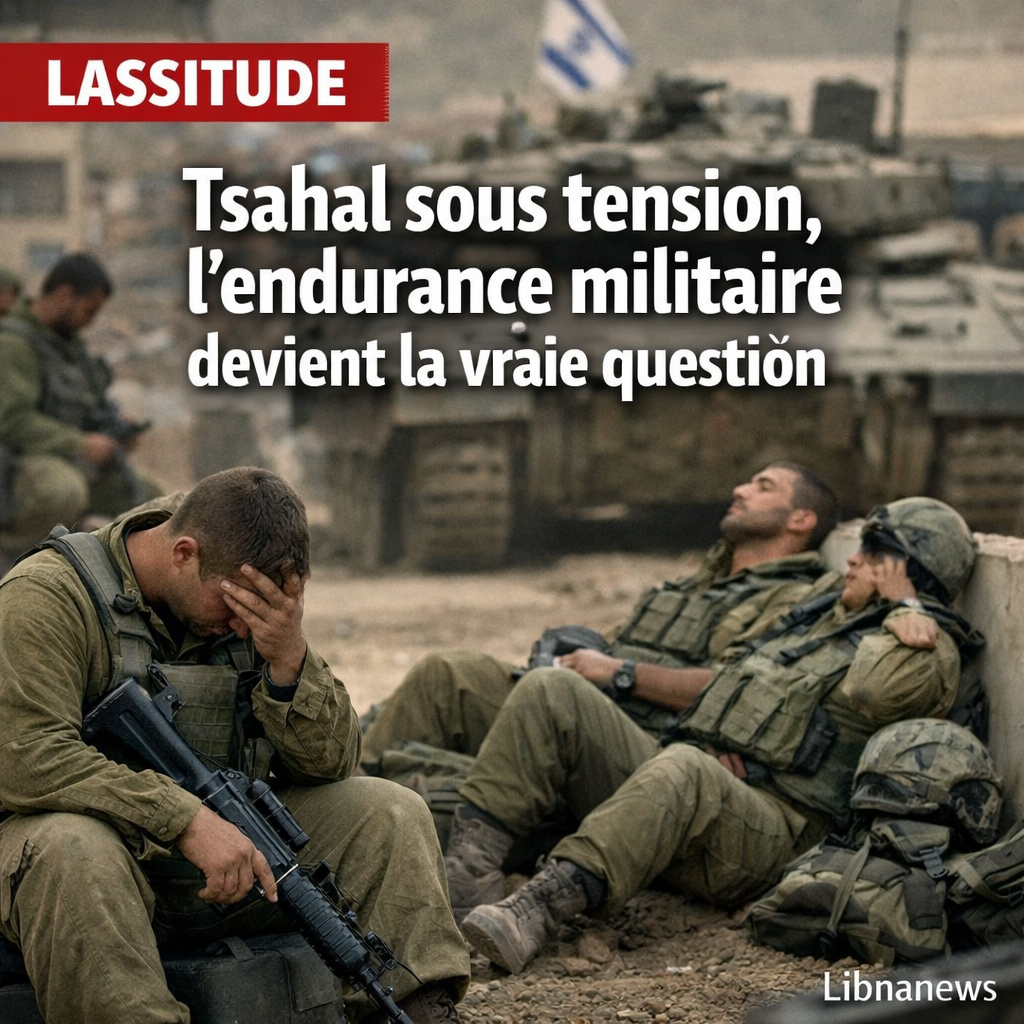
The Israeli army remains one of the most powerful in the Middle East. It maintains significant air superiority, a dense intelligence apparatus, a strong defence industry and a capability to strike that remains, on a regional scale, without any direct equivalent. Yet the debate that is now going through Israel is not just about this raw power. It concerns its sustainability. For several days, warnings from the military summit, relayed by several Israeli and international media, have described an institution engaged on too many fronts, with understaffed personnel, exhausted reservists, an anti-missile defence under tension and a society increasingly crossed by the fractures of service. The formula attributed to Chief of Staff Eyal Zamir on the risk of an army that could « scramble over itself » has struck the minds, less like a prophecy of immediate defeat than the signal of a system that now collects the cumulative cost of simultaneous wars.
The military diagnosis is based first on a data now publicly assumed: the army lacks about 15,000 soldiers, including nearly 8,000 combatants. This deficit comes at a time when operations are continuing in Gaza, the ground offensive in Lebanon absorbs considerable forces, the West Bank demands permanent reinforcements, Syria remains a scene of action and Iran has imposed a level of alert and additional mobilization since the opening of the direct conflict. The media that reported the remarks of the staff insist on the structural nature of the problem. It is not just an army that would need temporary support. It is a military aircraft whose missions multiply faster than the available human resources. The real question is no longer whether the IDF can still strike, but how long it can continue to do everything at the same time.
A multi-faceted war that changes the nature of the crisis
The current crisis can only be understood by observing the addition of the fronts. In Gaza, the army continues a long war that never really left the register of attrition. In the West Bank, it must conduct raids, protect the axes, contain tensions and secure an already highly militarized space. In Syria, it maintains positions and strike capabilities. In Lebanon, the campaign changed scale with a deeper ground advance linked to the declared goal of extending a safe area to the Litani. Finally, in the face of Iran, Israel must combine offensive strikes, air defence, strategic intelligence and protection of national territory. Each of these fronts requires a different combination of human and technical means. Together, they produce a saturation effect that the Israeli staff no longer hides.
This accumulation changes the nature of the problem. A conscription and reserve army can absorb a short and intense campaign. It can also support a sustainable front if the rest of the system remains relatively stable. However, when several theatres remain active simultaneously, the constraint is no longer only tactical. It becomes organic. It is necessary to keep lines, replace units, maintain stocks, rotate personnel, protect the back and absorb losses. It is from this perspective that we must read the recent warnings: not as the description of a collapse already committed, but as that of a cumulative fatigue that threatens the overall balance. A very modern army can continue to dominate the battlefield while becoming less sustainable over time.
Reserve system enters fatigue zone
The historical pillar of Israeli security remains the reserve system. It is it that allows the country to quickly rise in the event of a crisis. But this is also where the signs of wear appear most clearly. The articles published in recent days describe more than 150,000 reservists mobilized or deployed on various fronts, with successive reminders for many months. This mechanism has long been one of the main assets of the IDF. She is now becoming one of her frailties, because a reservist is not just a available soldier. He is also an employee, an independent, a parent, a student, a business manager. When it is constantly recalled, the system no longer corrects a crisis on time: it itself becomes a permanent mode of operation.
Wear is not just about reservists. The professional core also shows signs of tension.The WorldThis week reported that nearly 600 career staff had requested early departure at the end of 2025, a volume deemed very high. This figure is far greater than it seems. An army is not only held by the total number of its soldiers. It is also supported by its executives, specialists, instructors, technicians and intermediate officers. When this professional layer starts to collapse, the crisis becomes deeper than a mere shortage of recruits. It affects institutional continuity, the transmission of know-how and the quality of command.
Lebanon, a very men’s consumer front
The Lebanese front plays a central role in this tension. The in-depth entry of the Israeli army into southern Lebanon alters the human equation of the conflict. Even an intense air campaign does not demand the same resources as a sustainable land presence. When it comes to pushing towards the Litani, holding villages, monitoring axes, covering the tanks, evacuating the wounded, installing rotations and preventing reinfiltrations, the need for manpower explodes. Several analyses published this week point out that Lebanon is no longer a back-up front. It acts as a crisis multiplier, because it consumes large numbers of troops over time and mechanically reduces the margin available for other theatres.
The importance of this front is also due to its political and military memory. Any Israeli projection to the Litani reactivates the memory of the occupation of South Lebanon before 2000, with what this implies in human cost, moral wear and tear and stalemate. An offensive can always be presented as limited. A prolonged presence requires a continuous effort. It is this point that feeds the current debate in Israel. The more the Lebanese front becomes a theatre of maintenance and not just of penetration, the more it aspires to the army’s human reserves. So the problem is not just to conquer or destroy. It is then to hold, without emptying the institution of its human responsibility.
The missile defence no longer gives an impression of waterproofness
Another crack appeared in the open: missile defence, long presented as one of Israel’s major strategic assets, shows its limits in a war of endurance. The last few days have been marked by Iranian strikes affecting areas like Arad and Dimona, despite the interceptions announced by the army. TheWashington Postreports that more than 115 people were injured in strikes on two civilian neighbourhoods, even though the Israeli authorities continued to defend a high overall interception rate. The contradiction is only apparent: even when a system intercepts most of the projectiles, a few missiles that pass are sufficient to upset the perception of security. In a society subject to sirens, shelters and repeated warnings, the symbolic value of these impacts is immense.
The pressure is not only on technical efficiency but also on stocks. TheWall Street JournalThis week said that Israel was rationing its best-performing interceptors, especially in the face of heavy ballistic threats, while Iranian salves continued.The GuardianThe Iranian use of cluster missiles further complicates defence, as interception must take place prior to the dispersion of the load. Once the submunitions are separated, the threat becomes much more difficult to neutralize. Together, these elements draw a new reality: Israel’s missile defence remains one of the most advanced in the world, but it no longer offers the almost automatic image of invulnerability that still dominated public discourse recently.
The Israeli rear no longer had the feeling of being sanctified
This technical development has political and social consequences. For a long time, the Israeli security story was based on a strong idea: even if the army waged offensive or preventive wars, the rear was generally protected by the combination of early warning, shelter and multi-layer defence. Recent strikes have cracked this representation. Missiles have reached civilian areas and sensitive areas. Injured persons were identified in communities that were supposed to be relatively protected. Repeated alarms and the visibility of damage have a deeper sense of insecurity than in previous episodes. This psychological dimension counts as much as the material balance, because a long war is also gained by the ability of society to endure its duration.
The perceived fragility of the rear mechanically reinforces doubts about military endurance. A population more easily accepts the extension of a war if it feels that the national territory is largely out of reach. When this feeling erodes, the political and moral cost of the conflict increases. The IDF question is therefore not only military. It affects the security contract between the State and the company. An army that protects less perfectly than expected, even though it remains very efficient, sees increasing pressure on its operational choices, its budgetary priorities and its ability to justify the proliferation of fronts.
Israeli departures become a more visible phenomenon
In this context, departures from the territory have become more visible. The drastic limitation of flights at Ben Gurion Airport, decided for security reasons after several missile strikes, has pushed more Israelis to cross the land borders with Egypt and Jordan.Times of IsraelThis week reported that 5,055 Israelis had left the country in one day, compared with only 1,133 by air. Other data from the same period show that, since the partial closure of the Israeli sky, land passages have absorbed an increasing portion of departures. The US authorities in Jerusalem themselves recommended land routes to Egypt and Jordan as the quickest option to leave the country under current conditions.
However, these figures must be interpreted rigorously. They do not describe, on their own, a homogeneous leak. In parallel with these departures, many Israelis blocked abroad have also tried to return and a significant part of them have returned thanks to the flights maintained by Israeli companies. The observed phenomenon is therefore that of a deeply disturbed traffic, where there are co-existing precautionary departures, family or professional returns, aviation safety constraints and individual risk arbitrage. It would be excessive to talk about general exodus. It would be equally misleading to deny that the war has produced a concrete dynamic of exits from the territory, which has become much more visible since the Iranian front directly affected the Israeli sky.
Deserts, refusal to serve and conscientious objectors: three different realities
Public debate often mixes several distinct phenomena. Desertion in the strict legal sense is not the same as the one-time refusal to serve, and it is still distinguished from conscientious objection. The solid sources available do not allow to say that a massive and precisely quantified wave of new desertions would be overwhelming the army simply as a result of the ongoing war. On the other hand, they clearly show a broader crisis of mobilization and loyalty. By August 2025, the Israeli army had launched an exceptional amnesty against thousands of refractories and deserters registered in its administrative system, explicitly citing the shortage of troops. This already revealed that beyond the fronts, the institution faced a lasting difficulty in attracting, keeping and recalling its soldiers.
The conscientious objection belongs to a smaller but politically sensitive register. Contrary to those who sometimes try to escape service, objectors claim a moral or political refusal to wear uniforms or participate in war. Their number remains low.Tortoise MediaIn March 2025, it was reported that only a dozen Israeli teenagers had publicly refused to enlist on this ground since the beginning of the war in Gaza. But this numerical weakness does not make the phenomenon negligible. In a country where military service is presented as a central duty of citizenship, every public refusal to serve has a disproportionate symbolic resonance. It introduces into public space the idea that there is not only military fatigue, but also an ethical challenge to the war itself.
This dimension has been embodied in several media cases. In March 2025 Amnesty International devoted a portrait to Itamar Greenberg, presented as an 18-year-old Israeli conscientious objector, imprisoned several times for refusing to join the army after his convocation. The case is not representative of the number, but it says something of the time. In Israel at war, conscientious objection remains rare, socially costly and often marginalized. Yet, it exists, it becomes visible, and it now complements other forms of malaise: exhaustion of reservists, career departures, tensions over exemptions and increasing questioning of the sharing of military burden.
The fracture of military service undermines the endurance of the army
The workforce crisis cannot be separated from the ultra-orthodox issue. In June 2024, the Israeli Supreme Court unanimously ruled that the army should begin recruiting ultra-Orthodox men, legally challenging a long-standing exemption regime. Yet, despite this decision, the General Staff continues to denounce the gap between military needs and political arbitration. The government has repeatedly postponed a substantive response, as the subject threatens the balance of the coalition. For the army, the contradiction has become increasingly difficult to sustain: it demands more soldiers, while a large part of the male population of serviceable age remains in practice largely outside the common effort.
This inequality fuels deep resentment among those who already serve. Reservists repeatedly recalled, families exposed to prolonged absences, career soldiers tempted by departure: all see a widening gap between the discourse of national solidarity and the reality of sharing sacrifice. This is one of the keys to the current tightening of the debate in Israel. The army is not only facing a mechanical shortage of fighters. She faces a crisis of the military social contract. The longer the war spreads, the more political the question becomes: who fights, who is dispensed, who pays the human price of the open fronts, and how far this imbalance can still be accepted by Israeli society.
A powerful army, but less unlimited than before
The mistake would be to conclude that the IDF was in imminent collapse. The facts available do not permit such an assertion. Israel maintains an army that is technologically far superior to those of its direct adversaries, a considerable ability to strike and significant external support. But the opposite error would be just as great: believing that this superiority is enough to neutralize time, wear and tear and human limits. What appears today is not the sudden end of a military power. It’s the nude of his constraints. A very sophisticated missile defence can be put under pressure. An exemplary reserve system can enter its fatigue zone. A tactically victorious army can become more socially and politically vulnerable.
The interest of the current debate lies precisely in this. It obliges us to look at the IDF not as an abstract bloc, but as an institution dependent on men, stocks, budgets, laws, social consent and an increasingly disputed division of service. Conscience objectors are only a very minority component, but they recall that the crisis is not only quantitative. It is also moral and political. The spent reservists, the cadres who want to leave, the missiles which sometimes pierce the defence, the departures which became visible by the land borders and the persistence of exemptions make up, together, the same question: that of an army which is always very strong, but less and less unlimited, at the precise moment when the State asks it almost all at once.
International policy: the war against Iran is reshaping power relations far beyond Lebanon
Washington and Tehran locked in a climbing logic
On 28 March 2026, international politics was dominated by a simple reality: the confrontation between the United States, Israel and Iran now structured Lebanon’s entire strategic environment. Today’s Lebanese newspapers describe a confrontation that is no longer merely a matter of deterrence or shadow war, but of an open sequence, with strikes, explicit threats, energy calculations and the risk of regional expansion. Ad Diyar reports in his March 28, 2026 edition that US Secretary of State Marco Rubio claims that Donald Trump has all the options to deal with Iran, including sending ground forces if necessary, while arguing that Washington can achieve its goals without ground interference. The same newspaper quotes him saying that the military operation against Iran could end « in weeks, not months ». At this point, the American word does not seek to calm the game. Its main aim is to demonstrate Washington’s determination and maintain maximum pressure on Tehran.
But this demonstration of American firmness comes up against a fact that several newspapers point out: Iran does not give any sign of confidence in American promises or openings. Ad Diyar writes on 28 March 2026 that the loss of confidence between Americans and Iranians makes a rapid ceasefire agreement very difficult and that Tehran has prepared for a long war. The newspaper goes so far as to say that the Iranian authorities consider that prolonging the war is playing in their favour and that the real trap is now American, Donald Trump having failed to bring down the regime by a first decisive shock. Even if this reading is initiated, it joins a broader point in several titles: confrontation can no longer be reduced to a simple face-to-face on nuclear technology. It has become a struggle over duration, wear and tear, political credibility and the ability of each camp to bear the cost of a prolonged war.
Al Binaa, in its issue of March 28, 2026, goes in the same direction by describing the delay granted by Donald Trump as a manoeuvre that failed to calm the markets or create a real dynamic of relaxation. The newspaper notes that oil is moving up and that the current sequence is less a return to negotiation than a countdown to a new phase of confrontation. This reading complements that of Ad Diyar. It shows that, on the international ground, escalation is not only measured by missiles or statements. It is also reflected in the behaviour of the markets, in the energy nervousness and in the difficulty of the powers to convince that they still control the timetable.
Israel seeks to expand the strategic effect of war
The international policy of 28 March 2026 cannot be understood without Israel’s place. In several newspapers, the Hebrew state appears as the actor who pushes to broaden the scope of the conflict, not only against Iran, but also on the related fronts, including Lebanon. El Sharq reports in his March 28, 2026 edition that Israeli Chief of Staff Eyal Zamir told his soldiers that they were at a crossroads and that they had « great tasks to do from Tehran to Beirut ». The same passage insists on the Israeli will to complete what is presented as a continuing threat from both Iran and the Lebanese border. This formula is essential. It means that, in Israeli reading, Tehran and Beirut are no longer two separate scenes. They belong to the same strategic theatre.
This articulation between Iran and Lebanon also appears in Al Jumhouria of 28 March 2026, which describes the intensification of clashes in southern Lebanon, the strikes on the southern suburbs of Beirut and the lack of mediation capable of freezing the front. This treatment joins a broader reality: for Israel, the management of the Lebanese front can no longer be separated from the campaign against Iran and its allies. Operations on Lebanese territory are therefore not just local responses. They are part of a regional strategy to break or weaken the continuity between Tehran, its relays and its ability to pressure Israel.
Al Binaa, on 28 March 2026, insists on Israeli strikes against Iranian industrial sites and on the enemy’s desire to extend the campaign to targets of economic and strategic value. Again, the message is clear: Israel is not only seeking an immediate tactical advantage. It wants to affect production capacities, logistics circuits and the confidence of the opponent in its own strategic depth. This alters the very nature of war. The more economic, industrial or infrastructure sites affected, the more regionally destabilizing and difficult to contain the conflict.
Iran bets on endurance, not fast concession
In the face of this pressure, the newspapers of 28 March 2026 describe an Iran that refuses to yield quickly and puts on endurance. Ad Diyar presents a country that no longer believes in American offers, considers war long and prepares its coastal and territorial defence. The newspaper reports that Iranian circles consider it impossible to reach a close agreement with Washington and ask a question that summarizes their state of mind: how to sit down with Americans who have hit the country’s leaders, people and structures while still sending out conditions deemed unacceptable? This type of formulation shows that, in the current sequence, the question is no longer merely diplomatic. It is also moral, symbolic and political from the Iranian point of view.
Al Binaa of 28 March 2026 reinforces this image by evoking an Iranian response firmly prepared, including against industrial objectives in the occupied territories and in the region. The newspaper also cites sources close to the Iranian camp that the response should not remain limited to symbols, but should focus more broadly on the interests of those who support the aggression. Whether it’s a threat or a real preparation, the diplomatic and political message is the same: Tehran wants to make it clear that it won’t play the role of an obsessed actor seeking to buy a quick exit through concessions. On the contrary, Iran wants to show that it can extend the costs of the conflict to the entire region.
This posture has direct consequences on the international scene. It closes the horizon of a quick solution, makes any American bet more expensive on a decisive strike and obliges other powers to reason in terms of duration. On 28 March 2026, the Lebanese newspapers described a diplomatic world forced to think of war not as a crisis of a few days, but as a test of resistance between regional and global powers. This makes the current phase particularly dangerous. The more each side is convinced that time can eventually play for it, the less it is better to take the first step towards de-escalation.
Markets, oil and the Strait of Ormuz at the heart of the global game
This day’s international policy is not limited to armies and diplomats. It is also written in energy markets. Al Binaa of 28 March 2026 notes that the barrel of oil is going up again and approaching 110 dollars, indicating that the market no longer believes in temporary calm announcements. The newspaper points out that Donald Trump’s deadline did not restore confidence and that the economic world is now reading the sequence as a war that is settling rather than a close compromise. This economic reading is crucial, as it shows that war is already producing international effects beyond the Middle East. Oil, maritime insurance, transport and the expectations of large squares are in turn becoming political indicators.
Al Joumhouria, in its edition of 28 March 2026, develops this dimension by explaining that one of the challenges of the confrontation is Asian energy and the possible control or disruption of flows related to the Strait of Ormuz. The newspaper links the ongoing war not only with Iranian nuclear power or Israeli security, but also with the flow of oil and gas. This reading grid puts the crisis back into a much broader context. The Gulf, Asia and world markets are now indirectly present in every diplomatic debate on Iran. This also explains why the international community remains nervous: beyond alliances, it is the global energy system that is threatened by an upsurge.
Ad Diyar adds an important element by noting that Marco Rubio himself referred to the Strait of Ormuz and the risks associated with an Iranian decision on the sea crossing. Even when formulated as a warning, this reference confirms that the United States knows that the theatre of war is beyond military targets. The Strait remains one of the major potential tipping points of the international crisis. Any threat to this sea route would immediately raise pressure on importing powers, markets and diplomacy still seeking to contain the conflict.
Intermediate powers and secondary mediations remain behind
In this landscape dominated by Washington, Tehran and Israel, the other powers appear mainly as second-tier actors, even when they remain active. Al Joumhouria of 28 March 2026 shows that France continues to maintain channels with Beirut, but without decisive leverage in the face of Israeli refusal and lack of sufficient American support. Al Binaa reports that China maintains contact with Nabih Berri and closely monitors the consequences of the war on Lebanon, but does not appear to be the driving force behind a structured international initiative. As for Egypt, it was trying to open diplomatic breaches, particularly with Washington and with actors close to the Iranian axis, but without reaching a breakthrough yet. The general picture is therefore that of a polarised international system, in which intermediate powers remain present but peripheral.
This hierarchy is important. It shows that the international policy of the moment is not based on an orderly concert of powers. It works on the contrary according to a hard kernel logic. The United States, Israel and Iran impose tempo. Others try to influence the margins, slow down certain sequences or prepare exits, but without any real capacity for reversal. This asymmetry also explains the scepticism of many Lebanese newspapers about mediation. Initiatives exist, but they are not carried by those who directly control the logic of escalation.
The related fronts, from Yemen to Lebanon, confirm the complete regionalization of the conflict
One of the heaviest elements of 28 March 2026 is the confirmation that the conflict is no longer localizable in a single space. Al Binaa quotes Yemeni armed forces spokesman Yahya Saree saying « our hands are on the loose » for direct military intervention if other coalitions join the United States and Israel against Iran and the axis of resistance. This sentence is worth more than a threat. It indicates that the fronts are now thought to be linked. An escalation on Iran can activate Yemen. Pressure on Lebanon may affect other areas. American or Israeli action can cause chain reactions throughout the region.
Al Akhbar of 28 March 2026 follows this logic when he presents the war as a broader battle against resistance, Lebanon being just one of the crossing points of this regional confrontation. Even if the tone of the newspaper is engaged, it reveals a now central perception: conflicts in the region can no longer be analysed separately. They are connected by alliances, military trajectories, ideological narratives and response chains. This complete regionalization makes international policy much more unstable. A single file mediation is no longer sufficient if it does not take into account the rest of the architecture.
For Lebanon, this reality has an immediate consequence. The country ceases to be only a national scene affected by a turbulent neighbourhood. It becomes one of the areas in which the decisions taken in Washington, Tehran, Tel Aviv, Cairo and Sana’a are translated. International policy is therefore not a distant background to the Lebanese crisis. It is the active setting and sometimes the main engine.
An increasingly polarized world scene
What finally emerges from the newspapers of 28 March 2026 is an increasingly polarized international scene. On the one hand, the United States and Israel show their willingness to maintain the strategic initiative and maintain strong pressure on Iran. On the other hand, Tehran and its related forces bet on the duration, dispersal of the fronts and increasing the overall cost of war. Between the two, mediation exists, the major capitals speak, the messages pass, but the central logic remains that of a confrontation from which no major actor seems ready to emerge through a rapid compromise.
In this context, international policy today does not produce an order. It mainly produces tension, contradictory signals and risks of extension. Lebanon is watching this scene from a particularly vulnerable position, as every international movement almost immediately finds a local translation. That is why the international section of the day is inseparable from the rest of the press review: what is decided or threatened at the regional and global levels immediately enters the political, security and social equation of Lebanon.






