

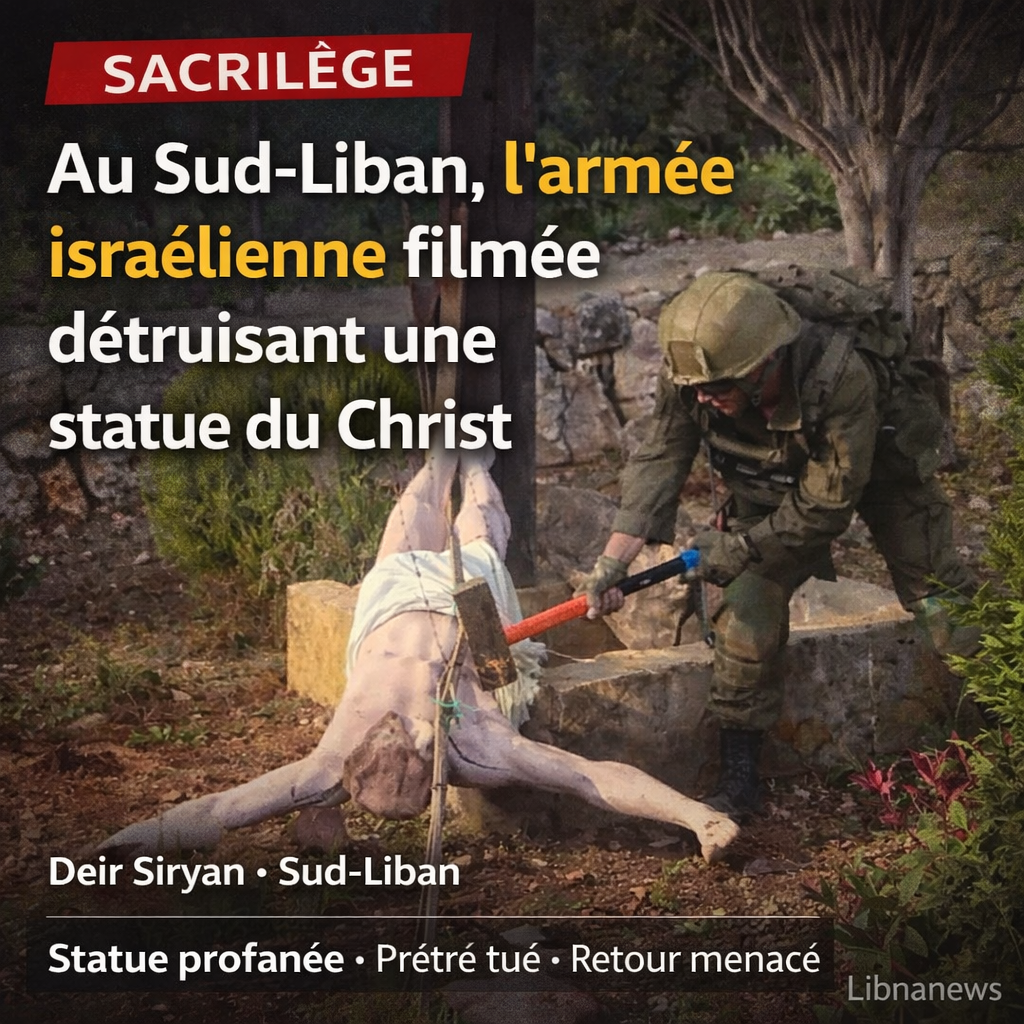
In South Lebanon, the video did more than scandalize. She confirmed, with almost clinical brutality, what many Christians on the border have been saying for weeks: they are not simply caught in a war, they are also exposed to a logic of humiliation. There is an Israeli soldier slaying at a statue of Christ in Deir Siryan, near the Litani River. The gesture is voluntary. It does not involve indiscriminate bombardment, collateral damage or exchange of fire. It points to another thing: a desecration committed in the open, then left to public circulation as if the image itself were part of the act.
In Christian villages in the South, this sequence was not received as an isolated episode. It was read as a concentrate of everything else: death, isolation, contempt, displacement, fear of erasure. The Israeli army’s response, which promised an investigation and claimed that such acts did not correspond to its values, was heard. But she didn’t convince anyone. Not because the very idea of investigating would be illegitimate, but because in Lebanon, after so many images and so many deaths, an investigation announced without visible sanction, without reparation and without public responsibility soon resembles a smoke curtain. At this stage, for many of the inhabitants concerned, this promise is mainly due to the powder in their eyes.
And maybe that’s where the malaise gets the deepest. For the question is no longer just whether a soldier acted wrong. The question is to understand what moral climate makes it possible for a soldier to feel free enough to return a statue of Christ, break his head and let the scene be seen. When an army that likes to present itself as « the most moral army in the world » has to regularly explain that such an image, such a shot, such a desecration, such death or such destruction do not correspond to its values, it ends up saying in spite of it something more embarrassing: the problem is perhaps no longer the exception, but the repetition.
Holy land struck in its flesh
South Lebanon is not just a border area, a strategic depth or a theatre of operations. For Eastern Christians, it is also a land that belongs to the evangelical geography, a Holy Land. Christ passed through the region of Tyre and Sidon. These cities, their surroundings, their roads and their memories are not outside the Christian narrative. In the conscience of many families in the South, this territory is not only a land of origin or land to defend. It is a holy land in the most concrete sense: a land driven by the very passage of the founding narrative.
That reminder counts. It is not used to sanctify politics. It is used to understand the intensity of the injury. When a statue of Christ is broken in a southern village, when a sanctuary is reached, when a church trembles, when a priest falls under fire, it is not just a religious fact among others. It is a local, biblical, family and national memory that is affected. The inhabitants live with this density. Their pain is not decorative. She’s rooted.
And this sacred geography is not only Christian. South Lebanon is also made up of maqams, Shiite shrines, cemeteries, dinars, shared places of devotion, sometimes frequented by several communities over generations. The violence that strikes these places therefore saves neither Southern popular Islam, nor frontier Christianity, nor the old Lebanese idea of a territory inhabited by superimposed memories. In this war, it is not only military positions that are destroyed. They are also sacred landmarks.
This is why the destruction or degradation of other sites has resonated so much in recent days. The Shrine of Chamoun es-Safa in Chamaa, a Shiite monument associated by local tradition with a venerated prophet and reported as a protected heritage site, was severely damaged and then given for destruction according to Lebanese heritage sources and officials. For both Christians and Muslims in the South, the message is clear: holy places are no longer thresholds. They also entered the field of desecration and crushing. A war that ends up allowing itself against symbols always ends up attacking the very possibility of living together.
For Christians in the South, the case does not start in Deir Siryan
Deir Siryan’s scene is untenable. But she doesn’t come out of nowhere. It adds to a chain of events that have profoundly transformed the gaze of Christians in the South on this war. The most brutal moment, perhaps, was the death of Abbé Pierre al-Rahi, Maronite priest of Qlayaa, killed in March by an Israeli fire while he was helping wounded. In these villages, a priest is not just a churchman. It is a social presence, a moral authority, a remedy, a living memory, sometimes the last thread between scattered families, the dead buried away, the displaced and those who remain.
When a priest is killed, everything changes. We understand that nothing really protects us anymore. Neither the sudan, nor the neutrality of the function, nor the mere fact of being a man of God in a village that does not live as a base of combat. This death acted like a tear. It destroyed the idea that there would exist, in the South, figures still subtracted from the logic of war. For many Christian families, the assassination of Father Pierre al-Rahi marked a line of psychological non-return.
Other tragedies followed or were reported by ecclesial and humanitarian sources. Christian inhabitants have been killed on roads or in communities threatened with encirclement. In Ain Ebel, Christian victims were reported during strikes in March. In Debel, a father and his son were given to kill by fire on the road. Even when these episodes do not all produce the same media wave, they accumulate in village consciousness and eventually form a common experience: that of a community that is neither sheltered nor out of sight, nor protected by its only weakness.
We must add to this the isolation. Rmeish, Ain Ebel and Debel lived at the rate of shortages, dangerous roads, communications cut off, concerns about fuel oil, drugs, supplies, infants, patients. The Vatican-supported aid convoy to Debel had to turn back under the bombardments. The scene alone summed up the absurdity of the moment: even aid for Christian villages trapped by war is no longer always able to cross the last kilometers. It is no longer just a matter of living under threat. Sometimes it’s about living in relegation.
Filming exaction, or the perverse part of war
What makes Deir Siryan’s video so overwhelming is not just the destruction of a Christian symbol. It’s the fact that the act is filmed. Destruction becomes performance. Humiliation becomes an image. And the image becomes almost a second violence, even colder, because it assumes in the author or his entourage that there is nothing inconceivable to show that.
This dimension should not be minimized. She introduces some perversity into the scene. Destroying is no longer enough; destruction must also be exposed. You have to play it again for the eye of others. It must be suggested that all this is normal, funny, trivial or meritorious. It’s not just war anymore. It is the war that looks at itself and, in this regard, loses the little restraint that it still claims to retain.
The people of the South understand this very well. What they see in this video is not just an unruly soldier. They see implicit permission. An atmosphere. Moral relaxation. A feeling of domination so strong that the religious symbol of the other can be treated as an accessory to victory. From then on, the promise of an internal inquiry necessarily takes on a bitter taste. Because if there is no public identification, no effective sanction, no reparation, no broader political confession, then the investigation is more than a convenient escape. A management formula. A powder of perlimpinpin thrown in the eyes of the public to absorb indignation without touching the structure of the problem.
It must be said clearly: an investigation makes sense only if it produces something other than a relief of communication. In Lebanon, many remember cases where indignation was absorbed by procedural promises, then dissolved in time, without visible consequences. Current scepticism is therefore not an ideological reflex. He was born from an accumulated experience. The inhabitants have seen too many images, heard too many justifications and buried too many dead to believe that a communiqué is enough.
The « most moral army in the world » facing its moral vacuum
Black irony that circulates today in Christian villages in the South is not free. It responds to a contrast that has become unsustainable. On the one hand, Israel presents its army as a model of restraint, discipline and morality. On the other hand, the inhabitants see a priest killed, empty villages, razed houses, cut roads, affected holy places and, from now on, a statue of Christ broken under the eye of a camera. By force, the slogan turns against itself.
We even have to go further. At this stage, the argument of declared morality no longer protects the institution; He can’t do it. Because the more an army sets itself as an example, the more every scene of gratuitous brutality reveals a structural defect. The « most moral army in the world » which lacks morals at the precise moment when it exercises its maximum strength on a weaker neighbour becomes, despite it, an unintentionally satirical formula. The disproportionate use of force is also considered a war crime.
Christians in the South do not need to be convinced by a thesis. They’re looking at the facts. They do not ask if Israeli vocabulary on combat ethics is sophisticated. They ask why their priests die, why their roads are cut off, why their convoys are stopped, why their statues are broken. From that point on, the official response to values often seems derisory. A value whose violation is constantly observed, without proportionate consequences, ends up like an empty word.
A border community that refuses to erase
There is a persistent misunderstanding about Christians in southern Lebanon. Seen from afar, they are often imagined as a small passive minority, caught between forces that exceed it. This is partly true, but insufficient. Because these villages are not only vulnerable. They are also deeply rooted. Rmeish, Ain Ebel, Debel, Qlayaa and other localities do not live as an accident. They live this presence as fidelity.
That’s why so many people wanted to stay despite evacuation orders, despite the risk, despite the pressure. Not for the taste of martyrdom. Not to serve propaganda. But because in Lebanon, leaving a village is never a neutral gesture. We know when we’re leaving. We still don’t know how we come back. And local history has taught these families that a prolonged vacuum can become an irreversible defeat.
Today, this concern worsens with the yellow line established by Israel in southern Lebanon. This military route within Lebanese territory, presented as an advanced line of defence, is not a technical detail. For Christian communities on the border, it poses an existential threat. It touches or approaches several Christian villages and turns war into something other than a sequence of bombings: a non-return, suspended presence and conditional territory.
People are told that security demands it. But from the village point of view, the result is simpler: their land still exists, but they are no longer sure of having the effective right to live there. Their house may be standing, but it is in a space whose access now depends on a foreign army. Their village remains on the map, but its human continuity has become negotiable. For a border community already weakened by emigration, economic crisis and war, this prospect is devastating.
Christian pain does not erase that of others, it reveals the state of the South
It would be wrong to reduce this war to Christian suffering alone. South Lebanon is largely Shia, it is also mixed, and destruction affects families of all kinds. The dead, the displaced and the ruins do not sort confessions with delicacy. But that is precisely why the case of Christians in the South is so important: it demonstrates by the absurd that Israeli violence cannot be presented as a clean, surgical mechanics confined to a single armed apparatus.
When Christian villages are isolated, when a Vatican convoy is turned back, when a priest is killed, when a statue of Christ is destroyed, when a protected Shiite sanctuary is touched, it is all the argument of a strictly military war that breaks out. The reality reappears: the South is a human and sacred fabric traversed by various communities, and this fabric is attacked as a whole, sometimes frontally, sometimes by cumulative effects, sometimes even in its most intimate symbols.
That is also why Deir Siryan’s case goes beyond Christians alone. She speaks to all those who see in South Lebanon something other than a sacrificial margin. She speaks to those who know that the attack on holy places, whether Christian or Muslim, is never neutral. She says that a war in that phase has already lost an essential part of its limits. And that a society that gets used to seeing sacred symbols crushed on the screen ends up getting used to much more.
What Christians in the South ask, and what they no longer accept
They do not ask for compassion of circumstance, let alone religious instrumentalization. They ask for things to be said as they are. Yes, Christians in southern Lebanon are victims of Israeli abuses. Yes, they saw one of their soutanes die. Yes, they have experienced fear of encircling, hunger, road breaking and abandonment. Yes, their symbols have been humiliated. Yes, the yellow line also endangers their collective future.
They also ask that their suffering be stopped as a footnote. Since Beirut, many families on the border have the feeling of being looked at with a polite emotion and then quickly silenced. As if their tragedy was not central enough to redefine the analysis of the conflict. As if it were always necessary to return to the great regional confrontation and its main actors, instead of finally looking at what this war actually does to rooted communities, old, and today threatened with their right to remain.
Finally, they accept more than confounding military communication with justice. The Israeli investigation announced after Deir Siryan’s video will be judged on a simple criterion: does it produce real, clear, assumed sanctions, or is it just a convenient screen? Without a tangible answer, it will remain what many already see: not a start of repair, but a mechanism of de-starting. A formula to save the image of the institution without facing the moral truth revealed by the image itself.
In the villages of the South, no one expects a procedural miracle. We’re waiting for a sign of reality. A sign that the dead count. May holy places count. Let the communities that live there still matter. Otherwise, the broken statue of Deir Siryan will join in the local memory the fallen priest of Qlayaa, the convoys stopped before Debel, the anguish of Rmeish, the dead of Ain Ebel, the sanctuaries affected and the yellow line that moves forward as a warning: in South Lebanon, the danger is no longer only to die, but to survive long enough to see his own presence become temporary.






