

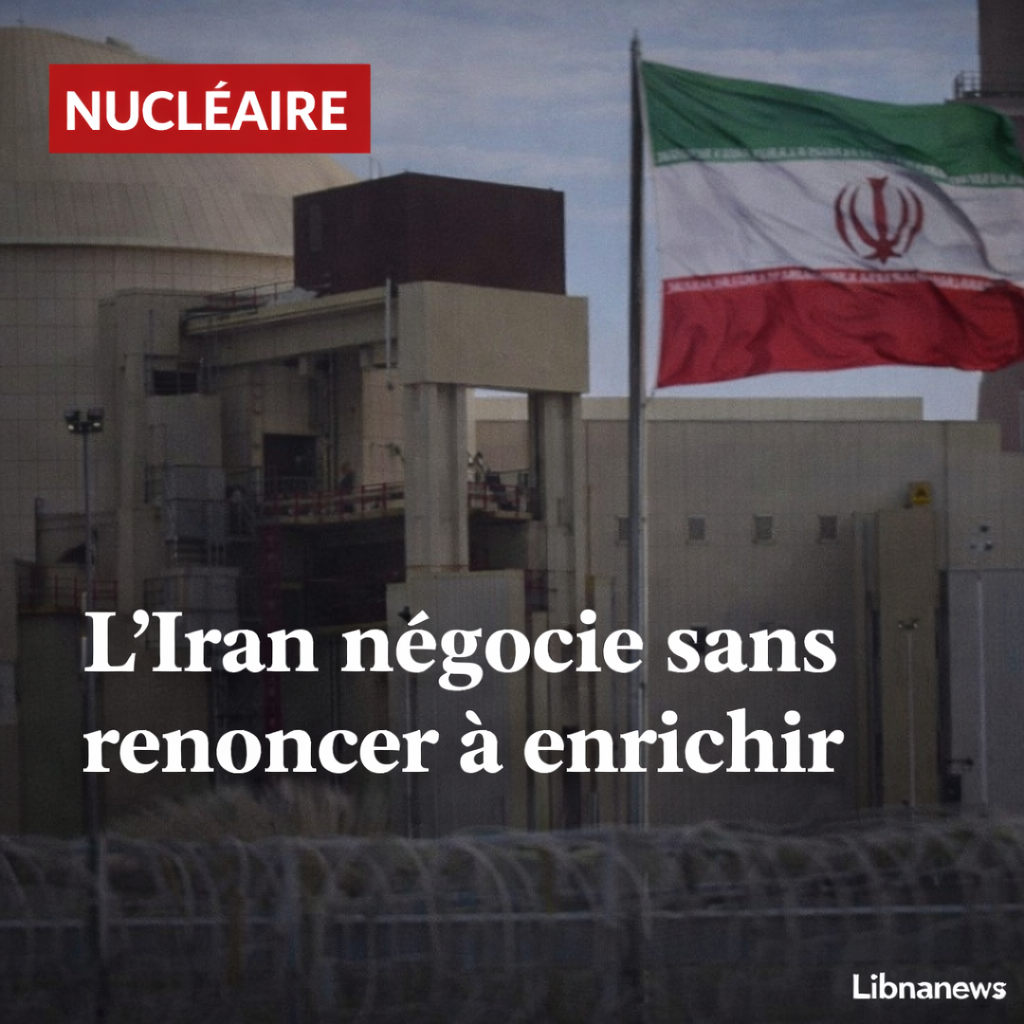
In judging the level of enrichment of uranium to be negotiable while proclaiming the very right to enrich, Tehran has set its line for further discussions with Washington. Recent developments do not indicate a breakthrough. Instead, they show that Iran wants to continue to discuss without turning the resumption of dialogue into an admission of hindsight.
Iran has chosen its sentence, and it is worth almost doctrine. In affirming that its right to enrich uranium is « indisputable » while considering the level of uranium enrichment to be negotiable, Tehran has not only clarified its nuclear position.
He set the political limit of what he can accept in the resumption of trade with Washington. The Islamic Republic does not say that it refuses any concessions. She says something more precise and useful for the future: she can discuss modalities, not legitimacy.
This shade seems technical. It is in fact the heart of the latest developments. After the failure of the Islamabad talks last weekend, the messages continue to circulate via Pakistan, and several international actors now consider it likely that contacts will resume.
So the diplomatic channel still holds. But Iran’s formula already indicates where Tehran wants to bring back the rest of the talks. For the regime, it is not a matter of entering into a negotiation that would look like a black-and-white surrender.
The aim is to show that a compromise can exist, provided that it does not erase what power has been presenting for years as an attribute of national sovereignty.
It is this logic that gives their scope to the statements made on Wednesday. The Iranian Ministry of Foreign Affairs reiterated that civilian nuclear power could not be withdrawn « under pressure or through war », but suggested that a discussion remained open on the degree of enrichment allowed.
In other words, Iran does not close the door. He’s moving it. What he refuses is not the idea of a limitation. What he refuses is that a limitation be formulated as a dispossession of law.
This difference illuminates the current moment much better than speculations on the date of a future meeting. It also explains why the indirect exchanges and cautious statements of the past few days do not yet lead to a visible breakthrough.
Both sides still talk about nuclear power, but they don’t quite talk about the same object. The United States wants to ensure that a capability deemed too close to the military threshold is permanently neutralized. Iran wants to preserve enough substance to say that it has not given in to the principle.
As long as this dissociation is not reduced, each opening gesture will remain fragile, because it will have to be interpreted without being able to be named as such.
Tehran Wants Above all to Avoid Political Defeat
One would be wrong in reading the Iranian position as the search for a spectacular diplomatic victory. Tehran’s logic is more defensive. It is less about winning than not losing publicly.
For two decades, power has transformed enrichment into a symbol of sovereignty. It has been linked to national dignity, resistance to Western pressures and refusal to be assigned to a lower status in the regional order.
In this narrative, abandoning enrichment would not only mean adjusting a technical program. This would mean admitting that American war, sanctions and military pressure eventually got what the negotiation had failed to pull out.
For a regime that has survived largely because of its ability to present itself as a non-deeding state, the cost of such an image would be immense.
That is why Iran can discuss a ceiling, a calendar, a type of centrifuges, a production intensity or a control mechanism, but much more difficult to give up explicitly.
According to several consistent sources, the American offer mentioned in Islamabad included a suspension of enrichment for a very long period. On the contrary, elements filtered from the Iranian side suggest that Tehran was prepared to consider a much shorter freeze.
The difference is obviously quantitative. But it is symbolic first. A few years may still be presented as a transitional arrangement. A much longer suspension looks like an entire diplomatic generation.
In the language of Iranian power, such a delay would not be a compromise. It would take the form of a decommissioning accepted under duress.
The Iranian formula of the last hours therefore serves as a political framework. It allows Tehran to remain in the discussion while protecting most of its inner narrative.
The regime can thus say to its population, its security apparatus and its competing elites: we do not close the door, but we do not negotiate our right to exist as a technological power.
This is crucial to understand why Iranian statements are carefully calibrated. They do not seek to reassure the western capitals first. They also aim at the inside of the system, where any inflection deemed humiliating could be instrumentalized by the toughest currents.
In Iran today, negotiation is never just a face-to-face with Washington. It is also a battle of legitimacy between those who want to strike a sustainable compromise and those who fear that a compromise will become the polite name of a strategic retreat.
Pakistan is not the solution, but the airlock.
In this context, Pakistan’s role deserves to be read with precision. Islamabad is not the political center of the Iranian nuclear issue. Nor is it the place where a major agreement will be decided by itself.
However, it has become the channel for the survival of dialogue. After the weekend talks failed, neither Washington nor Tehran had any interest in publicly adopting a definitive break.
The two capitals needed a space to keep talking without a major diplomatic revival. Pakistan offers exactly this: a regional intermediary, sufficiently involved to convey messages, but not yet loaded with too heavy a symbolism that would turn each resumption into a solemn test.
It was with this in mind that Tehran confirmed on Wednesday the continuation of exchanges through Pakistan and the prospect of new contacts with a delegation from Islamabad.
The message is double. First, the failure of the first round did not destroy the canal. Secondly, the Islamic Republic accepts that this channel remains active as long as it does not require it to display a setback in principle.
This is all the utility of a diplomatic airlock. It does not necessarily produce breakthroughs. He maintains the conversation at a level where no camp is still obliged to publicly assume the exact nature of his possible concessions.
Pakistani mediators know that. Their aim is not to resolve the nuclear dispute from the outset. It is to prevent the current impasse from turning into an irreversible rupture, especially when the ceasefire remains precarious and maritime tensions continue to exacerbate the regional cost of the crisis.
Pakistan fulfils a very special function. It preserves a language of dialogue in a sequence that remains dominated by coercion. It is a less spectacular role than a traditional but often more valuable peace mediation.
The comments made in recent hours by several international officials are in this direction: they do not promise a close agreement, they consider only possible, if not probable, a resumption.
The important word is not successful. It’s continuity. As long as the messages pass, neither side is condemned to choose between capitulation and total escalation.
For Iran, this is an important point. The Pakistani channel allows it to remain available without appearing as an applicant. He may indicate that he responds, that he transmits, that he listens to, but without giving the impression that he is moving towards a specific negotiation in Washington.
This nuance of posture is at least as important at this stage as the very content of the proposals exchanged.
Washington wants more than a slowdown
The Iranian sentence only makes sense in mirroring the American requirement. Since Islamabad’s failure, several elements have confirmed that Washington is not simply seeking a symbolic framework for Iran’s programme.
The American objective seems much more ambitious: to obtain a long, highly framed freeze capable of being presented as a real reduction in Iranian nuclear capacity after the war.
The US administration needs a clear enough result to convince that it has not only stopped an escalation, but has transformed the balance of power. It is this requirement that explains the hardness of the debate on the duration of a possible moratorium, the fate of already enriched stocks and the verification procedures.
Seen from Washington, a soft compromise would be politically bad. It would give the impression that the United States has paid the price of a regional confrontation without obtaining a lasting strategic change in Iran’s programme.
It would also leave open the criticism, already strong in some American circles, that Tehran would use every break to preserve most of its capabilities.
The administration is therefore looking for an agreement that looks like neutralisation, not just a break. This is where the Iranian word « negotiable » meets its limit.
For Tehran, this term is intended to shift the debate to parameters. For Washington, parameters are of interest only if they lead to a substantial, long and controllable reduction. This is not the same scale of ambition.
The statements of American officials over the past few days go in this direction. On the one hand, they suggest that Iranian negotiators want an agreement and that trade can resume quickly. On the other hand, they continue to link any progress to very strong nuclear safeguards.
This dual language is not an inconsistency. It reflects a strategy. The United States wants to retain the possibility of a diplomatic outcome without loosening the constraint which, in its view, makes this possible.
The maritime pressure around Iran is part of this logic. It is not just a strategic setting. It constantly reminds Tehran that negotiations are taking place under a balance of power that Washington intends to exploit to the end.
In other words, the White House doesn’t just want to talk. She wants to talk from a position of visible superiority.
The real battle is about the word « right »
This is why the battle under way is less about centrifuges than about the word « right ». Iran can agree to discuss the level of enrichment because it leaves intact the idea that it has a legitimate faculty, which it then agrees to frame.
The United States, on the other hand, wants the negotiation to have a reverse effect: not the management of a recognised right, but the limitation of a capacity considered to be excessively dangerous. This difference in diplomatic grammar is not incidental. She’s probably the main lock of the moment.
In Iranian logic, recognizing that the level is negotiable allows some technical flexibility to be reported. But this flexibility is of value only if it is part of an implicit recognition of civil nuclear rights with enrichment.
That is why Tehran insists so much on the « indisputable » nature of this right. The formula was not chosen at random. It prohibits in advance an American reading which would present a future agreement as the suspension of an activity deemed illegitimate at the base.
The regime wants to be able to say tomorrow that it has accepted limits for practical or political reasons, not that it has acknowledged that it has exercised a right that it should never have possessed.
For Washington, such implicit recognition would be much more difficult to sell. It would give the impression that the United States eventually accepted, at least in fact, the maintenance of an infrastructure that many officials consider too close to the military threshold.
The confrontation is therefore semantic as well as strategic. Iran wants to sanctify the principle and discuss the rest. The United States also wants to demonstrate that the principle no longer applies in its present form.
That’s why the case seems to be moving forward while remaining blocked. Each camp can describe its position as reasonable. Tehran will say that it accepts negotiation on intensity. Washington will say he only asks for credible guarantees.
But these two reasons do not yet overlap, because they are not based on the same definition of what a compromise must mean.
This battle of words also explains why the role of the International Atomic Energy Agency is becoming central again. Its Director General has recalled in recent hours that no agreement would be worth much without a very detailed verification mechanism.
Again, the issue is not only technical. Verification transforms diplomatic vocabulary into measurable reality. A text can preserve appearances for both sides.
The inspection, on the other hand, obliges us to say precisely what is allowed, at what level, at which sites, with which stocks, and under what control. This is the time when the useful ambiguities of diplomacy are beginning to diminish.
For Iran, accepting enhanced surveillance can be less politically costly than a waiver of principle. For the United States, this is the only way to make a compromise credible.
But the closer the verification is, the more likely it too is to be read in Tehran as a concrete violation of the sovereignty that the regime claims to defend.
Resuming trade does not mean breaking the deadlock
The latest developments therefore open up a real but narrow possibility. Yes, the Pakistani channel continues to work. Yes, several American and international officials consider a rapid resumption of trade plausible.
Yes, Iran has introduced a formula that allows us to imagine a more precise ground for discussion than the mere opposition between yes and no to nuclear. But none of this means that the impasse is getting rid of itself.
Messages are circulating. The language of compromise exists again. Yet the conflict of definition remains. In Tehran’s view, an acceptable agreement must preserve the law and regulate its exercise.
For Washington, a credible agreement must neutralize a capacity and make that neutralization verifiable. As long as these two stories remain incompatible, the resumption of contacts will look less like an exit from crisis than an organized management of the disagreement.
This is why the present moment requires careful reading. Markets, chancellors and mediators can cling to the idea of a second round, and they are right to do so as much as the continuation of open confrontation would be costly.
But the central problem is not the recovery itself. It is the starting point for this recovery. On what common sentence can both sides start talking again?
This is where the Iranian formulation of Wednesday becomes important. It proposes, in a way, a basis for restarting: not to dispute the principle, but to negotiate its intensity.
The problem is that this basis is not necessarily acceptable to the United States if it resembles implicit recognition of a right that they are precisely seeking to empty of its strategic scope.
The decisive article of the coming days may therefore not be a communiqué announcing a new meeting in Islamabad or elsewhere. This will be the way each camp will describe what it agrees to put on the table.
If Washington continues to demand a suspension so long that it looks like a de facto cancellation, Iran will find it difficult to remain in the discussion without exposing itself to a crisis of internal legitimacy.
If Tehran insists on an absolute defence of the principle without accepting very strict concrete translation, the United States will find that it does not obtain sufficient guarantees.
The possible compromise may exist in the meantime: a tight framework, limited in time but heavy enough to be presented in Washington as a success, and reversible enough to be defended in Tehran as a limitation without humiliation.
But this interval is narrow, and every word used since Wednesday shows how well both sides already know that it will not only be uranium negotiations. It will be a matter of deciding whether an agreement can still be sold, on both sides, as something other than a step back.






