

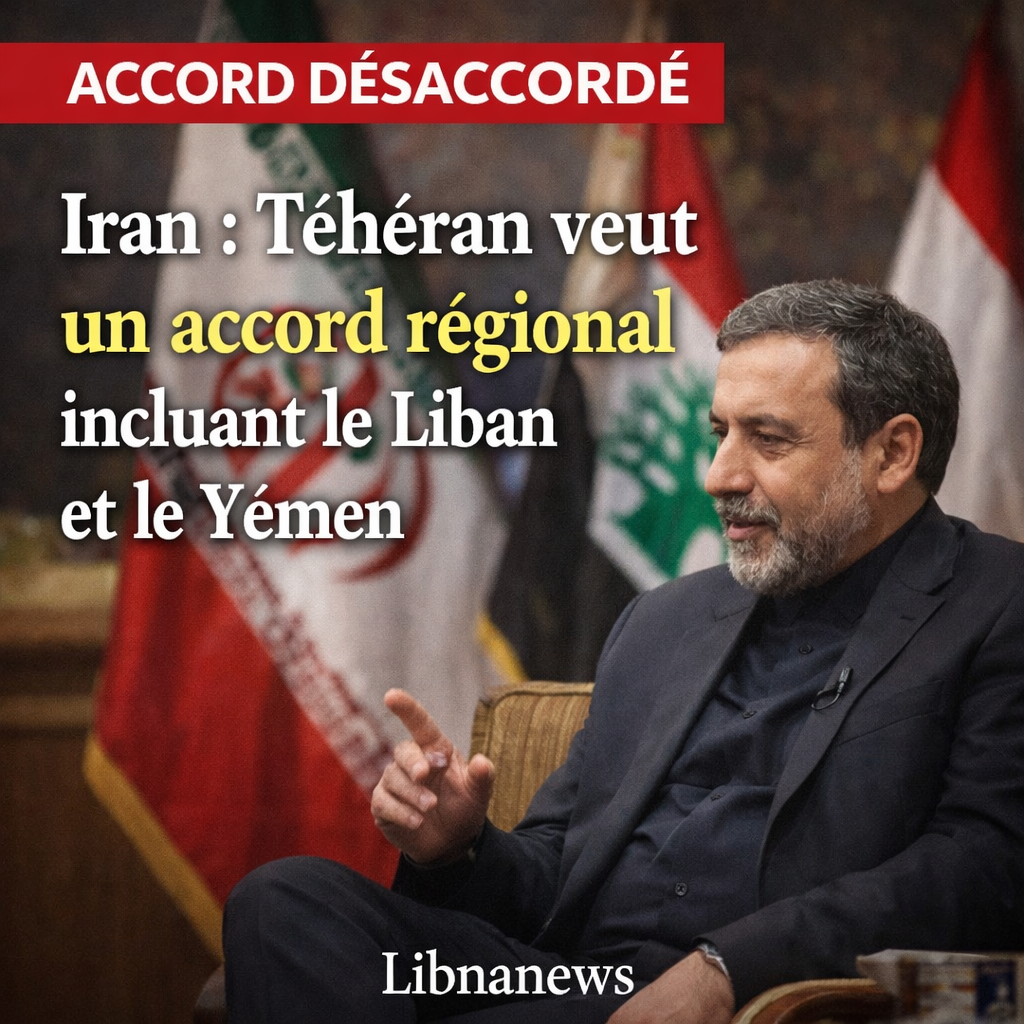
In an exclusive interview with a Qatari channel, Iranian Foreign Minister Abbas Araghchi set a political line that far exceeds the only nuclear issue or even the only direct confrontation between Tehran and Washington. His message is clear: Iran does not consider that an agreement can be limited to a halt to strikes on its territory or to a bilateral arrangement with the United States. For Tehran, any credible exit from the crisis must cover the entire regional theatre of war, which in fact means integrating Iran, Yemen and Lebanon into the same de-escalation architecture. The Minister does not declare it in the form of a frozen diplomatic list, but his formulation on the need for a total end to the war, in Iran as well as in the whole region, gives the exact framework of the Iranian position.
This clarification is decisive because it responds to two competing narratives that have been circulating for several days. The first, widely relayed on the American side, claims that a structured negotiation is already under way between Washington and Tehran. The second suggests that Iran would be prepared to accept, at least in part, a framework imposed by the United States in exchange for rapid de-escalation. Abbas Araghchi rejected both readings in front. He stressed a point of diplomatic vocabulary: for him, a negotiation implies that two parties sit together to reach an agreement. He said, however, that does not exist at this stage between Iran and the United States. It recognizes the exchange of messages, direct to their destination but transmitted by intermediaries, notably by the American envoy Steve Witkoff. But he refuses to qualify these exchanges as negotiations.
The shade is not only semantic. She said Tehran was trying to avoid the image of an Iran that had already returned to the table under military pressure. In the current sequence, accepting the word « negotiation » would mean admitting that the strike campaign has already had its main political effect. By refusing this terminology, Iranian diplomacy is instead trying to show that the government retains the initiative over the timetable, the words and the scope of a possible agreement. Abbas Araghchi’s interview is therefore used first to frame the debate: no, Iran did not validate an American roadmap; No, he did not respond to the supposed fifteen-point plan mentioned in Washington; and not, it does not want a simple ceasefire limited to its territory.
No negotiation, but message diplomacy
The core of Iran’s position lies in this distinction between indirect diplomacy and formal negotiation. Abbas Araghchi claims that messages are well exchanged, some coming directly from the American camp, others transiting through friendly countries in the region. He also states that these messages go through the official channels of the Ministry of Foreign Affairs, or at least with his knowledge, under the supervision of the Iranian Supreme Security Council. In other words, Tehran wants to cut short the idea of uncontrolled parallel channels or internal divisions on the conduct of the crisis. The Minister stressed the unity of decision-making and the institutional framework for indirect dialogue with Washington.
This point counts a lot, because the present war has reopened an old question about the real functioning of the Iranian power: who speaks, who decides, and at what level is contact with the United States being handled? By replying that there are no competing decision-making centres on this issue, Abbas Araghchi seeks to reassure Iran’s allies and to respond to American speculation about possible cracks in the system. His statement also targets an internal audience. She told the Iranians that, despite the war, the case remained centralized, without savage diplomacy or clandestine bargaining outside state control.
But this institutional firmness is accompanied by minimal openness: messages continue. This means that Iran does not completely close the door to a political outcome. He simply wants to avoid this being presented as a diplomatic capitulation or as a discussion limited to American parameters. This position also sheds light on the growing gap between Donald Trump’s remarks, which raised the possibility that US operations would stop within two to three weeks, and Iran’s reading of the situation. Where Washington seems to want to set up the idea of a conflict that could soon come to an end, Tehran replies that no such decision has yet been taken and that a lasting halt is subject to wider and more demanding conditions.
Why Tehran Refuses Close Ceasefire
The most important element of the interview is the formula used by Abbas Araghchi to describe Iranian objectives. He made it clear that his country did not accept a simple ceasefire. It requires a total end to the war, not only in Iran, but throughout the region. This sentence gives the key to Tehran’s desired focus: for the Iranian authorities, there is no possible partial peace if the peripheral fronts remain open. In other words, a halt to the strikes on Iran without de-escalation in Lebanon and Yemen would, from the Iranian point of view, be an incomplete, fragile and probably misleading truce.
This approach was not improvised. It reflects Iran’s long-standing strategic environment: not as a sum of separate crises, but as a set of interconnected fronts. In this sense, Lebanon is not a secondary issue, and Yemen is not an annex. These are two areas where the regional power relationship is played with Israel and, indirectly, with the United States. Therefore, accepting an agreement that would neutralize Iran while allowing military pressure to continue against Hezbollah in Lebanon or against the Houthis in Yemen would, in Tehran’s eyes, be tantamount to politically disarming the centre while keeping the peripheries under fire.
The refusal of a limited ceasefire is also due to recent experience. Since the resumption of the regional war in late February, the fronts have multiplied. Attacks have affected Iran, but also Lebanon, where Israeli strikes have resulted in heavy casualties, including around Beirut. At the same time, the Yemeni front became active again, with fire claimed from Yemen to Israel. For Tehran, these facts reinforce the idea that war is no longer confined to a single national space. It forms a regional system of cross climbing. That is precisely why Iran refuses that a possible agreement deals only with its territory or strategic programme.
Lebanon as an indispensable link in any exit from the crisis
Lebanon occupies a central place in this Iranian reasoning. First because he is now one of the hardest hit fronts. An international news agency reported that Israeli strikes around Beirut have still caused at least seven deaths and 24 injuries in recent hours, against the background of an expanded offensive against Hezbollah. More broadly, the Lebanese record of this new phase of war already exceeds one thousand dead and has displaced more than one million people, according to several consistent reports.
Secondly, Lebanon is at the heart of a very heavy Israeli strategic development. Israel’s Defense Minister, Israel Katz, said Israel intended to maintain control over the entire area south of the Litani after the end of the current conflict. He also claimed that hundreds of thousands of Lebanese internally displaced persons would not be allowed to return south of the river until the security of northern Israel was guaranteed, and the houses of villages near the border were destroyed. Such a line profoundly transforms the framework of the war: it is no longer merely a matter of ad hoc military operations, but of an assumed project of lasting presence and transformation of the territory of South Lebanon.
To this is added an even more radical speech by some Israeli officials. Finance Minister Bezall Smotrich has publicly declared that Israel’s new border should be the Litani. This declaration is one of the most explicit formulations of annexation or, at least, sustainable territorial seizure in southern Lebanon. For Tehran, this type of statement confirms that no serious agreement can ignore the Lebanese front. If Lebanon remains open to a prolonged offensive, then Iran will consider that there is no regional peace, but only a shift from the centre of gravity of the war.
Yemen, other than Tehran, refuses to dissociate
The same reasoning applies to Yemen. For several days, attacks claimed from Yemeni territory have targeted Israel, in a context of visible coordination between the pro-Iranian actors of the Iranian axis. Press reports reported that a missile launched from Yemen had been intercepted by Israel, while other sources reported coordinated strikes with Iran and Hezbollah. Even if each actor retains its own autonomy, the image that is imposed is that of a Yemeni front that has become fully active in the regional crisis.
For Tehran, Yemen performs several functions in the diplomatic equation. First of all, it recalls that the war has an impact on energy and maritime roads, while the Strait of Ormuz and oil flows have already been severely shaken. It then shows that the Iranian regional influence is not limited to the Levant. Finally, it gives Iran a simple political argument: how can we talk about an end to war if Yemeni theatre continues to produce strikes, interceptions and risks of enlargement? In this context, requiring that an agreement also covers Yemen amounts to a requirement of strategic coherence, not just political solidarity with an ally.
This reading explains why Abbas Araghchi speaks of a total end of war rather than a ceasefire. The ceasefire freezes a line of fire locally. The end of war, as Tehran defines it, involves dealing with the hotbeds of escalation that respond to each other. On this point, the message is clear: Iran does not want Washington to sell as a solution a bilateral arrangement that would break the Iranian impasse while allowing Israel to pursue its objectives in Lebanon or militarily contain the Yemeni front.
Guarantees, repairs, security: other Iranian conditions
Abbas Araghchi was not content to refuse the record of ongoing negotiations. He also laid down his country’s general requirements for an exit from war. These are three orders. First, Iran wants guarantees to prevent repeated attacks. He then demanded compensation for the damage suffered by the Iranian people. Finally, it insists on a comprehensive end to hostilities in the region. These three points are consistent between them: Tehran does not want a temporary suspension of the strikes, but rather a framework that makes it more costly and difficult to return quickly to climbing.
Diplomaticly, this puts the bar high. Guarantees of non-repetition are still difficult to obtain in such a moving war, especially when American and Israeli objectives do not seem to be fully aligned. Reparations are a classic demand in Iranian discourse, but very complicated to translate into concrete mechanisms as long as the conflict remains open. As for the regionalisation of the regulation, it is facing the US temptation to move towards a more rapid, narrower and neutralised arrangement in Iran. The gap between the two approaches is therefore real.
This also explains the very dry tone of the Iranian minister when he is questioned about the alleged US demands or about five conditions Iran would have put in return. He denies having responded to the plan in fifteen points and sweeps the five conditions as media speculations. Here again, the message is clear: Tehran does not want to enter into a dramaturgy where Washington would set the terms of the debate and where Iran would only have to validate, correct or refuse an already drawn menu.
What Tehran is really trying to impose
In reality, Iran is trying to shift the discussion from surrender to regionalization. Rather than responding line-to-line to American requests, he reformulates the problem. According to this logic, the real question is not what concessions Iran is willing to make, but what regional order can prevent the immediate resumption of strikes? It is in this context that Lebanon and Yemen reappear in the centre. Their inclusion is not an ideological supplement. It becomes evidence, from the Iranian point of view, that an agreement deals with the reality of the war as it actually unfolds, not as Washington would want to cut it.
This does not mean that Iran has a comfortable position. The country is under strong military, economic and psychological pressure. Oil prices, shipping routes, attacks on Gulf states and general instability show that the regional cost of war is rising rapidly. But specifically, Tehran seems to want to turn this fragility into a diplomatic lever. By saying that no peace is possible without Lebanon and Yemen, he makes the Americans understand that the war cannot be closed on the Iranian side alone while the other fronts continue to blow up the region.
In the immediate future, this position complicates rather than facilitates a rapid exit from crisis. But it has a major political usefulness for Tehran: it protects the image of an Iran that does not negotiate under threat alone, does not dissociate its allies from its own fate, and seeks to impose a regional reading of the conflict. The message of Abbas Araghchi can be summed up as follows: there will be no credible agreement if Iran is asked to close the main front while Lebanon and Yemen remain open, beaten or threatened.






