

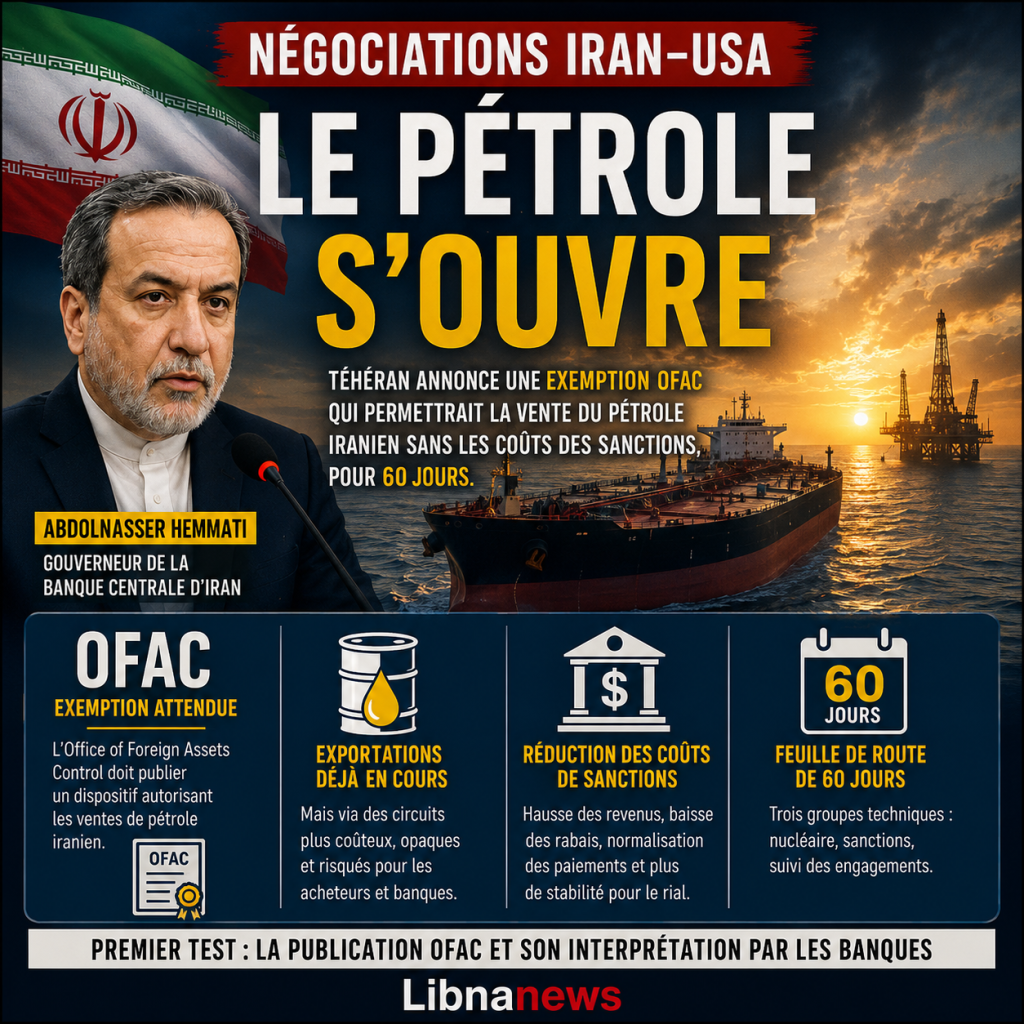
The governor of the Iranian Central Bank presented Monday, 22 June, the expected exemption from US oil sanctions as one of the most concrete results of the new Iran-USA round of negotiations. According to the Iranian version, the Office of Foreign Assets Control is required to publish a mechanism to sell Iranian oil without the additional costs of sanctions. Exports were already continuing, but they were based on more expensive, opaque and risky circuits for both buyers and banks. The Tehran message therefore aims to transform de facto tolerance into an assumed financial mechanism, at least for a transitional period.
This economic announcement takes place in a wider diplomatic sequence. The Swiss discussions, conducted with the mediation of Qatar and Pakistan, established a 60-day road map to a final agreement. Negotiators have set up working groups on nuclear, sanctions and monitoring commitments. The oil component serves as an immediate signal. It must show Iran that negotiations produce measurable effects, while maintaining for Washington a lever of control over the continuation of the process.
An OFAC exemption at the heart of Iran-USA negotiations
The term exemption must be used with precision. It does not necessarily mean a general and definitive lifting of US sanctions against Iran. Rather, it refers to a temporary or targeted authorization, supervised by the U.S. administration, to allow certain oil and petrochemical transactions. In the U.S. system, OFAC formalizes this type of authorization through licensing, exemptions, notices or enforcement documents. Until the operational text is published and interpreted by the banks, the exact scope remains to be confirmed.
| Item announced | Central data | Economic reading |
|---|---|---|
| Political duration of the roadmap | 60 days | period for negotiating a final agreement |
| Technical groups announced | 3 groups | sanctions, monitoring and settlement of disputes |
| Date of Iranian announcement | 22 june 2026 | first test after the swiss talks |
| Oil exemption expected | temporary | possible sale with reduction of sanctions costs |
| Most prudent status | to be formalized | the banking effect depends on OFAC publication and compliance instructions |
The Iranian governor insisted on two points. The negotiations had been intense, but the results would correspond to the objectives set by the delegation. This formulation seeks to respond to internal criticism. Part of Iran’s political apparatus fears that negotiations with Washington will lead to too fast concessions on nuclear power or Tehran’s regional relays. By presenting the oil exemption as an economic victory, the Central Bank is trying to shift the debate to income, payments and monetary stabilization.
The second point concerns the continuity of exports. Iran does not say that it is starting to export from scratch. He claims that sales already existed, despite the sanctions, but that they were done at a high cost. This cost is not limited to an accounting line. It affects sales prices, discounts to customers, insurance costs, marine risks, intermediaries, financial commissions and the difficulty of repatriating currencies through official channels.
The hidden cost of sanctions on Iranian oil
The immediate interest of an exemption would therefore be to narrow the gap between the real price obtained by Iran and the international price of the barrel. Under sanctions, an exporter often has to accept a discount. Buyers demand compensation for legal and financial risk. Banks refuse or limit payments. Shipowners are asking for a risk premium. Insurers are hesitant. Revenues arrive slower and may remain blocked in external accounts. A U.S. authorization, even if limited, may change this chain.
For the Iranian Central Bank, the stakes go beyond the energy sector. Oil remains the main source of strong currencies. Revenues through official channels can support currency, finance essential imports and reduce pressure on reserves. They may also limit the differences between official and parallel exchange rates. This dimension explains the governor’s presence in the delegation and the rapid communication on OFAC after the talks.
However, caution is still needed. International banks do not rely solely on political declarations. They await texts, categories of transactions authorized, entities covered, dates, accepted counterparties and exclusions. A buyer of crude can accept a principle. A large bank has to check whether the transaction exposes its accounts in dollars, its US correspondents or its subsidiaries to secondary sanctions. This step can take time, even when an exemption exists.
Washington also retains a margin of interpretation. An exemption may apply to certain volumes, buyers, ships or payments. It may authorize the sale, but not all related financial transactions. It can allow delivery without guaranteeing free repatriation of income. It may also expire automatically if Iran fails to comply with the steps set out in the memorandum. The word exemption should therefore not be confused with complete standardization.
Oil, Ormuz and Lebanon in the same trade
The Iran-USA negotiations place this mechanism in a broader exchange. Iran wants the sustainable reopening of oil circuits and the release of frozen assets. The United States wants regional de-escalation, a more verifiable nuclear framework and control of the Ormuz Strait. Qatari and Pakistani mediators try to link these cases without causing a break. Oil becomes the first visible reward. It can also become the first means of pressure if the truce in Lebanon or the nuclear talks deteriorate.
The link with the Strait of Ormuz remains central. Negotiators have planned a communication line to avoid incidents and misunderstandings about the passage of commercial vessels. For Iran, this line recognizes its weight in Gulf maritime security. For the United States and energy buyers, it aims first and foremost at traffic continuity. Any tension around Ormuz increases risk premiums, fuels price volatility and complicates insurance. An oil exemption is of real value only if the ships can circulate.
Market effects will depend on the credibility of the scheme. If buyers believe that the U.S. exemption is sound, Iranian shipments will be able to return more directly to commercial channels. If the exemption seems fragile, customers will keep their discounts and precautions. The first official transactions will set the tone. They will show whether the Iranian announcement opens a stable channel or whether it remains a political gesture intended to keep Tehran around the table.
The risk for Washington is the opposite. Too wide an exemption can be criticized as an early concession. Opponents of the agreement will say that Iran obtains income before it has provided sufficient assurances about its nuclear programme and its regional allies. The US administration will therefore seek to present the authorization as reversible. It will also be able to focus on specific stages, including the continuation of technical talks, de-escalation in Lebanon and the maintenance of the sea crossing.
A signal for the Iranian economy
For Tehran, the political benefit is already committed. The government can say that sanctions no longer completely block the sale of oil. He can also say that the costs imposed by indirect circuits are beginning to fall. This communication concerns the Iranian internal market. It seeks to reassure importers, exchangers, industrialists and households, all exposed to inflation and changes in the rial. A simple ad can produce a psychological effect even before the first payments.
This dynamic has its limits. US sanctions have produced a bypass ecosystem that does not disappear in a few days. Intermediaries built their margins on opacity. Buyers have learned to negotiate discounts. Insurers and banks have tightened their internal procedures. Even with an exemption, they will not all change behaviour immediately. Trade standardization requires trust, legal certainty and a longer perspective than 60 days.
The Governor of the Central Bank therefore insists on the most tangible part: the costs of sanctions. This expression summarizes the effect of US pressure on the oil chain. It is not just a formal ban. It refers to economic losses that accumulate between production, loading, transportation, sale, payment and currency conversion. Reducing these costs is tantamount to increasing the net income of the State, even if export volumes do not increase immediately.
The issue of frozen assets completes this table. An exemption on future sales will not have the same effect as an already accumulated asset release. The first revenues finance current activity. The assets released may provide a fiscal cushion, support imports or contribute to reconstruction and development programmes. The Iranian side claimed that a fraction of these assets had been released through the mediators. The modalities, amounts and channels of expenditure remain the most sensitive points.
Customers facing the risk of a back-up
The situation also recalls that energy serves as a diplomatic currency. Iranian oil is not limited to physical volumes. It represents access to the dollar, marine insurance, banking correspondents and Asian clients. A barrel sold by an indirect circuit can take weeks to produce usable income. A barrel sold under exemption can, in theory, reduce the payment time and improve the visibility of the Central Bank. This difference counts for a State facing military, social and reconstruction expenditures.
Potential customers will therefore follow three criteria. The first is legal: they will have to know whether the purchase still exposes their banks or insurers to secondary sanctions. The second is commercial: they will compare the Iranian price to the competing crude, integrating freight and political risk. The third is diplomatic: they will measure the likelihood of a brutal return of sanctions before the end of the sixty-day period. A cargo loaded today can become sensitive if the frame changes before payment.
The exemption may also change the behaviour of intermediaries. Some players in the so-called parallel channel may lose some of their usefulness if sales go through more visible channels. Others will seek to remain indispensable by offering services that large companies will still refuse to provide. This transition can create conflicts of interest within the Iranian oil trade itself. The bypass circuits generated revenues, but also commissions, dependencies and corruption zones.
Finally, the case concerns the credibility of the mediators. Qatar and Pakistan presented the discussions as a structured process, with political follow-up and technical groups. If the oil exemption is implemented, they will be able to claim a verifiable economic result. If it remains unclear, their role will be considered more fragile. For Doha, as for Islamabad, the challenge is to maintain sufficient confidence for negotiators to address the most difficult issues without repeating the logic of public threats.
The Lebanese dimension indirectly weighs on this economic architecture. Tehran linked the continuation of the process to the cessation of military operations in Lebanon. Washington wants to prevent the South Lebanese front from reviving regional confrontation. An oil exemption can therefore depend on a theatre that is not energy-free. If strikes or shots rekindle the crisis, commercial authorization can become politically unsustainable. Iranian oil is thus suspended from the stability of roads, villages and contact lines located away from export terminals.
The follow-up will depend on the expected concrete publication of OFAC. Negotiators may announce an exemption. Markets, banks and shipowners will wait for the text. They will read definitions, dates, excluded entities, payment terms and reporting obligations. The slightest ambiguity can reduce the economic effect of the announcement. Conversely, a clear text can turn diplomatic progress into visible trade flows.
The next few days will therefore have a test value. If the exemption appears quickly and if the first operations are accepted by the financial actors, Iran will be able to present the talks as a real economic opening. If publication is delayed, if it is limited to too narrow a perimeter, or if banks remain reluctant, the governor’s statement will become primarily an instrument of pressure on Washington. The Iran-USA negotiations are thus entering a phase in which sanctions law, cargo, bank accounts and diplomacy are now advancing at the same pace.






