

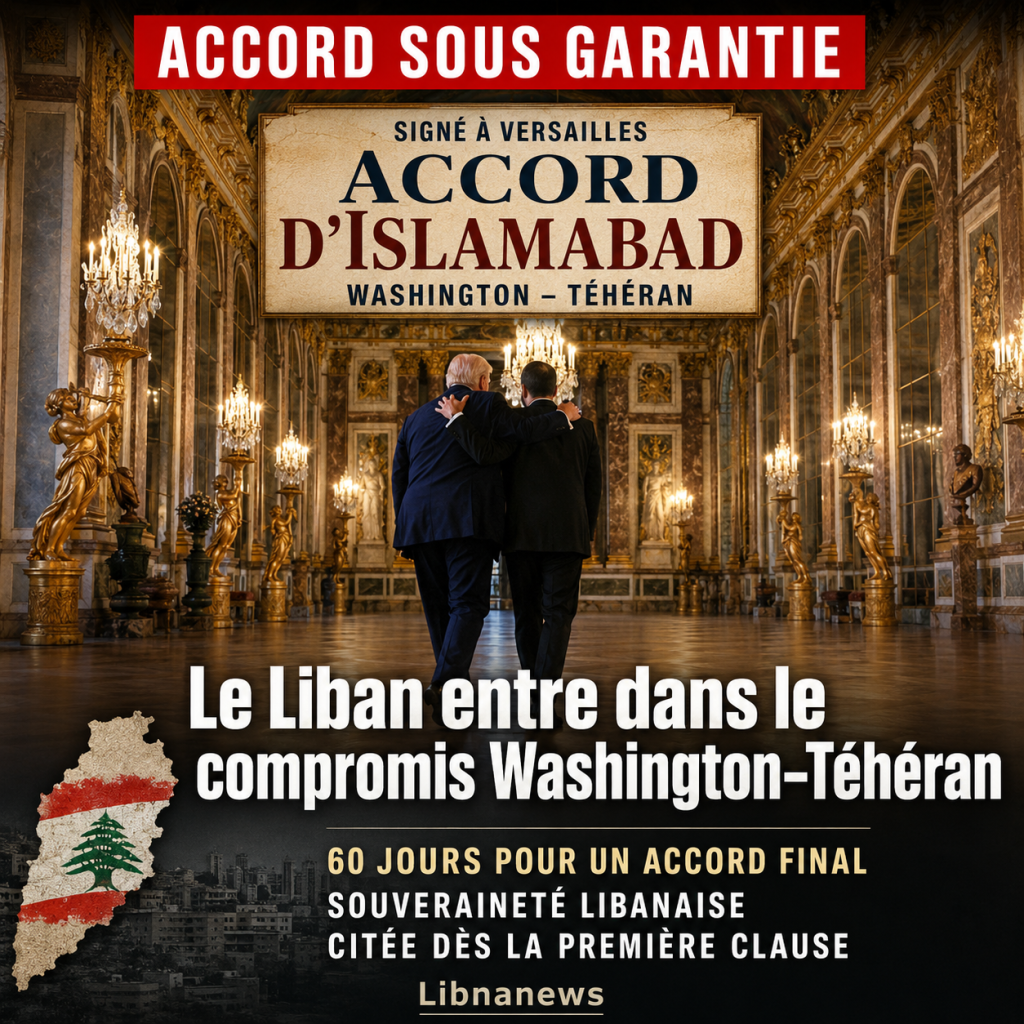
The night signing of the Islamabad memorandum in Versailles turned an official dinner into a first-class diplomatic scene. The text, negotiated between Washington and Tehran, is launching a sixty-day phase to convert a political ceasefire into a final agreement. For Lebanon, the stakes go beyond the suspension of hostilities. The first clause explicitly mentions the end of military operations on all fronts, including in Lebanon, and the requirement to guarantee Lebanese sovereignty. This formulation places Beirut at the heart of a regional arrangement whose sponsors are now the United States, Iran, the United Nations expected in the Security Council and, indirectly, Israel by its inclusion among the allies involved in the war. Through its signature in Versailles, France also established itself as a partner in the Middle East agreement.
Versailles, calculated decoration of an agreement from Islamabad
The choice of Versailles was nothing but a change of place. The sequence was initially to return to Geneva, a classic space for security negotiations and laborious compromises. She finally moved to the more solemn setting of an official French dinner, at the Palace of Versailles, under the gold of the diplomacy of the apparate. This move gives the memorandum a different political dimension. It is no longer just a technical text read by delegations. It becomes an act of staging, with France as host, the United States as a major signatory, and Iran as a recognized interlocutor in a central regional file.
Versailles bears a historical burden that the chancelleries know well. The place recalls the diplomacy of treaties, war and peace, European balances and major international recompositions. However, the symbol should be specified. American independence was recognized by the Treaty of Paris of 1783, signed in the French capital between American and British representatives. In the same diplomatic ensemble, treaties concluded at Versailles also governed peace between European powers. The castle is therefore not the exact legal place of American recognition. There remains a powerful setting to evoke the Franco-American alliance, the diplomatic birth of the United States and the French capacity to offer theatre to international compromises.
The official dinner served as a framework for this symbolic translation. Paris sought to put the agreement in a historical continuity favourable to Washington, without erasing the Pakistani role in the genesis of the text. The name of Islamabad remains attached to the memorandum, as the previous discussions have been associated with Pakistani mediation and the rapprochement phase between the two enemy capitals. Versailles gave the picture. Islamabad gave the name. Geneva, which was to host the technical continuation of the discussions, retained its role as a diplomatic laboratory.
This combination is not anomaly. It allows every actor to save a piece of story. The United States can present the text as a leadership victory. Iran can say that it has not signed a capitulation, but a balanced memorandum including the progressive lifting of sanctions and the recognition of sovereign rights. France can claim a reception and mediation capacity. Pakistan retains the political paternity of the canal that gave its name to the document. Lebanon, on the other hand, appears from the first clause, but without having been directly at the centre of the table.
Islamabad agreement: 14 points to stop climbing
The Islamabad agreement is based on fourteen points. This architecture is not neutral. It refers, by its number, to the tradition of major peace programmes. It also recalls, without limitation, Woodrow Wilson’s fourteen points formulated in 1918 to organize the First World War. The parallel must remain cautious. The current memorandum does not propose a new world order. It seeks first to stop a war, reopen the Strait of Ormuz, oversee Iran’s nuclear programme and open a wider negotiation.
The first point is the political key to the text. The United States, Iran and their allies in the ongoing war declare the immediate and permanent end of military operations on all fronts. The clause quotes Lebanon. It adds the commitment not to launch any war or military operation against each other. It also includes respect for Lebanese territorial integrity and sovereignty. For Beirut, this is the most important passage. Lebanon is not only treated as a secondary theatre. It becomes an explicit guarantee object.
The second point establishes mutual respect for American and Iranian sovereignty and commitment to non-interference. This clause refers first to relations between Washington and Tehran. It responds to decades of cross accusations. The United States blames Iran for its regional networks and indirect military capabilities. Iran accuses Washington of seeking to reshape its regime and strategic environment. The formula does not resolve these disputes. She’s setting a language frame.
The third point sets a maximum period of 60 days for reaching a final agreement, with the possibility of an extension by mutual consent. This calendar is tight. It requires negotiators to quickly translate a political text into verifiable obligations. It also carries a risk. The shorter the deadline, the more ambiguities can be pushed back to the final document. The memorandum is gaining immediate impact, but it leaves several major issues outstanding.
The fourth point provides for the beginning of the lifting of the US naval blockade and the gradual end of the maritime barriers against Iran. He mentioned a period of 30 days for the complete end of the blockade and the subsequent withdrawal of the US neighbourhood forces after the final agreement. This clause responds to one of the most urgent economic challenges. Tensions around the Gulf have affected energy flows, maritime insurance and market expectations.
The fifth point concerns the Strait of Ormuz. Iran undertakes to organize, within its best efforts, the safe passage of commercial ships between the Persian Gulf and the Oman Sea. The free passage is for sixty days. The text also provides for a technical phase of clearance and removal of military obstacles. Tehran must discuss with Oman and other riparian states the future administration of maritime services. This point shows that the memorandum does not erase Iranian claims to the Strait. He is supervising them provisionally.
Lebanon, first clause and first test
For Lebanon, the first clause is both an opportunity and a source of questions. The Islamabad agreement is not just calling for a truce in southern Lebanon. It refers to the permanent cessation of military operations on all fronts, including the Lebanese front. It adds the guarantee of territorial integrity and sovereignty. In a context marked by strikes, specific occupations, ceasefire violations and the fragility of the State, this sentence can become a diplomatic instrument.
Beirut can now rely on language that goes beyond bilateral arrangements or simple security mechanisms. If the text goes up to the final agreement and if it receives a binding resolution from the Security Council, Lebanese sovereignty will no longer be invoked solely by the Lebanese authorities. It will be part of an international arrangement directly related to the American-Iranian settlement. This is what changes the political balance.
However, the practical scope remains conditional. The memorandum opens a way. It does not yet replace a field verification mechanism. He did not say how any Israeli positions still in Lebanese territory would be evacuated. Nor does it define the timetable for a withdrawal or how the Blue Line would be controlled. It does not address the issue of Hezbollah weapons, nor does it address the exact role of the Lebanese army and UNIFIL in a stabilization phase.
This silence can be read in two ways. For the Lebanese authorities, it leaves the possibility of turning a general clause into a specific claim. For Israel, it is opening an area of concern. An international guarantee of Lebanese sovereignty can reduce the Israeli military margin in southern Lebanon. It can also make politically more costly any operation presented as preventive. This is where the agreement is in the interest of part of Israel’s security apparatus.
Three-tier sponsorship
The text draws an unprecedented diplomatic sponsorship. The first level comes from Iran. Tehran agreed to sign a document that mentioned Lebanon in its first clause. This presence, in fact, formalizes the Iranian influence in the Lebanese case. She doesn’t create it. It makes it visible in an international agreement negotiated with Washington. For Hezbollah’s opponents, this is a difficult observation. For the supporters of diplomatic realism, on the contrary, it is the recognition of an already installed balance of power.
The second level comes from the United States and, by extension, Israel. Israel does not appear to be a direct signatory to the memorandum, but the text targets the allies involved in the ongoing war. This formula includes politically the fronts linked to Israel, particularly Lebanon. It obliges Washington to translate engagement into its relationship with the Hebrew state. It’s a sensitive point. The United States should guarantee Israel that the text does not militarily strengthen its opponents, while preventing Israeli operations from emptying the Lebanese clause of its content.
The third level is United Nations. The fourteenth item provides that the final agreement will be endorsed by a binding resolution of the Security Council. It is the most important legal gateway. The memorandum remains an interim political agreement. A Security Council resolution can give it superior normative force. It can also integrate the Lebanese issue into an international monitoring mechanism. For Beirut, this is crucial, as it avoids Lebanese sovereignty being treated as an annex to the nuclear negotiations.
There is a contradiction in this triple sponsorship. It protects Lebanon by placing it in a wider architecture. But he also stresses his dependence on decisions taken by others. The country gains a diplomatic guarantee. It does not automatically gain control of the calendar. Its interest will be to transform the text into operational instruments: verifiable withdrawal, monitoring of violations, increased role of the army, coordination with UNIFIL and active diplomacy in the Security Council.
Sanctions, nuclear and Iranian money: the hard heart of compromise
Points six to eleven show that the Islamabad agreement is not just about regional security. The sixth item provides for a reconstruction and economic development plan for Iran of at least $300 billion, with regional partners and US financial licences. This sum is one of the most disputed aspects of the text. It gives Tehran a major economic perspective. It also raises criticism among those who fear the indirect strengthening of Iran’s regional networks.
The seventh point calls on the United States to end the sanctions against Iran within a timetable to be agreed in the final agreement. He mentioned the primary and secondary American sanctions, but also the resolutions of the Security Council and the International Atomic Energy Agency. The wording is broad. It does not mean that all sanctions fall immediately. It means that lifting them becomes a central subject of negotiation. For Tehran, this is a victory in principle. For Washington, it is a lever that remains conditioned by the final agreement.
The eighth point concerns nuclear power. Iran reaffirms that it will not acquire or develop nuclear weapons. Stored enriched materials must be treated according to a mechanism to be defined, with at least on-site dilution under IAEA supervision. This point seeks to reconcile two contradictory requirements. The United States wants to prevent militarization. Iran wants to preserve part of its programme and avoid the image of an imposed dismantling. International oversight therefore becomes the key to the credibility of the compromise.
The ninth point freezes the situation during the interim phase. Iran maintains the current state of its nuclear programme. The United States undertakes not to impose new sanctions and not to deploy additional forces in the region. The purpose of this clause is to prevent breaches during the 60 days of negotiations. She’s fragile. A maritime incident, a strike in Lebanon or a real or suspected nuclear acceleration could be sufficient to put it under pressure.
The tenth point provides for US exemptions for the export of Iranian crude oil, petroleum products and associated services. The eleventh point concerns Iran’s frozen or restricted funds, which must become usable under negotiated procedures. These arrangements offer Tehran a quick benefit. They also explain internal Israeli and American criticism. For opponents of the text, Iran receives economic gains before it has delivered definitive concessions. For its defenders, these gains are necessary to make the truce credible.
Why Israel sees the text with concern
Israel’s concern is due to several factors. The first is Lebanon. An explicit guarantee of Lebanese sovereignty may limit Israel’s doctrine of preventive strikes and cross-border actions. Even if Israel maintains its security argument, any operation in Lebanon will now have to deal with a Washington-led text intended to be endorsed by the Security Council. This changes the diplomatic cost of military actions.
The second element is Iran’s place. By signing a text in which Lebanon appears from the first clause, Tehran appears to be a necessary interlocutor on the Lebanese front. For Israel, this is a political setback. The agreement does not reduce Iranian influence. He’s channeling it. He turns it into a written commitment. This movement can stabilize the ground, but it also gives Iran a form of regional recognition.
The third element is nuclear. The text does not proclaim an immediate dismantling of the Iranian programme. It provides for negotiations on enrichment, Iranian nuclear needs and the fate of stored materials. This gradual approach can reassure the supporters of compromise. It is a matter of concern to those who consider that Tehran is using time to preserve capabilities.
Finally, the partial removal of economic constraints may alter regional balances. Facilitated oil exports and unlocked funds strengthen the Iranian financial margin. The real effects will depend on the control mechanisms, the final schedule and the counterparties imposed on Tehran. But the political signal is already clear: Iran is no longer just a state under pressure. He is once again an actor with whom Washington negotiates regional security.
Beirut facing a narrow diplomatic window
Lebanon cannot simply welcome the mention of its sovereignty. He must exploit it. The priority will be to request that the final agreement detail the obligations related to Lebanese territory. A general formula is not enough. Beirut will require specific mechanisms: verifiable cessation of strikes, withdrawal of any unauthorized foreign presence, consolidation of the role of the Lebanese Armed Forces, strengthening the UNIFIL follow-up mandate and prompt complaint procedures in case of violations.
The Lebanese government must also avoid an internal political trap. If the agreement is perceived as an exclusive consecration of Iranian influence, it will further divide the country. If presented as a lever of national sovereignty, it can become a broader point of support. It will depend on how Lebanese officials make their requests. The vocabulary will count as much as the steps. We need to talk about state, territory, security of civilians and public authority.
Lebanese diplomacy will have to act quickly in New York. The fourteenth item provides a perspective for a binding resolution. It is in this resolution that a part of the result will be played. If Lebanon is included only as a general reference, the opportunity will be reduced. If the resolution clearly incorporates Lebanese sovereignty, withdrawal, cessation of violations and the role of Lebanese institutions, the text will become a lasting tool.
The Islamabad memorandum therefore does not resolve the Lebanese crisis. He’s changing his frame. It brings Lebanon into the first paragraph of a compromise between Washington and Tehran. It gives Beirut a strong sentence, but not yet a complete mechanism. The follow-up will depend on the 60-day negotiation, the drafting of the UN resolution and the ability of the Lebanese authorities to turn a diplomatic guarantee into observable facts on the ground.






