

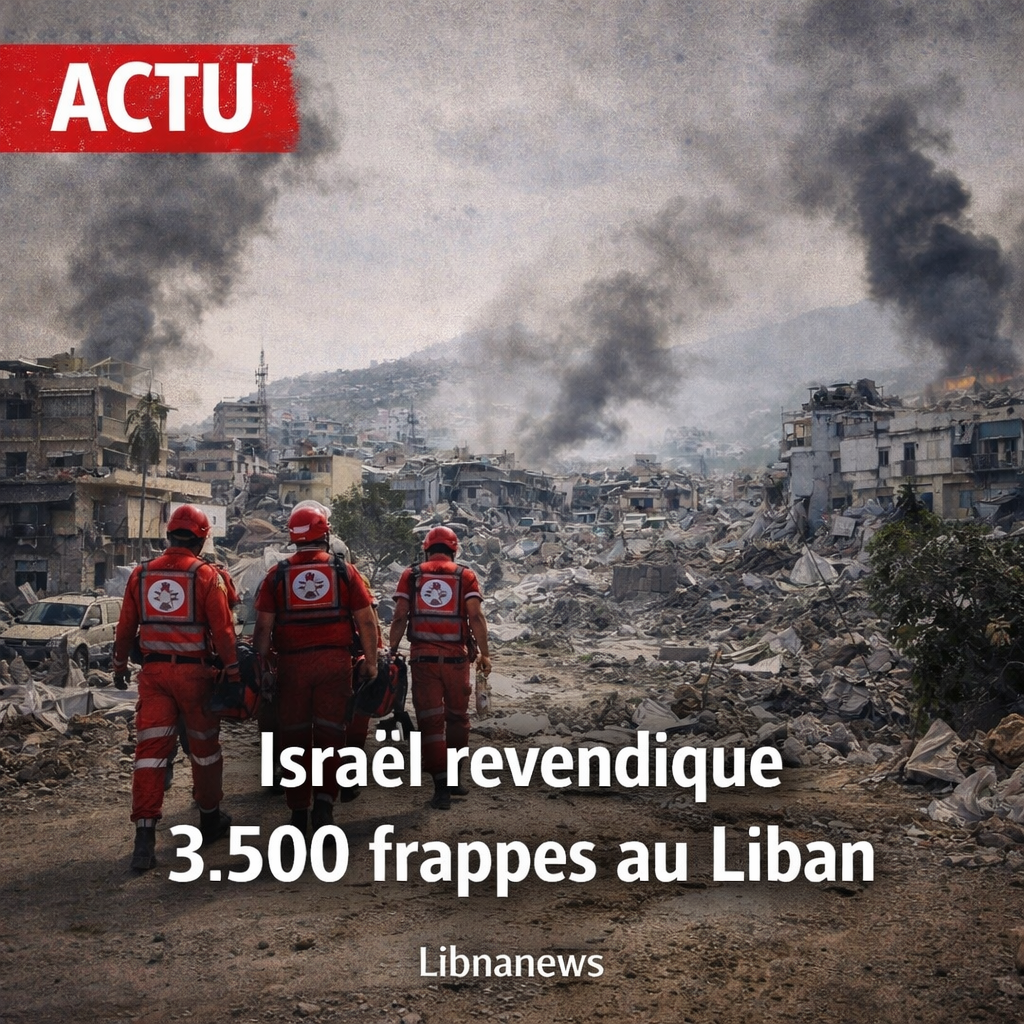
Israel claims to have hit more than 3,500 targets across Lebanon in the past month as part of the open war against Hezbollah since early March. In its statement, the Israeli army also said that it had « eliminate » about 1,000 Shiite fighters, targeting weapons depots, launching positions, command centres and other infrastructure presented as military. By its magnitude, this claimed balance gives a measure of the intensity of the conflict. But it cannot be read in isolation. Behind military statistics, Lebanon is suffering massive territorial destruction, a heavy human balance, a partial collapse of its health capacity and a growing threat of sustainable displacement in the South.
The most recent report by Reuters on 2 April reported more than 1,300 deaths in Lebanon and more than 1 million internally displaced persons since the resumption of hostilities in early March. A few days earlier, Reuters quoted the Lebanese Ministry of Health, which reported 1,268 deaths, including 125 children and 52 medical personnel. These figures do not systematically distinguish civilians and combatants, but they suffice to show that the Israeli campaign has already plunged the country into a massive human crisis. Even more so, the very nature of some strikes, particularly against residential buildings, relief teams, health facilities and journalists, is fuelling an increasingly frontal legal debate on possible war crimes.
The figure of 3,500 targets says a change of scale
The figure put forward by the Israeli army is equivalent to an average of more than one hundred targets struck a day over a month. In itself, this data is already revealing a shift. The Lebanese-Israeli front is no longer in a logic of limited exchanges or calibrated responses. It now operates according to a massive degradation campaign aimed at exhausting both Hezbollah’s military capabilities and the territorial environment in which they fit. In his presentation, the IDF claims to have targeted command infrastructures, weapons depots, launchers and positions related to the Shiite movement. The term « target » therefore covers different realities, from a building to a vehicle, underground depot, armed group or launch ramp. This prohibits too mechanical reading of the figure, but not its political interpretation: Israel assumes a war of volume and depth on Lebanese territory.
This change in scale was noticeable for several weeks. Reuters documented the extension of the Israeli campaign far beyond the border villages, with repeated strikes on Beirut, its southern suburbs, the Bekaa and several southern axes. On 31 March, Israel’s Defense Minister, Israel Katz, further reinforced this doctrine by saying that Israel would destroy all houses in villages near the border. It also announced its intention to establish a security zone up to the Litani. This band would cover nearly one tenth of Lebanese territory. From then on, the number of 3,500 targets is no longer limited to military communication on the pace of strikes. It is part of a broader project of reconfiguring the Lebanese South by force.
The other data put forward by the Israeli army, that of about 1,000 Hezbollah fighters « eliminated », shares the same logic. Israel seeks to demonstrate that its campaign is not just hitting sites, but is deeply disorganizing the human chain of the movement. However, this balance sheet is not independently verified in its entirety and refers to the Israeli categorization of its targets. In asymmetric wars, this issue is never secondary. The counting of combatants, the distinction with civilians and the qualification of targeted infrastructure are at the heart of the political battle that accompanies the military offensive.
The latest Lebanese review confirms a major crisis
Behind Israeli data, the Lebanese record continues to grow rapidly. Reuters reported on 2 April that more than 1,300 people had been killed in Lebanon since the beginning of the open war, with more than 1 million displaced. Two days earlier, another report from the Agency, based on the Lebanese Ministry of Health, reported 1,268 deaths, including 125 children and 52 medical personnel. The increase in these figures over a very short period underscores the extent to which violence remains sustained. It also shows that the human cost is not confined solely to Hezbollah fighters, but deeply affects the civilian population and the professions protected by international humanitarian law.
Massive population displacement is the other major event of this month of war. Reuters mentions more than one million displaced persons and the Lebanese Ministry of Social Affairs is preparing for the possibility of a long-term displacement of hundreds of thousands of people. Beirut absorbs some of this pressure, but reception capacity remains limited and humanitarian funding remains very inadequate, according to the Lebanese authorities relayed by the Agency. Schools transformed into shelters, inaccessible rentals and social tensions around accommodation show that this is no longer just an emergency. It is becoming a lasting transformation of the country’s daily life, social geography and administrative functioning.
This humanitarian crisis is worsening because it not only affects the people of the South in their immediate flight. It also affects their very possibility of returning. Reuters reported that the Israeli Defense Minister intended to prevent the return of 600,000 Lebanese displaced persons to the border area until security in northern Israel was guaranteed. It’s a major shift. What could be seen as a temporary displacement linked to the fighting tends in the Israeli doctrine to become a potentially permanent displacement. For Lebanon, this perspective resembles a de facto occupation of part of the South, with the installation of a buffer zone imposed by the war.
Hospitals, first aid workers, journalists: war reaches the most sensitive protections
The health component is one of the most alarming aspects of the conflict. On 28 March, the World Health Organization reported that nine rescue workers had been killed and seven injured in five separate attacks against health structures or teams in southern Lebanon. WHO also reported that four hospitals and 51 primary care centres had closed due to violence, while other facilities were slowing down. For a country whose health system is already emerging from several years of financial crisis, such a series of attacks is not only an immediate human attack. It also deprives entire regions of health care, health transport and first aid at a time when bombings are increasing.
Two weeks earlier, the Director General of WHO, Tedros Adhanom Ghebreyesus, had already announced that a strike against the primary care centre in Bourj Qalaouiyah had killed 12 health personnel, including doctors, nurses and first aid workers. On the same day, two paramedics were also killed in an attack on another health facility in Al Sowana. In 24 hours, 14 caregivers had lost their lives in southern Lebanon. Again, the debate goes beyond the human gravity of the event. When a clearly identified medical centre is affected, the question of compliance with international humanitarian law becomes central.
The same debate was further intensified following criticism by the Office of the United Nations High Commissioner for Human Rights. On 17 March, his office estimated that some Israeli strikes against residential buildings, displaced persons and health personnel in Lebanon could constitute war crimes. The UN finding is based on one specific point: even when a belligerent claims to pursue a military objective, it remains bound by the principles of distinction, proportionality and precaution. Destroying entire buildings in inhabited areas, hitting displaced persons or reaching medical teams therefore raises serious issues that cannot be swept away by the mere invocation of a Hezbollah presence.
Journalists are also among the victims of this sequence. Reuters reported on 28 March that an Israeli strike in southern Lebanon had killed three Lebanese journalists, including Ali Shoeib d’Al Manar and Fatima Ftouni d’Al Mayadeen, and her brother. The Israeli army claimed to have targeted Shoeib by presenting him as a Hezbollah intelligence officer, without making public any evidence supporting this accusation in the article consulted. The Lebanese authorities condemned the attack as a violation of the protection of journalists in the war zone. Reuters also reported that rescue workers sent to the scene had been affected, in a context where the total number of caregivers killed already exceeded fifty. The sequence of these facts makes the political and legal dossier against Israel more complex, as it gives the feeling of a campaign that now affects categories that are repeatedly protected.
Israeli objective on the Lebanese South changes the nature of the conflict
In the course of the Israeli statements, a clearer political line appears. The goal is no longer just to reduce Hezbollah’s firing capacity in northern Israel. It is also a matter of lasting reshaping of southern Lebanon. Reuters reported that Israel Katz wanted to establish a buffer zone up to the Litani, destroy the homes close to the border and prevent hundreds of thousands of displaced Lebanese from returning to their villages. This project alters the very nature of war. It is no longer just a military neutralisation campaign, but a strategy that risks changing the demographic and territorial landscape of part of the country.
This perspective feeds the accusations of forced displacement. Legal experts cited by Reuters indicated that the systematic destruction of houses and the ban on the return of inhabitants could result in violations of the law of war if they did not meet a strictly demonstrated military necessity. In practice, the effect on populations is already visible. When a village is repeatedly struck, its homes destroyed and the Minister of Defence of the attacking country publicly states that its inhabitants will not be allowed to return, the displacement ceases to be a parenthesis of the conflict. It becomes a political fact imposed by force. For Lebanon, this shift is as heavy as the immediate human balance. It affects the sovereignty, right of return and integrity of the territory.
The Lebanese Government itself is preparing for this eventuality. Reuters reported on 31 March that the Minister of Social Affairs, Haneen Sayed, considered the possibility of a long-term displacement of hundreds of thousands of people. The country, which does not want to set up new formal camps, is studying temporary solutions such as rent subsidies or the identification of new accommodation. But these responses remain far below the needs. At this stage, only a limited proportion of the aid requested was received. The war therefore destroys both homes, livelihoods and budgetary margins that would allow for a lasting response.
The battle for international humanitarian law is intensifying
Israel justifies its offensive by claiming that Hezbollah uses civilian areas, houses, schools or urban centres to conceal its weapons and command centres. This line is constant in the communication of the Israeli army. It aims to portray the strikes as self-defence operations directed against an armed organization embedded in the civilian fabric. Hezbollah rejects these accusations or denies their magnitude. But even if the Israeli thesis of an interlocking between military means and the civilian environment is retained, this does not end the legal debate. International humanitarian law does not permit any strike solely on the grounds that a fighter or military facility is present in a inhabited area.
That is precisely why the terms used by the United Nations have gained such weight. Talking about strikes that « may constitute war crimes » does not mean that a court has already delivered its judgment. But this means that an international body considers the hypothesis of serious violations credible, on the basis of elements sufficiently serious to trigger a public alert. The centres of this alert include destroyed residential buildings, affected health facilities, targeted medical teams and displaced populations. In other words, the battle around the 3,500 targets is not only on military ground. It is also played on the ground of law, evidence and international responsibility.
The political stake is considerable, as Israel seeks to impose the narrative of an effective campaign against Hezbollah, while Lebanon, United Nations agencies and several humanitarian organizations highlight the human, civil and institutional price of this strategy. The two stories are not entirely exclusive. It is possible that Israel may actually have a large number of Hezbollah-related targets. But it is also clear that the scale of the campaign is destroying entire sections of the Lebanese civilian fabric. It is this coexistence between the claimed military objective and the massive damage to civilians that places the conflict at the centre of an increasing international dispute.
A war of destruction and territorial greed
The past month therefore redefines the war in Lebanon on three levels. There is first the military level, with more than 3,500 targets claimed and about 1,000 Hezbollah fighters whom the Israeli army claims to have killed. There is then the human level, with more than 1,300 deaths, more than 1 million displaced persons, children, caregivers and journalists among the victims. Finally, there is the territorial level, perhaps the most decisive in the medium term, with Israel’s declared will to occupy a wide strip from the South to the Litani and to prevent the return of hundreds of thousands of inhabitants. Together, these three dimensions draw less of a one-off operation than a sustainable transformation of Lebanese space.
This point also illuminates the deep meaning of the current displacement. In many wars, the flight of civilians is linked to the hope of a return after the end of the fighting. Here, this horizon is blurring. When homes are promised destruction, when a buffer zone is envisaged on nearly one tenth of the country and when the return of displaced persons is explicitly refused, the exodus takes on another meaning. It is no longer just a matter of escaping the strikes. The aim is to deal with the possibility that the place left is no longer accessible, more habitable or more permitted. For hundreds of thousands of Lebanese in the South, the war thus opens not only a parenthesis of survival, but a threat of lasting uprooting.
In this context, the figure of 3,500 targets can no longer be considered as a technical data among others. It summarizes a war that strikes villages, cities, health centres, ambulances, journalists and return routes. He says both the violence of the offensive, the ambition of the Israeli doctrine and the depth of the shock inflicted on Lebanon. As the deaths, displaced persons, hospital closures and alerts of UN agencies accumulate, the issue of the number of strikes is no longer just one. It is that of what Israel wants to leave behind it in the south of the Litani, and of what Lebanon can still rebuild if this logic continues.






