

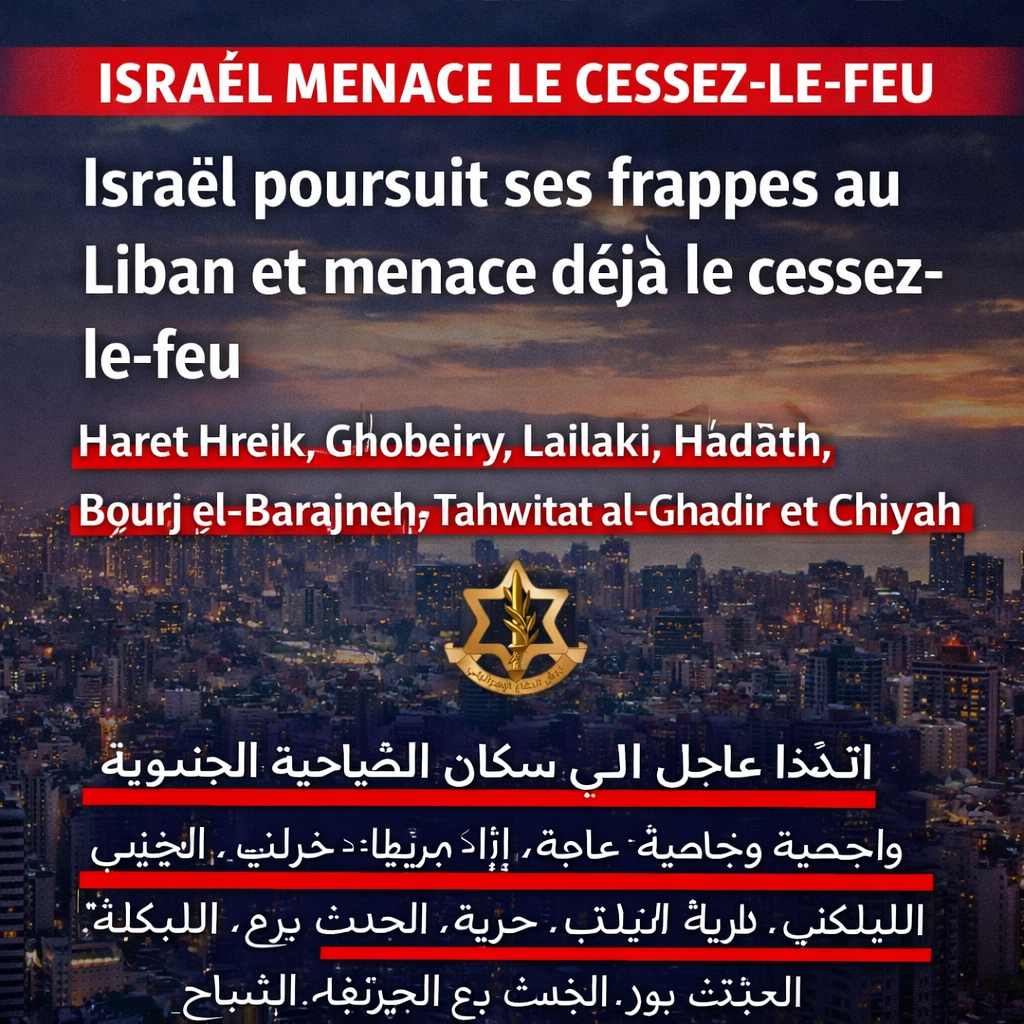
The ceasefire announced between Washington and Tehran was to open a regional de-escalation window. A few hours later, he was already facing the Lebanese front. Israel confirmed that the truce did not apply to Lebanon, where the battle continues against Hezbollah. Further evacuation warnings were issued in the south of the country, then to several neighbourhoods in the southern suburbs of Beirut — Haret Hreik, Ghobeiry, Lailaki, Hadath, Bourj el-Barajneh, Tahwitat al-Ghadir and Shiyah — while strikes continued on the ground. On the other hand, Tehran suggests that continued Israeli operations in Lebanon could lead to a direct response against Tel Aviv. Lebanon thus becomes once again the point of rupture of an already contested agreement on its perimeter, authority and credibility.
A ceasefire that, according to Israel, stops at the Lebanese border
The core of the problem is now explicit. The truce between the United States and Iran was presented by Pakistan and Iranian relays as a broader arrangement, including Lebanon. But on the Israeli side, the line is exactly the opposite: the ceasefire does not cover the war against Hezbollah. Reports issued on 8 April indicate that Benyamin Netanyahu clearly stated that Lebanon was not part of the agreement, while the Israeli army was continuing its evacuation warnings and preparing for further strikes in the south of the country.
This position was taken forward by the Arab-speaking spokesman of the Israeli army, Avichay Adraee, who assured that « the battle continues » in Lebanon and again called on the population to evacuate areas south of the Zahrani. The Israeli message is therefore twofold. On one side, Jerusalem supports the pause decided with Iran to avoid a wider regional war. On the other hand, she refuses to allow this pause to limit her campaign against Hezbollah. This distinction is not technical. It sets the Israeli strategic hierarchy: treat the Iranian front as a possible de-escalation dossier, but maintain the Lebanese front in an active war regime.
Southern Lebanon becomes the laboratory of regional contradiction
This dissociation has an immediate consequence: Lebanon becomes the space where it is checked whether the ceasefire has a regional reality or whether it is only a partial arrangement centred on the Washington-Teheran axis. The evacuations ordered for Tyre and the areas south of Zahrani show that Israel does not consider the Lebanese front frozen. The strikes announced in this sector are therefore much more than an operational continuation: they are a political response to the Iranian and Pakistani reading of the truce. Israel wants to demonstrate on the ground that neither Tehran nor Islamabad will impose the limits of its war against Hezbollah.
The situation is all the more serious as southern Lebanon is already paying a considerable human and territorial price. On 8 April, news agencies reported more than 1,500 deaths in Lebanon since the resumption of hostilities on 2 March, including more than 130 children and more than 100 women, as well as more than 1.2 million internally displaced persons. The Lebanese army itself warned the inhabitants that they could not return to certain areas because of the continued raids and the danger of unexploded ordnance. In this context, every new Israeli evacuation order takes immediate political significance: it denies, in action, the idea of a protective truce for Lebanon.
Seven neighbourhoods in the southern suburbs of Beirut directly threatened
The severity of the sequence is also due to the geographical spread of the risk. This time, the Israeli alert not only targets the southern suburbs as a whole, butseven designated neighbourhoods:Haret Hreik, Ghobeiry, Lailaki, Hadath, Bourj el-Barajneh, Tahwitat al-Ghadir and Chiyah. In its message, the Israeli army claims to continue operations against Hezbollah’s « military infrastructure » in various areas of the southern suburbs and assures that it « does not intend to target you », while calling on the inhabitants of these neighbourhoods to evacuate immediately.
The choice of explicitly citingHaret Hreik, Ghobeiry, Lailaki, Hadath, Bourj el-Barajneh, Tahwitat al-Ghadir and Chiyahchanges the scale of the threat. It is no longer a vague warning or a general formulation on Dahiyé. It is a precise designation of densely populated neighbourhoods, known, inhabited, crossed by key axes of the southern suburbs of Beirut. By naming these sectors one by one, Israel sends a very clear message: military pressure can now simultaneously exert itself on several critical points of the Beyrouth city.
This type of warning is no longer exceptional in this war, but it takes on a particular meaning in the aftermath of a ceasefire supposed to open a phase of regional de-escalation. It means that, in Israeli reading,Haret Hreik, Ghobeiry, Lailaki, Hadath, Bourj el-Barajneh, Tahwitat al-Ghadir and Chiyahremain fully integrated into the theatre of operations, regardless of the truce with Tehran. The repetition of these alerts shows that Israel is establishing a sustainable logic: treating the southern suburbs not as an area to benefit from regional appeasement, but as a permanent operational depth of Hezbollah.
The threat no longer targets only the south, but the Beirut-Dahiyah axis
This extension to Beirut further increases the pressure on the ceasefire. As the strikes approach the capital, it becomes more difficult to argue that Lebanon is only a peripheral front. The southern suburbs are not just an appendix to the battlefield. It is a densely populated, politically sensitive and symbolically central space in the relationship between Israel, Hezbollah and Iran. ThreateningHaret Hreik,Ghobeiry,Lailaki,Hadath,Bourj el-Barajneh,Tahwitat al-GhadirandChiyahat the very moment when a truce is celebrated elsewhere amounts to moving the crisis towards one of the most flammable points of the Levant.
The problem is therefore no longer only military. It also becomes psychological and social. A new evacuation warningHaret Hreik,Ghobeiry,Lailaki,Hadath,Bourj el-Barajneh,Tahwitat al-GhadirandChiyahmeans new displacements, new leaks, renewed pressure on families and a demonstration of force to remind that Beirut can become an active theatre at any time. In a context where Lebanon is already exhausted by destruction, economic collapse and political fractures, this type of immediate threat revives the feeling that no area is really protected, not even near the capital.
Tehran is already threatening to retaliate against Tel Aviv
Opposite, Iran does not leave the ground open. Its Supreme National Security Council had already explained, at the time of acceptance of the truce, that the cease-fire did not mean the end of the war and that the Iranian forces remained ready to respond to any new enemy « mistake ». Channels relaying Iranian positions have since suggested that in the absence of a ceasefire in southern Lebanon, strikes could target Tel Aviv in the coming hours. Not all major agencies have taken up this word for word, but they confirm that Tehran has accepted the conditional truce, maintaining a high level of military alert and refusing to present the agreement as a lasting renunciation.
The logic is transparent. Iran seeks to prevent Israel from emptying the ceasefire of its substance by continuing the war in Lebanon while enjoying a pause on the direct front with Tehran. In other words, the Islamic Republic wants to make it clear that, if Lebanon is effectively excluded, the agreement loses its regional scope and risks collapse. This threat does not automatically imply an immediate strike on Tel Aviv, but it is intended to reintroduce a strategic cost to Israel as it attempts to dissociate the fronts.
Hezbollah Retains, Israel Continues
Another element accentuates the fragility of the moment: Hezbollah, according to three Lebanese sources close to the movement, suspended its attacks on northern Israel and Israeli forces in Lebanon after the announcement of the truce. This does not mean disarmament or an exit from war. But this allows the Shiite movement to present itself, for the moment, as the camp that respected the pause while Israel was continuing its operations. This asymmetry of behaviour already feeds a battle of the narrative on the responsibility for a possible failure of the ceasefire.
For Israel, this argument has no value. The army and the government maintain that the fight against Hezbollah is a separate theatre. But politically, the situation is more difficult. If Hezbollah can convince that he held fire while Israel continued to bomb and evacuateHaret Hreik, Ghobeiry, Lailaki, Hadath, Bourj el-Barajneh, Tahwitat al-Ghadir and Chiyah, then the Israeli account of the legitimate continuation of the war risks encountering an effective counter-recital: that of a truce undermined first by the exclusion of Lebanon, then by the continuation of the strikes.
Alerting the seven neighborhoods increases the risk of immediate escalation
The new Israeli warning changes the risk scale for the next few hours. A Targeted Alertseven neighbourhoods at a time — Haret Hreik, Ghobeiry, Lailaki, Hadath, Bourj el-Barajneh, Tahwitat al-Ghadir and Shiyah —does not announce a marginal operation. It potentially prepares a wider wave of strikes, or at least a military pressure strong enough to cause a massive evacuation movement. In Israeli logic, it is a matter of hitting Hezbollah’s infrastructure before the movement takes advantage of the ambiguity of the ceasefire to reorganize itself. In Iranian and pro-Hezbollah logic, it is, on the contrary, an attempt to impose a military fait accompli before any clarification on the perimeter of the truce.
This creates a very concrete danger: the more the strikes threatenHaret Hreik,Ghobeiry,Lailaki,Hadath,Bourj el-Barajneh,Tahwitat al-GhadirandChiyahThe more pressure on Hezbollah to respond, even though the movement has so far claimed restraint. The ceasefire between Washington and Tehran is thus suspended from an explosive equation: Israel wants to show that it keeps its hands free in Lebanon, while Iran wants to prove that Lebanon cannot be left out of the agreement. Between the two, the southern suburbs of Beirut become a possible tipping point.
A truce already challenged by the facts
Perhaps the most striking in this sequence is the speed with which the truce was challenged by reality. As soon as it was announced, it was followed by new evacuation orders, persistent strikes, debates on its perimeter and threats of cross-retaliation. The markets welcomed the agreement, and several capitals called for de-escalation. But in Lebanese theatre, the gap between diplomatic discourse and military facts remains immense. It is this gap that undermines public confidence and undermines the credibility of the process.
For Lebanon, the lesson is severe. The country is not only the dead end of the ceasefire. He is also the place where his weakness is revealed. As long as Israel can continue to strike by claiming that the truce does not concern it, and as long as Iran responds by linking the fate of Tel Aviv to that of southern Lebanon, the ceasefire will remain suspended on a front that nobody really controls. And as long as this contradiction is not lifted, every additional bombardment will bring the region closer not to a stronger peace, but to a new shift.






