

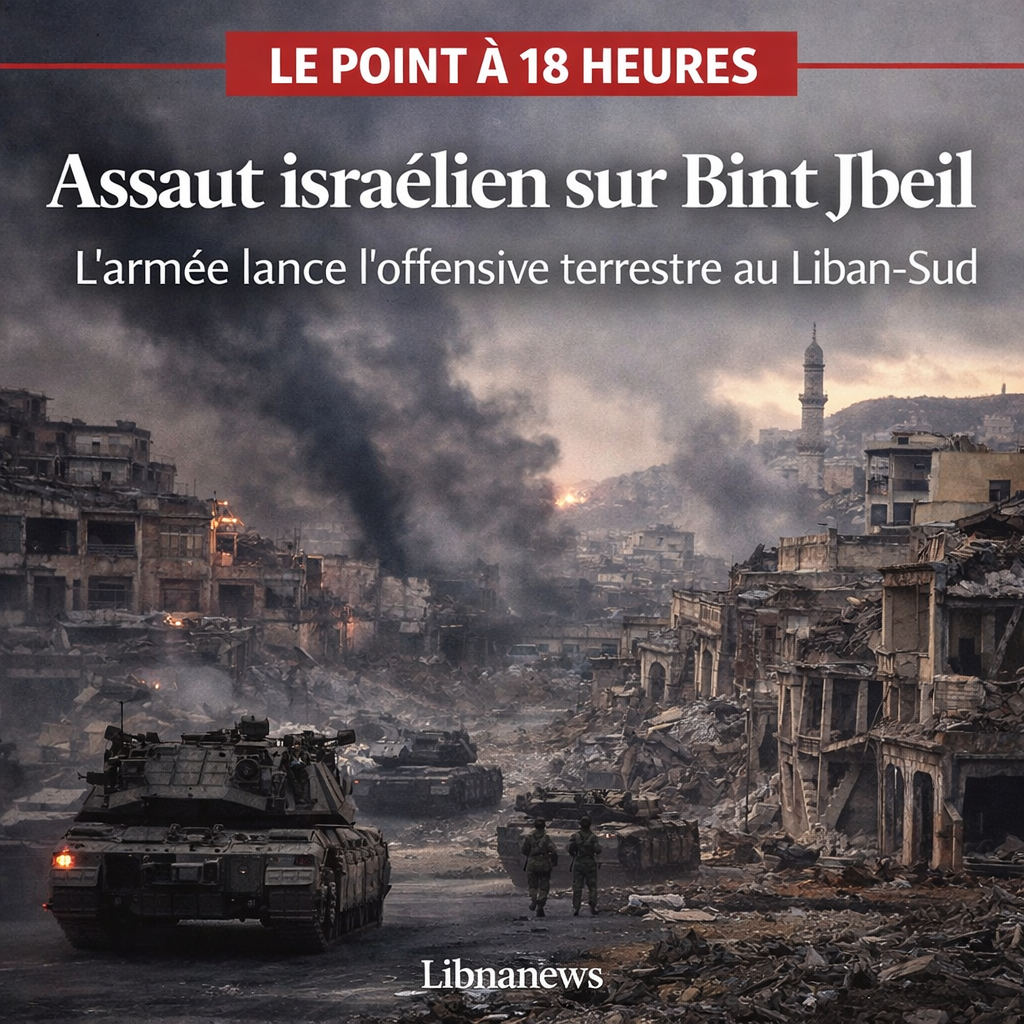
On Monday, 13 April, in the middle of the day, the Israeli defence forces announced that they had completed the complete encirclement of Bint Jbeil, a strategic city in southern Lebanon, and had launched a ground attack on Hezbollah’s positions that were being cut off. The operation, led by the 98th division of the Israeli army, marks a further escalation in the ground fighting that has been taking place in this border region for several weeks, while direct negotiations between Israel and Lebanon are scheduled for Tuesday in Washington.
The Israeli military authorities stated that only a small number of Hizbullah fighters remained in the area and that full operational control of the city was expected to be acquired in the coming days. According to an army spokesman, the troops eliminated more than a hundred militants over the past week through air strikes and close fighting. « The forces of the 98th Division completed the encirclement of the city of Bint Jbeil and began its assault, » said Colonel Avichay Adraee on the army’s official networks. IDF images show units advancing in the outskirts of the city, with targeted destruction of sites used, according to Israel, for rocket fire and weapons caches.
Bint Jbeil, located only five kilometres from the Israeli border, is a historic stronghold of Hezbollah. The city, which serves as a provincial capital for part of the South, is surrounded by villages that have long served as launch points for cross-border attacks. Its symbolic value is strong: this is where Hassan Nasrallah delivered his famous speech of the « spider web » in 2000, claiming that the Israeli army was vulnerable. The Israeli army reported having taken and destroyed the stadium of the city, emblematic site of this speech, in the last few hours. Home-to-house fighting is ongoing, with the exchange of artillery fire and the use of suicide drones by Hezbollah.
At 1230 hours on Monday, Hizbullah responded by launching a salve of rockets at the Avivim barracks in Israeli territory. The armed group, via its military communication body, claimed this attack as a direct response to the ongoing ground offensive. Sirens rang in several locations in northern Israel, from Kiryat Shmona to Nahariya, and interceptions were reported by the Iron Dome defence system. Hezbollah also reported drone strikes against Israeli positions around Bint Jbeil itself, claiming to have hit a command post between Aynata and the besieged city.
These developments occur in a context of war that has lasted since 2 March 2026, when Hezbollah opened a front in Lebanon in support of Iran, firing rockets and drones towards Israel. Since then, Israeli operations have systematically targeted the infrastructure of the Shiite movement, its command centres and its weapons stockpiles. Despite the announcement of a ceasefire between Washington and Tehran on 8 April, Israel maintained that this agreement did not apply to the Lebanese theatre, continuing its most intense strikes of the war that day – more than a hundred targets achieved in just ten minutes, according to IDF.
The human balance remains heavy. The Lebanese Ministry of Health reported more than 2,055 deaths since the beginning of the conflict, including some 30 additional casualties in the last 24 hours in the south of the country. On Monday, at least six people were killed in air strikes, including in Bazouriyeh, where one resident died and nine others were injured in an attack by hunters. Rescue workers and civilians were also affected in other locations in the South, as reported by the civil defence services.
On the ground, the Israeli army claims to have neutralized rocket launchers, tunnels and weapons caches, including inside a government hospital in Bint Jbeil where, according to Israel, militants observed Israeli movements. The Lebanese authorities denied these accusations, referring to attacks on civilian and medical infrastructure. Close fighting was reported in the suburbs of the city, with artillery exchanges and precision fire.
Bint Jbeil’s progressive circle and Israeli strategy
The 13 April operation is part of a broader strategy to secure the border band. Israel intends to create a buffer zone by systematically destroying Hezbollah’s advanced positions along the Blue Line. For several weeks, land forces have progressed village by village, combining raids, air strikes and demining operations. The 98th Division, an elite unit specializing in urban combat and difficult terrain, plays a central role. His commander stressed that the capture of Bint Jbeil would significantly limit Hezbollah’s ability to target northern Israel.
Lebanese security sources confirm that Hizbullah fighters remaining in the city are determined to resist, citing both the strategic and symbolic value of the site. Sporadic clashes had already taken place in recent days, with rockets, artillery and suicide drones claimed by Hezbollah against Israeli troops around the city. The Israeli army reported that it had eliminated dozens of militants during these pre-conflict clashes.
At the same time, continuous air strikes are targeting other areas of southern Lebanon. On Monday, explosions were reported near Tyre and in the Nabatiyah area, where roads and infrastructure were damaged. The objective of the IDF remains the destruction of Hezbollah’s military capabilities, including its stocks of precision missiles and underground command networks.
Hezbollah’s reaction and continued cross-border fire
Hezbollah soon replied. In addition to the salve on Avivim at 1230 hours, the movement increased its reports of 44 attacks over the past 24 hours, targeting six Israeli towns, including Shlomi, Yiron, Kiryat Shmona, Margaliot, Avivim and Nahariyah. Bombing drone swarms were also launched against barracks, including that of the Valley Battalion in Beit Hillel. According to Hezbollah, these actions are aimed at relieving pressure on besieged fighters in Bint Jbeil and maintaining active deterrence.
On the Israeli side, the authorities activated the sirens in a wide northern perimeter, confirming several interceptions and the fall of debris in unpopulated areas. No injuries were reported immediately on Israeli soil this Monday, but tension remains extreme in border localities.
The role of Finul and the incidents with peacekeepers
In this climate of high tension, the United Nations Interim Force in Lebanon (Final) reiterated its concern. In a statement issued this Monday, the UN mission reported that, on two recent occasions, Israeli soldiers had hit Finul vehicles with a Merkava tank, causing significant damage in one case. Israeli soldiers also reportedly blocked a road to the Finul positions in Bayada, southern Lebanon. Over the past week, « summation » shots have hit clearly identified vehicles, one of which is less than one metre away from a blue helmet. These incidents impede the freedom of movement of 10,000 peacekeepers deployed along the border.
La Finul, present since 1978, calls for respect for its mandate and the protection of its personnel. These events add to a series of clashes that have already claimed the lives of Lebanese soldiers and civilians in the area of operations.
Diplomatic efforts of Lebanese Prime Minister Nawaf Salam
Politically, Lebanese Prime Minister Nawaf Salam has reaffirmed his commitment to ending the war in recent days. On Sunday, he said he was working actively to secure an Israeli withdrawal and the cessation of hostilities. « Lebanon is determined to stop this war and rebuild the State, » he stressed, calling for national unity on the occasion of the anniversary of the beginning of the 1975 civil war. The Lebanese government is preparing for direct negotiations with Israel, a historic first, to begin on Tuesday in Washington under American auspices.
These talks are aimed, on the Lebanese side, at obtaining a cease-fire and the withdrawal of Israeli troops, while Israel makes any agreement conditional on the disarmament of Hezbollah and the final security of its northern border. Hezbollah, for its part, denounces any negotiation as a « treason », accentuating internal divisions in Lebanon.
Humanitarian situation and impact on civilian populations
The fighting on Monday aggravates an already severe humanitarian crisis. More than one million Lebanese, or almost 20 per cent of the population, have been displaced since the start of operations. Southern and Beirut hospitals are saturated, with increasing shortages of trauma kits. The World Health Organization has alerted about the risk of depletion of vital drug stocks in the coming days. Bridges to the Litani River were destroyed in previous strikes, making it difficult to deliver humanitarian aid to the most affected areas.
The villages around Bint Jbeil are largely emptied of their inhabitants, who fled to the north or took refuge in makeshift reception centres. The Lebanese Red Cross and Civil Defence teams continue to intervene under bombardments, despite the risks. A rescue worker had already been killed by an Israeli drone during a humanitarian mission a few days ago.
The Washington negotiations in a context of persistent tension
As Lebanese and Israeli envoys prepare to meet in Washington, military operations continue unabated. Israel made it clear that the discussions would not be about an immediate ceasefire with Hezbollah, but rather about the modalities for disarmament and normalization. Prime Minister Benjamin Netanyahu reiterated that the war against Hezbollah was far from over and that it was aimed at eliminating any long-term threat against northern Israel.
On the Lebanese side, the government of Nawaf Salam, supported by the regular army, is trying to maintain a fragile balance between international pressure and the realities on the ground. The Lebanese Armed Forces deployed additional units south of the Litani River, in accordance with their commitments, but their capabilities remain limited in response to the scale of Israeli operations.
In the hours following the beginning of the attack on Bint Jbeil, exchanges of fire intensified in the vicinity of the city. Columns of smoke were visible from the Israeli border, while reconnaissance drones flew over the area. Hezbollah continued to claim specific strikes against advanced IDF positions, claiming to have hit tanks and command posts. The Israeli army, for its part, carried out targeted raids and destruction of underground infrastructure, according to military sources.
The situation remains extremely fluid on Monday afternoon, with reports of additional troop movements on both sides and new air alerts in northern Israel. Local populations, both Lebanese and Israeli, remain on maximum alert, while international chancelleries are following closely developments on the eve of the Washington talks.






