

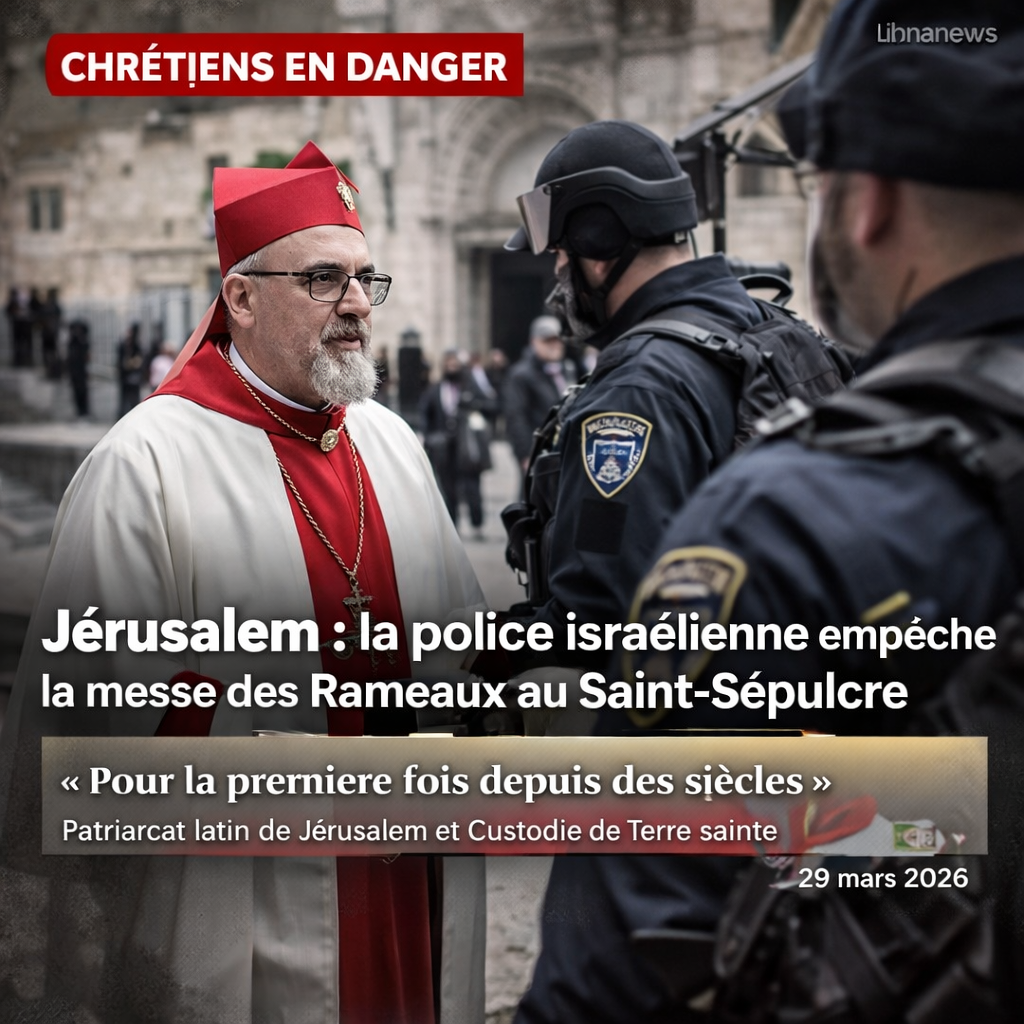
Cardinal Pierbattista Pizzaballa, Latin Patriarch of Jerusalem, was prevented from entering the church of the Holy Sepulchre on Sunday 29 March to celebrate the Palm Sunday Mass, according to a joint communiqué of the Latin Patriarchate of Jerusalem and the Custody of the Holy Land. Father Francesco Ielpo, Custos of the Holy Land and guardian of the Holy Sepulchre, was also blocked by the Israeli police. The two Catholic leaders were arrested on the way and forced to turn back. The ecclesial authorities speak of an unprecedented fact « for the first time in centuries ».
According to the communiqué, the two men went to the Holy Sepulchre privately to ensure the liturgical celebration, in a context where the major public ceremonies had already been cancelled because of the war and security restrictions. The Patriarchate and the Custody denounce a « demonstrably unreasonable » and « grossly disproportionate » decision, considering that it violates freedom of worship and the status quo regime that has been in charge for generations of the organization of holy places in Jerusalem.
The incident occurred as Jerusalem saw a Holy Week deeply shaken by the regional war. The traditional Palm Sunday processions had already been cancelled in the previous days. The Latin Patriarchate had announced the abolition of the procession between the Mount of Olives and the Old City, as well as the postponement or adaptation of other highlights of the Easter week. The message of the Catholic authorities was then that of a small celebration, but kept in a minimal format. The inability of Cardinal Pizzaballa and the Custos of the Holy Sepulcher changes the nature of this sequence.
The Holy Sepulchre is one of the most sacred places of Christianity. This is where the Christian tradition places the crucifixion, burial and resurrection of Christ. Palm Sunday, which marks the beginning of Holy Week, occupies a central liturgical place. The fact that the two main Catholic officials linked to this sanctuary were unable to access it this Sunday gives the case a far wider scope than just a police incident.
In their text, the Latin Patriarchate and the Custody of the Holy Land point out that the security measures imposed in recent days had already been respected. The outside celebrations had been cancelled. The gatherings had been reduced. Retransmissions were to allow the faithful to follow the offices remotely. Despite this, both officials were stopped before reaching the church. Catholic institutions say they do not understand a decision that, in their view, cannot be justified solely by the need to prevent crowds.
The tension around the holy places is part of a broader context of security in Jerusalem. Since the outbreak of the war against Iran, the city has experienced exceptional restrictions. The gatherings are limited, several holy places of the Old City have been closed, and the presence of pilgrims and visitors has fallen. A report published this Sunday describes an unusually empty Jerusalem near Pessah and Easter, with deserted streets, affected shops and a sharp contraction of religious ceremonies.
This closure particularly affects Christians in the Holy Land. As early as last week, several Catholic media reported that traditional Holy Week rituals would be severely reduced this year. The Palm Sunday procession was cancelled, the chrismal Mass postponed, and access to the Holy Sepulchre itself had already become very difficult under the restrictions imposed around the Old City.
The new element of this Sunday is therefore the direct impediment of the leaders of the Catholic Church in the Holy Land. The communiqué stresses this exceptional character. He speaks not only of a celebration reduced or prevented by war, but of a break in the historical continuity of the rites in Jerusalem. By claiming that this had not happened « for centuries, » the ecclesial authorities seek to emphasize the symbolic gravity of the scene.
Cardinal Pizzaballa occupies a central place in local Christian life. Latin Patriarch of Jerusalem, for several years he has been one of the main voices of the Catholic Church in the Near East. Father Francesco Ielpo, as the Custos of the Holy Land, is for his part directly responsible for the custody and administration of the main Catholic shrines of the region, including the Holy Sepulchre. Their simultaneous blocking reinforces the institutional weight of the incident.
At this point, the fact confirmed by the ecclesial authorities is precise: the two officials were arrested on their way, while they were going to the Holy Sepulchre, and were unable to celebrate the Mass on Palm Sunday. The statement explicitly refers to the Israeli police as the perpetrator of the impediment. The sources consulted do not yet report a detailed response from the Israeli authorities on the exact circumstances of this decision.
The episode takes place in a year when Easter is already largely amputated in Jerusalem. The Palm procession did not take place. Foreign faithful are rare. Local communities celebrate in small formats. The war emptied the city of much of its usual religious rhythm. The case of the Holy Sepulchre now adds a direct dispute between the Catholic authorities and the Israeli police.
For the Latin Patriarchate and the Custody, the stakes go beyond the Sunday office. Both institutions see this as an infringement of religious freedom and the continuity of historical usage in the Holy Places. Their statement presents the incident as a serious precedent in a city where every gesture affecting Christian shrines has a global dimension.
In the midst of regional war, Jerusalem was already supposed to live a silent Palm Sunday. She now finds herself with an additional crisis: that of an prevented mass in the heart of the main Christian sanctuary of the city, and of a patriarch stopped before even being able to reach the church he was to serve.






