

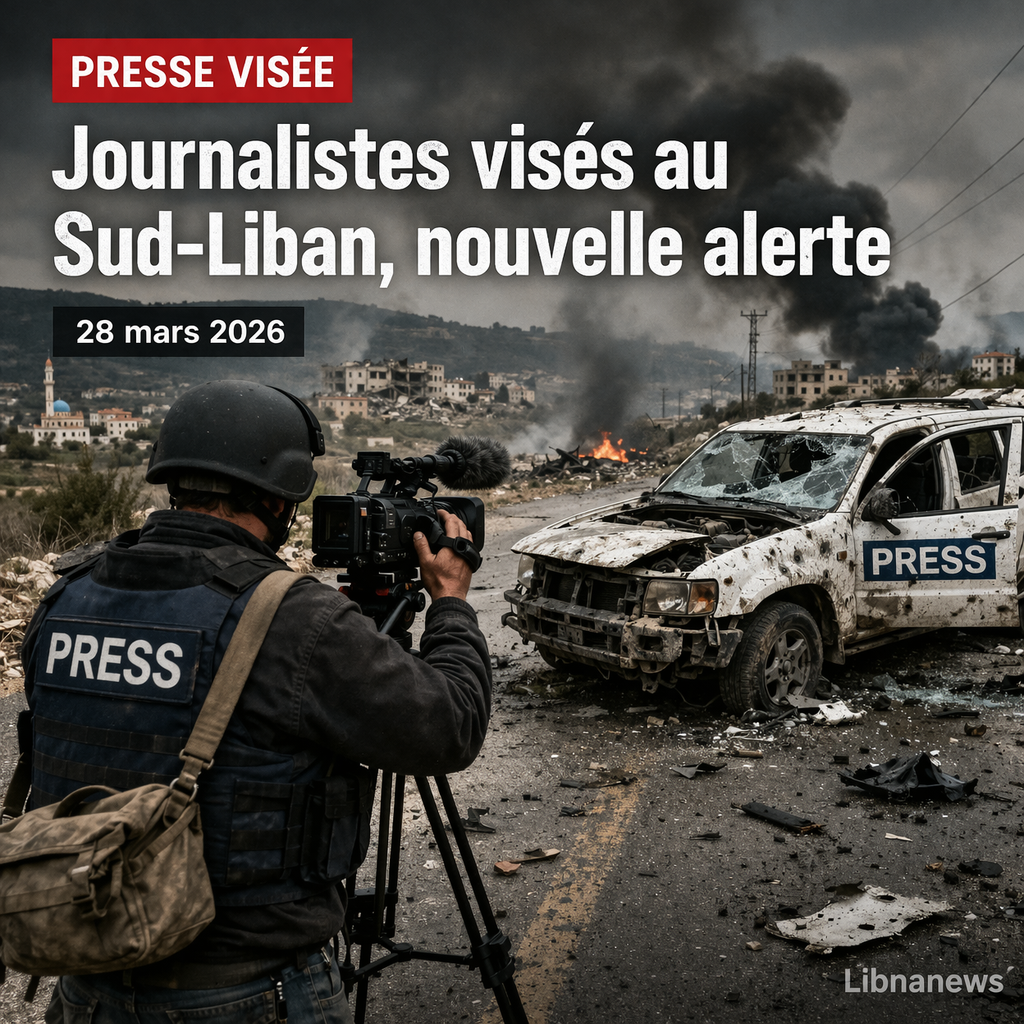
South Lebanon has just experienced another attack on the press, in a context where journalists are already among the most exposed civilian professions of this war. On Saturday, 28 March, a number of Lebanese media reported the death of two journalists in an Israeli strike targeting a car on the Jezzine road in southern Lebanon. The names that come back in the first accounts are those of Ali Shoeib, correspondent of Al-Manar and known voice of the southern front cover, and Fatima Ftouni, presented as correspondent of Al-Mayadeen. At this time, local information converges on their deaths, but the exact circumstances, the total number of casualties in the vehicle and the possible presence of other team members were still being consolidated early in the afternoon.
Caution is required especially as the sequence is very recent. The first available evidence suggests a hit on a vehicle in the Jezzine area. Lebanese media reported direct targeting of a press team, while others reported that the two journalists were in a hit car as they covered military developments in the South. At the time of writing, there was not yet a detailed public comment by the Israeli army on this precise strike. The still fragmented nature of the information does not prevent an immediate observation: in less than two weeks, several journalists have already been killed in Lebanon, and Jezzine’s new strike reinforces the impression of a profession now taken in the very axis of operations.
Ali Shoeib and Fatima Ftouni, two well-known faces of the southern front
The symbolic scope of this attack is also due to the profiles of the journalists cited. Ali Shoeib was not a secondary name in the Lebanese media landscape. He was a field correspondent in the South and had long followed the confrontations on the border and appeared regularly in reports of Israeli strikes, village destruction and military movements. His name had already been associated, in 2024, with Hasbaya’s murderous attack on a group of journalists, from whom he had escaped while a cameraman working with him had been killed. His death, if confirmed in the same terms by all sources in the next few hours, would thus mark the elimination of a reporter long identified as one of the leading chroniclers of the war in southern Lebanon.
Fatima Ftouni, presented by several media as a correspondent for Al-Mayadeen, also belonged to this generation of field journalists who directly covered the attacks, the bombed villages and the humanitarian consequences of the strikes. His name appeared in the first local information published after Jezzine’s attack. Again, the detailed biographical elements were still few when the first dispatches fell. But the main thing is elsewhere: the two victims announced were members of media that were very present on the South Lebanese ground and very directly involved in the coverage of the conflict. This point counts because it means that the journalists targeted were not far off the ground, but reporters following military operations as closely as possible.
A sequence that fits into an already heavy series
Jezzine’s attack does not occur on a blank page. In recent days, at least two more journalists have already been killed in Lebanon in Israeli strikes. On 26 March, photojournalist Hussain Hamood was killed in Nabatiyah while covering an Israeli raid on the city, according to the Committee to Protect Journalists, which requested an impartial investigation. CPJ points out that the Lebanese Minister of Information, Paul Morcos, denounced his death and referred to the targeting of journalists in Lebanon. The organization adds that Hamood died a week after the death of journalist Mohammed Sherri, also linked to Al-Manar, killed with his wife in an Israeli strike on Beirut centre on 18 March.
Both cases had already been a source of serious concern in the press. Hussain Hamood was presented by NNA as a press photographer from Yahmar al-Shqif, killed at dawn in a strike on Nabatiyah. Paul Morcos had then spoken of a new breach of international law and called on the international community to act. In the case of Mohammed Sherri, the International Federation of Journalists had denounced a strike on a residential building in central Beirut and requested accounts. The addition of these successive deaths, and the announcement today of the death of Ali Shoeib and Fatima Ftouni, draws a very worrying escalation sequence for Lebanese editorials.






