

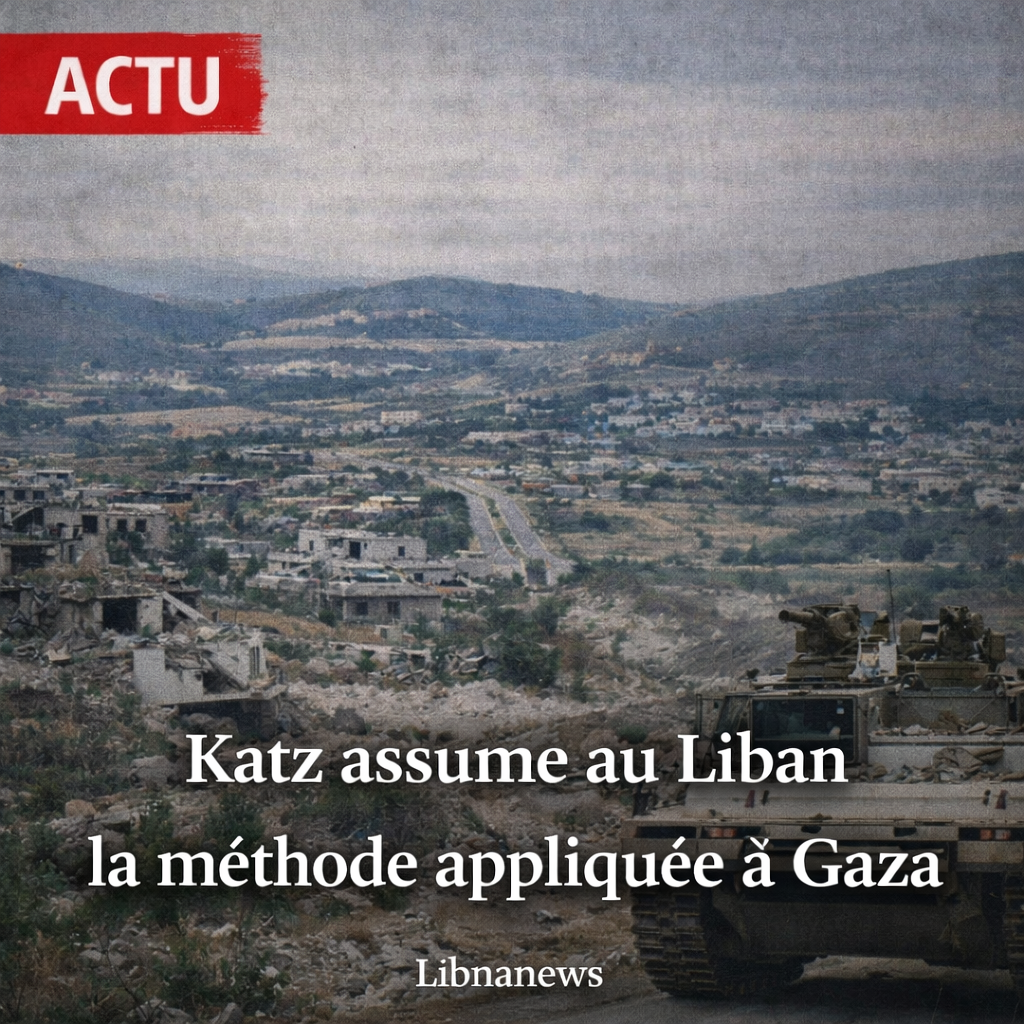
Israel no longer seeks to wrap up its strategy in Lebanon with prudent language. In a few days, the statements of his officials lifted some of the veil on what is being played out in the south of the Litani River: the systematic destruction of villages close to the border, the mass evacuation of the inhabitants, the long-term military control of the land and the announced refusal to return for a considerable part of the displaced. The heaviest sentence came from the Minister of Defence, Israel Katz, when he promised to shave all the houses in the border villages according to the « Rah and Beit Hanoun model ». This reference alone explicitly links South Lebanon to the method applied in Gaza: emptying, destroying, holding.
For weeks, the Israeli discourse on Lebanon could still be described as a response to reverse Hezbollah. This register remains, but it is no longer sufficient to describe the line followed. The words used by Katz, the decisions announced by Benyamin Netanyahu and the statements of Bezall Smotrich draw a broader perspective: South Lebanon is no longer just a front, it becomes a space to reconfigure. In this area, it is no longer just a question of striking positions, but of changing the human and territorial map in a sustainable way. Both in Beirut and in the villages of the South, many now see it as an attempt to inflict on Lebanon what has been inflicted on Gaza.
Change is not just rhetoric. It relies on facts already visible. More than one million people have been displaced in Lebanon since the resumption of the open war in early March, and the human impact has exceeded 1.300 deaths. The evacuation orders covered the entire area south of Litani. Bridges were struck, roads cut off, villages emptied under the pressure of bombardments and ground progress. At the same time, the United Nations denounced widespread displacement orders, while human rights organisations warned that the forced displacement of civilians and the destruction without clear military necessity could constitute war crimes.
Katz puts specific words on a destruction strategy
Israel Katz gave this war its most brutal expression. His words leave almost no room for ambiguity. The Minister of Defense explained that Israel intended to establish a buffer zone up to Litani, maintain its control over the entire area south of the river, destroy all houses in villages close to the border and prevent approximately 600,000 Lebanese displaced persons from returning until the security of northern Israel was assured. In other words, it does not refer to a short-term operation. He talks about a new territorial regime for southern Lebanon.
The weight of this statement also lies in the choice of words. When a defence minister announces in advance the destruction of houses and the blocking of the return of the inhabitants, he no longer describes the collateral effects of a war. It sets out an objective. The village is no longer only the place where the enemy would hide. It itself becomes a problem to erase. In the recent history of Israeli-led conflicts, this combination of building destruction, mass evacuation and long-term control of the land immediately returns to Gaza. Katz assumed himself by quoting Rafah and Beit Hanoun, two names that became, for the Arab world as well as for a part of international opinion, the symbols of a war that first sprayed the living environment before pretending to administer the vacuum.
In the region, this reference was understood as an admission. Comparisons with Gaza no longer come only from Israel’s criticism. They come from the mouth of a minister who presents the « Gaza model » as an operating matrix. This gives the events of South Lebanon a new dimension. The destroyed house is no longer just a house affected in the exchange of fire. It becomes an element of an assumed method of war. Displacement is no longer just the escape from danger. It becomes a wanted condition. And non-return is no longer an abstract fear. It is now publicly formulated by one of the leading Israeli political and military leaders.
Netanyahu validates enlargement, Smotrich pushes towards the border
Benyamin Netanyahu does not always use the same formulas as Katz, but the direction is the same. The Prime Minister ordered the expansion of Israeli operations in southern Lebanon to expand the security zone and prevent the resumption of Hezbollah fire. In the Israeli military communication, the Litani is increasingly becoming a strategic pillar. This river, which has long been mentioned in the scenarios of de-escalation or the removal of weapons, is now presented as a line of control from which the north of Israel should be sheltered. This is no longer a military hypothesis among others; It’s a course of action.
More to the right, Bezalel Smotrich took a further step by saying that the Litani should become the « new Israeli border ». The formula is not a legal decision annexation. But it counts politically, because it shows that, within the Israeli government, South Lebanon is now viewed by some not as a mere buffer zone, but as a space whose status could be permanently altered by war. This slide is not trivial. In contemporary conflicts, de facto annexation often begins before the texts: it involves destruction, displacement, prolonged military presence and the installation of a territorial reality that diplomacy then struggles to undo.
The set forms a coherent sequence. Katz talks about house destruction and no return. Netanyahu orders the extension of the offensive. Smotrich pushes the idea of a new frontier. Ended, these elements draw a strategy that no longer resembles only a war against Hezbollah. It looks like a war of transformation in southern Lebanon, with the risk of a de facto annexation in the medium term. This explains why, in Beirut, many officials and inhabitants are no longer talking about occupation, but about a project to change the face of the southern part of the country.
South Lebanon emptied like Gaza
What strikes in the Lebanese sequence is the resemblance of the processes. In Gaza, the war combined massive evacuation orders, residential strikes, destruction of infrastructure, road cuts, repeated displacements and increasing difficulty in returning to the ravaged areas. In Lebanon, this grammar quickly recomposes. Displacement orders covered the entire area south of Litani. Bridges were hit. Villages have been abandoned. The inhabitants were pushed north, in a country already unable to absorb a new exodus of this magnitude without further tension or collapse.
The Israeli authorities maintain that this strategy responds to the threat of Hezbollah’s weapons and the alleged use of southern villages as bases, caches or firing points. This argument accompanies almost all wars in inhabited areas. But the magnitude of the measures announced changes the nature of the debate. When an army promises in advance to destroy all houses in a series of villages and to prevent the return of hundreds of thousands of inhabitants, the question no longer concerns only the location of weapons or combatants. It concerns the territory itself, its future habitability and the right of the people to return.
This logic of territorial emptying does not save the communities who could believe in a form of distinction. The evacuation or pressure of Christian villages in the South has reinforced the feeling in Lebanon that the Israeli strategy is not only aimed at a social environment identified with Hezbollah, but also at a geographical band. This joins the perception of a « gasaization » of the conflict: not only hit an armed actor, but treat an entire region as a space to purge, grid and remodel.
Temporary displacement becomes an announced non-return
One of the most striking features of this war is how displacement changes its meaning. In any war, evacuation is officially justified by the protection of civilians. They are supposed to leave to survive and then return when the danger moves away. The problem here is that this return is already being questioned by the Israeli leaders themselves. When Katz announces that 600,000 Lebanese displaced persons will not be allowed to return south of the Litani River, he turns a measure presented as provisional into a non-return policy.
This perspective changes everything for families in southern Lebanon. Leaving no longer only means waiting for the end of fighting in relatives or shelters. Leaving means entering into uncertainty about the survival of the village, the house, the land and the community itself. In a country already plagued by ancient exoduses, repeated destructions and a major social crisis, this threat has immense weight. She recalls that displacement is never purely humanitarian when accompanied by the systematic destruction of the place left and the announcement of an prevented return.
It is on this point that international warnings have been tightened. The UN Human Rights Office has denounced Israeli displacement orders covering the entire area south of the Litani and stressed that they bring more misery to an already exhausted population. Independent UN experts have warned that when civilians are bombed, their homes are destroyed, their communities are broken and their return becomes impossible, forced displacement can be a crime of war and crimes against humanity. Human Rights Watch also considered that the displacement of civilians in Lebanon under these conditions could constitute a war crime.
Hospitals, first aid workers, roads: the war extends to the civilian fabric
The parallel with Gaza is further strengthened when we look at what happens to civilian structures. In South Lebanon, attacks on the health sector have increased. The World Health Organization reported that nine rescue workers had been killed and seven injured in five separate attacks against health structures or teams. Four hospitals and fifty-one primary care centres closed, while others were operating in slow motion. This type of damage is never limited to immediate loss. It permanently weakens the ability of a territory to survive the war.
Roads and bridges have also been integrated into this strategy. The strikes on the Litani bridges and the infrastructure of the South are not only used to hinder the movements of Hezbollah. They help to isolate the region, complicate the delivery of aid and make return more difficult. In Gaza, such destruction has contributed to the transformation of entire neighbourhoods into cut, displaced and fragmented spaces. In South Lebanon, the repetition of the same pattern feeds the idea that the territory is no longer merely a field of confrontation, but a space that is gradually rendered uninhabitable or almost uninhabitable.
The United Nations human rights office also found that some Israeli strikes in Lebanon could constitute war crimes, including attacks on residential buildings, displaced persons and health facilities. The choice of these terms is cumbersome. This is not yet a judgment, but a strong official warning. And this alert is precisely in line with the criticisms expressed over the past months about Gaza: a war that not only destroys military capabilities but strikes the very conditions of civilian life.
What is at stake in Lebanon is beyond the war against Hezbollah
There is, in the current sequence, something that goes beyond the classical framework of a confrontation between Israel and Hezbollah. The destruction announced, the forced displacements and the words on the border show that another objective is being created: to produce a new reality in southern Lebanon. The Litani River is no longer just a line mentioned in military resolutions and plans. It becomes the benchmark around which a new territorial balance of power emerges, where the absence of the inhabitants would count as much as the presence of the soldiers.
In the past, Israel has already occupied South Lebanon under the cover of a security zone and with the support of the South Lebanon Army. Today, the strategy appears more direct, more nude. There is no longer a comparable credible local facade. So there remains either an open occupation or a territory so emptied and devastated that it becomes controllable by force alone. This is where the comparison with Gaza reaches its full scope: not in a perfect identity of the two conflicts, but in the idea that space can be dominated by the destruction of its normal living conditions.
For Lebanon, the stake is immense. In the short term, it is about surviving the war. In the medium term, the question is whether the South will still be a territory of living villages, or a band of ruins and dams, forbidden to those who lived in it. Katz’s statements have at least this brutal merit: they put clear words on a strategy that many already perceived on the ground. Israel no longer hides itself from wanting to apply in Lebanon a method already used in Gaza. And that is precisely why the debate now is not just about the intensity of the war, but what it is preparing for the next.






