

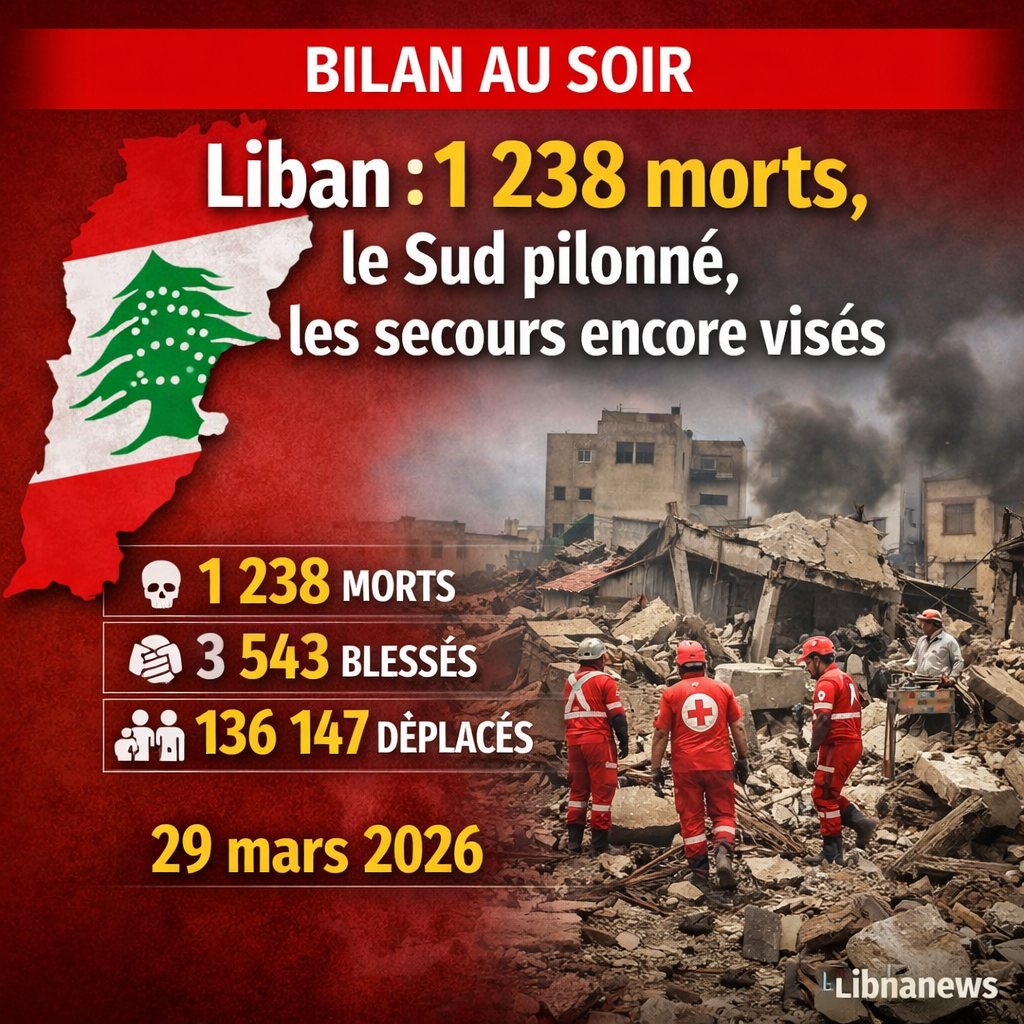
The human record continues to grow in Lebanon. According to the daily report sent this Sunday 29 March at 5 p.m. by the Risk Management Unit to the Council Presidency, the cumulative number of deaths now reaches1 238, for3,543 injured. On the day alone, the document states that49 deathsand116 injured. It also4,401 hostile acts,663 open accommodation centres,136 147 internally displaced personsin collective shelters and35,170 displaced families. This table confirms that the war is no longer limited to a front line: it affects the villages of the South, the relief, the evacuation roads and all the civilian fabric.
On the ground, Sunday was marked by a new series of Israeli strikes in southern Lebanon. In Bint Jbeil, the National News Agency confirmed that two drone strikes targeted an Islamic Health Authority centre near the city hospital. Two rescue workers were killed in this attack. On the same morning, another rescue centre was also hit in Deir Kifa, with no casualties reported. The NNA also reported a raid on Haddatha, a strike on a house in Charkieh, as well as bombings on the outskirts of Frun and a raid on Qoleileh. In Aba, a night strike destroyed a house and killed two people, while in Nabatiyah, a shopping mall suffered significant damage.
Bint Jbeil’s strike is not an isolated episode. It intervenes in the aftermath of a day already marked by attacks against journalists, rescue workers and members of the Lebanese army. The National News Agency reported on Saturday the official convictions after the death of journalists and the targeting of rescue personnel and soldiers, while Nabih Berri described these attacks as a « war crime » deliberately committed. In the meantime, the Minister of Information Paul Morcos announced that he had re-launched the case of attacks on journalists before diplomatic bodies.
The media close to Hezbollah have, for their part, highlighted the continuity of this targeting. Al-Manar reported that two rescuers had been killed on Saturday while trying to evacuate journalists hit on the Jezzine road. The same media also reported on Sunday that an ambulance had been targeted in Bint Jbeil, killing an ambulance attendant and the wounded he was carrying. Al-Manar links this sequence to a broader pattern of first aid attacks in southern Lebanon, while the World Health Organization was alarmed by the increased number of strikes against medical personnel.
The health record is now one of the heaviest in this war. According to a joint statement by the UN humanitarian coordinator in Lebanon and the WHO representative, issued by the NNA, the escalation of attacks against first aid workers and health workers is a matter of deep concern, despite the fact that these teams are already operating in extreme conditions. In recent days, MTV Lebanon reported that dozens of first aid workers and health workers had already been killed or injured, and ambulances, rescue centres and hospitals had been damaged.
Militaryly, the southern front remains very active. The NNA relayed Sunday morning Hizbullah’s statements claiming to have targeted Merkava tanks in Beit Lif, Bayyada and Chamaa, as well as to have repelled Israeli incursion attempts. Al-Manar, for its part, has detailed other operations announced by the Shiite formation during the day: striking a tank in Deir Seryan, firing a tank in Bayyada, and attacking drones against Israeli soldiers in Alma al-Shaab. The day before, the movement had claimed a wider wave of rocket, drone and anti-tank missile fire against several Israeli positions, in what it describes as a direct response to the attacks on Lebanon.
These demands are part of a day when Israeli strikes continued to plough several areas of the South. Al-Manar reported raids on Shaqra, Tayri and Jouaya, as well as artillery bombardments on Wadi al-Sluqi and on the outskirts of Majdal Selm, Qabrikha, Safad al-Batikh, Barachit, Beit Yahun, Haris and Haddatha. Already on Saturday, the same media reported attacks on localities in the district of Tyre, Nabatiyah and Bekaa, with several deaths in the area of Maaraké, Aichiyé, Deir al-Zahrani and Kfar Tebnit.
The sequence of these last 48 hours shows above all that strikes now reach the essential links of civil life. Rescue workers are affected in their centres and ambulances. Journalists are hit on the news routes. Lebanese soldiers are also among the victims of recent raids. In particular, Al-Manar reported the death of Corporal Mohammad Tfeily, a member of the Lebanese military police, after a strike on Deir al-Zahrani. This accumulation is fuelling Lebanon’s idea of a war that goes well beyond the only confrontation between Israel and Hezbollah and targets categories that are protected by international humanitarian law.
In Beirut, the pressure is not waning either. On Sunday morning, the NNA reported Israeli threats against the inhabitants of the southern suburbs, indicating that the capital remains under tension, even though most of the most deadly bombings are concentrated in the South. This atmosphere weighs on the entire country: displacement of population, partial closure of institutions, online courses in several universities and growing concern over a conflict that continues to spread.
The situation report transmitted at 5 p.m. offers a wider picture of this deterioration. The1,238 deathsand3,543 injuredAt this time, it is clear that March has turned Lebanon into a new phase of war. The663 open accommodation centresand136 147 internally displaced personsinstalled in collective shelters give an idea of the scale of the humanitarian crisis. The4,401 hostile actsFinally, it is pointed out that the war is no longer only through a few spectacular strikes, but in a continuous, scattered, daily military pressure that uses cities, villages and vital services.
In essence, Sunday does not change the nature of the conflict; Rather, it confirms the hardening. The balance sheet is still rising. Strikes continue on several southern localities. The operations claimed by Hezbollah show that the front remains open and mobile. But it is mainly the attacks on rescue workers, journalists and civilian infrastructure that mark this sequence. In Bint Jbeil, near a hospital, two rescue workers were killed again. And this simple fact sums up, by itself, the state of Lebanon at the end of the day: a country where even those who come to save others become targets.






