

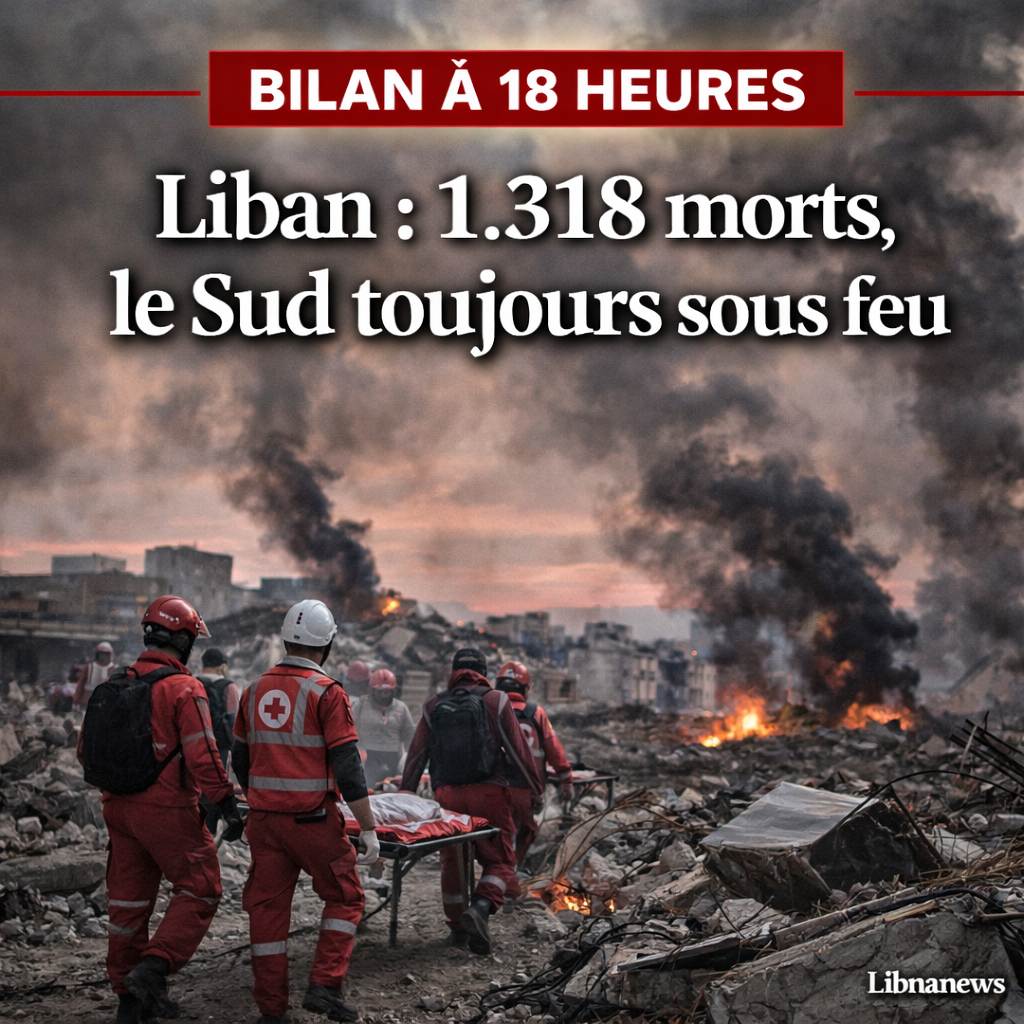
At 6.30 p.m. on Wednesday, 1 April, the last official Lebanese assessment of the Israeli strikes was1.318 deathsand3.935 injuredsince 2 March, according to the daily report relayed by the health authorities. Deaths include:91 women,125 childrenand53 medical personnel. The previous day, the official balance sheet reported that1.268 deaths. In 24 hours, the total number of casualties recorded thus increased by another fifty deaths, in a context where attacks on Beirut and the South continued, while ground fighting remained concentrated on several border axes.
Seen from Beirut, the day has confirmed a clear trend since the previous night: the war is no longer limited to border localities. The strikes of Jnah and Khalde, in the capital region, continued to weigh on the national reading of the sequence, while the South remained subjected to shelling, drone raids and artillery fire on several sectors. The Lebanese reading of this day is therefore twofold. On the one hand, the national figure is still growing. On the other hand, the combat zones remain largely located in southern Lebanon, between Tyre, Bint Jbeil, Marjayoun, Nabatiyah and the outskirts of the southern coast.
The most immediate fact remains the weight of the official human balance. This new total consolidates the impression of a war of wear and tear that has become a war of territorial crushing. The figures of the Ministry of Health do not distinguish civilians and combatants in the general total, but the detail provided on women, children and medical personnel highlights the extent of the impact on non-combatant populations and on care structures. At the same time, the Lebanese government continues to portray the war as an aggression against national territory, with an increasing emphasis on sovereignty, forced displacement and the risk of a lasting Israeli grip south of the Litani.
A review that gets bigger after a night of strikes on Beirut
The change from 1,268 to 1,318 dead is primarily due to the latest strikes, particularly in the Beirut area. Lebanese health authorities reportedseven deadand26 injuredin Israeli strikes on Jnah, south of Beirut. Other consistent reports already reported on the night of at least seven dead and 24 wounded between Jnah and Khaldé, before a slight adjustment of the wounded in the Lebanese follow-up published in the morning. These attacks marked a new level by bringing war back to the immediate vicinity of the capital, into dense urban areas where civilians live, where relief flows and media visibility is highest.
The Israeli army claimed to have targeted a senior Hizbullah official in Beirut. During the day, she said she killedHaj Youssef Ismail Hashem, presented as commander of Hezbollah’s southern front. The movement confirmed his death. For Lebanon, however, the immediate impact remains first of all that of the strike itself on the urban fabric and on the official human balance sheet. In the Lebanese narrative, the central question remains less the identity of the claimed target than the continued extension of the strikes to the depth of the territory.
Across the country, the figure of 1,318 deaths acts as a symbolic threshold. He says that the war opened since 2 March is no longer a mere sequence of border trade. It has produced in less than a month a level of loss of life, destruction and displacement that alters the political reading of the conflict in Lebanon. More than one million people have already been displaced, according to several press and agency reports, which directly affects the state’s capacity to respond to military, health and social emergencies at the same time.
Fighting zones this Wednesday until 18:30
From the morning to the end of the afternoon, the most active areas of fighting remained in theSouth Lebanon. At dawn, the National Information Agency reported artillery fire on the outskirts of theHaniyéandMansuri, as well as the continued bombing on the axisBayyada-Naqourauntil the early morning hours. The same source also mentioned a night strike onRamadiyé. This already confirmed that the southern and western coasts remained among the most exposed points.
In the course of the day, the reports then multiplied aroundMaroun al-Ras,Bint Jbeil,Jezzine,Qleileh,Haniyé,Mansuri,Wadi JilouandZawtar. The National Information Agency reported aintermittent artillery bombardment on the Maroun al-Ras axis – Bint Jbeiland oneintense overflight of Israeli aircraft at low altitude over the Jezzin area. She also reported thatartillery bombardment on the Qleileh-Haniyé sector,Fictitious raids over Tyre1hit a motorcycle in Wadi Jilou1violent strike on Mansouriand, later, aartillery bombardment concentrated on Zawtar East and West. At 6.30 p.m., the series of strikes and shootings drew a map of the battle that remained very broken, but still centered on the South.
Other sectors have also been affected in and around Tyre District. The National Information Agency reported earlier drone strikes against avanand onecaron the road toMaaroub, near the Green City, as well as a raid onSrifa. This beam of attacks shows that the day was not dominated by a single axis of combat, but by continuous pressure on several roads, villages and areas of passage from the South.
The caseKhiamillustrates this confused and fragmented field war. At 1810 hours, reports from MTV indicated that the rumours of mass explosions in the city were exaggerated: according to the channel, this was mainly a matter ofAutomatic weapon sweeping in the eastern district of Khiamandstrike on the outskirts of the city, between Khiam and Dibbine. This is important because it reminds us that, as war intensifyes, the battle of information also becomes a confrontational ground. The Lebanese media are following developments as closely as possible, but they must always distinguish between confirmed and amplified accounts.
The South remains the military heart of war
Despite the attacks on Beirut, the military heart of the conflict remains in the South. SectorsNaqoura,Qantara,Markaba,Khiam,Maroun al-RasandBint Jbeilcontinue to appear as areas of direct friction between Israeli forces and Hezbollah. Al Manar’s press releases in the afternoon reported new attacks claimed against Israeli positions and rallies near Al Manar.MarkabaandQantara. These claims alone do not constitute neutral balances, but at least confirm the continuing intensity of the clashes on these axes.
On the Israeli side, the strongest military record available at this time remains that made public on Tuesday and resumed on Wednesday with several press reports:four Israeli soldierswere killed in an exchange of fire in southern Lebanon, which led toat least 10the number of Israeli soldiers killed in the fighting in South Lebanon since 2 March, according to figures from the Israeli army quoted by regional media. Another dispatch still quoted Tuesday the threshold offour soldiers killedat the time of the announcement of the expansion of the offensive. In other words, the land front also continues to cost Israel dearly, although the imbalance in human losses remains massive in Lebanon’s disfavor.
The sequence of Wednesday also confirms another development: Israel no longer speaks only of point operations or deterrent strikes. His Minister of Defence said he wanted to establish asecurity control to Litanidestroy the houses of villages close to the border and prevent the return of hundreds of thousands of displaced persons south of the river until the security of northern Israel is considered secure. For Beirut, this speech is now akin to a new occupation project. This perspective weighs heavily on how Lebanese read every bombardment of the day: as an immediate military operation, but also as a possible prelude to a lasting recomposition of the South.
On the Lebanese side, diplomacy still exists, but without breakthrough
On the diplomatic front, the day did not bring a major breakthrough at 6.30 p.m. The Council of Ministers meeting in the Grand Serail focused mainly onmaintenance of supplies to occupied or besieged villagesthe monitoring of internally displaced persons, accommodation, humanitarian aid and the search forinternational supportto deliver basic needs to communities still in the South. The Government also recalled that elements of the Internal Security Forces remained present in some advanced villages. This meeting shows that, on the Lebanese side, today’s diplomacy has mainly taken the form of war management and a call for help, rather than a negotiation on the way to a successful conclusion.
The contrast with the discourse of several local media is clear. Tuesday night, MTV described aarrest diplomacyconsidering that Israel showed no real willingness to negotiate and that the country continued to burn while political channels remained blocked. This reading sums up quite well the atmosphere of the day: contacts and initiatives exist, but none translated this Wednesday into a clear signal of de-escalation.
There are some international efforts in the background. France doubled its humanitarian aid to Lebanon toEUR 17 millionon 19 March, as part of efforts to secure a ceasefire between Israel and Hezbollah. The recent death ofthree Indonesian peacekeepersIt also led to an urgent meeting of the United Nations Security Council requested by Paris, which shows that the Lebanese issue remains present in international discussions. But, at this time, there is nothing to talk about a decisive diplomatic initiative that has altered the balance of power on the ground.






