

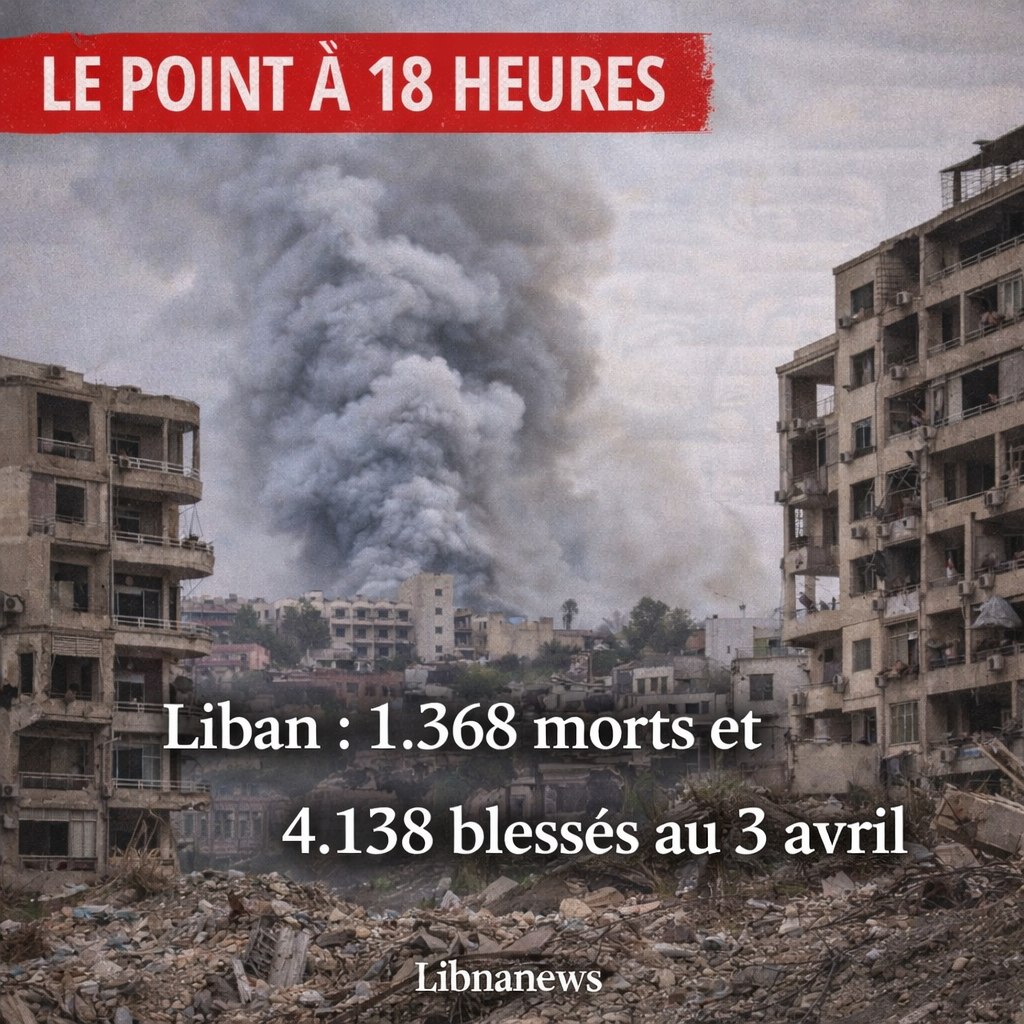
At 1800 hours, the official record of the war in Lebanon rose to1.368 deathsand4.138 injuredsince 2 March, according to the daily report of the Ministry of Health released in the afternoon. This update comes after a day marked by Israeli strikes on theBekaa, thesouthern suburbs of BeirutandSouth Lebanon, but also byfurther attack on UNIFILin the south of the country.
The day confirmed the geographical and operational extension of the war. In theWestern BekaaSohmor was hit and two bridges were placed under direct threat. ToBeirutThe Israeli army announced and then conducted new raids on Hezbollah infrastructure in the southern suburbs. In theSouth Lebanonbombardments continued in several locations, while an explosion in a UNIFIL position injuredthree peacekeepersof which:two seriously.
Human balance still rising
The new statement submitted by the Lebanese health authorities therefore fixes the total as1.368 deathsand4.138 injuredSince the beginning of the open war. This figure summarizes the intensity of an Israeli campaign now carried out on several internal fronts, from the southern border to the Bekaa, to the southern periphery of the capital.
This balance is part of a dynamic of rapid deterioration. Over the past few days, the strikes have expanded to include traffic infrastructure, urban areas, border villages and deeper areas of Lebanese territory. At the same time, the country continues to face a major humanitarian crisis, with more than one million internally displaced persons reported in the latest international assessments.
The Bekaa under pressure, Sohmor struck and two bridges threatened
In theWestern Bekaathe day was dominated by the sequence ofSohmor. Lebanese media reported that an Israeli strike hit the area of the Ahl al-Bayt mosque at the end of Friday’s prayer, making at leastTwo deadand11 injuredAccording to the first local reports. In parallel, the Israeli army announced that it was going to hit theSohmor and Machghara bridgesclaiming to prevent the transfer of Hizbullah reinforcements and combat assets to southern Lebanon.
The Israeli warning also asked the population to move north of theZahrani, effectively expanding the area under threat. This point is important because it shows that the Israeli army no longer targets only localities close to the border line, but also intends to disrupt thetraffic routes between Bekaa and the South. The announced targeting of the Sohmor and Machghara bridges is part of a territorial cut-off strategy already observed further south.
The southern suburbs of Beirut again targeted
ToBeirut, the southern suburb plunged back into the cycle of warnings followed by strikes. Evacuation orders were issued for several areas before raids were reported late in the afternoon. LBCI reported Israeli strikes on the southern suburb, while live follow-ups reported further explosions following warnings earlier that day.
Most importantly, the Israeli army officially announced on Friday the launch ofnew strikes on Hezbollah infrastructure in the southern suburbs of Beirut. This announcement is part of a broader sequence in which IDF claimed to have struckmore than 3,500 targets across Lebanon in one month, since the resumption of the open war. This figure, put forward by the Israeli army, summarizes the rise in the air and land campaign launched since 2 March.
This military claim gives another depth to the raids of the day. The strikes on the southern suburb are not presented by Israel as isolated episodes, but as a link in a methodical campaign targeting Hezbollah’s command centres, weapons depots, launching positions and logistical networks. The southern suburbs remain one of the nerve centres of this offensive.
New attack on UNIFIL in the South
One of the most serious facts of the day concerns theUNIFIL. Friday afternoon, an explosion occurredwithin a UN position in southern Lebanoninjuredthree peacekeepersof which:two seriouslyAccording to the spokesman for the mission, Kandice Ardiel. The origin of the explosion was not established immediately.
This new attack comes after a week already deadly for the UN force. Three Indonesian peacekeepers were killed in less than a week in two separate incidents in southern Lebanon, triggering an urgent meeting of the Security Council and new international alerts on the security of peacekeepers. With Friday’s explosion, UNIFIL is under another serious attack as the war intensifyes around its positions.
The repetition of these incidents shows how the positions of the UN mission are now being taken in the combat zone. Between bombardments, explosions and vehicle traffic along southern roads, peacekeepers operate under increasingly deteriorating security conditions.
South Lebanon remains under continuous bombardment
In theSouth Lebanon, the strikes did not stop during the day. Communities in theBint JbeilandTyreThey were again targeted, while aerial searches and shooting continued in several villages. This continuity of the raids confirms that the southern front remains the military heart of the war, although the Bekaa and the southern suburbs are now also heavily exposed.
The destruction in the border villages, the pressure on the routes of passage and the successive displacement orders maintain a climate of permanent war throughout the southern arch of the country. The Israeli strategy now combines deep strikes, land-based actions, infrastructure targeting and increasing pressure on Hezbollah’s circulation capacities across Lebanese territory.
IDF claims 3,500 targets in one month
The Israeli demand formore than 3,500 targets across Lebanon in one monthis another major event of the day. This figure, highlighted Friday by the Israeli army, gives a measure of the scale of the current campaign. It is in addition to the Israeli announcements on the elimination of Hezbollah fighters and on strikes targeting infrastructure, command centres and weapons depots.
On Lebanese ground, this claim results in simultaneous pressure on several spaces:South, theBekaa, theSouthern suburbsthe roads, bridges and even UNIFIL positions taken in the war. At 6 p.m., the picture of the day is therefore that of an ever-wider conflict, with a continuing increase in human performance, a large-scale Israeli campaign and increasingly exposed civilian or UN areas.






