

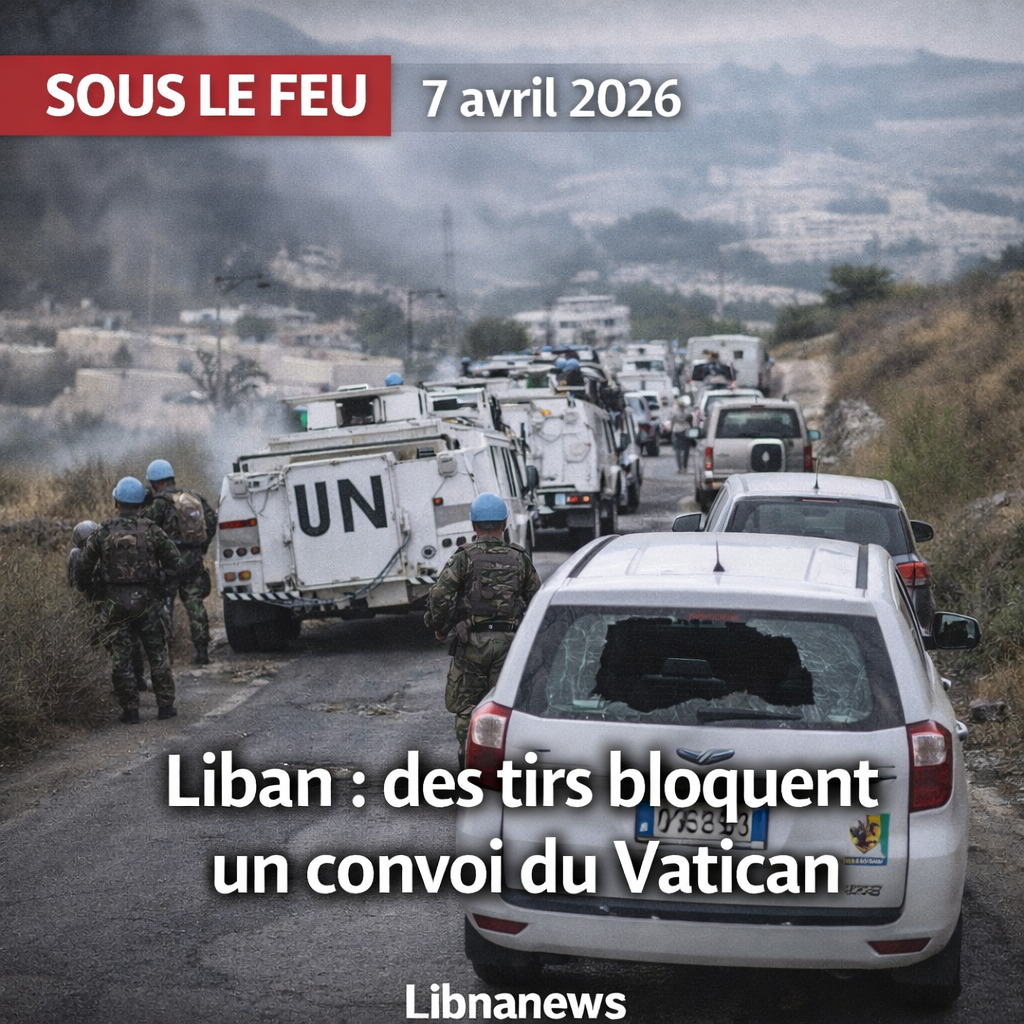
The convoy was to bring medicines, basic necessities and, beyond that, a concrete sign that the Christian villages bordering the South Lebanon were not completely abandoned. On Tuesday, this humanitarian mission organized under the aegis of the Apostolic Nuncio in Lebanon, however, had to turn back after having been shot near Debl, in the Bint Jbeil area. The convoy, escorted by the French battalion of La Finul, could not reach its destination. According to available information, the vehicles were hit, and a French Blue Helmet was injured. This marks a new threshold in the security degradation of the South: even a Vatican-related mission, under UN protection, can no longer reach civilian populations already trapped in fighting.
The Lebanese National Information Agency reported that the convoy of the Apostolic Nuncio had to turn around after more than two hours of waiting in a locality near Bint Jbeil, due to the exchange of fire and the intensification of fighting between Israel and Hezbollah. The mission targeted villages such as Debl, Ain Ebel and Rmeich, where residents lack essential products, medicines and infant milk. The failure of this humanitarian operation is therefore not a mere setback. It illustrates a tougher reality: in South Lebanon, humanitarian access itself is now exposed to fire.
The convoy was heading towards Debl, near the Israeli border, when it was shot near the border area. Material damage was reported on the vehicles. But the major element, in this new sequence, is the injury of a French Blue Helmet. The presence of the French contingent did not translate into a guarantee of passage. On the contrary, it resulted in a new direct exhibition of peacekeepers sent to secure a humanitarian mission. The episode confirms that the Finul is no longer merely a theoretical observation or interference force: it is now itself caught by the military degradation of the ground.
This point is particularly sensitive for Paris. France had already reported serious incidents in recent days against its contingent in the South Lebanon. In the Security Council, his representative had referred to serious acts committed against French soldiers in the Finul region, particularly in Naqoura. Other recent incidents had already shown that French soldiers were no longer in shelter, including on logistical trips. The case of the Vatican convoy extends this series in an even more symbolic framework: this time it is not only a UN movement that has been exposed, but a humanitarian mission to Christian villages, carried by the Holy See.
This sequence shows an increasingly clear reality in the Lebanese South. The Christian border villages, especially Debl, Ain Ebel and Rmeich, largely refuse evacuation despite Israeli calls to leave the area. Many people assure that this war is not theirs and believe that abandoning their village would mean losing moral and human control. But this choice to remain in a situation of growing isolation. Local donation campaigns highlighted the lack of medicines, infant milk and basic commodities. The Vatican convoy had to respond precisely to this emergency. The fact that he could not pass, despite the escort of the Finul, further worsens the feeling of encirclement.
The religious and diplomatic nature of the mission, however, gave it a special significance. It was not a simple transport of aid organised by one association among others. It was a convoy linked to the apostolic nuncio, therefore to the representative of the Holy See in Lebanon, explicitly targeting Christian localities in the South. This dimension was supposed to offer the mission additional moral legitimacy. Its blocking under fire has the opposite effect: it shows that even an operation under such sponsorship no longer benefits from a protected space. Aid, religious diplomacy and international protection now face the same limitations as the rest.
The Maronite patriarchate had already denounced the cancellation of a previous convoy to Debl, referring to a violation of international humanitarian law. This vocabulary becomes even stronger after Tuesday’s episode. When a convoy for civilians in need of medicine cannot reach its destination and a French peacekeeper is injured during escort, the problem is no longer only humanitarian. It becomes political, diplomatic and international. It calls into question the very possibility of maintaining channels of assistance to civilian localities, which are identified, known and theoretically protected by the principles of the law of war.
In these villages, the psychological effect is probably as severe as the material lack. The inhabitants already know that they live in exposed localities. But they could still hope that humanitarian convoys accompanied by the Finul, with French participation and Vatican support, would cross the line of danger. The failure of this mission says something else: it suggests that no label, neither religious nor humanitarian nor UN, is enough to guarantee the passage. It is this impression of increased abandonment that is now spreading in the villages of the area.
The fact that a French Blue Helmet was injured finally changes the scope of the case in Paris. As long as the incidents remained limited to intimidation, warning shots or material damage, France could still speak of a serious but contained degradation. The wound of one of his soldiers in a Vatican-related humanitarian convoy gives the case a more direct charge. It turns a local incident into a potential diplomatic affair between Paris, the United Nations and the actors involved in the fighting in South Lebanon. It also recalls that the French soldiers of La Finul are no longer merely witnesses of a war they observe powerless: they are now more facing the consequences in front of them.
In South Lebanon, this Tuesday, the most telling image is not only that of a stopped convoy. This is the case of humanitarian aid from the Vatican, escorted by the French battalion of La Finul, forced to retreat under fire in the approach of villages already weakened by shortages and isolation. And in this scene, a fact now imposes itself in the foreground: the injury of a French Blue Helmet shows that even international protective devices are themselves caught up in the war.






