

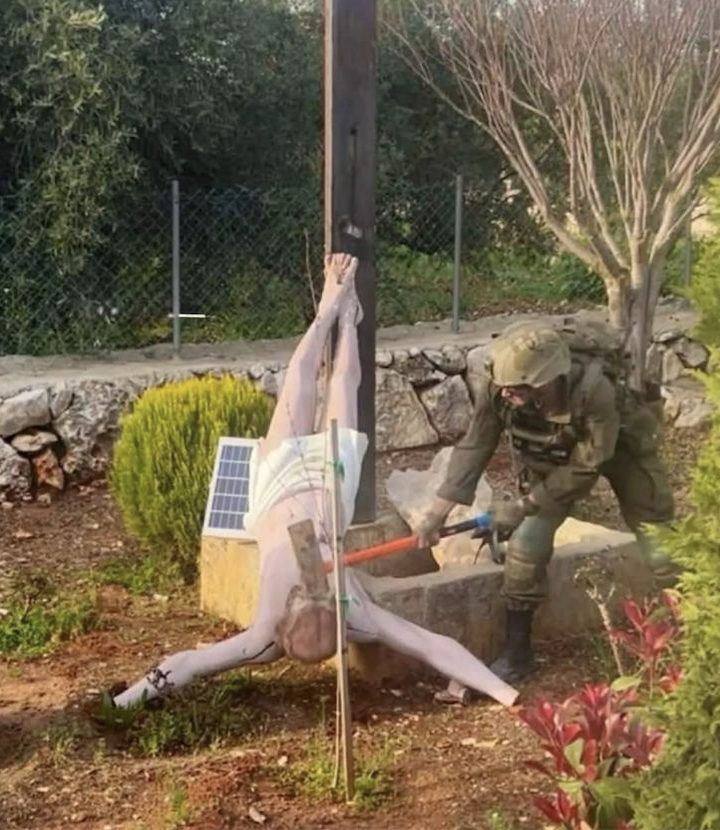
It is no longer possible for the Israeli army to take refuge behind doubt, conditionality or the argument become familiar with visual manipulation. The post published by the official account of the Israeli army marks a clear shift: the photograph showing a soldier striking a statue of Christ in southern Lebanon is very authentic, and the man visible on the picture is indeed an Israeli soldier operating in the area.
In a few hours, the file has changed its nature. There is no longer any question of a disputed image. There is a fact recognised by the institution itself.
This confirmation is politically cumbersome. It closes the door to the most convenient defence line, which consists of denying, relativizing, talking about assembly, poisoning or enemy propaganda. It also transforms the case. What was still, a few hours earlier, the controversy over authenticity is now a problem of command, military discipline, political responsibility and international image.
When an army recognizes that one of its men has desecrated a Christian symbol in a neighbouring territory that it occupies militarily, it no longer manages a simple incident. It is confronted with a truth that it can no longer outsource.
The most striking in this sequence is the speed with which Israel moved from suspicion to confession. Spokesperson Nadav Shoshani had first explained that the army was examining the reliability of the cliché and that, if the image were real and recent, such behaviour would not correspond to the expected values of a soldier. Then came the official message: after a first examination, it was established that the photo shows a soldier of the Israeli army operating in southern Lebanon.
The institution added that it considered the facts with great severity, that an investigation would be conducted by the Northern Command and that action would be taken against the persons involved.
Change is decisive. It means that Israel no longer challenges the reality of the image or the membership of the soldier. So the heart of the debate is no longer whether the scene has taken place, but what Israel will now do with its own confirmation.
From viral image to official confession
In contemporary conflicts, many images circulate without being verified, removed from their context or recycled for other purposes. The armies know this and often use it to maintain a useful blur zone. That is precisely why the official recognition of the cliché changes everything.
By admitting that the scene shows one of its soldiers, the Israeli army withdraws from its most zealous supporters the argument of false or hostile manufacture.
This is all the more important because, on social networks, the first reactions followed a scenario that became routine. A part of Israel’s defenders had immediately spoken of a fabricated image, anti-Semitic lie, manipulation of informational warfare. Israeli authentication makes this reflex untenable.
It is no longer a Lebanese, Palestinian or militant accusation. It is the Israeli army itself that says: yes, this man is one of us.
This recognition also has a special symbolic significance in Lebanon. Because the image does not show a combat action, an exchange of fire or the destruction of a military position. She shows a free act of desecration.
An armed soldier does not neutralize any immediate threat. He sarches on a representation of Christ. It does not strike a military goal. He hits a symbol.
And it does so in southern Lebanon, in a region where Christian communities already feel vulnerable, exposed and threatened in their very continuity.
The file then takes on a much larger dimension than that of an individual slip. For if the gesture is that of a man, his political weight lies in the context in which it took place: a de facto military occupation of areas of southern Lebanon, displaced or partially emptied villages, affected sanctuaries, and a Christian border presence that is already seen as weakened.
Israeli confirmation does not fix anything. But it suppresses at least one more form of insult: that which would have consisted of treating witnesses, inhabitants and indignant people as propagandists incapable of telling the truth.
What exactly Israel says, and what Israel does not say
The Israeli communiqué is precise on one point and remarkably vague on several others. It confirms the authenticity of the photograph and the institutional identity of the soldier: it is indeed an Israeli soldier operating in southern Lebanon.
The army adds that its behaviour is totally incompatible with the expected values of its troops, that an investigation is under way and that appropriate measures will be taken according to its conclusions. She also said she was working with the local community to put the statue back in place.
But this language, as important as it is, does not meet the essentials. The soldier’s name was not made public. His rank was not communicated. His unit was not specified.
It is not known whether the man has already been suspended, removed from office, recorded, questioned under disciplinary regime, or within which time a decision will be taken. It is also unclear whether the direct chain of command will be examined beyond individual responsibility.
This opacity is at the centre of the problem. Because a military institution can always verbally condemn an act, especially when it becomes impossible to deny. The real question is not the sentence in words. It is the penalty in deed.
Now, at this point, the Israeli discourse looks like a well-functioning mechanism: to recognize what the image requires to recognize, to say shock, to open an inquiry, to promise follow-up, and then to refer the rest to an administrative time which the opinion may forget.
This is where the Lebanese, and even more Christian, mistrust takes on its full meaning. An investigation is of value only if it leads to something other than a crisis statement. Without clear identification, no responsibility assumed, no real visible sanction, this investigation will look less like a justice exercise than an escape.
In Lebanon, many already see a smokescreen, a media management formula, a powder of perlimpinpin launched in the eyes of people to contain indignation without facing the background of the scandal.
The restoration of the statue, if it takes place, will not change this reality. Putting a symbol in place does not remove the intention that led to breaking it, nor the message of domination contained in the act. We can straighten the wood or plaster. It is not so easy to repair what the image has already said.
Why this confirmation is more serious than a simple technical confession
One might be tempted to see in this sequence a simple authentication problem: a viral image, then an official verification. That would be a mistake.
Israeli recognition is more serious than a technical confession, because it involves several levels of responsibility.
First, it reaches the credibility of a recurring discourse. For years, Israel has been presenting its army as « the most moral in the world », a formula repeated inside and outside the country. This rhetoric is not anecdotal. It serves to frame the international gaze, to establish the idea of ethical superiority, to make it appear that blunders, humiliations or degradations would be only marginal exceptions in a profoundly virtuous whole.
When the same army is forced to admit that one of its soldiers has desecrated a Christian symbol in a Lebanese village, its moral posture ceases to be impressive. It’s starting to sound like another defensive slogan.
Then this confirmation reaches Israel’s relationship with Christian communities, both in Lebanon and beyond. The case does not concern only the population of Debel or the area where the statue was located. It affects the relationship between an army and a universally identifiable religious symbol.
Christ broken by an operating soldier is not an image that is easily enclosed in a local file. It is an image that circulates, which hurts, which is permanently printed in memories already worked by other destructions of holy places, Christian or Muslim.
Finally, confirmation is important because it comes at a time when Christian villages in the South already feel threatened by more than a war. They feel threatened by possible erasure.
The yellow line imposed by Israel in southern Lebanon touches or approaches several Christian localities and feeds the fear of a prevented return, a prolonged displacement or a slow vacuum imposed. In this context, seeing an Israeli soldier attack a statue of Christ is no longer just a sacrilege. This, for many inhabitants, is an additional sign that their presence itself is not regarded as worthy of respect.
For Christians in the South, confirmation does not change pain, it changes proof
In border villages, the effect of Israeli recognition is paradoxical. She doesn’t relieve anything. She doesn’t appease anger. She doesn’t absolve neither the offending nor the fear nor the dead.
But it brings one essential thing: admitted evidence.
For weeks, Christians in southern Lebanon have said that they are affected not as abstraction, but as concrete communities. They talk about isolation, roads cut off, convoys obstructed, sanctuaries affected, displaced families.
They also recall the events that profoundly changed their gaze on the war, including the death of Abbé Pierre al-Rahi in Qlayaa, a Maronite priest killed in March while he was helping the wounded. From the moment a priest falls, many understand that no moral or religious figure offers more symbolic protection.
The photograph of the soldier striking the statue of Christ was therefore received through this immediate memory. Not as a detached episode, but as one more moment in a long chain of brutality, fear and humiliation.
When Israel confirms that the man in the image is indeed an Israeli soldier, it validates in spite of him what the inhabitants were already saying: what they saw was neither a collective hallucination nor a fabrication of informational war.
There is a strong moral dimension. Because injured communities do not only demand material reparations. They also ask that they not be robbed of the reality of what they have suffered.
The first violence is the act. The second, often, is denial. By confirming the photo, Israel removes at least this second violence. But he doesn’t exonerate himself. On the contrary, he is obliged to prove that his words on the gravity of the case are not merely cosmetic surgery.
Holy land and sacred places struck one after another
To understand the magnitude of emotion, it is necessary to recall what southern Lebanon represents in the Eastern Christian imagination. It is not just a national periphery exposed to war. It is also an evangelical land.
Christ passed through the region of Tyre and Sidon. For Christian families in the South, this memory is not a matter of pious detail. It places their territory in a biblical continuity, in a sacred geography lived daily, between bell towers, sanctuaries, processions, cemeteries, crosses of paths and deep-rooted parishes.
Destroying a statue of Christ in this landscape is therefore not only degrade a religious object. It is desecrating a place of memory in a land that its inhabitants also live as holy.
And this injury does not concern Christians alone. South Lebanon is traversed by Muslim sacred places, maqams, mausoleums, Shia or Sunni shrines linked to ancient local devotions.
Many of these sites have also been damaged or razed in recent weeks. The case of the Shrine of Chamoun es-Safa in Chamaa, reported as severely affected and then given to be destroyed by cultural and heritage leaders, has marked the minds far beyond one community.
That point deserves to be said frankly. The current violence is not just about homes and roads. It also affects the sacred topography of the South. It reaches landmarks that connect the living to their history, communities to their territory, faith to geography.
That is why the matter of the statue of Christ is not a mere anecdote of war. It is part of a wider series of attacks on holy places and symbols, both Christian and Muslim.
Debel, the border and fear of emptiness
Israeli recognition finally comes in a very special context: that of increasing anxiety about the very future of Christian border villages. Debel, Rmeish, Ain Ebel, Qlayaa and other localities have been living for weeks with the idea that war not only threatens the bodies, but also the demographic, social and spiritual continuity of their presence.
People know what starting means. They know that return is never guaranteed. They also know that an empty border is rapidly changing. It ceases to be a space of life. It becomes an area of control, surveillance, manoeuvring, sometimes ruins.
The Israeli yellow line, published the day after the ceasefire and maintained as an advanced line of deployment, reinforces this anguish. For many Christian families, it is less like an ad hoc security measure than a technique of suspending their right to remain.
In this context, the photograph of the soldier and Israeli authentication take on additional meaning. They don’t just say that a soldier misled himself. They show a wider relationship to these villages and their symbols.
A relationship where the occupying army allows itself the free gesture, then promises an investigation after the fact. A relationship where the territory is first thought as an operational space, and only then as a place inhabited by communities with their churches, priests, deaths and memories.
What an investigation is worth when it all depends on sanctions
The point of truth in this case is no longer the photo. Nor is it the institutional identity of the soldier. This point of truth, now, is the next.
If the investigation announced by Israel results in a vague call to order, an invisible sanction, an administrative conclusion closed behind closed doors or a rapid oblivion, it will confirm what many already fear: that it will only have been used to absorb the media shock.
It will then appear for what it is in the minds of many Lebanese: an instrument of de-starting, not justice.
If, on the contrary, the Israeli army publicly identifies the soldier, specifies its chain of command, pronounces a clear sanction, recognizes the religious and political significance of the gesture, and admits that it is not a detail without consequence, then only his speech on the gravity of the affair will gain a start of credibility.
For the moment, this credit does not exist. It cannot exist on word. Because the image was too violent. Because the context is too heavy. Because Christians in southern Lebanon have already seen theirs die, have already seen their villages threatened, have already seen their symbols affected, and can no longer be content with procedural indignation.
Israel therefore confirmed the essential: yes, the soldier who strikes the statue of Christ is indeed an Israeli soldier. This sentence alone destroys all the denial reflexes that followed the diffusion of the cliché.
It now obliges the Hebrew state to leave the register of agreed words. The real test begins after the confession, at the moment when it is necessary to decide whether the proclaimed morality will finally produce a real sanction, or whether it will remain, once again, a brilliant formula laid on a vacuum.






