

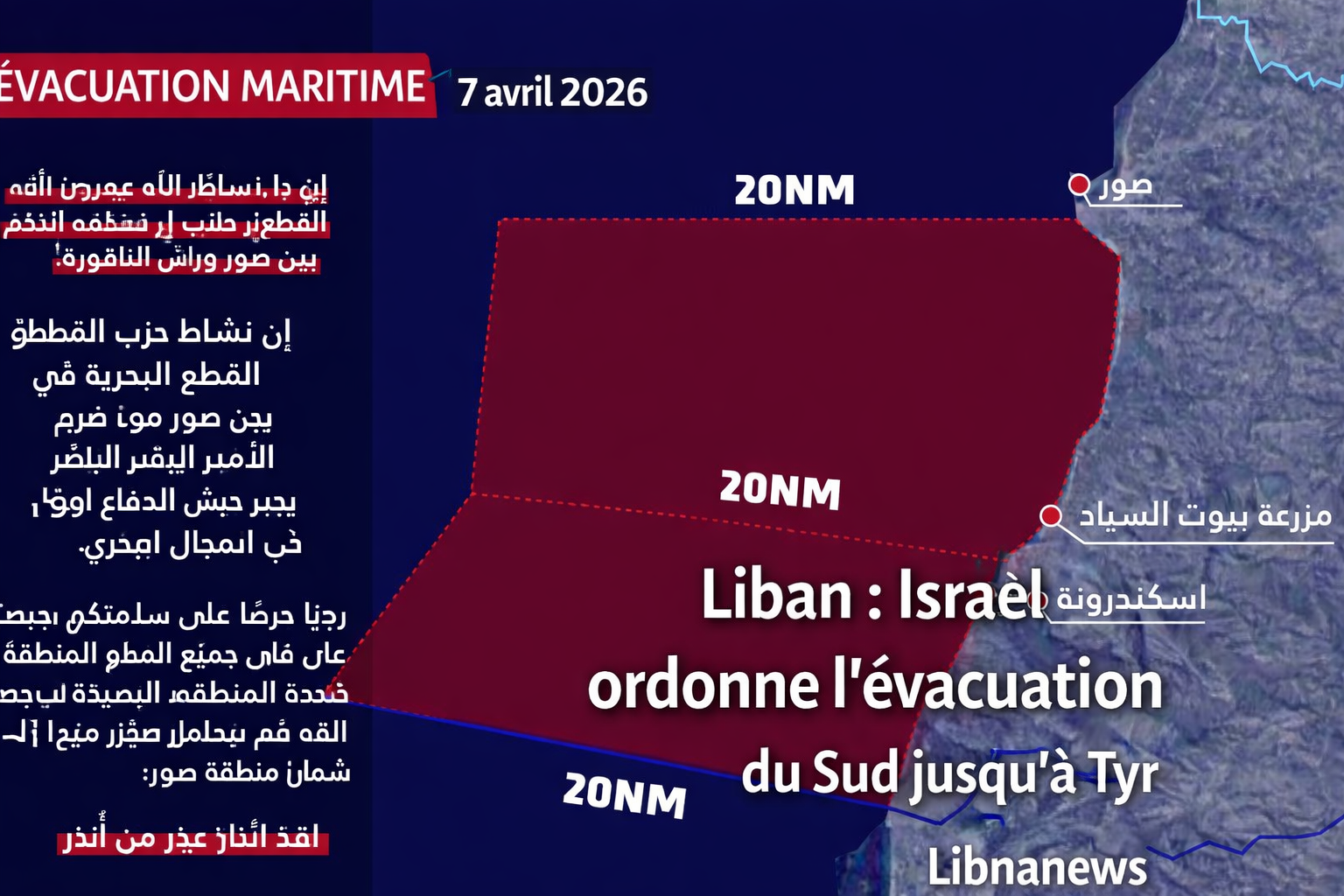
On Tuesday evening, the Israeli army expanded its warnings to the Lebanese maritime front by calling on all vessels to leave the southern Lebanese coastal zone from the border to Tyre. In a message published by her Arab-speaking spokesman, Colonel Avichay Adraee, she warned that she was going to act « in this maritime sector » against Hezbollah and asked « all ships to anchor or sail » up to 20 nautical miles off to proceed immediately north of the Tyre region.
This alert opens a new phase of the war in South Lebanon. Since 2 March, Israeli warnings were directed primarily at border villages, then the localities south of the Litani River, before extending to certain areas of Tyre and several land axes. By now targeting the maritime area to Tyre, Israel is further expanding the perimeter of the areas it considers to be part of its operation against Hezbollah. The measure concerns not only fishing or recreational craft, but more broadly any naval presence in a coastal area already weakened by strikes and evacuations.
A warning following several strikes around Tyre
The ad does not fall into a vacuum. In the last few days, Tyre and its region have been repeatedly hit. According to several press reports, an attack on the port of Tyre hit a small boat and damaged other moored boats, while strikes also destroyed nearby buildings. Bombardments around the city also caused damage in the vicinity of a hospital, pointing out that the south coast is no longer merely a space for civilian traffic, but a direct military theatre.
The scope of the Israeli warning is therefore immediately concrete. This is not a theoretical message about an abstract maritime area. It is part of a context where the coastal facilities in Tyre have already been exposed and where local maritime traffic has already suffered damage. In ordering the departure of all ships to the north of Tyre, Israel points out that it now considers the South Sea Strip as a fully operational area.
Tyre, tilt line between front and rear
Tyre occupies a special place in the present war. The city is not in immediate contact with the border, but for weeks it has been a tipping point between the southern border, the villages already depopulated or bombed, and the rest of the country. Its coastline, port, access roads and peripheral areas play a central role in displacement, residual economic activity and the very perception of the depth of the front. When Israel includes Tyre in its warnings, it again moves this depth.
This extension is not isolated. On 4 April, the Israeli army had already ordered the evacuation of areas of Tyre before strikes on targets that it presented as related to Hezbollah. In the previous days, it had also spread its calls to leave the entire area south of the Litani River, as part of an offensive that Israel was presenting to establish a security zone against Hezbollah. The maritime warning of Tuesday is therefore a continuation: gradually expanding the space deemed operational, both at sea and on land.
The sea in turn becomes a space of war
So far, the war in South Lebanon began with air strikes, artillery, destruction of bridges, raids on border villages and fighting around land axes. The order given to the ships to leave the area to Tyre marks an inflection: the sea is more visibly entering the immediate field of operations. This does not only mean a risk to local fishing or navigation activities. This also means that the southern coast is now being treated by the Israeli army as an extension of the land front.
For the people of the South, this development has direct consequences. In a context where many roads have already been hit, where several bridges have been destroyed and where some villages live in near isolation, the coastline and port areas remain of major logistical, economic and psychological importance. By calling for maritime evacuation, Israel further reduces traffic margins and accentuates the sense of circle in southern Lebanon.
A military but also a political message
Like the previous warnings issued by Avichay Adraee, Tuesday’s message is formulated in the language of the protection of civilians, but it also has a clear political function: publicly redesigning the map of risk areas and pre-empting displacement of populations and activities. By asking the ships to go north of Tyre, Israel is not content to announce an operation. It establishes a new provisional boundary between the maritime space it considers threatened and that which it considers, at least for the time being, out of immediate reach.
This type of warning itself produces effects. Even before any strike, it disrupts harbour activity, fishing, local navigation and the habits of coastal residents. It also helps to broaden the mental map of war. What was again yesterday from the rear of Tyre gradually slides towards a status of exposed area. In today’s South Lebanon, this gradual extension of the military perimeter is part of the war as much as the strikes themselves.
New pressure on an already cut South
The maritime warning finally intervenes in an already deeply fragmented South. Dozens of villages were hit or emptied, several land axes were cut, and repeated strikes on infrastructure reduced the margins of traffic between the border, Tyre and the rest of Lebanon. The order given Tuesday evening to the ships to leave the area until Tyre reinforces this partitioning dynamics. The South is no longer confined to the earth; It also closes by the sea.
At this stage, Israel has not publicly detailed the exact nature of the announced maritime operation. But his spokesperson’s message is enough to change the situation on the ground. In a few lines, the Israeli army made the southern coastal strip, to the outskirts of Tyre, a space to evacuate. After the border villages, the Litani axes and some urban areas, the war has now officially reached the sea.






