

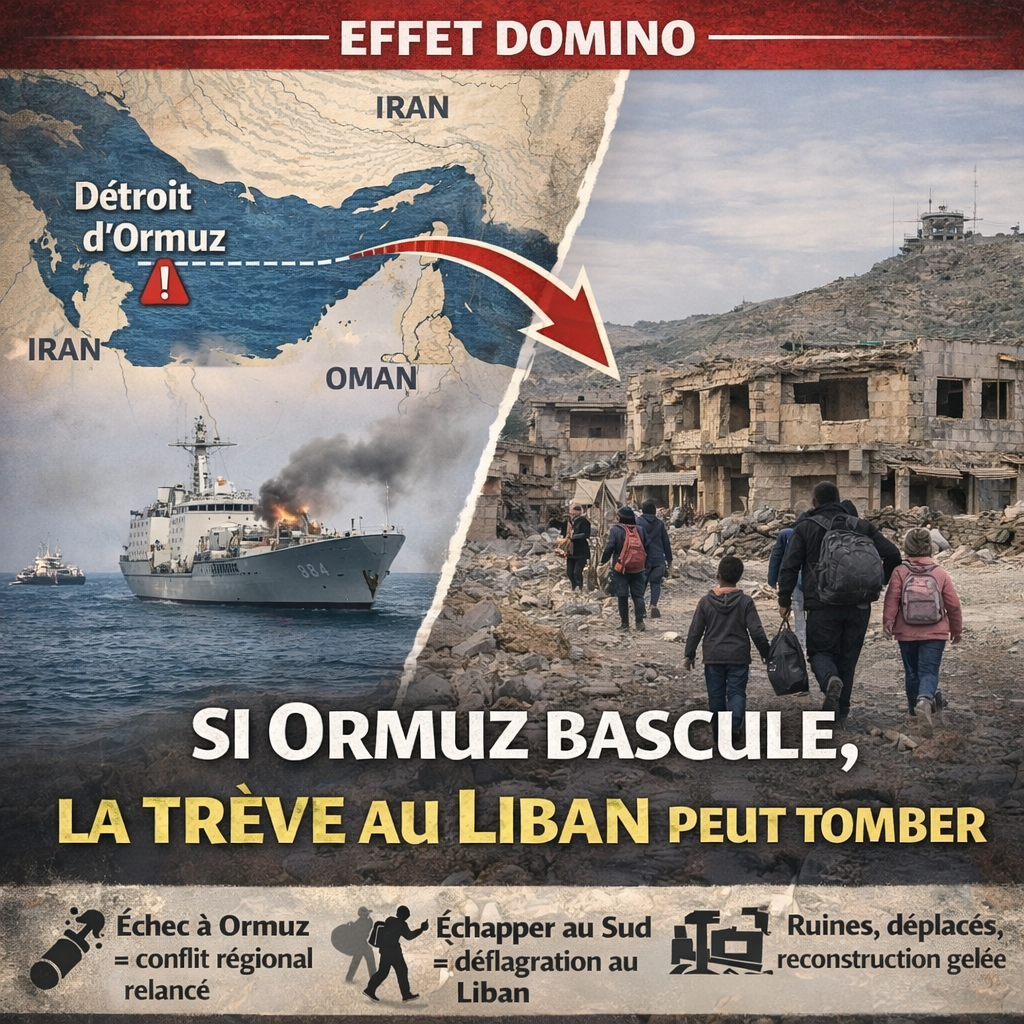
The question is no longer whether the Ormuz crisis will raise the price of oil in Lebanon. The major risk for Beirut is elsewhere: the truce in Lebanon itself. If the fragile de-escalation sequence between Washington and Tehran breaks in the Gulf, the ten-day truce on the Lebanese front can lose its main political umbrella. And, in the present state of the ground, that would be enough to get the South back into a suspended war logic.
For the past few days, Lebanon has been breathing without real reassurance. Families have returned. Neighbourhoods in the southern suburbs of Beirut have regained some movement. Rescue continued their work. The Lebanese authorities have tried to put the sequence within a state framework, with the hope that a stop to the fire, even in short, will pave the way for more lasting arrangements. But this respite never looked like deep stabilization. It looks more like a pause from outside, under conditions, and vulnerable to any regional change.
This is where the Strait of Ormuz becomes decisive again. If the break between Washington and Tehran breaks, if maritime incidents worsen, if the seizure of an Iranian cargo ship by the Americans marks the beginning of a new phase of confrontation, Lebanon will cease to be a separate file. It will become one of the places where the pressure between the two camps is measured. Clearly, the first danger to Lebanon would not be economic first. It would be military, political and territorial.
This angle is essential because the Lebanese terrain remains unstable despite the partial cessation of fighting. Israel maintains forces within Lebanese territory. The Israeli army issued for the first time a map of its new deployment line in the South, with de facto locations in a control zone. Civilians cannot return everywhere. The destruction is massive. Displaced persons often return to see the extent of the ruins rather than to resume normal life. And Hezbollah never suggested that it would feel permanently bound by a diplomatic architecture negotiated above it.
A Lebanese truce that is not a peace
We must first recall what this truce is, and what it is not. She suspended some of the clashes. It allowed for the start of the return of displaced populations. She opened a diplomatic space. But it neither settled the status of southern Lebanon, clarified the modalities of an Israeli withdrawal, resolved the issue of Hezbollah armament, or restored a normal chain of security on the border.
In official accounts, the truce was sometimes presented as a clear step towards a settlement. On the ground, the image is much harsher. Residents who return discover destroyed villages, damaged roads, still threatened areas and limited access. The return exists, but it is partial. The truce has reopened the way back. It has not yet rebuilt the conditions of return.
This shade changes the entire sequence reading. Peace, even imperfect, creates stabilization mechanisms. A short truce, in a still active military environment, creates above all a suspension of fire. It’s an intermediate state. It can lead to a stronger agreement. It can also serve as a simple corridor between two phases of confrontation. In Lebanon, there is still no evidence that this corridor will automatically lead to sustainable stabilization.
Israeli behaviour in the South shows this. Israeli military and political statements continue to speak in terms of security, buffer zone and neutralization of Hezbollah infrastructure. Mission vocabulary has not disappeared. He only adapted to the truce. This means that Israel does not approach this period as an end of the campaign, but as a transition under surveillance.
On the Lebanese side, the government is trying to put the sequence in an institutional logic. The Presidency and the civilian authorities want to show that the ceasefire can become the starting point for more permanent agreements. That will exists. But it strikes a simple reality: official Lebanon does not control all armed actors or regional tempo. As long as the main parameters are in play between Washington, Tehran and Israel, Beirut mainly manages the consequences.
Southern terrain remains ready to re-degrade
The latest developments have been confirmed. The Israeli army released its line of deployment inside southern Lebanon, with an announced depth of several kilometres from the border. This publication is not a communication detail. It means that Israel wants to materialize its presence, make it visible, present it as a security data and not as a temporary episode without tomorrow.
For the people of the South, this map has a very concrete effect. She draws villages partially or totally cut off from their usual rhythm. It maintains doubt about the possibility of a full return. It also feeds a heavy psychological reality: a cease-fire that leaves a foreign military hold on is less like an exit from war than an interrupted war before its settlement.
The human and humanitarian record of the recent campaign exacerbates this fragility. According to figures relayed by the authorities and humanitarian agencies, more than 2,000 people have been killed since the beginning of the March escalation, and more than 1.2 million have been displaced. Tens of thousands of families continue to face the destruction of their homes, the presence of unexploded ordnance, the collapse of basic infrastructure and continued insecurity.
In this context, a resumption of hostilities would not be a return to a previous situation. It would strike an already empty territory, already ruined, already exhausted. South Lebanon is not in a consolidated reconstruction phase. It is in a very fragile suspension phase between flight, return and waiting. A negative regional signal is enough to transform this suspension into a new exodus.
The other sensitive point is the ambiguity of access. Some areas have seen the return of civilians. Others remain closed or very constrained. The Israeli military authorities have not clearly guaranteed that all internally displaced persons could return to their homes. For a village, for a family, for a farmer, this uncertainty is not abstract. It determines the work of the fields, the rehabilitation of a dwelling, the reopening of a business, the sending of children to school. A truce that does not regulate the freedom of return remains an incomplete truce.
Why Ormuz directly threatens the truce in Lebanon
The link between Ormuz and Lebanon may seem indirect at first sight. In reality, it is now central. The Lebanese truce was not built in a regional vacuum. It settled in a wider sequence where Washington sought to contain the escalation with Iran, calm several fronts at the same time and preserve a negotiating window. The Lebanese front served as a useful de-escalation zone at that time.
This means that a break in the Gulf can produce an almost immediate political contagion effect. If Washington and Tehran stop talking, or if they continue to talk in an open climate of naval confrontation, Lebanon loses the context that made the truce bearable for all. The United States will have less political capital to devote to maintaining the fire. Israel could argue that the restraint sequence failed. Iran will be able to consider that it is no longer in its interest to leave the Lebanese front frozen if US pressure is strengthened elsewhere.
The Lebanese front is therefore not an independent theatre. He’s a barometer. As long as the relationship between Washington and Tehran remains in a logic of risk management, the ceasefire in Lebanon can hold, even painfully. If this relationship goes back into the assumed confrontation, Lebanon becomes again one of the areas where tension is re-expressed. This is precisely what the evolution of the last hours around Ormuz suggests.
The taking of an Iranian cargo ship by the United States is more than its only maritime impact. It changes the political climate. It gives Tehran an additional reason to consider that Washington wants to negotiate while continuing to strike. It complicates Pakistani mediation. It hardens the narratives on both sides. As a result, each front closely or by far linked to the Iranian-American axis becomes more unstable, including Lebanon.
We must not imagine mechanical automation. A crisis in Ormuz does not instantly trigger a general resumption of fighting in South Lebanon. But it changes the calculation of actors. And in a region where the calculation often precedes the action of only a few hours, this change suffices to make the truce much more vulnerable.
A ceasefire suspended from the regional context
This is one of the most important facts in this sequence. The Lebanese truce was often read in Beirut as a Lebanese event. This reading was understandable. The first effects were seen in Lebanon: lower strikes, return of displaced persons, breathing in affected neighbourhoods. Yet, very quickly, another reading was imposed. The ceasefire was not only Lebanese. It was a fragment of a wider regional moment.
Washington had better show that he could produce de-escalation. Tehran had better let a moment of respite exist without appearing to be under pressure. Israel had an interest in translating its military campaign into territorial and strategic gains while at the same time pawning its American ally. Each had a separate reason to accept a limited break.
The problem is that a limited break will not last long if the whole logic is deregulated. Lebanon does not need a perfectly reconciled regional order to hold a truce. He needs a minimum of discipline in the Washington-Tehran report. It is precisely this minimum that is becoming fragile today in the Gulf.
You can say that differently. Lebanon is not only exposed to the consequences of Ormuz on oil. It is exposed to the consequences of Ormuz on the hierarchy of strategic priorities. If the Gulf re-engages, the actors will no longer read the Lebanese truce as a useful step. They will read it as a temporary constraint, even as a luxury that has become useless.
Hezbollah is not locked in Lebanese diplomatic logic
The other reason why the truce remains fragile is the position of Hezbollah. The movement accepted a period of de facto disqualification. But it has not fully integrated the political logic of the discussions initiated by the Lebanese State. A senior official made it clear to an American agency that Hezbollah would not feel bound by any agreements resulting from the direct talks between Lebanon and Israel.
This position is crucial. It means that state diplomacy alone is not enough to lock the truce. Official Lebanon can discuss, lay its red lines, seek a permanent framework. But if the main armed actor on the front considers that he is not bound by the result, the strength of the ceasefire remains conditional.
This dissociation between the State and the armed group is not new in Lebanon. However, it takes on a particular intensity in the current sequence. The shorter the truce, the more it depends on the tactical consent of the actors on the ground. The more it depends on tactical consent, the more it becomes sensitive to a change in the regional context. If Iran hardens its stance against the United States, Hezbollah’s margin of autonomy reads differently. It becomes an ability to reactivate the forehead.
This does not mean that a decision to resume attacks would be announced publicly or immediately. Armed organizations also know how to deal with ambiguous areas. They can test, report, respond in a limited way, calibrate an escalation. But the mere fact that Hezbollah does not consider itself automatically linked to the diplomatic sequence is enough to make the truce reversible.
For Beirut, this is a major weakness. Power can defend a stabilization strategy. It cannot guarantee that all decision-making centres will respect it if the regional power ratio worsens. As long as this dissociation continues, Lebanon remains exposed to a rupture whose final decision can be taken in part outside its institutions.
Israel already treats the South as a security zone in the future
The fragility of the truce does not depend solely on Hezbollah. It is also about how Israel speaks and acts. The Israeli authorities did not give up the feeling of abandoning their draft buffer zone. On the contrary, the map published on 19 April and statements on the destruction of structures deemed threatening confirm a long-term security reading.
This posture changes the very nature of the ceasefire. If a party sees the truce as a tool to freeze tactical gains, broaden defensive depth and maintain pressure, it does not fit into a logic of reciprocal normalization. It enters into a useful suspension logic. A useful suspension can be broken as soon as it ceases to produce its benefits.
In this context, a worsening in Ormuz could provide an additional argument to Israel. If Tehran and Washington plunge into confrontation, Israel can argue that the northern front cannot remain treated as a parenthesis. He may say that Hezbollah remains an extension of the regional conflict and that the security zone in southern Lebanon must be consolidated rather than alleged. The truce, instead of being deepened, would then be redefined as a simple operational breathing.
The risk is not only that of a dramatic recovery. It is also that of slow re-deterioration: point strikes, even more restricted access, additional destruction of infrastructures, incidents along the deployment line, calibrated responses. A truce can die in many ways. It can explode in one night. It can also gradually empty itself of its substance until it is more than a diplomatic word.
Displaced persons would be the first to pay for the breakdown
The truce is often referred to in military and diplomatic terms. Yet his first hostages remain civilians. Since the announcement of the fire, thousands of internally displaced persons have begun to return to the southern suburbs of Beirut, Nabatiyah, Tyre and many southern localities. Many found uninhabitable housing, devastated streets, interrupted services and a still dangerous environment.
If the truce breaks, this return will reverse immediately. The families who started moving again will have to leave. Those who were still hesitant will conclude that there is no safe window. Schools, clinics, shops and local networks will remain in between. The whole fabric of the return, already precarious, can be defeated in a few hours by the resumption of the strikes or by a simple hardening of the accesses.
The psychological effect would be immense. A population can endure war displacement. She is much less able to endure the repetition of displacement, especially when she has already begun to return, to clean, to repair, to project. The feeling of living in an endless temporary undermines local society more deeply than destruction statistics.
Reconstruction, too, would be delayed. No serious actor engages heavily in heavy construction as long as the risk of fire recovery remains high. Donors are slowing down. Companies are waiting. Households differ from expensive repairs. Municipalities manage the emergency rather than plan. A break in Ormuz that would blow up the truce in Lebanon would not only destroy more. It would also block the possibility of rebuilding what has already been.
The Lebanese army and UNIFIL are reported to be under pressure again
Another consequence, less visible but decisive, concerns actors supposed to stabilize the ground. The Lebanese army, already requested on several levels, needs a minimum of calm in order to effectively redeploy itself, secure the axes, accompany returns and reaffirm an institutional presence in the bruised areas. A short truce barely gives him time to start this work. A regional relapse would interrupt almost immediately.
UNIFIL is in a comparable situation, with increasing political vulnerability. Every incident against peacekeepers, every cross accusation, every difficulty in access reduces its ability to appear as a stabilization factor. In a more difficult regional climate, its room for manoeuvre is shrinking. The mission does not disappear, but its deterrent effect and practical legitimacy can erode.
For Lebanon, this erosion would be costly. The smaller the capacity of the army and UNIFIL to hold the ground, the more the vacuum is occupied by confrontational logics. And the more these logics dominate, the more the southern front becomes available for regional military messages.
The real cost to Lebanon would first be strategic
Of course, a break in Ormuz would also weigh on oil, freight, inflation and the Lebanese economy. This risk exists. He’s real. But in the immediate future, the most decisive danger is that of a strategic rupture. For a war that returns to South Lebanon recomposes everything else: prices, displacement, trust, investment, summer season, relationship with the diaspora, internal political functioning.
In other words, Lebanon would not only suffer the indirect effects of the Gulf. It could once again become one of the direct theatres where the failure of de-escalation between Washington and Tehran is paid off. It is this possibility that must govern the analysis. When a local truce depends on a regional balance, it is never totally local. And when this regional balance cracks, the Lebanese border becomes one of the first places where the crack can appear.
That’s why the central word may not be broken, but exposure. Lebanon is exposed to a decision which it does not take, at a tempo which it does not fix, to a balance of power which it does not dominate. As long as the Ormuz crisis remains contained, the truce in the South can still gain a few days, perhaps some arrangements, perhaps a beginning of political translation. If the Gulf changes, Lebanon risks finding out very quickly that its greatest vulnerability was not the energy bill, but the fact that the ceasefire had never ceased to be suspended from another greater than it was.






