

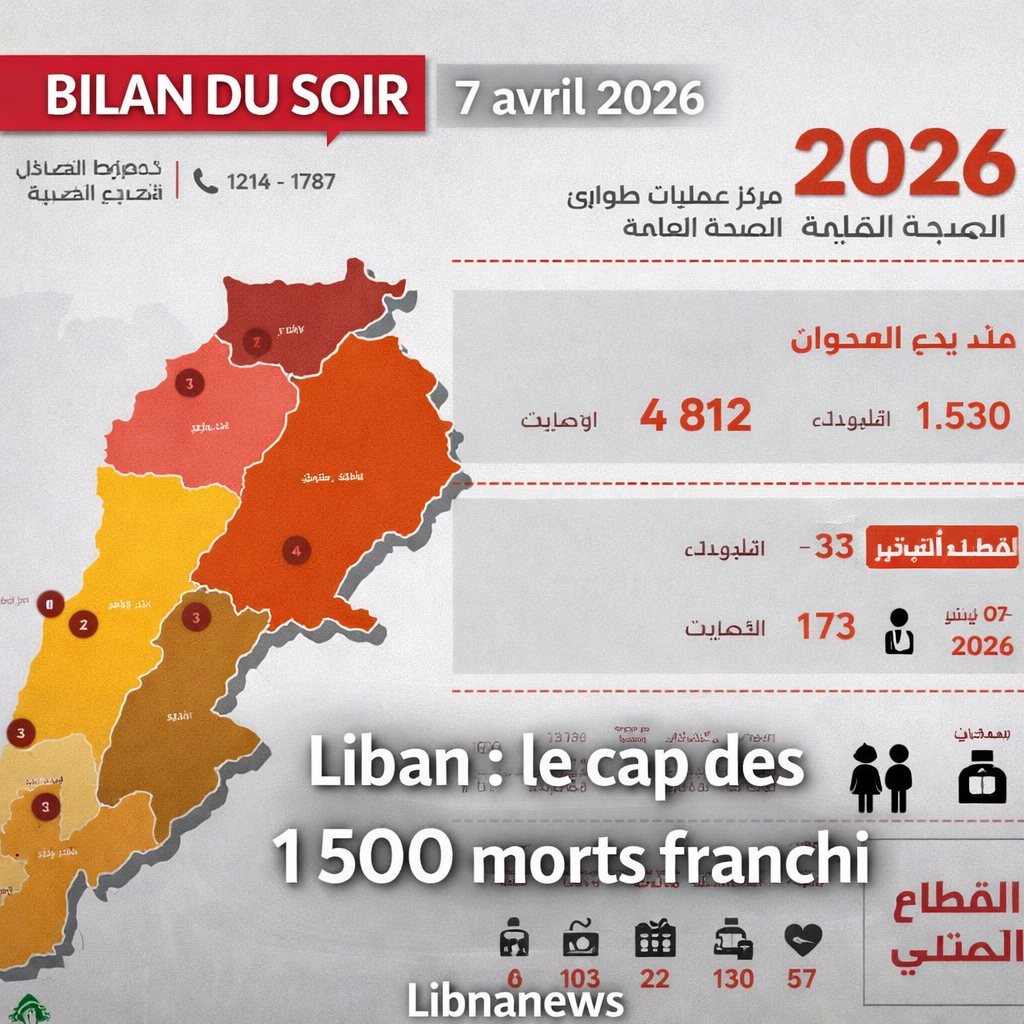
At 1800 hours, Lebanon crossed a threshold that changed the reading of the war. The infographic provided by the Health Emergency Operations Centre of the Ministry of Public Health now sets the cumulative balance sheet at1,530 deathsand4,812 injuredSince the fighting began on 2 March. For the only day of7 April, it lists33 deathsand173 injured. The figures relayed by LBCI in the afternoon are consistent with this heading and also detail the price paid by civilians and essential services, with102 women,130 childrenand57 health personnelamong the deaths recorded so far. The passage over the 1,500 dead is therefore not a mere statistical marker. He confirmed that Lebanon had entered a war of heavy wear and tear, where each day added an independent balance sheet without the loss of the previous day having ceased to produce its effects.
This crossing is all the more significant as it takes place very quickly. Libnanews again recalled in its press review published on 7 April that the country remained under « maximum pressure », between increased strikes, battle for vital access and heavy loss of life. A few hours later, the health infographic and the assessment taken by LBCI show that this pressure has changed further. Lebanon is no longer in an intermittent tension sequence. It is in a phase in which war produces simultaneous death, injury, isolation of villages, ground thrusts and internal political tension.
The balance sheet of the last 24 hours further increases the Lebanese front
The number of the day,33 dead and 173 injured, already gives the magnitude of the last 24 hours. But it must be placed in its geographical context. According to the NNA, the night and morning were marked by intensified Israeli strikes in the South and in the Bekaa, with at leastEight deadrecorded in night attacks:three in Maaraké,one to Zebdine,one in Deir al-Zahraniandthree in Tyredba. These localities do not all belong to the same immediate tactical axis, which shows that the day was not summed up in a single area. On the contrary, the danger was divided between the southern coast, the interior of Nabatiyah and several deep southern pockets.
The dynamics of the day confirm this dispersion. The strikes did not only target border areas in the strict sense. They have extended a modus operandi where the South and its support lines remain exposed continuously. This means that the daily record of 33 deaths should not be read as the result of a single major raid, but as the result of a series of attacks on several parts of the country, combined with ground fighting and artillery fire. It is this fragmentation of the front that makes the human balance more difficult to absorb and politically heavier.
Bint Jbeil and his axis remain the military heart of the day
At 6 p.m., the most sensitive area remained that ofBint Jbeiland approaches. LBCI reported in the afternoon violent clashes between Hezbollah and the Israeli army in the axisAinata–Maroun al-Ras–Bint Jbeil, while Israel was trying to push towards the city fromAinata,KunineandAl-Tiri, towards theSaf al-Hawawhich dominates Bint Jbeil. According to the chain, Hizbullah responded with suicide drones and rockets, while the Israeli army shelled the area with 155 mm artillery and conducted new air strikes on the heights and accesses of the city.
This front around Bint Jbeil is not an episode among others. It concentrates a decisive part of the day because it says where the deep battle of South Lebanon is played. We are no longer only in harassment strikes or in a one-time exchange at the border. We are in an attempt to control accesses, hills and second-line villages around a city that is both symbolic and strategic. The battle for Bint Jbeil thus remains the best indicator of the Israeli military logic of the moment: to move forward in dominant points, to consolidate corridors, and then to try to impose a territorial reality deeper than the mere border border.
Bombardments continued until the end of the afternoon
The last hours of the day have not marked a clear break. On the MTV home page at 6 p.m., several updates showed, on the contrary, the continuation of the strikes and alerts:drone strike on Abbassiyéin the district of Tyre18:00, while the channel also relayed in its news of the day developments aroundHanineand other sectors of the South. The same page also referred to Hezbollah’s firing into Israel and the continuation of military developments in southern Lebanon, indicating that, at the time of the point, the front remained fully active.
The 18-hour picture is therefore that of an unclosed day. The human record is already known, but the pace of events shows that the strikes and exchanges did not stop with the fall of the afternoon. It is an important element to read correctly the 33 deaths of the day: this balance is already heavy, and it intervenes even though the front was still in motion at the time of the point.
Hezbollah maintains its response capacity
On the Hezbollah side,Al ManarAt the end of the afternoon, several military communiqués showed a clear desire to increase pressure on the Israeli rear while the Israeli army was growing in southern Lebanon. To5.41 p.m., the chain reported rocket fire at Israeli army infrastructure atSafedand in the colony ofRosh Pina. To5.48 p.m.it announced a new salve against military infrastructure at theAcre. Then to6.14 p.m.It reported an attack by drones on a swarm of Israeli soldiers atMetulaand in the barracks ofYiftah.
These announcements alone are not independent verification of each military result claimed. But they allow us to grasp the general logic of the day. The more the Israeli army accentuates its thrusts around Bint Jbeil and in several villages in the South, the more Hezbollah seeks to show that it retains its ability to strike beyond the immediate contact line. At 6 p.m., this dimension of response therefore remains fully embedded in the military landscape of the day.
Lebanese power tries to contain the internal fracture
On the domestic political front, the Lebanese Presidency focused its communication on internal stability. According to LBCI,Joseph AounTuesday stated that the current security conditions remained « under control ». He stressed the need for coordination between citizens, army, security services and municipalities, and explained that the army was redeploying to Beirut and other regions to maintain order and reassure the population. He also warned that no citizen remaining in his village or locality should be charged with treason, collaboration or disloyalty.
This intervention is not incidental. It responds to a climate of internal tension fuelled by strikes outside the border South alone, rumours around the affected civilian areas and the growing fear that the war will also produce a divide between Lebanese. The President is obviously seeking to prevent military enlargement from leading to a crisis of widespread suspicion between internally displaced persons, residents, villages in the South and hinterland. In other words, the State is still trying to maintain a second front: that of national cohesion.
The Vatican, Christian villages and the failure of aid
The last 24 hours have also confirmed the deterioration of humanitarian access in Christian villages in the South. Libnanews again this morning summarized this battle as the « vital access » of Lebanon, from the southern front to the connecting roads. This diagnosis has been tested very concretely with the persistent difficulties in refuelling certain border localities such asDebl,Ain EbelandRmeich, already weakened by fighting, shortages and the refusal of part of their inhabitants to abandon the village. The headquarters logic is therefore not only military. It also becomes logistical and humanitarian.
This dimension counts a lot to understand the 18-hour point. The record of 1,530 deaths alone does not summarize the Lebanese situation. The last 24 hours also show a country where roads, villages and supply lines themselves become war issues. In this reading, the South does not only suffer from strikes: it also suffers from a gradual shrinking of its vital margins.






