

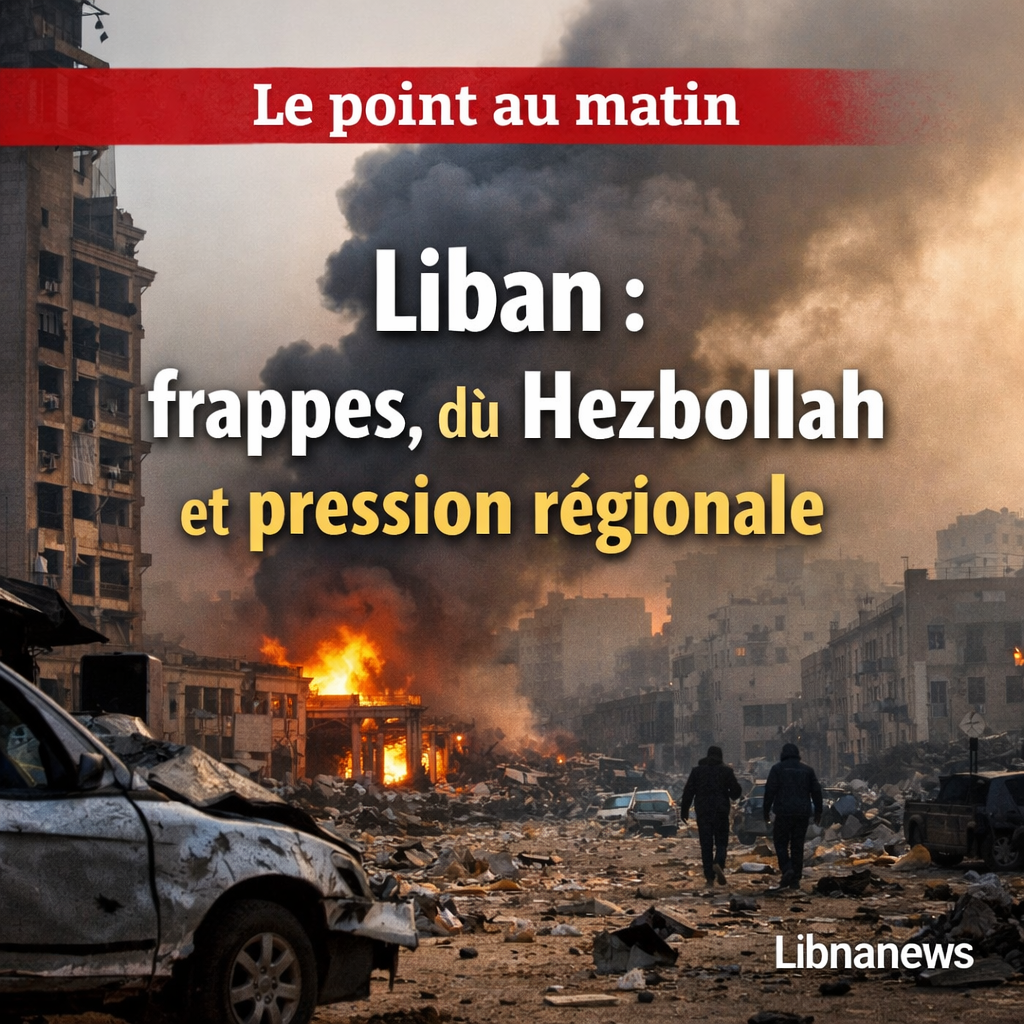
On the morning of Friday 27 March 2026, Lebanon wakes up under a double war reality. On the one hand, Israeli strikes once again hit the southern suburbs of Beirut and several sectors of the South, confirming the intensity of a military campaign that has already killed more than 1,000 people in Lebanon and displaced more than one million people since 2 March. On the other hand, Hezbollah maintained, and even intensified, according to several Lebanese media, its rocket fire, drone attacks and operations against positions and localities in northern Israel. This dimension has often been relegated behind the scale of the Lebanese civilian tragedy, but it weighs directly on the military and political reading of the current sequence.
Before dawn, a strike involving three missiles targeted a building in the southern suburb of Beirut, according to Reuters, without immediate definitive results in the early hours. At the same time, shelling and artillery fire were reported in the south, including around Qana, Seddiqine, Haddatha and Kfar Rummane, according to information relayed by MTV from the NNA. The Israeli scoping remains unchanged: hitting Hezbollah’s capabilities, pushing its units away from the border and preparing a buffer zone to the Litani. But on the ground, this logic translates into continued military pressure on civilian settlements, roads and emergency structures.
Lebanon’s latest civilian record continues to grow
The human record in Lebanon remains, by far, the heaviest of this war. Reuters reported on 20 March that at least 1,000 people had already been killed and about 1 million had been displaced. Since then, other publications by Reuters, PA and live monitoring media have reported an even higher record, exceeding 1,100 deaths and 3,000 injuries as the strikes increase. This rapid progression confirms that the conflict has changed in nature: it is no longer just a border trade, but a war with a high civilian density, with cumulative effects on housing, relief, infrastructure and internal displacement.
Beyond the national total, the composition of the balance sheet also informs the evolution of the campaign. Reuters documented the death of at least 42 first aid workers since 2 March, as well as the damage or decommissioning of several hospitals and medical facilities. AP also noted that Hizbullah-affiliated health centres, but receiving civilians, had been struck, while rights organizations challenged several Israeli justifications. In concrete terms, this means that mortality no longer depends solely on the violence of strikes, but also on the real ability to evacuate, treat and respond in time. In a city like Nabatiyah, largely emptied of its population, this deterioration of relief becomes a central factor in the human balance.
Details of the bombings in the night and in the early morning
The military sequence of the last few hours shows a series of air strikes, artillery fire and ground operations. In Beirut, the dawn strike on the southern suburbs revived the fear of a steady return of raids on the capital or its immediate periphery. In the south, MTV reported NNA reports of shooting at the outskirts of Qana and Seddiqine, as well as a raid on Haddatha. The same chain reported that the raid on Kfar Rummane resulted in two deaths and eight injuries according to the Ministry of Health. This mapping is not accidental. It affects both residential areas, axes of movement and spaces associated with the logistical depth of Hezbollah.
Israel now has a broader strategy than just a one-off response. Reuters reported on 26 March that the Israeli army was moving towards the establishment of a « buffer zone » to the Litani, with the destruction of bridges, the fortification of positions and the accelerated demolition of homes in the border area. AP stressed that this orientation revived Lebanon’s fear of prolonged occupation of the South on the model of previous episodes. In practice, this strategy transforms war into a territorial remodelling campaign: less mobility for civilians, more difficulties for return, and increasing pressure on Beirut to assume political and military control of the South alone.
Hezbollah’s retaliation for Israel has been intense
This aspect cannot be left behind. Yes, Hezbollah’s reprisals against Israel have been sustained and, according to several indicators, intense. Reuters recalls that the current escalation began after Hezbollah attacks on Israel on 2 March, and that the movement continued to launch rockets from the north and south of Litani during the Israeli offensive. In its analysis of 26 March on the future buffer zone, the agency explicitly describes deadly and repeated exchanges, in which Hezbollah retains sufficient fire capacity to target northern Israeli localities and complicate Israeli progress.
The Lebanese media close to the ground report an even sharper rise. In the early hours of 27 March, the NNA relayed an intensification of Hezbollah’s operations, with artillery fire on Israeli troops and vehicles in Khiam, as well as a drone fire to the Shtula settlement. Al Manar, for his part, has published several military communiqués referring to rocket flares against artillery positions, bases and localities in northern Israel, as well as drone swarms targeting Metula and other targets. These elements give a clear picture of the current operation: combining rockets, drones and anti-tank missiles to saturate the Israeli north front, curb ground manoeuvres and show that no Israeli advance is being made without cost. On the other hand, the precise details of each claimed target cannot always be independently verified at the time these operations are announced.
The impact on Israel is not theoretical. TheWall Street Journalreported that a man about 30 years old had been killed in Nahariya on Thursday, 26 March, by a missile fire, with several wounded, including at least one seriously hit according to Magen David Adom. Reuters had already reported at the beginning of the month that a missile fired from Lebanon had hit a house in northern Israel, wounding a person. Other attacks also affected or threatened Misgav Am, Metula and other locations near the border. In other words, the north of Israel remains under real pressure, with damage, injury, death and a civilian life always disturbed by warnings and fire.
An asymmetrical but not one-way war
However, the hierarchy of facts must be maintained. The intensity of Hezbollah’s reprisals does not erase the asymmetry of the conflict. The human, material and territorial costs are incomparably higher in Lebanon, where Israeli strikes have affected Beirut, the South, relief workers, medical infrastructure and roads. But it would be equally incorrect to present this phase as a one-way war. Hezbollah continues to demonstrate significant harm to Israel, whether it is rockets, drones or anti-tank attacks. It is precisely this persistence that feeds the Israeli discourse on the need for a depth of security beyond the border.
This dynamic also illuminates the battle of the narrative. On the Israeli side, Hezbollah’s attacks on northern cities and positions are being put forward to justify ground progress and the creation of a buffer zone. On the Hezbollah side, every shooting on a base, every drone salve and every Israeli loss must show that the Israeli army can neither quickly secure the front nor move forward without increasing costs. It is in this context that we must read the press releases about Metula, Shtula, Shamir or the rallies of soldiers near the border: they are not only used to announce an action, but to establish politically the idea of a continued resilience.
Israeli casualties: several soldiers were also killed
This intensity of retaliation is also reflected in Israeli military casualties. Reuters reported the death of two Israeli soldiers during fighting in southern Lebanon on 26 March. Earlier, the Agency had already reported the death of two other Israeli soldiers at the beginning of the current phase of the conflict. This results in at least several deaths in Israeli ranks as a result of fighting in Lebanon. Other announcements are circulating in Israeli or partisan media, but not all have the same level of independent confirmation at the same time. Caution is therefore required on the exact total, without calling into question the reality of the losses.
Politically, these deaths matter a lot. As Israeli casualties increase, the more difficult it becomes for the government to present the ground operation as a mere security mission. They also feed Hezbollah’s argument that a sustainable occupation of the South would have a high military price. For Israel, on the other hand, these losses serve to demonstrate that the pre-war status quo is no longer tenable and that a security distance must be imposed. The Israeli northern front and the southern Lebanon thus respond in mirror: one serves as justification to the other, and every salve, every raid, every killed soldier reinforces the logic of escalation.
Lebanese Policy: A State Under Pressure, Hezbollah in Challenge
In Beirut, the political scene remains dominated by the same contradiction. The government seeks to reaffirm state authority over Hezbollah, while facing an Israeli campaign that destroys part of the territory and increases the anger of an exhausted population.The Worldreported on 25 March that Hezbollah openly challenged the tightening of the Lebanese state, after the expulsion of the Iranian ambassador and the demonstrated willingness to frame the military activity of the movement more firmly. This internal tension does not suspend the war; She’s complicating her. For the State must both manage the displaced, maintain institutional cohesion and respond to a military reality over which it has only limited control.
The current war thus has a threefold political effect. It materially weakens Lebanon through destruction and displacement. It puts pressure on Hezbollah as a central armed actor in the conflict. And it pushes the Lebanese power to position itself more clearly than before on the issue of the monopoly of force. However, this clarification comes at the worst possible moment, as society collects the strikes, public services are weakened and the South is likely to be permanently reshaped by the Israeli offensive. In this context, the issue of sovereignty is not dealt with in the abstract: it is dealt with under bombs.
Trump extends the deadline and hardens the tone on Iran
At the regional level, the day of 27 March 2026 remains marked by Donald Trump’s decision to extend the deadline by ten days before possible strikes on Iranian energy infrastructure, thus delaying the deadline to 6 April 2026. Reuters reported that the U.S. President claimed that the discussions were « very good, » while repeating that the U.S. could resume or intensify the strikes if no agreement emerged. Iran, for its part, contested the idea of an advanced negotiation. This combination of tactical suspension and offensive language is highly uncertain throughout the region.
For Lebanon, this extension of the US calendar is not an external detail. As long as Washington, Tehran and Israel remain engaged in an open confrontation, the Lebanese front retains a strategic function. Hezbollah acts as a regional channel of pressure against Israel. Israel seeks to degrade the military tool closest to its northern border. And Beirut is trying to survive politically a war whose logic is far beyond the national framework. The postponement announced by Trump may slow down an escalation on some Iranian infrastructures, but it does not automatically reduce violence in peripheral theatres. On the contrary, it can encourage each side to improve its position before any more formal negotiations can take place.






