

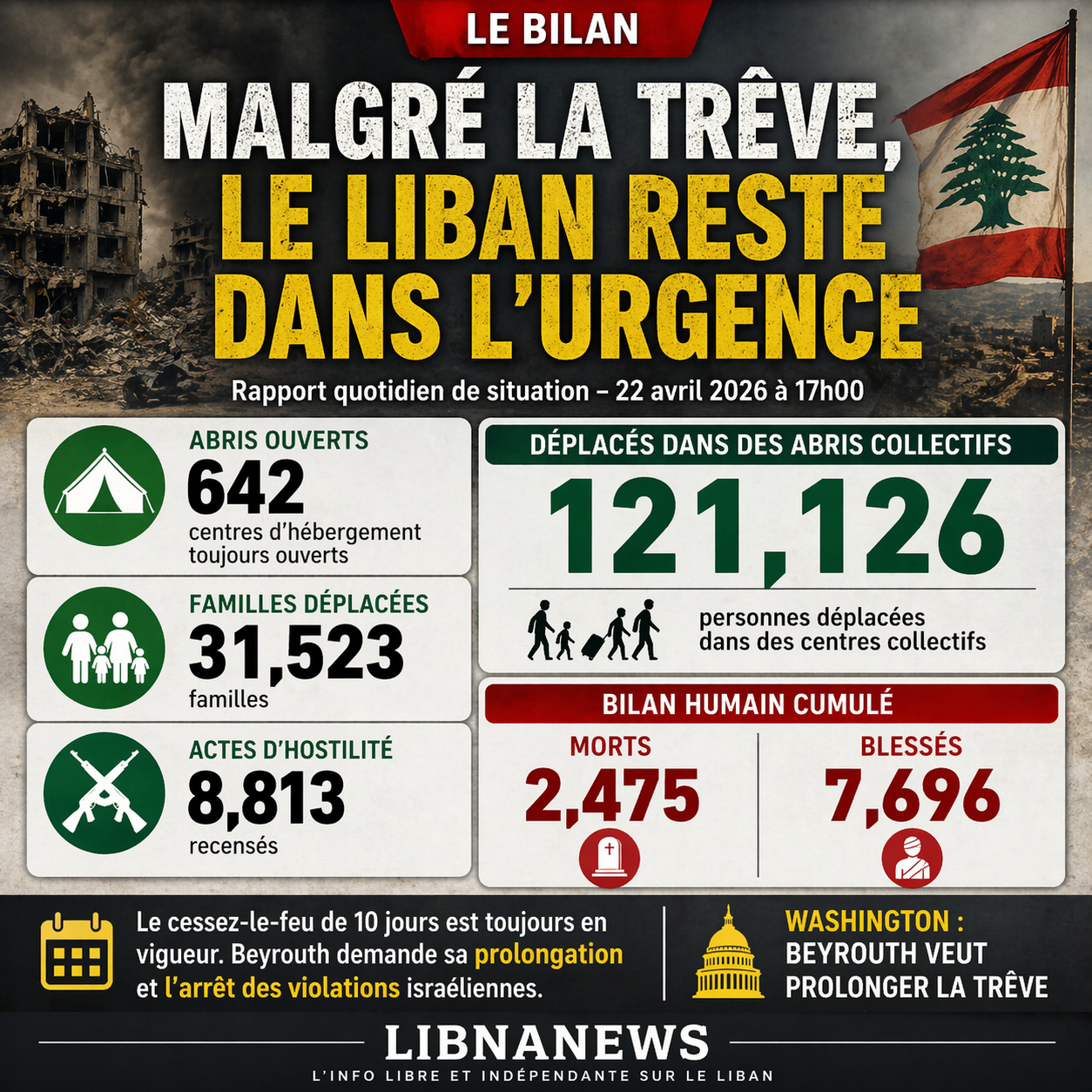
The new daily situation report issued by the Disaster Risk Management Unit in Lebanon on Wednesday, 22 April, at 5 p.m., shows an ongoing massive crisis, despite the current ceasefire. The document states that642 accommodation centres still open, of121 126 internally displaced persons accommodated in collective centres, of31,523 displaced families, of8,813 hostile acts identifiedand a cumulative human2,475 deathsand7,696 injured.
These figures give a clear picture of the Lebanese situation as the country seeks an extension of the truce negotiated under American mediation. Officially, the 10-day ceasefire is still in effect. In fact, Beirut continues to denounce Israeli strikes, demolitions and restrictions in the south of the country, while the expiry date of the truce is approaching, according to authorities and agency dispatches, scheduled for Sunday.
The daily report published on Wednesday does not describe a country emerging from the war. He describes a country suspended from a precarious lull, with a very large number of internally displaced persons still unable to return to their homes for a long time, a human balance that continues to weigh on the entire territory and a public apparatus still mobilized around the emergency. Beyond the diplomatic vocabulary on the truce, indicators remain those of a war crisis.
A still very high level of displacement
The first lesson of the report is the continuing extent of displacement. In total,121 126 personsare still registered in collective centres, i.e. more than one hundred and twenty thousand displaced persons still dependent on organised emergency accommodation. The31,523 familiesshows that displacement does not only involve isolated cases, but affects entire family units, often over several generations.
The number of642 open accommodation centresit also confirms the magnitude of the shock. Although the truce has allowed partial returns or resettlement movements in some areas, the network of collective shelters remains massively sought out. This means that, for a large part of the population, the conditions for a sustainable return are still not met.
This high number of internally displaced persons is in line with the findings of recent days by humanitarian agencies. The United Nations reported this week that, despite the ceasefire, more than one hundred and seventeen thousand people remained in collective accommodation and that humanitarian needs remained considerable, particularly in areas of partial return and in areas where infrastructure had been damaged.
In fact, the return depends on several variables. First, communities must be physically accessible. Secondly, roads, bridges, essential networks and minimum security conditions must allow families to return. However, southern Lebanon remains partially subject to restrictions, destruction and an Israeli military presence in a border band that the Hebrew State presents as a safe area. Reuters further reported on 20 April that Israel was consolidating a band of 5 to 10 kilometres within Lebanese territory and was asking the inhabitants to stay away from several sectors.
In these circumstances, the figures in the daily report should not be read as a mere statistical statement. They reflect a concrete reality: tens of thousands of families cannot yet consider that the ceasefire has reopened a normal horizon of return. As long as this situation persists, the burden on municipalities, requisitioned schools, reception facilities and support networks remains very heavy.
A human balance that continues to weigh
The second major element of the report concerns loss of life. The document states that2,475 deathsand7,696 injuredtotal. These figures are part of a sequence begun with the resumption of the war on 2 March 2026, after the regional enlargement of the conflict. The reports published in recent days by Lebanese news agencies and officials also describe a war that has caused more than 2,400 deaths in Lebanon since that date.
The fact that the daily report continues to add up the dead and wounded despite the entry into force of the ceasefire speaks a lot about the nature of the current phase. The truce reduced the overall intensity of the most massive bombings, but it did not close the loss cycle. Israeli strikes continue on an ad hoc basis. The destruction continues in some southern villages. Armed incidents have continued in recent days, including Hezbollah’s reprisals towards northern Israel following attacks denounced by Beirut as ceasefire violations.
The report8,813 hostile actsshows that the war cannot be reduced to the only period before the truce. The figure gives a cumulative measure of violence recorded over the period covered by the national monitoring tool. Although the document does not detail the precise distribution of these acts in this infographic, it highlights the overall intensity of the conflict and the depth of the footprint left on the country.
For the Lebanese authorities, this human balance sheet directly feeds the diplomatic argument put forward in parallel. Beirut asserts that a ceasefire cannot be considered credible if the strikes continue, Israeli demolitions continue in the South and civilians remain prevented from returning safely. It is this line that President Joseph Aoun and the government defended before the new meeting in Washington.
A cease-fire still in force, but already contested
The 10-day truce between Lebanon and Israel was announced on 16 April under American mediation, for a subsequent entry into force. From the early hours, it was presented as a temporary framework to stop the most intense fighting and pave the way for wider discussions. Reuters reminded again on 22 April that this cease-fire must expire on Sunday if no extension is decided.
But, on the Lebanese side, the leaders continued to say that the truce remained incomplete. President Joseph Aoun said that Lebanon’s Ambassador to Washington should ask for an extension of the agreement and demand the cessation of Israeli demolition operations in southern villages and localities. This position was echoed in the agency dispatches and in the Presidency statements.
The Lebanese government defends a similar line. Prime Minister Nawaf Salam, received in Paris by Emmanuel Macron, explained that Lebanon was counting on the diplomatic path to consolidate the truce and protect the country’s sovereignty. He called for support from international partners in this sensitive phase.
The Lebanese speech is therefore based on two points. The first is procedural: the truce must not expire in the present state of the ground. The second is material: Israel must respect what it has accepted and cease the bombings, demolitions and restrictions which, according to Beirut, already empty the ceasefire of part of its content. These requests will be at the heart of Washington’s new meeting between Lebanese and Israeli representatives.
Beirut requests an extension before any other stage
The Lebanese application is not presented as a mere diplomatic formality. Beirut is seeking an extension of the truce from the outset. Several converging dispatches indicate that Lebanon wants an extension of approximately one month, as well as an end to Israeli bombardments and destruction in the areas still occupied or under military pressure.
This demand is explained by the very concrete situation shown by the figures in the daily report. With more than one hundred and twenty thousand people still in collective centres and more than thirty-one thousand displaced families, the country cannot absorb an immediate return to a logic of total war. The Lebanese authorities are therefore seeking to secure additional time to organize returns, ease the pressure on shelters, repair access routes and continue political discussions.
It is also explained by the fact that the ceasefire is coming to an end without having produced the effects that a lasting cessation of hostilities is supposed to guarantee. In several southern localities, demolitions continued to be reported. Israel maintained its forces in a border strip and forced the inhabitants not to return to certain areas. From the Lebanese point of view, this means that the truce did not bring about full civilian security.
President Joseph Aoun explained that the Lebanese delegation had to arrive in Washington with a clear mandate: to extend the ceasefire, to stop Israeli demolitions and to defend Lebanon’s sovereignty without giving way to the country’s territory or rights. This line is consistent with its previous statements that no future agreement should lead to territorial abandonment.
Figures that contradict the idea of a simple return to calm
Wednesday’s report also has political value. It shows that, despite the expression « ceasefire », Lebanon has not entered an ordinary post-war phase. The642 accommodation centresstill open indicate an emergency mobilisation still very wide. The121 126 internally displaced personsin collective shelters, the return is not acquired. The2,475 deathsand7,696 injuredmaintain the country in a war balance logic. And the8,813 hostile actsstress the extent of the military sequence crossed.
These figures are in line with other humanitarian reports released in April. During the period from 2 to 16 April, UNFPA reported more than 2,124 deaths and 6,921 injuries, highlighting the deterioration of access and isolation of vulnerable populations due to the destruction of infrastructure. The figures published on 22 April show that the balance sheet has improved further since then.
The importance of displacement is also confirmed by previous records of the humanitarian system. In early April, WHO reported that nearly 139,000 internally displaced persons were living in 678 collective centres. The new national report shows a decline in the number of people in collective shelters, but at a level that remains very high. This partial decline may reflect some returns, some displacements to other forms of accommodation or readjustments of devices, without this being a crisis exit.
In other words, Lebanon does not present, on Wednesday night, the face of a country that has returned to normal. It presents a country that remains in war management, under precarious diplomatic cover.
The South remains at the centre of the crisis
The territorial dimension is central to this assessment. South Lebanon continues to concentrate a major part of the destruction, restrictions and tensions. This is where the return of the inhabitants, the rehabilitation of roads and bridges, the resumption of civilian activity and the very credibility of the ceasefire are concerned. It is also in this region that Israel has strengthened its presence and materialized a de facto security band.
For Lebanon, this trend makes the request for an extension even more urgent. Beirut fears that an end to the truce without prior clarification will lead to a new phase of escalation even though the terrain has not been stabilized. Lebanese officials therefore want to use the Washington meeting to turn a temporary lull into a framework at least a little more sustainable.
The difficulty for Beirut is that the country is negotiating in a very unfavourable balance of power. The front is still active. The state must manage a huge internal displacement. Infrastructure remains fragile. And the internal debate on Hezbollah, on discussions with Israel and on the state’s place in southern security remains very sensitive. It is in this context that the daily report also takes on a political function: it recalls, with supporting figures, that Lebanon has been speaking since a very real emergency situation.
A Humanitarian Pressure That Remains Whole
Finally, the report’s data show that the issue is not limited to safety. With more than one hundred and twenty thousand displaced in collective shelters, the pressure on local authorities, reception facilities and support networks remains very strong. Municipalities, requisitioned schools, public centres and associations continue to absorb a high volume of needs.
This humanitarian burden joins the calls already made by the Lebanese Government to its partners. Nawaf Salam called from Paris for increased international support to deal with the consequences of war and prevent the humanitarian crisis from turning into a new phase of collapse. His call for EUR 500 million over six months was precisely based on this logic: to stand in the emergency before even being able to talk about large-scale reconstruction.
The Wednesday daily report therefore provides an additional argument for this request. It shows that the emergency apparatus remains heavily mobilized and that the country has not yet switched to a normalisation phase. As long as the movement remains massive, the injured continue to flow to the cumulative balance and the South remains partially inaccessible, stabilization will remain incomplete.
A Review of the Washington Meeting
On the eve of the new meeting in Washington, this numerical record also serves as a diplomatic backdrop. Lebanese officials want to defend a simple position: the truce must be prolonged and Israel must respect it fully. This double message is now constant. It was carried by Joseph Aoun, relayed by the delegation to Washington and supported by the government.
The daily report does not use diplomatic language. He is not talking about extension, negotiation or a ceasefire line. But he gives the figures that justify this request. A country with642 shelters still open,121 126 internally displaced persons in collective centres,2,475 deathsand7,696 injuredcannot consider that ten days of truce are enough to close the crisis.
In Lebanon, the battle for the next few days will therefore take place on two closely related levels. On the one hand, the reality of the terrain, always marked by losses, displacements and restrictions. On the other hand, Beirut’s diplomatic attempt to prevent the announced expiry of the ceasefire on Sunday from reopening a wider cycle of strikes and destruction, even though the last official assessment of the day shows that the war, despite the truce, continues to structure the country.






