

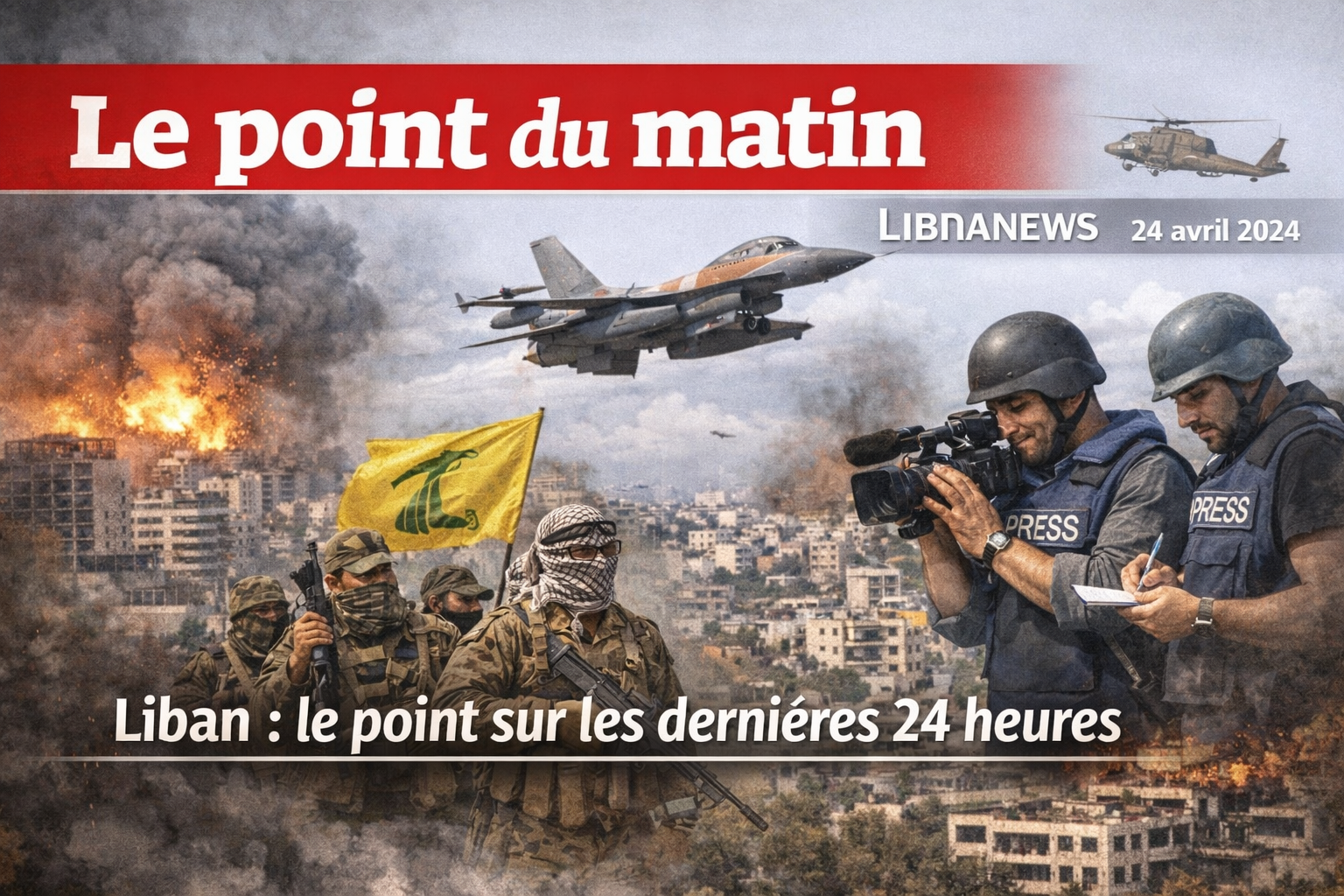
Lebanon has experienced another day of intense tension, between Israeli overflights over Beirut, intensive bombings in the South and the Bekaa, deadly strikes against journalists and rescue workers, and political turmoil in Beirut over the role of Hezbollah and Iran. According to the Lebanese Ministry of Health reported by the Associated Press, 47 people were killed and 112 injured in 24 hours, bringing the number of deaths recorded in Lebanon since 2 March to 1,189. At the same time, the Israeli army reported having hit more than 100 targets in Lebanon since Friday, while Hezbollah claimed to have launched approximately 250 projectiles in 24 hours towards Israeli positions and Galilee.
In Beirut, the evening was again marked by psychological pressure from heaven. The NNA, the Lebanese official agency, had already reported this week that Israeli aircraft had crossed the sound barrier over several Lebanese regions. This sequence is part of a campaign of overflights and strikes that also affects the capital and its southern suburbs. Reuters also reported a strike on the southern suburbs of Beirut on Friday, as part of the current escalation. At the military level, Al-Manar, the Hezbollah-affiliated chain, claimed that the movement had engaged an Israeli combat aircraft over Beirut with a ground-to-air missile, a sign that the capital was once again becoming a direct force demonstration space.
Human balance is still growing
The figure that dominates this situation remains that of the human balance. According to the Lebanese Ministry of Health cited by AP, 47 people were killed in 24 hours and 112 were injured. This results in a total of 1,189 deaths in Lebanon since 2 March. In the same sequence, Minister of Health Rakan Nassereddine reported that nine first aid workers had been killed on Saturday, bringing the total number of health personnel killed since the beginning of this war to 51. The World Health Organization confirmed that these deaths involved five separate attacks against health structures and teams in southern Lebanon, and reported that four hospitals and 51 primary health centres had closed, while others were operating in slow motion.
You also mentioned an Israeli death toll of about five. At the time of writing, the strongest sources consulted do not allow for a clear confirmation of this total over the last 24 hours. AP reported nine Israeli soldiers injured in two attacks in southern Lebanon, while theWall Street Journalmentions the death of an additional Israeli soldier on Saturday, presented as the third Israeli soldier killed in the ongoing land offensive. Reuters had also reported a few days earlier the death of an Israeli civilian near Misgav Am, eventually attributed to an Israeli friendly fire, as well as two soldiers killed in the Lebanon campaign. In other words, the number of Israeli deaths has increased well in recent days, but I have not found sufficient robust confirmation of a consolidated total of five deaths for the only sequence of the last 24 hours.
Lebanese journalists targeted in full report
One of the most serious events of the day was the attack on a press vehicle in the district of Jezzine. Three Lebanese journalists were killed there: Ali Shoeib, a correspondent for Al-Manar, and Fatima Ftouni and her brother Mohammed Ftouni, a videographer working with Al-Mayadeen. Reuters, AP and other agencies agree on this point. Israel acknowledged that it had targeted Ali Shoeib, accusing him of belonging to a Hezbollah intelligence unit, without providing at this stage public evidence to support this claim. On the contrary, the Lebanese authorities have denounced an attack on journalists protected by international humanitarian law.
This strike also has a very strong symbolic scope. Ali Shoeib was one of the most well-known figures on the war cover for Al-Manar, a channel openly affiliated with Hezbollah. Fatima Ftouni worked for Al-Mayadeen, a pan-Arab medium perceived as close to the pro-Iranian axis. The fact that these journalists were killed in the South, far from a mere instant border clash, feeds the conviction in Beirut that the press teams are now also fully exposed. AP points out that these deaths bring to five the number of journalists and media workers killed in Lebanon since the beginning of the year. A few days earlier, Mohammed Sherri, responsible for Al-Manar’s political programmes, had already been killed with his wife in a strike on Beirut. Reuters also cites the case of independent journalist Hussein Hamoud, a collaborator of Al-Manar, who died on Wednesday in another Israeli strike.
In Beirut, the political reaction was immediate. According to AP, President Joseph Aoun denounced a » flagrant crime » against journalists. The NNA subsequently reported the convictions of Information Minister Paul Morcos, Prime Minister Nawaf Salam and Speaker of Parliament Nabih Berri, all referring to a serious violation of international law and, for some, a war crime. This institutional consensus is important: it shows that, despite the deep divisions around Hezbollah, a large part of the Lebanese State seeks to diplomatically isolate the issue of the protection of civilians, first aid workers and journalists.
The military point: where the strikes hit
On the ground, the mapping of the bombings further expanded. The NNA reported on Saturday strikes on Ma`raka and Aichiyé, which killed at least three and injured several people, as well as artillery fire on Hebbariyah and Fardis, near residential areas. This Lebanese official report already draws an axis from the area of Tyre to the area of Hasbaya and Arqoub, confirming simultaneous pressure on several segments of the South.
The survey published by Al-Manar, which should be read as that of a committed and affiliated Hezbollah media, gives an even wider overview of the affected communities over the course of the day. The chain cites, inter alia, destruction in Doueir, Harouf and Deir al-Zahrani, shelling in Adlun, Kfarsir, Arab Salim, Toul, Qalawiya, Frun, Beit Yahun and Konine, as well as shelling on Yahmar al-Shaqif, Arnoun and Harj Ali al-Taher. It also refers to the use of phosphorus on al-Bayada. Taken together, these names show that the strikes no longer focus solely on the extreme border edge, but extend to the depth of the South, roads, residential areas and local traffic nodes.
At the same time, Reuters reported that Israel claimed to have hit more than 100 targets in Lebanon since Friday. This intensification also affects official personnel: the agency reported the death of two Lebanese army soldiers in the South. This point counts politically as well as militarily. When military members of the regular army fall, the conflict goes even further beyond the logic of confrontation between Israel and Hezbollah and weighs directly on the sovereignty of the Lebanese state.
Hezbollah’s ground fighting and demands
The land front is still active, especially in the areas of al-Bayada, Chamaa, Taybe, Qantara, Deir Seryan, Debel and Beit Lif, according to military communiqués relayed by Al-Manar. The media describes very short-range fighting, guided missile strikes against Merkava tanks, ambushed Israeli columns and waves of rocket or drone fire at Israeli military sites and groups. He also cites strikes against Kiryat Shmona, Nahariya, Metula, Margaliot, Shlomi, Even Menachem, Ramot Naftali, Beit Hillel, Dan, Krayot, Stella Maris, Meron and Gadot.
The nature of this source, however, needs to be clarified. Al-Manar is the Hezbollah chain and its communiqués directly echo the statements of « Islamic resistance ». They therefore provide useful information on the narrative of the movement, the areas in which it claims to fight and the targets it claims, but they are not the only independent confirmation of each tactical success announced. This scoping remains essential for a situational article, as it helps to understand how Hezbollah wants to show that it retains its leadership, despite the density of Israeli strikes and the heavy losses in Lebanon.
On the Israeli side, AP reports that some 250 projectiles were fired from Lebanon in 24 hours. Few would have crossed the defences in significant numbers, but the pace was sufficient to maintain constant pressure on northern Israel and the army’s deployment areas. This also sheds light on the tightening of the Israeli offensive in Lebanon: Israel’s goal is no longer merely to reduce cross-border fire, but to fundamentally degrade Hezbollah’s military and territorial infrastructure.
Beirut under pressure, between hits and sound wall
The passage of Israeli aircraft over Beirut and the crossing of the sound barrier have a limited military effect in themselves, but a massive psychological impact. In a city already marked by strikes on the southern suburbs, these overflights at any time remind that the capital remains within immediate reach. This week, the NNA described a two wave sonic fort over Beirut and its suburbs. Other media then reported the persistence of low-altitude flights and, on Friday, another strike on the southern suburbs. The logic seems clear: to maintain pressure on the political, urban and symbolic background of Hezbollah, while testing the response thresholds.
The fact that al-Manar claimed that an Israeli aircraft had been engaged over Beirut by a ground-to-air missile adds a new dimension. Even if this claim is not independently confirmed, it shows that the battle of communication around the Beirut sky becomes an issue in itself. Israel wants to show that it maintains complete air control. Hezbollah wants to prove that it can at least challenge, if not break, this superiority. For the inhabitants, the result is above all a feeling of total war that is no longer limited to the villages of the southern front.
Political developments: the Lebanese state tries to regain control
The military sequence is doubled by a major political turning point in Beirut. According to AP, the government of Nawaf Salam declared Hezbollah’s military activities illegal after the movement entered into war earlier this month, and reaffirmed that only the state had to decide on issues of war and peace. In the same vein, Beirut ended the visa waiver for Iranians, banned the activities of Iranian Revolutionary Guards on Lebanese soil, and then decided to expel the Iranian ambassador, who had been ordered to leave the country by 29 March.
These decisions are a major breach. They do not mean that Hezbollah has lost its military or political weight, far from it. But they reveal that part of the Lebanese executive is trying to draw a reaffirmation of state sovereignty from the present war. Nawaf Salam accused the Revolutionary Guards of leading Hezbollah operations in Lebanon. Hezbollah and its allies denounced a « witty » decision about the Iranian ambassador. The country is therefore caught up in a double confrontation: an open war with Israel in the South, and an internal battle over the real authority that decides the war in Lebanon.
In this context, the unanimous condemnation of strikes against journalists, first aid workers and Lebanese soldiers also serve as a minimal gathering point. Power tries to avoid the image of a completely absent state, knowing that it has neither control of the front nor the means to impose de-escalation alone. The risk for Beirut is to see this political posture caught up in the ground if the Israeli offensive continues towards a deeper buffer zone south of the Litani, as several Israeli officials quoted by the international press have suggested.






