

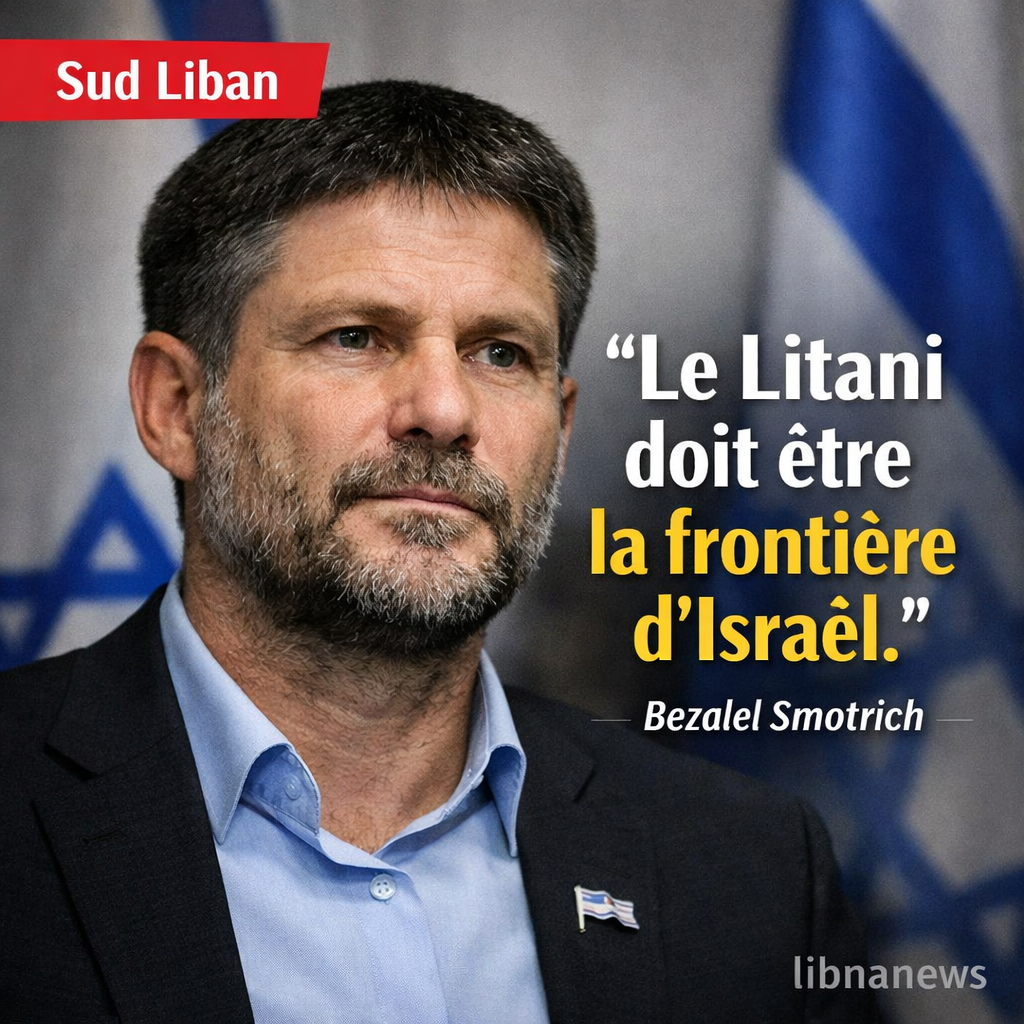
A statement that moves the front line
Bezalel Smotrich, Israeli Minister of Finance and influential figure of the ruling coalition, said on 23 March that « his vision » was to make the Litani River « the border between us and Lebanon ». In the same intervention, he linked this idea to a logic of territorial control, saying that « as we control 55 per cent of Gaza, we must do the same in Lebanon ». This position does not look like a simple stand-up formula. At the heart of the Israeli political debate, it sets out an ambition of fixed-line and lasting depth, as the army intensifyes its operations in South Lebanon and the issue of evacuations and destruction of infrastructure becomes central. In a region where geography has often served as a language for power relations, the name of the Litani is not a detail: it is a strategic marker that immediately reacts, on the Lebanese side, the memory of the occupation of southern Lebanon and, on the Israeli side, the idea of a buffer zone presented as a security condition.
In Lebanon, the Litani is not an abstract landmark. The river crosses agricultural areas, cuts down key roads and flows into the Mediterranean to the north of Tyre, near crossings that structure civil mobility as well as logistics. Since the 2006 war, it has also belonged to the diplomatic vocabulary: Security Council resolution 1701 has made southern Litani an area where only the Lebanese army and UNIFIL must carry weapons, in order to limit militarization and stabilize the border. The Litani has never been an international border. Presenting it as such amounts to shifting from an imperfect but recognized framework of de-escalation to a logic of disputed sovereignty and lasting presence, with direct involvement for the inhabitants, relief, Lebanese institutions and international partners.
The Litani, from the United Nations reference to the territorial objective
Resolution 1701 did not redraw borders, but fixed an operational benchmark. It reaffirms the territorial integrity of Lebanon, the obligation to respect the Blue Line and the role of UNIFIL alongside the Lebanese army in the south. It mentions the Litani as a reference line for the application of an area where non-State forces should not be present. In the spirit of the text, this architecture should reduce friction, limit escalation and create progressive stability. Smotrich’s words reverse this logic: he no longer speaks of a security device, but of an assumed line of separation, formulated as a desired border. This is a slide of magnitude, as a border is not a temporary measure. It requires control, rules, prohibitions, and often a capacity to prevent returns or traffic.
This change of registry illuminates the immediate crisis in Beirut. The Israeli occupation of southern Lebanon from 1982 to 2000 remains a structural episode of Lebanese political memory, as well as an operational precedent for Israel. The « safe zone » of the time had not begun with a proclaimed annexation. It was established by the presence, duration and supervision of the territory. The novelty of 2026 is due to the regional environment and the explicit reference to Gaza, which in Arab opinion refers to a war of mass destruction and a logic of prolonged control. Even when he does not formally commit the doctrine of the army, a minister who imposes this vocabulary in the public space moves the lines: he prepares the political acceptability of a lasting presence and gives a reading of the war as an opportunity to redraw the territorial depth in the north of Israel.
Operational decisions that give substance to the line
Smotrich’s words overlap with a military sequence where the Litani infrastructure takes on an unusual place. In recent days, the Israeli army has targeted bridges crossing the Litani and has hit a major bridge on the coastal axis in the Qasmiyeh area, a key crossing between Tyre and the rest of the country. At the same time, decisions issued by the Israeli authorities referred to the destruction of river crossings and the acceleration of house demolitions in border villages. Presented as a way of disrupting Hezbollah logistics, these measures have immediate effects on civilian life: a bridge cut extends ambulance routes, increases supply, weakens trade and complicates humanitarian access. In a country already weakened by a sustainable economic crisis, every damage to a transport infrastructure acts as a crisis multiplier.
This dimension is central in the event of an occupation. Controlling a territory is not just about entering it: it must be able to maintain it, organise mobility and reduce the margin of action of the opponent. A campaign aimed at crossing the Litani can thus produce a double effect. On the one hand, it can complicate some armed movements. On the other hand, it makes the return of civilians more costly and makes it more difficult for an entire region to function normally. This second effect feeds the risk of a fait accompli: a progressively isolated area, where the population settles in displacement, and where reconstruction becomes more difficult as the structural axes collapse. In this sense, a phrase on the « Litani border » ceases to be a slogan: it finds a material echo in the way the land is transformed.
Evacuation, return ban and buffer zone logic
War is also included in the orders addressed to the inhabitants. Evacuation warnings were issued for extended perimeters in the south, until civilians were asked to travel north of the Zahrani, beyond the Litani River. On the ground, the effect is immediate: much of the South is empty, civilian activity is frozen, and space becomes more « available » for military manoeuvre. In many contemporary conflicts, this combination — wide evacuation, targeted infrastructure, return to a security objective — is one of the classic springs of a buffer zone strategy. It does not need to be proclaimed to produce its effects: it settles by duration, by de facto prohibition and by the progressive destruction of the conditions of return.
It is here that Smotrich’s statement is of particular significance. To make the Litani a « border » is, in practice, to normalize the idea that the inhabitants located south of the river might not return until the security of northern Israel is considered guaranteed. However, the return of a population to an external objective changes the very nature of displacement. It is no longer just a matter of escaping an immediate danger. It is about living in an indefinite suspension, with concrete consequences: interrupted schooling, loss of income, access to more difficult care, accelerated debt. In a Lebanon with weak public safety nets, every week of additional displacement increases insecurity and transfers the burden to host municipalities, already under pressure after years of economic crisis and social tensions.
Israeli security argument and its limitations
Israel’s security discourse is based on a simple idea: protecting northern Israel requires that Hezbollah’s firing capabilities and military infrastructure be removed. Historically, the prospect of a withdrawal of Hezbollah north of the Litani River had already been raised in discussions on de-escalation mechanisms. The difference today is the shift from a political requirement to a direct control projection. An area south of the Litani could offer Israel tactical gains: controlling certain terrains, installing forward posts, making certain infiltrations more difficult, and reducing immediate border exposure. This argument weighs all the more as the current escalation has revived a sense of security urgency on the Israeli side and a desire to avoid a return to a configuration deemed untenable.
But the 1982-2000 precedent recalls that this type of presence can turn into a war of wear and tear. Maintaining a rural and hilly territory requires staff, logistics and doctrine of permanence. This exposes troops to asymmetric attacks and, above all, does not mechanically suppress the ability to fire from further north. A buffer zone can move the problem without solving it, while creating a higher international political cost if civilian destruction and return restrictions become structural. It is this paradox that makes the debate explosive: occupation can be presented as a security tool, but it can also feed resistance, strengthen the adversary and lock Israel in a lasting presence whose exit becomes more expensive than entry.
Lebanon faces an existential risk and internal fractures
In Beirut, Smotrich’s announcement acts as a brutal teller. It feeds the idea that war is no longer just about reducing military capabilities, but about re-designing the country’s effective sovereignty. Lebanon then faces a double vulnerability. The first is institutional: the State is already struggling to finance its public services, rebuild and impose its authority throughout the country. The second is political: the role of Hezbollah deeply divides between those who denounce an expensive adventure, those who invoke resistance, and those who seek only an end to the bombings. In this context, the spectre of an occupation south of the Litani can tighten positions, speed up polarization and make it more difficult to emerge from a coherent national strategy, even as the population is experiencing a massive humanitarian and economic shock.
The human dimension further worsens these fractures. Movements to the centre and north put pressure on housing, schools, water, electricity and hospitals. Displaced families lose income, interrupt the schooling of children and often settle in precarious conditions. When road infrastructure is damaged, economic circuits disorganize: agricultural products are less well circulated, transport costs increase and supply becomes more erratic. In a country where the economy is already functioning under degraded conditions, the combination of a security shock and a mobility shock can lead to a rapid deterioration of daily life, including away from the combat zone. The Litani then becomes, beyond the symbol, a line that also separates access to services, the ability to rescue, and the ability to maintain a minimum economic life.
International law: a border does not decree by force
The reference to the Litani also commits the law. Resolution 1701 is a framework in which the United Nations reaffirms the territorial integrity of Lebanon and respect for the Blue Line. A border unilaterally proclaimed, or made effective by a durable military presence, would collide with fundamental principles: the prohibition of the acquisition of territory by force and the obligation to protect civilians. International humanitarian law does not prohibit any destruction of infrastructure, but strictly regulates proportionality and the distinction between military objectives and civilian property. In a space such as South Lebanon, where bridges are first and foremost used for daily life, the question of proportionality becomes immediately central, especially if strikes make it more difficult for humanitarian access and the flow of relief.
The other sensitive point concerns evacuations and return. An evacuation may be aimed at protecting civilians from immediate danger, but it must remain temporary and compatible with dignified conditions. When return is explicitly conditioned to an external security objective, and when home demolitions accelerate, the risk of prolonged displacement becomes a major legal and political issue. Several human rights organisations have already warned against the dangers of widespread return bans and destruction that could render entire areas uninhabitable. In this context, Smotrich’s sentence is not just a comment: it is an indication of political intention, which can be mobilized to assess the overall direction of operations and their effects on civilians.
Scenarios: buffer zone, silt or pressure arrangement
The statement comes as diplomacy is still looking for an exit. A first scenario would be a temporary security zone, followed by an agreement strengthening the deployment of the Lebanese army and UNIFIL to the south, with more robust verification mechanisms. This scenario, however, requires a de-escalation and a real capacity of the Lebanese State to exercise its authority, which is difficult to guarantee in the current context. A second, darker scenario would see the installation of an extended Israeli presence south of the Litani, with control of key points, restrictions of return and destruction making the area durable impassable. In this case, occupation would not necessarily be proclaimed, but would become a reality on the ground, with increasing human and political costs.
A third scenario is based on silencing. Israel could seek to maintain an area without permanently neutralizing Hezbollah’s capabilities, while Hezbollah, despite its losses, would maintain asymmetric resistance. Finally, a fourth scenario depends on the regional dynamics: if the crisis around Iran and energy roads is intensifying, the Lebanese front could be absorbed into a wider escalation, making any fixed line fragile and aggravating the humanitarian crisis. In all cases, the Litani remains a pivot because it provides a « readable » line that politics transforms into a slogan and that the ground turns into reality. The more bridges fall, the longer evacuations take, the more the de facto border consolidates, regardless of the statements.



