

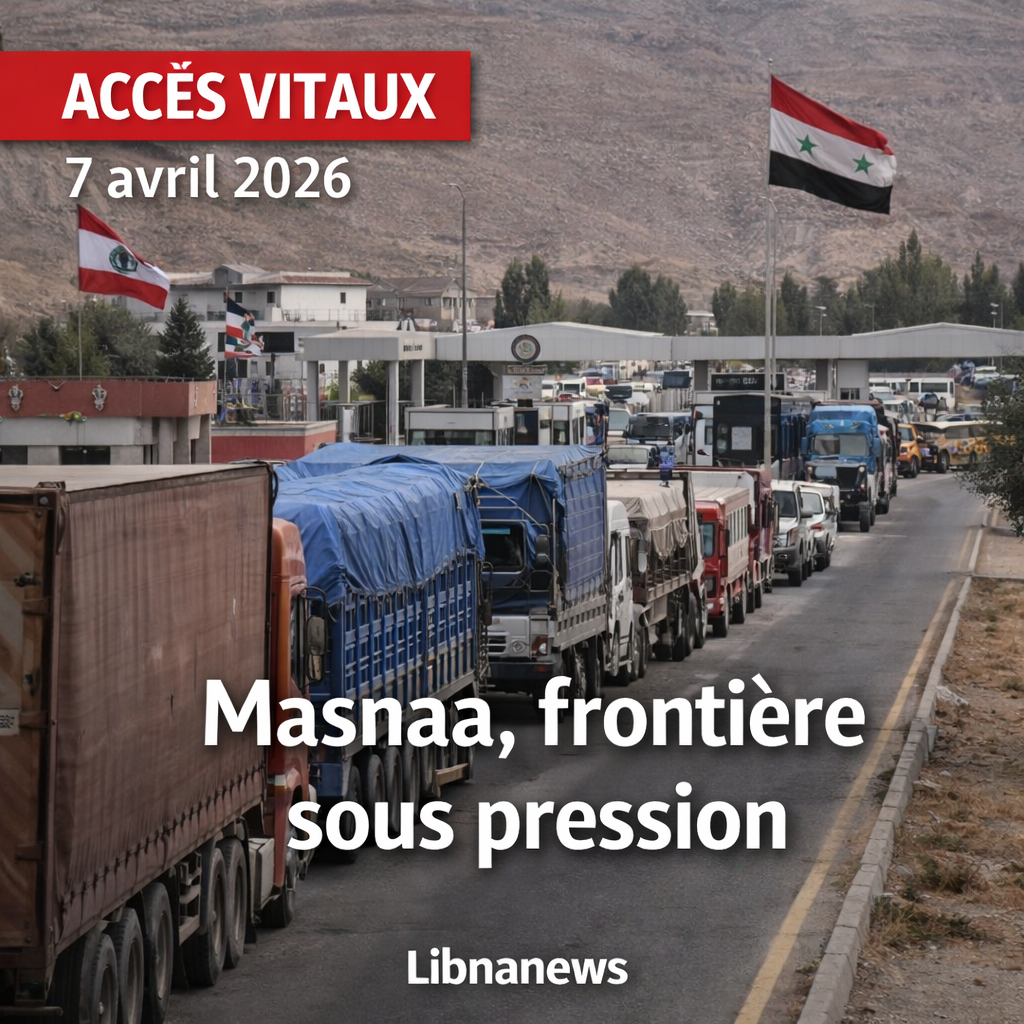
Masnaa is not just a border crossing on the map of Lebanon. It’s an artery. This is the point where economy, exodus, sovereignty and diplomacy intersect. When Israel threatens this axis, it does not only threaten a customs infrastructure in the Bekaa. It targets a vital node, one of the few places where Lebanon still physically holds by road. The Masnaa post, linked to the Syrian side at Jdeidet Yabous, remains the main land gate between Beirut, Damascus and the Arab hinterland. In recent days, the Israeli army has threatened to strike him, causing evacuations, closure of the passage and chain reactions in Beirut. The government tried to avoid the strike, the ministers activated, the security services emptied the area and the debate immediately exceeded the military issue alone. For in Lebanon today, touching Masnaa amounts to touching the state where it is still visible: on the border, on trade, on roads, and on the country’s ability to stay connected to its environment.
The mistake would be to see in Masnaa a common administrative terminal, an alignment of healers, barriers and formalities. In reality, this passage concentrates several functions that Lebanon can no longer easily replace. It is both an exit door for civilians, a truck corridor, a symbol of sovereignty, a regional transit tool and a point of contact between Lebanese and Syrian security aircraft. When the threat comes to such a place, it produces effects that go far beyond the immediate perimeter of the border. It raises the economic risk. It upsets traffic flows. It awakens the spectrum of encirclement. It also obliges Beirut to demonstrate that its sovereignty is not a hollow word. That’s why Masnaa is worth more than a border post today: it is almost the same as a national test.
Masnaa, a road before being a building
What makes Masnaa’s political strength is not first its architecture. That’s his position. The passage links Beirut to Damascus and is part of a much wider land corridor, which counts for regional trade between the Levant and Arab markets. The World Bank already recalled, in its work on the Mashrek corridors, that improving the crossing points and logistics chains in the Mashrek area required access to regional and international markets, and identified Masnaa as one of the posts to be upgraded on the Lebanese side of the Syrian border. In other words, this point has never been a mere administrative appendix: it belongs to a geography of exchanges, delays, costs and opportunities.
It is precisely for this reason that the Israeli threat immediately took on a greater dimension than a mere tactical warning. On Friday, the Israeli army warned that it was targeting the Masnaa crossing, claiming that the site was used by Hezbollah for military use and for smuggling combat equipment. The reaction was immediate: the Lebanese authorities evacuated the Lebanese side post, traffic was suspended, and emergency measures were taken to prevent massive congestion from turning the border into a trap for drivers, passengers and security services. This closure itself already says everything. When a State urgently emptys its main land axis under threat of strikes, it implicitly recognizes that the road in question is no longer solely a matter of border management but of national security.
Public Works Minister Fayez Rassamny sought to contain the sequence on two fronts: the practical front and the political front. According to NNA and MTV, he intensified his contacts to secure the movement of trucks along Masnaa, while rejecting as unfounded Israeli accusations of smuggling weapons. In coordination with the Ministry of Finance, the authorities moved approximately 200 trucks with their drivers to the customs areas to relieve congestion in the area, while empty Lebanese trucks were allowed to enter. This logistical detail is essential. It shows that in Lebanon, a threatened border crossing becomes within hours a matter of commercial fluidity, personal security and state credibility.
A threat to Masnaa is a threat to sovereignty
One of the most sensitive aspects of this sequence is the language used by Lebanese officials. In Beirut, the answer was not just to deny Israeli accusations. It was a reaffirmation of the very nature of the passage. NNA relayed the statements of General Security Director Hassan Choucair after his visit to Masnaa: he claimed that the passage was legal, that it could not be used for arms trafficking and that all trucks were subject to rigorous inspections. The same move was part of a desire to show that security measures remained disciplined and under control in his words. This choice of vocabulary is not trivial. It aims to recall that Masnaa is not a dead spot in the territory, but a border monitored by the Lebanese State.
This is a decisive point, for Israel has not only designated a road. He challenged Lebanon’s ability to control an official post through his argument. However, when a foreign State explains that it might strike a formal border crossing because it believes that the crossing is used for illegal military transfers, it does not only challenge the alleged use of the site. He also implicitly contests the sovereignty of the authority that administers. Masnaa then became a place of narrative conflict. On the one hand, Israel writes in its security grammar. On the other hand, Beirut tries to prove the opposite: that of a regulated post, inspected, visible, and therefore protected by law and sovereignty.
The debate therefore goes beyond whether the Israeli accusation is true or false. It affects the very structure of Lebanese legitimacy. In a country where the authority of the State is often challenged, shared or competing, there are few places where sovereignty materializes in as concrete a way as in an official border post. A flag, controls, customs, registers, truck lines and security services: all this constitutes a state scene. Threatening this scene means trying to demonstrate that it does not really protect what it claims to control. For Lebanon, therefore, defending Masnaa is not only preventing a strike. It also means preventing an official border from being publicly requalified as a vulnerable, suspicious or permeable point.
Trade not only goes through Masnaa, but Masnaa still counts
One of the arguments put forward to relativize the importance of Masnaa is to recall that land flows no longer dominate the Lebanese economy as in the past. That’s partly correct. LBCI, citing the Ministry of Economy and Trade, reported that Lebanon’s total annual trade was around $21 billion, of which approximately $700 million would pass through Masnaa, or between 2 and 5 per cent of the total. The same officials point out that the importance of land crossings has diminished in recent years, particularly with the decline of some Gulf imports. Taken in isolation, these figures could suggest that the passage remains important without being irreplaceable. That would be too much accounting reading.
Masnaa is not only worth its percentage in total trade. It is worth the nature of the flows it concentrates and its role as a land door. The logic of a corridor is not only measured in relative terms, but in concrete terms. A port can absorb volume. However, it does not replace a road to Damascus, to inside Syria, to Iraq or to Arab markets hit by truck. Arab News reported that the Masnaa-Jdeidet Yabous crossing was Lebanon’s main land route for trade, agriculture, tourism and transit to other Arab countries, and representatives of the agricultural sector recalled that its closure would affect the entire country commercially, touristically, industrially and agriculturally. In other words, the effect of a closure is not only in the gross trade balance. It reads in time, in margins, in the vulnerability of channels and in the loss of options.
For a country already weakened by the financial collapse, this loss of options is in itself a political cost. When an exporter or carrier knows that only one threat is enough to freeze the main land axis, uncertainty becomes a hidden tax. Delays cost. Insurance costs. Diversion by other roads or modes of transport costs. Perishable goods cost more to save than ordinary shipments. The impact is therefore not spectacular only because there would be immediate mass destruction, but because a threatened border turns any economic decision into a bet. In an already asphyxiated economy, this logistical instability is worth almost as much as a sanction.
What Masnaa represents in Lebanon of 2026
| Function of Masnaa | Why it’s strategic | Immediate effect of a threat |
|---|---|---|
| Official sovereign passage | It materializes state authority at the border | Political and symbolic destabilization |
| Land trade axis | It connects Lebanon with Syria and the Arab Hinterland | Delays, congestion, rising costs |
| Civilian road | It allows outings, returns and family trips | Blocking, waiting, disorientation |
| Diplomatic corridor | It obliges the authorities to mobilise guarantees and contacts | Rapid internationalization of the crisis |
| Security checkpoint | It focuses on inspections, customs and general security | Questioning security credibility |
The picture does not sum up the real density of the problem. Because Masnaa does not perform her duties separately. He cumulates them. It is this combination that explains the seriousness of a threat to the site.
The civilian road, the other truth of Masnaa
Masnaa is not just a merchant border. It is also a human frontier. Recent precedents have shown forcefully. In October 2024, an Israeli strike near the passage had cut off the road used by hundreds of thousands of people fleeing the bombings in Lebanon towards Syria, according to Reuters. The then Lebanese Minister of Transport explained that the attack had created a crater in Lebanese territory, making the axis impracticable to vehicles. A few days later, the UN High Commissioner for Refugees estimated that some 220,000 people had crossed to Syria, describing the attack in Masnaa as a major obstacle to these flows. The message of these episodes did not disappear: when Masnaa waves, it is not only the goods that slow down. It is also the lives that are tangled in wait.
More recent data show that this civilian dimension remains intact. At the end of March, UNHCR reported that cross-border movements to Syria in the current regional context were 47% concentrated on Masnaa–Jdeidet Yabous, compared with 38% for Al Qaa–Jousseeh. IOM reported, at the beginning of March, that official land crossing points remained operational and that 46,800 people had left Lebanon to Syria, including via Masnaa and Al Qaa. These figures do not describe mere road traffic. They describe a function of exit, reflux, return or refuge. In a country whose southern facade is closed by war and whose western side overlooks the sea, the Syrian border retains a human importance that trade statistics cannot summarize.
It is here that Masnaa becomes a point of national survival in the most concrete sense. A state in crisis still keeps a few escape places. Ports, airports, roads. In Lebanon, these places are neither numerous nor interchangeable. Threatening Masnaa reminds civilians that the eastern road is not guaranteed. This is to weaken the only imaginary land evacuation available on a large scale. It is, more deeply, to make the population feel that the country can be compressed to the border. This feeling counts politically. It feeds the idea of a progressive circle, where each vital axis becomes conditional, temporary and reversible.
A diplomatic as well as military issue
One of the reasons Masnaa is worth more than a border post is that it immediately obliges the authorities to move from the security registry to the diplomatic registry. The official reactions of the last few days show this. Interior Minister Ahmad al-Hajjar acknowledged on MTV that the crisis was severe and hoped that the threat against Masnaa would not be carried out. For its part, LBCI reported that Lebanon was working to obtain an international guarantee that would prevent the strike. MTV also relayed, quoting the Israeli broadcasting authority, that Washington allegedly asked Tel Aviv to suspend the attack on the passage. Even when this information remains partial or related to the conditional, it reveals the essential: a threat to Masnaa does not remain local. It calls for mediations, messages, interventions and arbitrations beyond the field.
This is due to the status of the place. Hits on an alleged deposit, shelling an open area, attacks on positions in the periphery: all this can be covered by a strictly military reading. But an official border post, on the most sensitive axis between Lebanon and Syria, belongs to a different category. Targeting or threatening to target it forces capitals to position themselves, chanceries to react, Lebanese services to respond publicly and security apparatus to prove that the state is not absent from the scene. Diplomacy then becomes a direct extension of the road. This is no longer just an aviation or artillery file. It is a matter of international circulation, trade, law and image.
What this means for today’s Lebanon must be measured. The country no longer has a lot of financial margins, more coercive leverage, and more projection tools. On the other hand, it still has places that it can defend diplomatically because they are under the most visible international law: an airport, a port, a border, a customs post. Masnaa belongs to this category. Threatening him therefore amounts to pushing Beirut to defend not only a road, but the very fiction of a state still capable of saying: this is an official passage, this is a matter of our sovereignty, this cannot be treated as a mere grey zone. In a fragmented Lebanon, this battle of qualification is almost as important as the physical battle.
Masnaa said something about the Lebanese state itself
Finally, there is one last reason why Masnaa is worth more than a border post. The site reveals the Lebanese condition. Everything is condensed here: economic dependency, forced geography, Syrian neighbourhood, security vulnerability, competing narratives, and permanent need for external diplomatic coverage. What has been played in recent days around Masnaa is not only an episode of war. It’s an x-ray of the country. A threatened axis. Ministers in emergency. Security services evacuating. Charges of smuggling. Official denials. Displaced trucks. Civilians suspended in the state of the road. And, overhangingly, the question always recommences: how far does the Lebanese state really control its own thresholds?
Hassan Choucair’s visit to Masnaa, the assurances about inspections, the denials of smuggling and the clearance operations carried out for trucks demonstrate a clear will: to take hold of the story. This is not a communication detail. It is a political necessity. For if Masnaa appears to be a post that Lebanon really administers, then the threat against him resembles aggression against a formal element of sovereignty. If, on the contrary, it appears as a dubious, porous or instrumentalized area, then Israel more easily imposes its own security justification. The stakes are here. It is not just on asphalt. It is on the very definition of the place.
Masnaa, in the background, became the opposite of a decor. It is a point where the war is measured in lorries as well as in military alerts, in passport stamps as well as in terms of strength, in diplomatic rumour as well as in threat of strike. A country normally can treat a border post as a technical infrastructure. Lebanon, on the other hand, no longer has that luxury. In its present state, some roads carry more than vehicles. They carry the minimum of national continuity still available. And that is precisely why Masnaa weighs almost as much, politically, as a front line.






